Turkey Fans Market Growth Rate
According to 6Wresearch internal databases and industry insights, the Turkey Fans Market is projected to grow at a compound annual growth rate (CAGR) of 5.4% during the forecast period 2026–2032.
Turkey Fans Market Year-wise Growth Rate and Key Drivers (2022–2032)
This graph illustrates the annual growth rates of the Turkey Fans Market from 2022 to 2032, highlighting a steady upward trajectory and projected market expansion over the forecast period.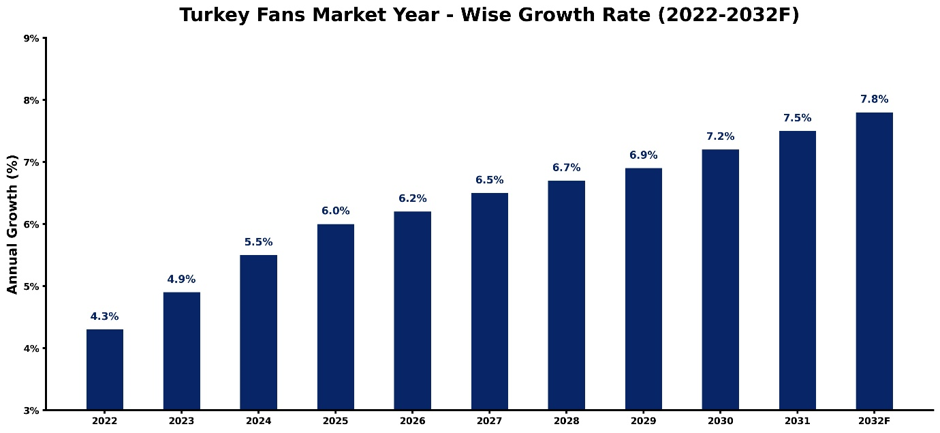
The following table summarizes the historical and forecasted growth rates of the Turkey Fans Market, along with the rationale behind each year’s performance.
| Year | Estimated Growth (%) | Market Rationale |
| 2022 | 4.3% | Resurgencein industrial manufacturing and commercial construction increased ventilation equipment demand. |
| 2023 | 4.9% | Expansion of automotive, food processing, and textile industries supported higher fan installations. |
| 2024 | 5.5% | Rising investments in commercial HVAC systems and industrial modernization strengthened market growth. |
| 2025 | 6% | Higher demand for energy-efficient ventilation equipment across factories and commercial facilities accelerated adoption. |
| 2026 | 6.2% | Industrial automation and warehouse development increased installation of advanced ventilation systems. |
| 2027 | 6.5% | Growth in smart buildings and sustainable construction boosted demand for efficient fan technologies. |
| 2028 | 6.7% | Expansion of logistics centers and manufacturing facilities supported steady market development. |
| 2029 | 6.9% | Increasing replacement of conventional ventilation systems with energy-efficient models drove sales. |
| 2030 | 7.2% | Government emphasis on industrial energy efficiency encouraged equipment modernization. |
| 2031 | 7.5% | Greater adoption of digitally controlled HVAC systems expanded demand for premium fans. |
| 2032 | 7.8% | Continued industrial investments and stricter environmental standards sustained long-term market growth. |
Topics Covered in the Turkey Fans Market Report
The Turkey Fans Market Report provides a comprehensive analysis based on Types and Application. It offers detailed insights into key industry trends, growth drivers, emerging opportunities, competitive developments, and high-growth segments. The report presents an objective assessment of current dynamics and future prospects, enabling stakeholders to make informed business decisions and develop effective strategies aligned with the evolving industry landscape.
Turkey Fans Market Highlights
| Report Name | Turkey Fans Market |
| Forecast period | 2026–2032 |
| CAGR | 5.4% |
| Growing Sector | Industrial |
Turkey Fans Market Synopsis
The Turkey Fans Market is expected to grow at a consistent rate, driven by industrialization, infrastructure development, and increasing requirements for the systems used to move air efficiently. In general, fans are machines that are designed to move air, cool down spaces, ventilate spaces, and ensure good indoor air quality within industrial plants, commercial premises, and residential premises. Fans are often employed in HVAC systems, manufacturing plants, warehouses, shopping centers, hospitals, power plants, data centers, and residences. The growing emphasis on energy conservation, workplace safety, and sustainable construction is expected to continue driving demand for advanced ventilation equipment throughout the forecast period.
Evaluation of Growth Drivers in Turkey Fans Market (2026–2032)
Below are some major drivers and their influence on the market dynamics:
| Drivers | Primary Segment Affected | Why It Matters (Evidence) |
| Development of industrial manufacturing | Industrial | Manufacturing facilities necessitate consistent ventilation and cooling systems for continuous production. |
| Evolution in commercial construction | Commercial | New offices, hospitals, hotels, and retail complexes increase HVAC installations. |
| Increasing energy efficiency regulations | Axial Fans | High-efficiency fans diminish electricity consumption and operating costs. |
| Widespread warehouse and logistics infrastructure | Industrial | Large distribution centers require advanced air circulation systems. |
| Smart building adoption | Commercial | Intelligent HVAC systems increase demand for digitally controlled ventilation equipment. |
The Turkey Fans Market is expected to witness stable expansion, exhibiting a CAGR of 5.4% during 2026–2032 owing to continuous industrial modernization, commercial real estate development, and increasing adoption of energy-efficient ventilation technologies. Turkey's urbanization rate has exceeded 77%, increasing demand for residential and commercial HVAC installations. Furthermore, government initiatives promoting energy efficiency and sustainable industrial practices are encouraging replacement of conventional ventilation equipment with high-performance fan systems. Growing investments in automotive manufacturing, food processing, cement production, and textile industries are expected to further strengthen demand for industrial ventilation equipment throughout the forecast period.
Evaluation of Restraints in Turkey Fans Market
Below are some major restraints and their influence on the market dynamics:
| Restraints | Primary Segment Affected | What This Means (Evidence) |
| Volatility in raw material prices | Industrial | Fluctuating steel, aluminum, and copper prices increase manufacturing costs. |
| Dependence on imported motors and electronic components | Axial Fans | Exchange-rate fluctuations can raise production and procurement expenses. |
| High initial investment for premium energy-efficient systems | Commercial | Small businesses often delay replacement of conventional ventilation equipment. |
| Shortage of skilled HVAC installation and maintenance professionals | Residential | Limited technical expertise may affect proper installation and after-sales service quality. |
| Intense price competition from low-cost imports | Manufacturers | Domestic producers face margin pressure while competing with imported products. |
Turkey Fans Market Challenges
Although the Turkey fans market growth is supported by strong industrial demand, manufacturers continue to encounter several operational and economic challenges. For instance, production costs are directly affected by price volatilities of steel, aluminium, copper, and electronic components. While, on the other hand, exchange rate fluctuations increase the cost of imported motors, bearings and control systems. Turkey has seen inflation rates over 30% in recent years, forcing industries to keep a close eye on capital expenditure while still investing in modernization. Further, the continued rise in electricity prices drives end users to invest in highly energy-efficient equipment, while at the same time pressuring manufacturers to offer advanced products at competitive prices.
Turkey Fans Market Trends
Emerging trends shaping the Turkey Fans Market include the following:
- Smart ventilation system integration: Monitoring through Internet-of-things technology, diagnostics, and automated airflow management are the current requirements for commercial and industrial ventilation systems.
- Green building development: The construction of energy-efficient commercial buildings has increased the requirement for sustainable and international fan standards, like LEED and BREEAM, in the HVAC fans.
- Renewed industrial facility demand: The manufacturers of ventilation systems are replacing the old fans with more efficient ones at older factories to lower maintenance costs and enhance work safety conditions.
Investment Opportunities in the Turkey Fans Market
Attractive investment opportunities within the Turkey Fans Industry include the following:
- Expansion of domestic manufacturing facilities: Investors can capitalize on Turkey's growing industrial base by establishing local production units for energy-efficient fan systems, reducing dependence on imported products.
- Development of smart HVAC technology: With the increasing adoption of intelligent building management systems, there is an opportunity for manufacturers who provide Internet-of-things-based ventilation systems.
- Industrial retrofit and modernization projects: Conventional fans are being replaced with energy-efficient fans at old cement, steel, chemical, and food processing manufacturing plants.
Top Players in Turkey Fans Market
A comprehensive listing of prominent players in the Turkey Fans Market is provided below:
1. Danfoss A/S
| Company Name | Danfoss A/S |
|---|---|
| Established Year | 1933 |
| Headquarters | Nordborg, Denmark |
| Official Website | Click Here |
Danfoss provides advanced air movement solutions, variable speed drives, and HVAC technologies that improve fan efficiency and system performance.
2. Johnson Controls International plc
| Company Name | Johnson Controls International plc |
|---|---|
| Established Year | 1885 |
| Headquarters | Cork, Ireland |
| Official Website | Click Here |
Johnson Controls offers integrated HVAC and building management solutions, including ventilation systems, air handling equipment, and fan technologies.
3. Rosenberg Ventilatoren GmbH
| Company Name | Rosenberg Ventilatoren GmbH |
|---|---|
| Established Year | 1981 |
| Headquarters | Künzelsau, Germany |
| Official Website | Click Here |
Rosenberg Ventilatoren specializes in high-efficiency fans, EC motor technology, air handling units, and ventilation solutions for industrial, commercial, and cleanroom applications.
4. Nidec Corporation
| Company Name | Nidec Corporation |
|---|---|
| Established Year | 1973 |
| Headquarters | Kyoto, Japan |
| Official Website | Click Here |
Nidec manufactures electric motors, fan systems, and thermal management solutions used in HVAC equipment, industrial machinery, electronics cooling, and automation applications.
5. Aldes Group
| Company Name | Aldes Group |
|---|---|
| Established Year | 1925 |
| Headquarters | Lyon, France |
| Official Website | Click Here |
Aldes Group develops ventilation and air quality solutions, including residential ventilation systems, air extraction fans, heat recovery ventilation units, and indoor air management technologies.
Government Initiatives being Implemented in the Turkey Fans Market
The Turkish government has been implementing various initiatives to improve industrial energy-efficiency, sustainable manufacturing processes, and green buildings, which have indirectly supported the Turkey fans market growth. As part of the National Energy Efficiency Action Plan (NEEAP) initiative, industrial facilities are advised to replace their old electric systems, including the industrial ventilation systems, with more energy-efficient systems to cut down on their electricity usage.
Moreover, the Energy Efficiency Law No. 5627 has made it mandatory for large-scale industries to conduct energy audits and adopt high-efficiency motor and HVAC equipment. Ongoing initiatives by the Ministry of Industry and Technology in terms of modernizing the OIZ facilities have boosted the demand for industrial ventilation systems. Lastly, Turkey's Zero Waste Project and sustainable building initiatives are prompting companies to install energy-efficient HVAC and air circulation systems.
Future Insights of the Turkey Fans Market
The Turkey Fans Market is anticipated to see steady growth in the upcoming years due to rising industrial activities, infrastructure development, and the importance of energy efficiency at the national level. Turkey’s manufacturing sector contributes around 24% of the country’s GDP, and the export of manufactured goods forms over 90% of the total merchandise exported.
Apart from this, urbanization exceeds 77%, resulting in constant construction of business buildings, hospitals, shopping complexes, and housing units that require the use of advanced HVAC systems. The integration of Industry 4.0, automated production lines, and building management systems will result in higher demand for digitally controlled, energy-efficient fans.
Market Segmentation Analysis
This report presents a detailed analysis of the market segments along with their leading categories.
By Types – Axial Fans Dominate the Market
According to Ravi Bhandari, Research Head, 6Wresearch, Axial Fans captured the largest share of the Turkey Fans Market, accounting for 52.84% in 2025, attributed to high airflow capacity, simple design, lower installation costs, and extensive usage across industrial ventilation, commercial HVAC systems, warehouses, cooling towers, tunnels, and agricultural facilities. This segment is projected to expand at a CAGR of 6.19% during 2026–2032, driven by rising adoption of electronically commutated (EC) motors, energy-efficient ventilation systems, and intelligent airflow control technologies.
By Application – Industrial Sector Maintains Market Leadership
In 2025, the industrial segment represented the largest application category with a 61.42% share of the Turkey fans market. The demand is mainly driven by the automotive, textile, food processing, cement, mining, chemical, steel, and power generation industries, all of which need reliable ventilation for temperature control, dust extraction, process cooling, and worker safety. This segment is expected to grow at a CAGR of 6.48% from 2026 to 2032, driven by ongoing factory expansion, industrial automation, and the replacement of old ventilation systems with high-efficiency fan technologies.
Note- Market size estimations and growth projections presented in this report are based on 6Wresearch's proprietary forecasting methodology, utilizing the latest available industry data, government publications, and primary research inputs.
Key Attractiveness of the Report
- 10 Years of Market Numbers.
- Historical Data Starting from 2022 to 2025.
- Base Year: 2025
- Forecast Data until 2032.
- Key Performance Indicators Impacting the market.
- Major Upcoming Developments and Projects.
Key Highlights of the Report:
- Turkey Fans Market Outlook
- Market Size of Turkey Fans Market, 2025
- Forecast of Turkey Fans Market, 2032
- Historical Data and Forecast of Turkey Fans Revenues & Volume for the Period 2022-2032
- Turkey Fans Market Trend Evolution
- Turkey Fans Market Drivers and Challenges
- Turkey Fans Price Trends
- Turkey Fans Porter's Five Forces
- Turkey Fans Industry Life Cycle
- Historical Data and Forecast of Turkey Fans Market Revenues & Volume By Types for the Period 2022-2032
- Historical Data and Forecast of Turkey Fans Market Revenues & Volume By Axial for the Period 2022-2032
- Historical Data and Forecast of Turkey Fans Market Revenues & Volume By Centrifugal for the Period 2022-2032
- Historical Data and Forecast of Turkey Fans Market Revenues & Volume By Cross Flow for the Period 2022-2032
- Historical Data and Forecast of Turkey Fans Market Revenues & Volume By Application for the Period 2022-2032
- Historical Data and Forecast of Turkey Fans Market Revenues & Volume By Commercial for the Period 2022-2032
- Historical Data and Forecast of Turkey Fans Market Revenues & Volume By Industrial for the Period 2022-2032
- Historical Data and Forecast of Turkey Fans Market Revenues & Volume By Residential for the Period 2022-2032
- Turkey Fans Import Export Trade Statistics
- Market Opportunity Assessment By Types
- Market Opportunity Assessment By Application
- Turkey Fans Top Companies Market Share
- Turkey Fans Competitive Benchmarking By Technical and Operational Parameters
- Turkey Fans Company Profiles
- Turkey Fans Key Strategic Recommendations
Market Covered
The report offers an extensive study of the following market segments:
By Types
- Axial
- Centrifugal
- CrossFlow
By Application
- Commercial
- Industrial
- Residential






































