Turkey Food Packaging Market Summary
The turkey food packaging market was estimated at USD 1491 Million in 2025 and is projected to reach USD 2163 Million by 2032, growing at a CAGR of 6.5% from 2026 to 2032.
Turkey Food Packaging Market Year-wise Growth Rate and Key Drivers
This graph highlights how the Turkey Food Packaging Market has steadily grown over the past five years, supported by major growth factors.
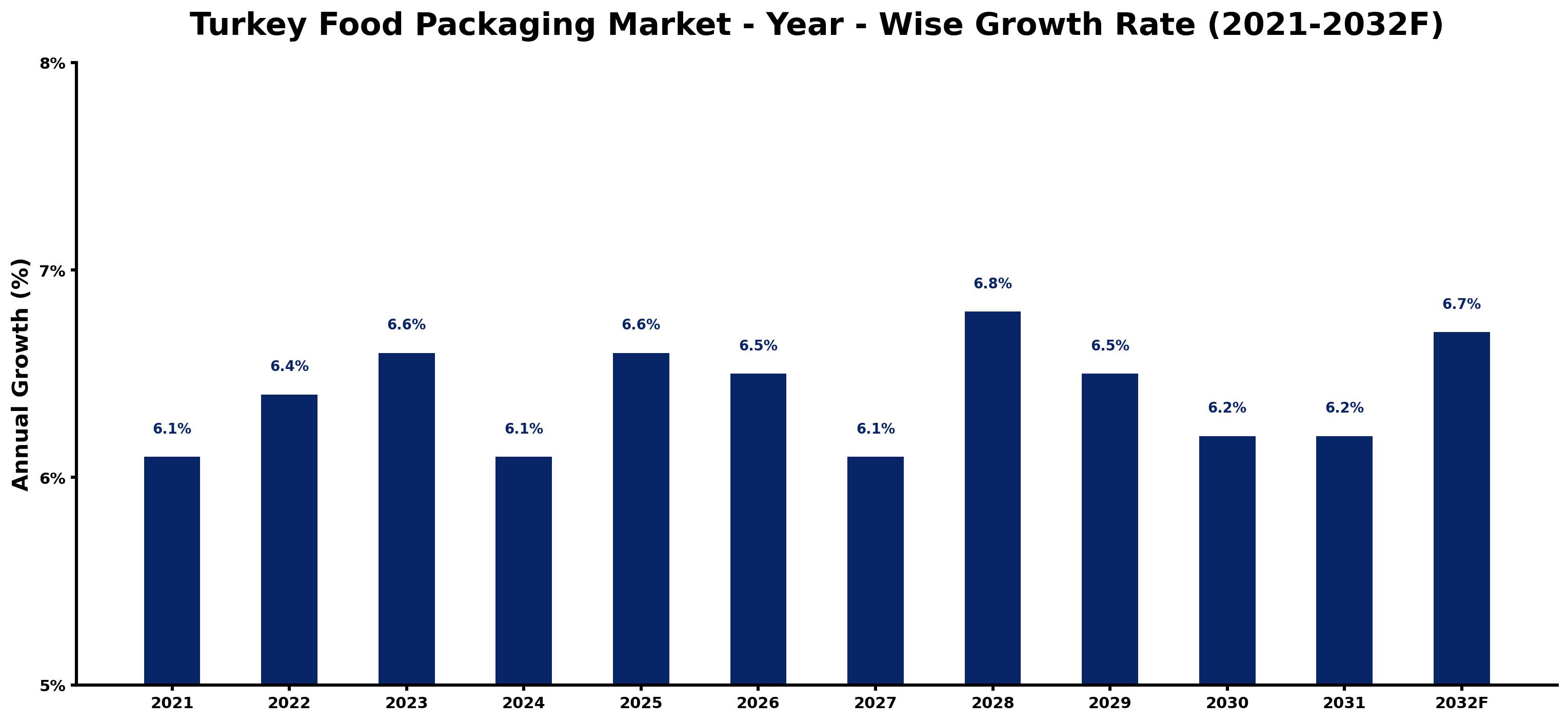
The table below presents the year wise growth rates along with the key drivers influencing the market
| Year | Growth Rate | Major Drivers |
| 2021 | 6.1% | Shifts toward sustainability prompted a greater focus on eco-friendly packaging solutions. |
| 2022 | 6.4% | Local manufacturers expanded their capabilities, enhancing production capacities across various sectors. |
| 2023 | 6.6% | Post-pandemic recovery saw food delivery services booming, increasing packaging demand significantly. |
| 2024 | 6.1% | Rising consumer preferences for convenience encouraged innovations in packaging design and functionality. |
| 2025 | 6.6% | E-commerce growth necessitated robust packaging solutions, driving investments in logistics systems. |
| 2026 | 6.5% | Emerging technologies offered new materials, enhancing durability and reducing overall weight in packaging. |
| 2027 | 6.1% | Increased awareness of food safety and hygiene led to stricter packaging standards in Turkey. |
| 2028 | 6.8% | Urbanization trends required more efficient packaging, catering to the fast-paced lifestyle of consumers. |
| 2029 | 6.5% | Collaboration between food brands and packaging firms fostered creative solutions to market needs. |
| 2030 | 6.2% | Focus on minimizing waste in supply chains encouraged innovations in reusable packaging options. |
| 2031 | 6.2% | Strengthened export regulations boosted demand for compliant packaging tailored for international markets. |
| 2032 | 6.7% | Consumer education on sustainability influenced choices toward biodegradable and recyclable packaging solutions. |
Note - Market size estimations and growth projections presented in this report are based on 6Wresearch's advanced forecasting approach, validated with industry datasets as of June 2026.
Turkey Food Packaging Market Synopsis
The Turkey Food Packaging Market is projected to reach 6.5% and witness significant growth during the forecast period (2026-2032). This growth is largely attributed to the increasing demand for convenience food products, changing consumer preferences leaning towards eco-friendly options, and the enforcement of stringent food safety regulations. The market features an array of packaging solutions, including flexible, rigid, and paperboard packaging, with a noticeable shift towards innovative and sustainable materials.
Turkey Food Packaging Market Growth Drivers
Several key factors are driving the expansion of the Turkey Food Packaging Market. Firstly, the rise in disposable incomes among consumers has led to a greater demand for packaged and convenience food options. Secondly, urbanization is prompting a shift towards on-the-go consumption patterns, further fueling the need for innovative packaging solutions that cater to busy lifestyles. Thirdly, the growing consumer awareness regarding sustainability is pushing manufacturers to embrace biodegradable and recyclable packaging materials. Additionally, stringent regulations mandating food safety standards are compelling companies to adopt modern packaging technologies that enhance product safety and shelf life. Lastly, advancements in packaging technologies, such as smart and active packaging, are increasingly being integrated into market offerings, driving growth.
Turkey Food Packaging Market Trends and Opportunities
Current trends within the Turkey Food Packaging Market indicate a robust inclination towards sustainability and innovation. Key trends include:
- Increasing demand for sustainable packaging: Consumers are gravitating towards products that utilize eco-friendly materials, prompting companies to innovate in this space.
- Rise of convenience packaging: The popularity of single-serve portions and resealable pouches reflects the demand for easy-to-use packaging that aligns with modern lifestyles.
- Enhanced product preservation: There is a growing focus on packaging technologies designed to extend product shelf life and maintain freshness, addressing consumer concerns about food safety.
- Smart packaging solutions: The integration of technology into packaging, such as QR codes and sensors, is being adopted to enhance the consumer experience and provide additional information on product usage.
- Personalized packaging: Personalized designs aimed at engaging consumers are becoming a notable trend, as brands seek to differentiate their products in a competitive market.
Turkey Food Packaging Market Challenges and Restraints
Despite the growth prospects in the Turkey Food Packaging Market, there are notable challenges that players must navigate. Rising raw material costs have posed significant hurdles, impacting profit margins across the packaging sector. Additionally, increased competition among manufacturers has created a price-sensitive environment where quality must be maintained. Fluctuating exchange rates further complicate the procurement of materials, especially for companies relying on imports. Moreover, the transition towards sustainable packaging solutions requires substantial investment in R&D, which may strain the resources of smaller firms. Regulatory pressures regarding packaging standards and environmental impact also demand ongoing compliance, presenting further challenges for market participants.
Turkey Food Packaging Market Investment Opportunities
The Turkey Food Packaging Market is ripe with investment opportunities, particularly in sectors driven by the demand for innovative and sustainable solutions. Key areas for potential investment include:
- Eco-friendly materials: Investment in the development of biodegradable plastics and recyclable options is crucial to meet consumer preferences for environmentally sustainable products.
- Smart packaging technologies: Investing in advanced technologies that offer active packaging solutions can enhance food safety and shelf life, which is increasingly valued by consumers.
- Efficient machinery and automation: As demand for packaged food rises, investment in modern packaging machinery can optimize production processes and improve efficiency.
- Recycling initiatives: Companies can benefit from investing in recycling programs, aligning with consumer expectations for sustainability and responsible business practices.
- Online food delivery packaging: With the growth of online food delivery services, developing packaging that protects food quality during transportation presents a significant investment opportunity.
Turkey Food Packaging Market Government Investment and Initiatives
The Turkish government has established policies aimed at fostering a safe and sustainable food packaging environment. Ongoing initiatives focus on ensuring compliance with food safety regulations while promoting environmentally friendly packaging practices. Public spending on infrastructure improvements related to waste management and recycling efforts supports the transition to sustainability within the packaging industry. Furthermore, the government encourages innovation through grants and incentives for firms investing in R&D to develop eco-friendly packaging technologies. These initiatives collectively contribute to enhancing consumer protection and promoting public health standards in the Turkey Food Packaging Market.
Turkey Food Packaging Market Latest Developments (May 2025 - June 2026)
In the period from May 2025 to June 2026, the Turkey Food Packaging Market has seen numerous developments reflecting the shift towards sustainability and technological innovation. There has been an uptick in collaborations among packaging firms and research institutions aimed at developing biodegradable packaging materials. Additionally, companies are increasingly investing in smart packaging technologies, integrating digital features that enhance traceability and consumer engagement. The focus on reducing carbon footprints has led many firms to adopt more sustainable practices in their production processes. Furthermore, legislative measures promoting recycling and the use of eco-friendly materials have gained traction, signaling a commitment to environmental sustainability within the industry.
Turkey Food Packaging Market - Key Attractiveness of the Report
- 10 Years of Market Numbers
- Historical Data Starting from 2022 to 2025
- Base Year: 2025
- Forecast Data until 2032
- Key Performance Indicators Impacting the Market
- Major Upcoming Developments and Projects
Key Highlights of the Report:
- Turkey Food Packaging Market Outlook
- Market Size of Turkey Food Packaging Market, 2025
- Forecast of Turkey Food Packaging Market, 2032F
- Historical Data and Forecast of Turkey Food Packaging Revenues & Volume for the Period 2022-2032F
- Turkey Food Packaging Market Trend Evolution
- Turkey Food Packaging Market Drivers and Challenges
- Turkey Food Packaging Price Trends
- Turkey Food Packaging Porter's Five Forces
- Turkey Food Packaging Industry Life Cycle
- Historical Data and Forecast of Turkey Food Packaging Market Revenues & Volume By Material Types for the Period 2022-2032F
- Historical Data and Forecast of Turkey Food Packaging Market Revenues & Volume By Paper & board for the Period 2022-2032F
- Historical Data and Forecast of Turkey Food Packaging Market Revenues & Volume By Plastic for the Period 2022-2032F
- Historical Data and Forecast of Turkey Food Packaging Market Revenues & Volume By Metal for the Period 2022-2032F
- Historical Data and Forecast of Turkey Food Packaging Market Revenues & Volume By Glass for the Period 2022-2032F
- Historical Data and Forecast of Turkey Food Packaging Market Revenues & Volume By Others for the Period 2022-2032F
- Historical Data and Forecast of Turkey Food Packaging Market Revenues & Volume By Product Types for the Period 2022-2032F
- Historical Data and Forecast of Turkey Food Packaging Market Revenues & Volume By Rigid for the Period 2022-2032F
- Historical Data and Forecast of Turkey Food Packaging Market Revenues & Volume By Semi-Rigid for the Period 2022-2032F
- Historical Data and Forecast of Turkey Food Packaging Market Revenues & Volume By Flexible for the Period 2022-2032F
- Historical Data and Forecast of Turkey Food Packaging Market Revenues & Volume By Applications for the Period 2022-2032F
- Historical Data and Forecast of Turkey Food Packaging Market Revenues & Volume By Bakery & Confectionary for the Period 2022-2032F
- Historical Data and Forecast of Turkey Food Packaging Market Revenues & Volume By Dairy Products for the Period 2022-2032F
- Historical Data and Forecast of Turkey Food Packaging Market Revenues & Volume By Fruits & Vegetables for the Period 2022-2032F
- Historical Data and Forecast of Turkey Food Packaging Market Revenues & Volume By Meat, Poultry, & Seafood for the Period 2022-2032F
- Historical Data and Forecast of Turkey Food Packaging Market Revenues & Volume By Sauces & Dressings for the Period 2022-2032F
- Historical Data and Forecast of Turkey Food Packaging Market Revenues & Volume By Others for the Period 2022-2032F
- Turkey Food Packaging Import Export Trade Statistics
- Market Opportunity Assessment By Material Types
- Market Opportunity Assessment By Product Types
- Market Opportunity Assessment By Applications
- Turkey Food Packaging Top Companies Market Share
- Turkey Food Packaging Competitive Benchmarking By Technical and Operational Parameters
- Turkey Food Packaging Company Profiles
- Turkey Food Packaging Key Strategic Recommendations






































