Turkey Formwork Market Summary
The turkey formwork market was estimated at USD 379 Million in 2025 and is projected to reach USD 531 Million by 2032, growing at a CAGR of 6.0% from 2026 to 2032.
Turkey Formwork Market Year-wise Growth Rate and Key Drivers
This graph highlights how the Turkey Formwork Market has steadily grown over the past five years, supported by major growth factors.
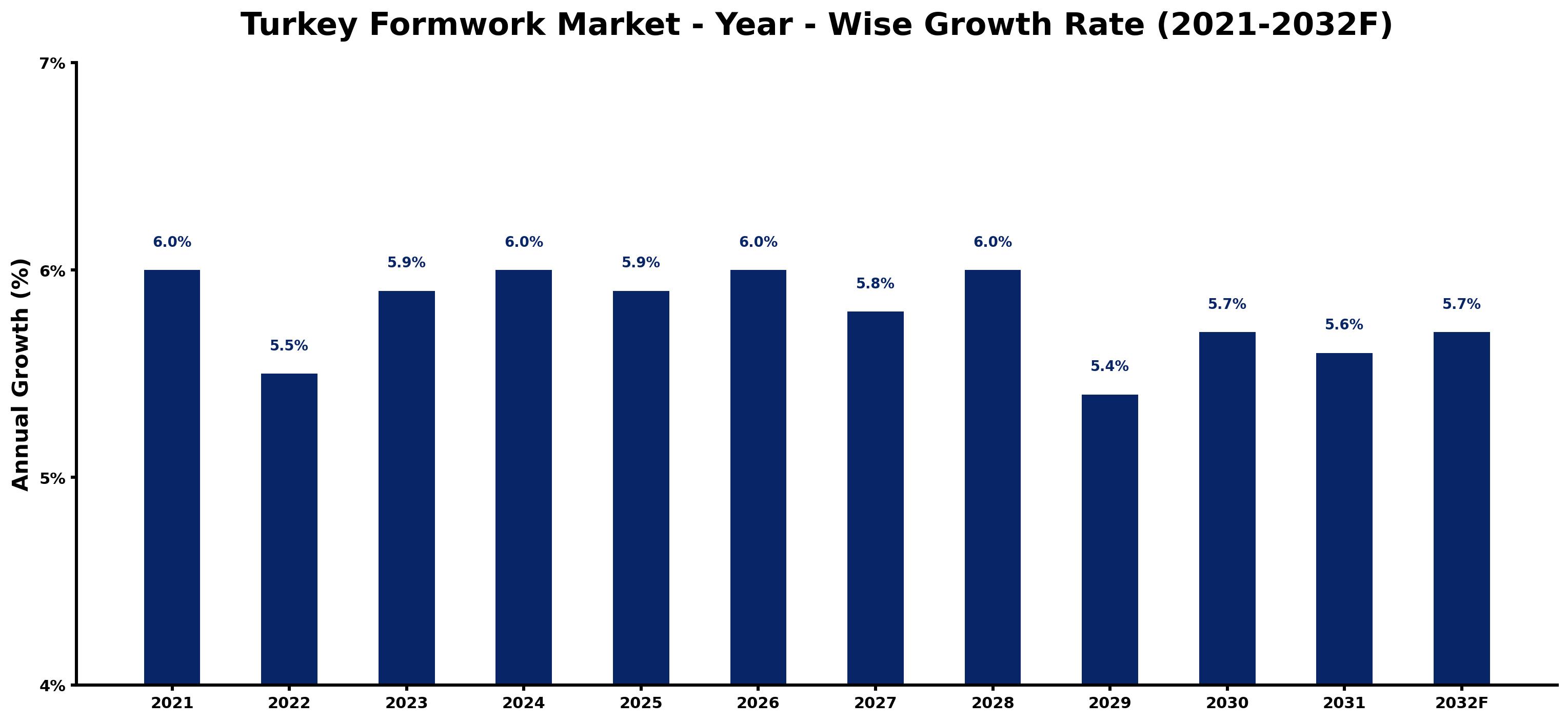
The table below presents the year wise growth rates along with the key drivers influencing the market
| Year | Growth Rate | Major Drivers |
| 2021 | 6.0% | Construction activity rebounding sharply after pandemic restrictions fuels formwork projects. |
| 2022 | 5.5% | Investment in infrastructure, including roads and bridges, boosts demand for formwork solutions. |
| 2023 | 5.9% | Urbanization trends lead to increased residential and commercial construction across major cities. |
| 2024 | 6.0% | Technological integration in construction, like BIM, enhances formwork efficiency and precision. |
| 2025 | 5.9% | Sustainability practices prompt companies to explore eco-friendly formwork materials and solutions. |
| 2026 | 6.0% | The real estate sector sees renewed interest, particularly in mixed-use developments and high-rises. |
| 2027 | 5.8% | Public-private partnerships in infrastructure create new opportunities for innovative formwork technologies. |
| 2028 | 6.0% | Expanding manufacturing capabilities in Turkey support local formwork production and reduce costs. |
| 2029 | 5.4% | Regional construction trends, especially in the GCC, stimulate cross-border formwork supply chains. |
| 2030 | 5.7% | Skilled labor shortages drive demand for advanced formwork systems that reduce manpower requirements. |
| 2031 | 5.6% | Increased focus on energy efficiency in buildings encourages investment in modern formwork solutions. |
| 2032 | 5.7% | Cultural shifts towards urban living promote vertical construction, favoring formwork market expansion. |
Note - Market size estimations and growth projections presented in this report are based on 6Wresearch's advanced forecasting approach, validated with industry datasets as of June 2026.
Turkey Formwork Market Synopsis
The Turkey Formwork Market is projected to reach 6.0% and witness significant growth during the forecast period (2026-2032). This growth trajectory is primarily driven by an increasing demand for both residential and commercial construction, along with supportive government regulations aimed at stimulating investment in the construction sector. The influx of foreign investments has also played a vital role in shaping the formwork industry landscape in Turkey, as it fosters enhanced construction activities and infrastructure development across the nation.
Turkey Formwork Market Growth Drivers
The primary growth drivers for the Turkey formwork market encompass several factors that collectively enhance its potential. These include:
- Heightened demand for residential and commercial buildings, as urbanization accelerates and more individuals seek housing, thereby increasing the need for efficient construction solutions.
- Government initiatives designed to facilitate foreign direct investment, which have resulted in improved funding and resources for construction projects across various sectors.
- Increasing public and private sector investment in infrastructure projects, such as highways, bridges, and public transportation systems, which require advanced and durable formwork solutions.
- Advancements in construction technology, notably the adoption of precast concrete formwork systems that significantly enhance construction efficiency and reduce lead times.
- Growing awareness about the importance of environmental sustainability, driving the adoption of innovative and eco-friendly formwork materials and techniques.
Turkey Formwork Market Challenges and Restraints
While the growth prospects are promising, the Turkey formwork market also faces several challenges that could impede progress. Key challenges include:
- Fluctuating material costs can adversely affect project budgets, making it difficult for construction firms to maintain profitability while adhering to competitive pricing.
- Regulatory hurdles and bureaucratic processes can delay construction projects and deter foreign investments, thus impacting the overall growth of the formwork market.
- Shortages of skilled labor in the construction sector pose a significant risk, as the lack of trained professionals limits the implementation of advanced construction techniques.
- Market competition can be intense, which may lead to price wars and reduce profit margins among formwork solution providers, constraining growth opportunities.
- Economic fluctuations, including inflation and currency volatility, can affect investor confidence and subsequently impact overall market performance.
Turkey Formwork Market Trends and Opportunities
The Turkey formwork market is witnessing several notable trends that present significant opportunities for stakeholders:
- Increased focus on automation and digital tools in project management, allowing for more precise planning and execution of formwork tasks.
- Growing preference for modular and reusable formwork systems, which promote cost savings and sustainability by reducing waste and resource consumption.
- Expansion of public-private partnerships aimed at accelerating infrastructure development, creating numerous opportunities for formwork suppliers to engage in large-scale projects.
- Rising demand for innovative design solutions, facilitating the construction of complex structures that require specialized formwork applications.
- Emergence of eco-friendly materials and construction practices, fostering demand for sustainable formwork solutions that align with global environmental standards.
Turkey Formwork Market Government Investment and Initiatives
The Turkish government has taken significant steps to enhance the formwork market through various investments and initiatives. Key aspects include:
- Implementation of the Investment Support and Promotion Agency (ISPAT) aimed at attracting foreign investments, which has broadened the financial landscape for construction-related projects.
- Prioritization of infrastructure development as part of national economic policy, resulting in increased public spending on transportation, education, and healthcare facilities.
- Support for research and development in construction technologies, facilitating innovation in formwork materials and systems.
- Encouragement for local manufacturers to adopt advanced technologies and processes, which assists in enhancing the competitiveness of the domestic formwork industry.
- Promotion of sustainable building practices through regulations that encourage the use of environmentally friendly construction methods and materials.
Turkey Formwork Market Latest Developments (May 2025 - June 2026)
Recent developments in the Turkey formwork market have underscored the sector's dynamic evolution in response to changing economic and technological landscapes. Observations during this period include:
- Continued investments in large-scale infrastructure projects, such as urban transit systems and highways, which have accelerated demand for advanced formwork solutions.
- Implementation of sustainability initiatives that have prompted construction firms to seek more eco-friendly formwork materials.
- Enhanced collaboration between construction firms and technology providers to adopt automation tools, leading to improved efficiency in formwork operations.
- Market entrants focusing on innovative formwork designs that cater to the specific requirements of contemporary architectural trends.
- Government-backed programs aimed at training skilled labor, addressing the workforce shortage in the construction sector and thereby supporting overall market growth.
Turkey Formwork Market - Key Attractiveness of the Report
- 10 Years of Market Numbers
- Historical Data Starting from 2022 to 2025
- Base Year: 2025
- Forecast Data until 2032
- Key Performance Indicators Impacting the Market
- Major Upcoming Developments and Projects
Key Highlights of the Report:
- Turkey Formwork Market Outlook
- Market Size of Turkey Formwork Market, 2025
- Forecast of Turkey Formwork Market, 2032F
- Historical Data and Forecast of Turkey Formwork Revenues & Volume for the Period 2022-2032F
- Turkey Formwork Market Trend Evolution
- Turkey Formwork Market Drivers and Challenges
- Turkey Formwork Price Trends
- Turkey Formwork Porter's Five Forces
- Turkey Formwork Industry Life Cycle
- Historical Data and Forecast of Turkey Formwork Market Revenues & Volume By Product Type for the Period 2022-2032F
- Historical Data and Forecast of Turkey Formwork Market Revenues & Volume By Traditional timber formwork for the Period 2022-2032F
- Historical Data and Forecast of Turkey Formwork Market Revenues & Volume By Engineered Formwork System for the Period 2022-2032F
- Historical Data and Forecast of Turkey Formwork Market Revenues & Volume By Re-usable plastic formwork for the Period 2022-2032F
- Historical Data and Forecast of Turkey Formwork Market Revenues & Volume By Others for the Period 2022-2032F
- Historical Data and Forecast of Turkey Formwork Market Revenues & Volume By Applications for the Period 2022-2032F
- Historical Data and Forecast of Turkey Formwork Market Revenues & Volume By Buildings for the Period 2022-2032F
- Historical Data and Forecast of Turkey Formwork Market Revenues & Volume By Transportation for the Period 2022-2032F
- Historical Data and Forecast of Turkey Formwork Market Revenues & Volume By Industrial Facilities for the Period 2022-2032F
- Turkey Formwork Import Export Trade Statistics
- Market Opportunity Assessment By Product Type
- Market Opportunity Assessment By Applications
- Turkey Formwork Top Companies Market Share
- Turkey Formwork Competitive Benchmarking By Technical and Operational Parameters
- Turkey Formwork Company Profiles
- Turkey Formwork Key Strategic Recommendations






































