Turkey Gaming Market Size, Share & Growth Rate
The Turkey Gaming Market was estimated at USD 168 Million in 2025 and is projected to reach USD 229 Million by 2032, growing at a CAGR of 4.5% from 2026 to 2032. This robust growth is largely driven by the country's young and tech-savvy population, which has a voracious appetite for interactive entertainment. As mobile gaming rises in popularity, the demand for diverse gaming experiences continues to shape the market dynamics.
Turkey Gaming Market Year-wise Growth Rate and Key Drivers
This graph highlights how the Turkey Gaming Market has steadily grown over the years, supported by major growth factors.
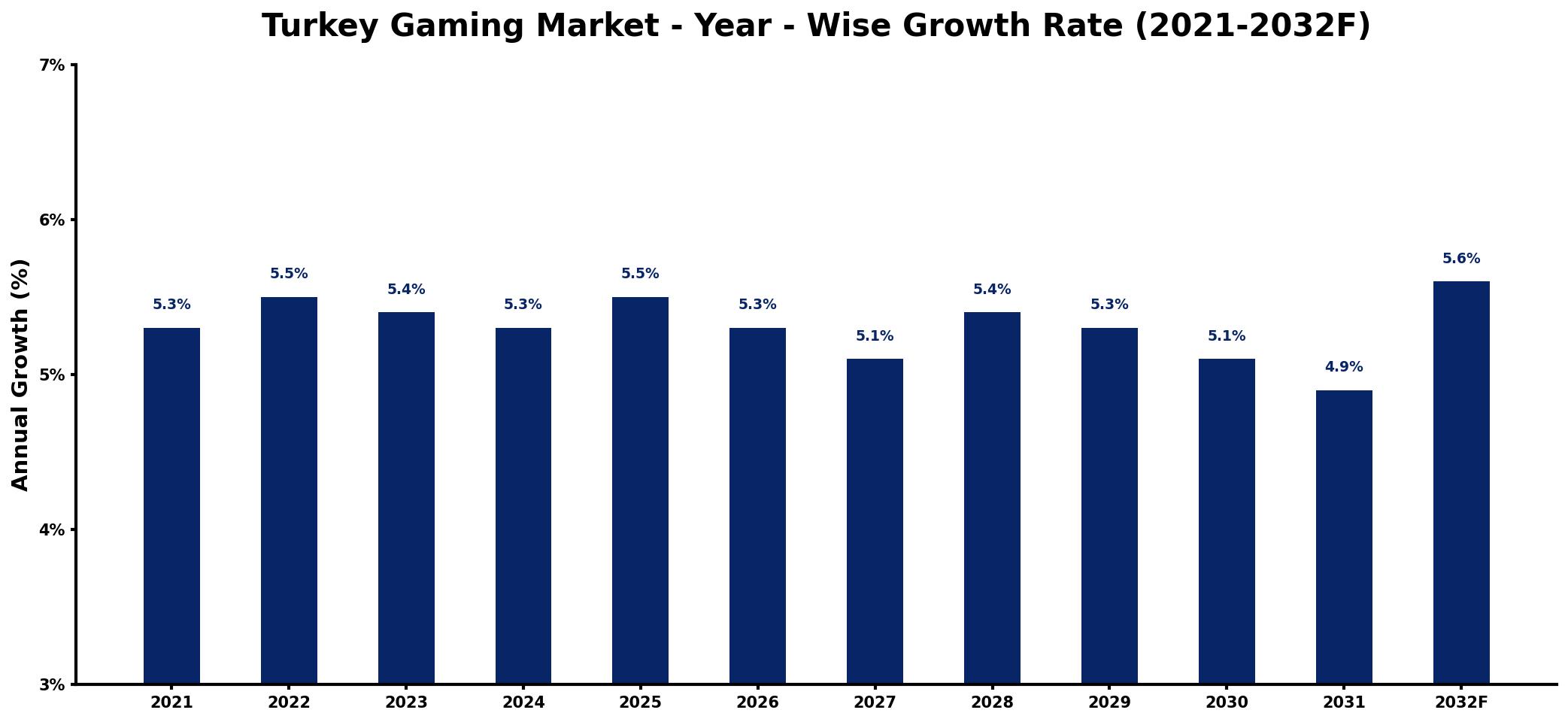
The table below presents the year‑wise growth rates along with the key drivers influencing the market
| Year | Growth Rate | Major Drivers |
| 2021 | 5.3% | Rise in mobile internet users |
| 2022 | 5.5% | Increased disposable income levels |
| 2023 | 5.4% | Expansion of online platforms |
| 2024 | 5.3% | Growing popularity of esports |
| 2025 | 5.5% | Investment in technology innovation |
| 2026 | 5.3% | expanding manufacturing base activity |
| 2027 | 5.1% | Emergence of VR experiences |
| 2028 | 5.4% | Adoption of blockchain solutions |
| 2029 | 5.3% | Enhanced user engagement strategies |
| 2030 | 5.1% | Development of local content |
| 2031 | 4.9% | Diversification of entertainment options |
| 2032 | 5.6% | Strengthening of regulatory frameworks |
Note: Market size estimations and growth projections presented in this report are based on 6Wresearch's proprietary forecasting methodology, utilizing the latest available industry data, government publications, and primary research inputs.
Turkey Gaming Market Synopsis
Turkey's gaming landscape is rapidly evolving, characterized by a surge in mobile and online gaming. Gamers are increasingly drawn to immersive experiences, such as esports and multiplayer online games, fostering a sense of community while driving sales of related products. This burgeoning sector is attracting significant attention from both local developers and international companies.
In particular, the rise of local game studios is reshaping consumer preferences, as developers create content that resonates with Turkish culture. Alongside this, gaming influencers are harnessing their popularity on streaming platforms to elevate engagement levels, further contributing to the market's vibrancy.
Turkey Gaming Market Key Takeaways
- The gaming market in Turkey is being driven by a young demographic eager for innovative gaming experiences.
- Mobile gaming dominates the market, benefitting from widespread smartphone adoption.
- Esports is gaining considerable traction, leading to substantial revenue generation through sponsorships and viewership.
- Local game development is on the rise, enabling the creation of culturally relevant gaming content.
- Regulatory challenges remain, impacting game distribution and content across the region.
Evaluation of Restraints in Turkey Gaming Market
While the Turkey Gaming Market is poised for growth, several restraints impede its full potential. Regulatory restrictions, including censorship laws, can significantly affect how games are developed, marketed, and distributed. The market also grapples with a payment infrastructure that lacks robustness, often limiting in-game purchases and the overall monetization strategies for developers. Furthermore, rampant piracy presents a formidable challenge, undermining the revenue streams of game publishers. As the competition intensifies, both local and international players must navigate these hurdles with strategic foresight to thrive.
Turkey Gaming Market Trends
The trends currently shaping the Turkey Gaming Market are diverse and multifaceted. An upward trajectory in mobile gaming continues, driven by user-friendly apps that cater to on-the-go gaming preferences. Additionally, the esports ecosystem is expanding, with tournaments and competitive events drawing considerable attention and funding. Notably, social gaming platforms are fostering community engagement among players, allowing for collaborative and interactive experiences. As technology advances, we also see a shift towards more immersive gameplay via virtual and augmented reality, which is expected to become increasingly mainstream in the coming years.
Turkey Gaming Market Opportunities
Investors and developers looking to capitalize on the Turkey Gaming Market will find ample opportunities across various segments. The increasing interest in mobile and online gaming provides a fertile ground for game development studios, especially those focusing on local content. Additionally, as esports gains momentum, opportunities for gaming events and tournaments are burgeoning, complemented by a rising demand for gaming peripherals. Government initiatives supporting the gaming industry, including tax incentives, further enhance the attractiveness for investment, particularly in local partnerships and innovative marketing strategies.
Government Initiatives in the Turkey Gaming Market
The Turkish government has established a regulatory framework to promote the gaming industry while ensuring consumer protection. The Information and Communication Technologies Authority (BTK) plays a vital role in licensing and regulating online gaming operators to ensure fair competition. In efforts to protect vulnerable populations, especially minors, advertising for online gaming has been significantly restricted. Despite these regulations, there are ongoing initiatives aimed at fostering the growth of the local gaming sector through potential funding programs and supportive policies.
Future Insights of the Turkey Gaming Market
Looking ahead to 2026-2032, the Turkey Gaming Market is set to continue its upward trend, fueled by advancements in technology and an increasingly engaged consumer base. The growing internet penetration and rising disposable incomes will further enhance accessibility to gaming content. As digital platforms expand, innovative gaming experiences like virtual reality are likely to emerge, pushing the boundaries of what gamers can expect. The vibrant esports scene will provide additional avenues for revenue generation, reinforcing Turkey's position as a key player in the global gaming ecosystem.
Turkey Gaming Market Latest Developments (2025 - 2026)
Recent developments in the Turkey Gaming Market indicate a shift towards increased collaboration between local developers and international entities, fostering innovation and cross-border partnerships. The esports landscape continues to grow, with more tournaments attracting larger audiences and sponsorships. Additionally, consumer demand for immersive gaming experiences is driving advancements in technologies such as virtual and augmented reality. These trends are likely to further enhance the engagement levels within the gaming community.
Turkey Gaming Market - Key Attractiveness of the Report
- 10 Years of Market Numbers
- Historical Data Starting from 2022 to 2025
- Base Year: 2025
- Forecast Data until 2032
- Key Performance Indicators Impacting the Market
- Major Upcoming Developments and Projects
Key Highlights of the Report:
- Turkey Gaming Market Outlook
- Market Size of Turkey Gaming Market, 2025
- Forecast of Turkey Gaming Market, 2032
- Historical Data and Forecast of Turkey Gaming Revenues & Volume for the Period 2022-2032F
- Turkey Gaming Market Trend Evolution
- Turkey Gaming Market Drivers and Challenges
- Turkey Gaming Price Trends
- Turkey Gaming Porter's Five Forces
- Turkey Gaming Industry Life Cycle
- Historical Data and Forecast of Turkey Gaming Market Revenues & Volume By Game Type for the Period 2022-2032F
- Historical Data and Forecast of Turkey Gaming Market Revenues & Volume By Shooter for the Period 2022-2032F
- Historical Data and Forecast of Turkey Gaming Market Revenues & Volume By Action for the Period 2022-2032F
- Historical Data and Forecast of Turkey Gaming Market Revenues & Volume By Sports for the Period 2022-2032F
- Historical Data and Forecast of Turkey Gaming Market Revenues & Volume By Role-Playing for the Period 2022-2032F
- Historical Data and Forecast of Turkey Gaming Market Revenues & Volume By Others for the Period 2022-2032F
- Historical Data and Forecast of Turkey Gaming Market Revenues & Volume By Device Type for the Period 2022-2032F
- Historical Data and Forecast of Turkey Gaming Market Revenues & Volume By PC/MMO for the Period 2022-2032F
- Historical Data and Forecast of Turkey Gaming Market Revenues & Volume By Tablet for the Period 2022-2032F
- Historical Data and Forecast of Turkey Gaming Market Revenues & Volume By Mobile Phone for the Period 2022-2032F
- Historical Data and Forecast of Turkey Gaming Market Revenues & Volume By TV/Console for the Period 2022-2032F
- Historical Data and Forecast of Turkey Gaming Market Revenues & Volume By End-User for the Period 2022-2032F
- Historical Data and Forecast of Turkey Gaming Market Revenues & Volume By Male for the Period 2022-2032F
- Historical Data and Forecast of Turkey Gaming Market Revenues & Volume By Female for the Period 2022-2032F
- Turkey Gaming Import Export Trade Statistics
- Market Opportunity Assessment By Game Type
- Market Opportunity Assessment By Device Type
- Market Opportunity Assessment By End-User
- Turkey Gaming Top Companies Market Share
- Turkey Gaming Competitive Benchmarking By Technical and Operational Parameters
- Turkey Gaming Company Profiles
- Turkey Gaming Key Strategic Recommendations






































