Turkey Gas Equipment Market Size, Share & Growth Rate
The Turkey Gas Equipment Market was estimated at USD 366 Million in 2025 and is projected to reach USD 490 Million by 2032, growing at a CAGR of 4.3% from 2026 to 2032. This upward trajectory is primarily fueled by the rising demand for natural gas across various sectors, particularly in industrial, commercial, and residential applications. The increasing focus on energy efficiency and environmentally friendly solutions further propels the adoption of advanced gas equipment technologies.
Turkey Gas Equipment Market Year-wise Growth Rate and Key Drivers
This graph highlights how the Turkey Gas Equipment Market has steadily grown over the years, supported by major growth factors.
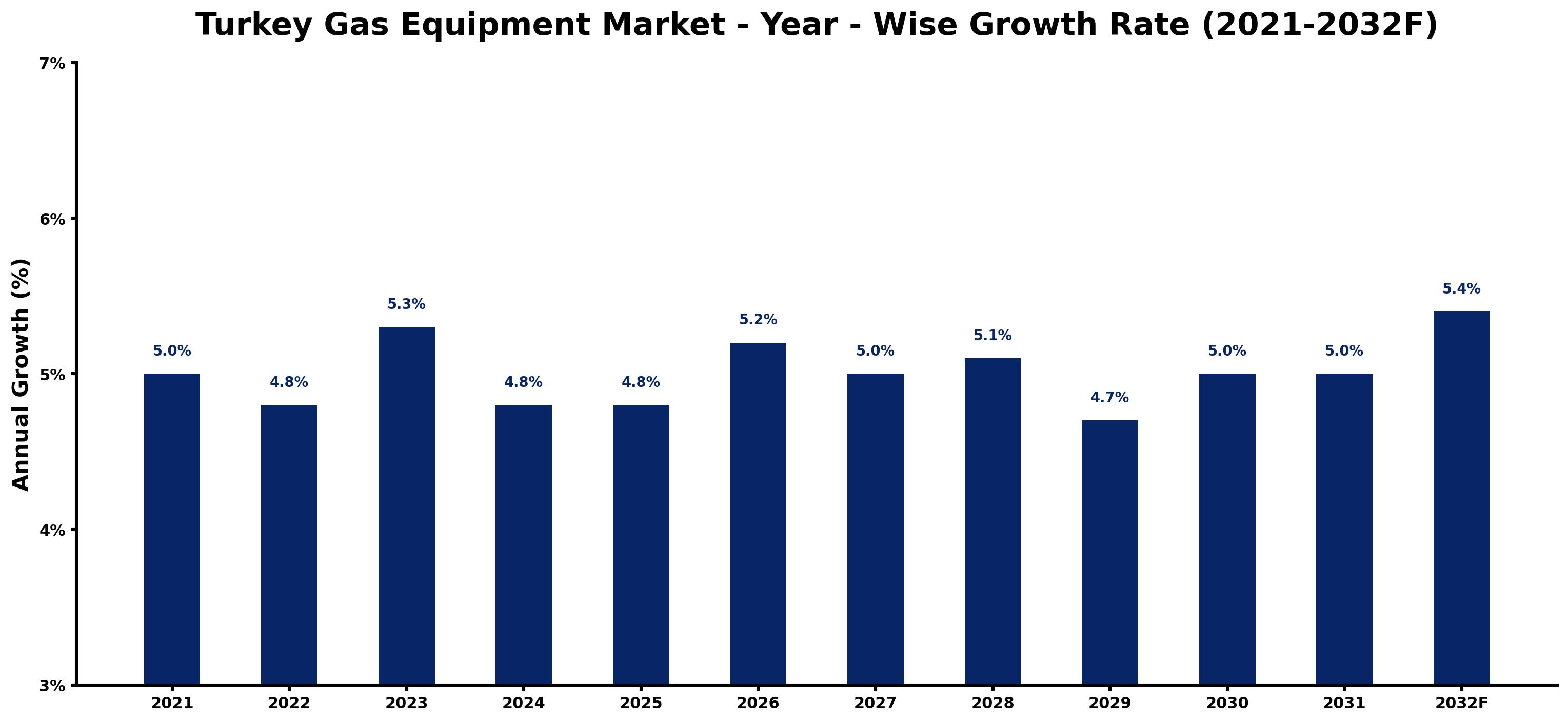
The table below presents the year‑wise growth rates along with the key drivers influencing the market
| Year | Growth Rate | Major Drivers |
| 2021 | 5.0% | Increasing industrial infrastructure investments |
| 2022 | 4.8% | Rising electricity demand across industries |
| 2023 | 5.3% | Increasing smart city development projects |
| 2024 | 4.8% | Rapid growth in telecom and data center sectors |
| 2025 | 4.8% | Rapid growth in telecom and data center sectors |
| 2026 | 5.2% | Rising electricity demand across industries |
| 2027 | 5.0% | Government infrastructure modernization initiatives |
| 2028 | 5.1% | Increasing industrial infrastructure investments |
| 2029 | 4.7% | Increasing adoption of advanced technologies |
| 2030 | 5.0% | Expansion of manufacturing activities |
| 2031 | 5.0% | Increasing adoption of advanced technologies |
| 2032 | 5.4% | Increasing adoption of advanced technologies |
Note - Market size estimations and growth projections presented in this report are based on 6Wresearch's advanced forecasting approach, validated with industry datasets as of June 2026.
Turkey Gas Equipment Market Synopsis
The Turkey Gas Equipment Market is currently experiencing a phase of robust expansion, characterized by heightened investment in natural gas infrastructure and a shift towards cleaner energy sources. As Turkey embraces natural gas as a primary fuel, the demand for essential gas equipment such as meters, regulators, and valves is surging.
With an ongoing commitment to sustainability, both governmental and industrial sectors are prioritizing advanced technologies that enhance operational efficiency while minimizing emissions. This dynamic landscape is creating new opportunities for suppliers and manufacturers in the market.
Turkey Gas Equipment Market Key Takeaways
- The market is anticipated to grow steadily, reflecting Turkey's strategic energy transition.
- Technological advancements, particularly in IoT and smart gas equipment, are reshaping market dynamics.
- Government policies promoting natural gas use further stimulate market demand.
- Investment in innovative solutions is crucial for companies to remain competitive.
- The focus on safety standards is increasingly influencing equipment design and manufacturing.
Evaluation of Restraints in Turkey Gas Equipment Market
While the Turkey Gas Equipment Market shows promise, several factors are hindering its full potential. Increased competition from both local and international manufacturers pressures pricing strategies, often leading to thinner margins. Additionally, fluctuations in raw material costs can affect profitability and the feasibility of new projects. The regulatory landscape remains complex, with frequent changes that challenge compliance efforts. These factors compel companies to innovate continuously and find cost-effective solutions to maintain their market share amidst uncertainties.
Turkey Gas Equipment Market Trends
A significant trend in the Turkey Gas Equipment Market is the growing acceptance of natural gas as a cleaner alternative to coal and oil, driven by an increasing public awareness of environmental issues. High-efficiency appliances, such as advanced boilers and furnaces, are seeing heightened demand as both consumers and businesses strive for reduced energy costs and lower carbon footprints.
Furthermore, the emergence of smart meters and IoT-enabled devices is transforming gas usage monitoring and management. These technologies empower users with real-time data, allowing for improved efficiency and cost savings. A keen focus on safety and compliance with stringent regulations is also shaping product innovations within the industry.
Turkey Gas Equipment Market Opportunities
The Turkey Gas Equipment Market is ripe with investment opportunities, particularly as the country seeks to expand its natural gas distribution networks and storage capabilities. Companies have the chance to engage in cutting-edge research and development focused on energy-efficient technologies, such as smart leak detection systems and high-performance appliances. Additionally, Turkey's geographical position as a link between Europe and Asia presents an opportunity for businesses to leverage the growing energy market in neighboring regions.
Government Initiatives in the Turkey Gas Equipment Market
Government initiatives in Turkey are increasingly focused on enhancing energy efficiency and promoting sustainable practices within the gas equipment sector. Regulatory frameworks have been established to ensure the safety and quality of gas equipment, thereby instilling consumer confidence. Moreover, the government offers incentives for companies that invest in innovative gas technologies and renewable energy solutions. These measures aim to bolster Turkey's energy security while fostering a competitive marketplace that encourages growth and development.
Future Insights of the Turkey Gas Equipment Market
Looking ahead, the Turkey Gas Equipment Market is expected to maintain a positive growth trajectory driven by increasing energy demand and government support for natural gas usage. The market will likely benefit from ongoing infrastructure investments and an industrial shift towards cleaner energy solutions. As technological advancements continue to emerge, firms that prioritize innovation and adapt to changing consumer preferences will position themselves favorably in this evolving landscape.
Turkey Gas Equipment Market Latest Developments (May 2025 - June 2026)
Recent developments in the Turkey Gas Equipment Market have underscored a push towards more sustainable energy solutions. Companies are actively exploring partnerships and collaborations to enhance their product offerings, especially in the realms of efficiency and safety. There is also a marked increase in the implementation of smart gas management systems, reflecting a broader industry trend towards digital transformation. The ongoing emphasis on regulatory compliance continues to shape product development and operational standards.
Turkey Gas Equipment Market - Key Attractiveness of the Report
- 10 Years of Market Numbers
- Historical Data Starting from 2022 to 2025
- Base Year: 2025
- Forecast Data until 2032
- Key Performance Indicators Impacting the Market
- Major Upcoming Developments and Projects
Key Highlights of the Report:
- Turkey Gas Equipment Market Outlook
- Market Size of Turkey Gas Equipment Market, 2025
- Forecast of Turkey Gas Equipment Market, 2032
- Historical Data and Forecast of Turkey Gas Equipment Revenues & Volume for the Period 2022-2032F
- Turkey Gas Equipment Market Trend Evolution
- Turkey Gas Equipment Market Drivers and Challenges
- Turkey Gas Equipment Price Trends
- Turkey Gas Equipment Porter's Five Forces
- Turkey Gas Equipment Industry Life Cycle
- Historical Data and Forecast of Turkey Gas Equipment Market Revenues & Volume By Equipment Type for the Period 2022-2032F
- Historical Data and Forecast of Turkey Gas Equipment Market Revenues & Volume By Gas Delivery Systems for the Period 2022-2032F
- Historical Data and Forecast of Turkey Gas Equipment Market Revenues & Volume By Gas Regulators for the Period 2022-2032F
- Historical Data and Forecast of Turkey Gas Equipment Market Revenues & Volume By Flow Devices for the Period 2022-2032F
- Historical Data and Forecast of Turkey Gas Equipment Market Revenues & Volume By Purifiers & Filters for the Period 2022-2032F
- Historical Data and Forecast of Turkey Gas Equipment Market Revenues & Volume By Gas Generating Systems for the Period 2022-2032F
- Historical Data and Forecast of Turkey Gas Equipment Market Revenues & Volume By Gas Detection Systems for the Period 2022-2032F
- Historical Data and Forecast of Turkey Gas Equipment Market Revenues & Volume By Cryogenic Products for the Period 2022-2032F
- Historical Data and Forecast of Turkey Gas Delivery Systems Gas Equipment Market Revenues & Volume By Accessories for the Period 2022-2032F
- Historical Data and Forecast of Turkey Gas Equipment Market Revenues & Volume By Process for the Period 2022-2032F
- Historical Data and Forecast of Turkey Gas Equipment Market Revenues & Volume By Gas Generation for the Period 2022-2032F
- Historical Data and Forecast of Turkey Gas Equipment Market Revenues & Volume By Gas Storage for the Period 2022-2032F
- Historical Data and Forecast of Turkey Gas Equipment Market Revenues & Volume By Gas Detection for the Period 2022-2032F
- Historical Data and Forecast of Turkey Gas Equipment Market Revenues & Volume By Gas Transportation for the Period 2022-2032F
- Historical Data and Forecast of Turkey Gas Equipment Market Revenues & Volume By End-Gas for the Period 2022-2032F
- Historical Data and Forecast of Turkey Gas Equipment Market Revenues & Volume By Nitrogen for the Period 2022-2032F
- Historical Data and Forecast of Turkey Gas Equipment Market Revenues & Volume By Hydrogen for the Period 2022-2032F
- Historical Data and Forecast of Turkey Gas Equipment Market Revenues & Volume By Helium for the Period 2022-2032F
- Historical Data and Forecast of Turkey Gas Equipment Market Revenues & Volume By Oxygen for the Period 2022-2032F
- Historical Data and Forecast of Turkey Gas Equipment Market Revenues & Volume By Carbon Dioxide for the Period 2022-2032F
- Historical Data and Forecast of Turkey Gas Equipment Market Revenues & Volume By Others for the Period 2022-2032F
- Historical Data and Forecast of Turkey Gas Equipment Market Revenues & Volume By End-Users for the Period 2022-2032F
- Historical Data and Forecast of Turkey Gas Equipment Market Revenues & Volume By Metal Fabrication for the Period 2022-2032F
- Historical Data and Forecast of Turkey Gas Equipment Market Revenues & Volume By Chemicals for the Period 2022-2032F
- Historical Data and Forecast of Turkey Gas Equipment Market Revenues & Volume By Healthcare for the Period 2022-2032F
- Historical Data and Forecast of Turkey Gas Equipment Market Revenues & Volume By Oil and Gas for the Period 2022-2032F
- Historical Data and Forecast of Turkey Gas Equipment Market Revenues & Volume By Food and Beverage for the Period 2022-2032F
- Historical Data and Forecast of Turkey Gas Equipment Market Revenues & Volume By Others for the Period 2022-2032F
- Turkey Gas Equipment Import Export Trade Statistics
- Market Opportunity Assessment By Equipment Type
- Market Opportunity Assessment By Process
- Market Opportunity Assessment By End-Gas
- Market Opportunity Assessment By End-Users
- Turkey Gas Equipment Top Companies Market Share
- Turkey Gas Equipment Competitive Benchmarking By Technical and Operational Parameters
- Turkey Gas Equipment Company Profiles
- Turkey Gas Equipment Key Strategic Recommendations






































