Turkey Gas Sensors Market Size, Share & Growth Rate
The Turkey Gas Sensors Market was estimated at USD 468 Million in 2025 and is projected to reach USD 634 Million by 2032, growing at a CAGR of 4.4% from 2026 to 2032. This growth trajectory is largely propelled by increasing regulatory compliance in workplace safety and heightened environmental awareness across industries. The oil & gas sector, along with healthcare and manufacturing, is particularly driving the demand for advanced gas detection systems that not only meet safety requirements but also enhance operational efficiency.
Turkey Gas Sensors Market Year-wise Growth Rate and Key Drivers
This graph highlights how the Turkey Gas Sensors Market has steadily grown over the years, supported by major growth factors.
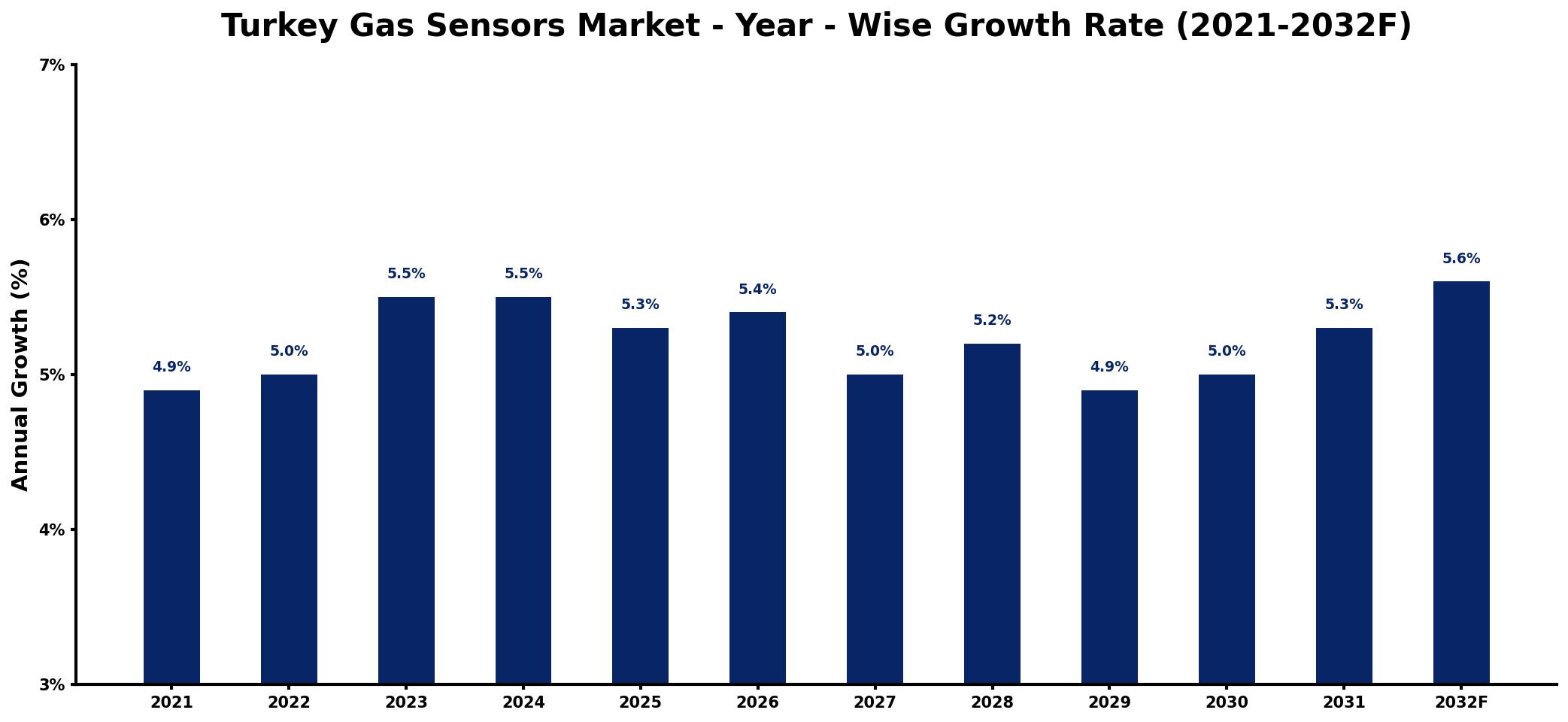
The table below presents the year‑wise growth rates along with the key drivers influencing the market
| Year | Growth Rate | Major Drivers |
| 2021 | 4.9% | Rising industrial safety regulations |
| 2022 | 5.0% | Growth in environmental monitoring initiatives |
| 2023 | 5.5% | Increased investment in manufacturing technology |
| 2024 | 5.5% | Expansion of urban infrastructure projects |
| 2025 | 5.3% | Surge in renewable energy projects |
| 2026 | 5.4% | Heightened focus on workplace safety |
| 2027 | 5.0% | increased domestic production output |
| 2028 | 5.2% | Demand for smart home solutions |
| 2029 | 4.9% | Increased focus on energy efficiency |
| 2030 | 5.0% | Development of new industrial standards |
| 2031 | 5.3% | expanding healthcare application demand |
| 2032 | 5.6% | Rising demand for automated solutions |
Note: Market size estimations and growth projections presented in this report are based on 6Wresearch's proprietary forecasting methodology, utilizing the latest available industry data, government publications, and primary research inputs.
Turkey Gas Sensors Market Synopsis
A rising emphasis on air quality monitoring is reshaping the Turkey Gas Sensors Market, compelling organizations to adopt sophisticated gas detection solutions. The Turkish government has implemented stringent regulations aimed at ensuring environmental protection and workplace safety, fostering a more substantial demand for reliable gas sensors.
Technological advancements, particularly in the areas of IoT-enabled and miniaturized sensors, are creating innovative pathways for real-time gas monitoring and improved data accuracy. As industries increasingly prioritize employee safety and environmental sustainability, the gas sensors market is set for robust expansion.
Turkey Gas Sensors Market Key Takeaways
- The market is driven by stringent regulations and rising safety standards across various sectors.
- Technological innovation, particularly in wireless and IoT-enabled sensors, is enhancing market dynamics.
- Investment opportunities are flourishing in the realm of environmental safety and smart city applications.
- Local manufacturers are benefitting from government initiatives aimed at promoting domestic production.
- Anticipated growth in automotive and healthcare sectors will further augment the demand for gas sensors.
Evaluation of Restraints in Turkey Gas Sensors Market
The Turkey Gas Sensors Market faces several restraints that could hinder its full potential. Competition from both local and international manufacturers adds pressure to pricing strategies, making it essential for companies to innovate continually. Rapid advancements in technology also lead to shorter product lifecycles, compelling manufacturers to invest heavily in research and development. Furthermore, external factors such as economic uncertainties and geopolitical tensions may create an unstable business environment, impacting profitability and operational efficiency. Rising raw material costs are also a concern, necessitating strategic sourcing to maintain competitive pricing.
Turkey Gas Sensors Market Trends
Several key trends are shaping the Turkey Gas Sensors Market today. A significant shift towards IoT applications allows for better data analytics and real-time monitoring, greatly enhancing the functionality of gas detection systems. Moreover, an increasing focus on energy efficiency is prompting manufacturers to develop sensors that require less power while providing higher accuracy. The automotive industry is also embracing gas sensors for emission control, further elevating their application across different sectors.
Turkey Gas Sensors Market Opportunities
Investment opportunities abound within the Turkey Gas Sensors Market, primarily driven by rising regulatory standards and a growing commitment to environmental sustainability. Organizations are actively seeking cost-effective, reliable gas detection solutions tailored to their specific needs. Furthermore, as urban areas evolve into smart cities, the demand for integrated sensor systems will likely surge, opening new avenues for growth. Firms that emphasize innovation and sustainability in their product offerings will be in a prime position to capitalize on this expanding market.
Government Initiatives in the Turkey Gas Sensors Market
The Turkish government is keen on promoting safety and innovation within the Gas Sensors Market through various initiatives. Policies have been introduced that focus on ensuring the quality and safety of gas sensors, while also encouraging compliance with international standards. Financial incentives and tax benefits are being offered to local manufacturers to boost domestic production capabilities. These measures not only support the growth of the gas sensor industry but also prioritize environmental protection and public safety.
Future Insights of the Turkey Gas Sensors Market
Looking forward to the period from 2026 to 2032, the Turkey Gas Sensors Market is poised for considerable growth. An increased focus on workplace safety and air quality management will drive demand, particularly within the oil & gas and healthcare sectors. The evolving landscape of smart technologies and continuous advancements in sensor capabilities will further amplify the market's expansion. As companies become increasingly aware of the need for compliance with stringent safety regulations, the appetite for advanced gas detection solutions is set to grow substantially.
Turkey Gas Sensors Market Latest Developments (2025 - 2026)
Recent trends indicate a shift toward the integration of advanced technologies in gas sensors, with manufacturers exploring partnerships and collaborations to enhance their offerings. Companies are investing in R&D to develop next-generation sensors that are not only more effective but also energy-efficient. Regulatory frameworks are becoming increasingly stringent, prompting a response from businesses to innovate and comply. Additionally, public sector spending on safety measures continues to rise, reflecting a commitment to improving air quality and workplace conditions.
Turkey Gas Sensors Market - Key Attractiveness of the Report
- 10 Years of Market Numbers
- Historical Data Starting from 2022 to 2025
- Base Year: 2025
- Forecast Data until 2032
- Key Performance Indicators Impacting the Market
- Major Upcoming Developments and Projects
Key Highlights of the Report:
- Turkey Gas Sensors Market Outlook
- Market Size of Turkey Gas Sensors Market, 2025
- Forecast of Turkey Gas Sensors Market, 2032
- Historical Data and Forecast of Turkey Gas Sensors Revenues & Volume for the Period 2022-2032F
- Turkey Gas Sensors Market Trend Evolution
- Turkey Gas Sensors Market Drivers and Challenges
- Turkey Gas Sensors Price Trends
- Turkey Gas Sensors Porter's Five Forces
- Turkey Gas Sensors Industry Life Cycle
- Historical Data and Forecast of Turkey Gas Sensors Market Revenues & Volume By Product for the Period 2022-2032F
- Historical Data and Forecast of Turkey Gas Sensors Market Revenues & Volume By Hydrogen for the Period 2022-2032F
- Historical Data and Forecast of Turkey Gas Sensors Market Revenues & Volume By Ammonia for the Period 2022-2032F
- Historical Data and Forecast of Turkey Gas Sensors Market Revenues & Volume By Hydrogen Sulfide for the Period 2022-2032F
- Historical Data and Forecast of Turkey Gas Sensors Market Revenues & Volume By Methyl Mercaptan Sensor for the Period 2022-2032F
- Historical Data and Forecast of Turkey Gas Sensors Market Revenues & Volume By NOx Sensor for the Period 2022-2032F
- Historical Data and Forecast of Turkey Gas Sensors Market Revenues & Volume By Carbon Monoxide Sensor for the Period 2022-2032F
- Historical Data and Forecast of Turkey Gas Sensors Market Revenues & Volume By Carbon Dioxide Sensor for the Period 2022-2032F
- Historical Data and Forecast of Turkey Hydrogen Gas Sensors Market Revenues & Volume By Oxygen/Lambda Sensor for the Period 2022-2032F
- Historical Data and Forecast of Turkey Gas Sensors Market Revenues & Volume By Technology for the Period 2022-2032F
- Historical Data and Forecast of Turkey Gas Sensors Market Revenues & Volume By Infrared for the Period 2022-2032F
- Historical Data and Forecast of Turkey Gas Sensors Market Revenues & Volume By Catalytic for the Period 2022-2032F
- Historical Data and Forecast of Turkey Gas Sensors Market Revenues & Volume By Photo-Ionization Detector for the Period 2022-2032F
- Historical Data and Forecast of Turkey Gas Sensors Market Revenues & Volume By Solid State/MOS for the Period 2022-2032F
- Historical Data and Forecast of Turkey Gas Sensors Market Revenues & Volume By Semiconductor for the Period 2022-2032F
- Historical Data and Forecast of Turkey Gas Sensors Market Revenues & Volume By Electrochemical for the Period 2022-2032F
- Turkey Gas Sensors Import Export Trade Statistics
- Market Opportunity Assessment By Product
- Market Opportunity Assessment By Technology
- Turkey Gas Sensors Top Companies Market Share
- Turkey Gas Sensors Competitive Benchmarking By Technical and Operational Parameters
- Turkey Gas Sensors Company Profiles
- Turkey Gas Sensors Key Strategic Recommendations






































