Turkey Hafnium Market Size, Share & Growth Rate
The Turkey Hafnium Market was estimated at USD 774 Million in 2025 and is projected to reach USD 1099 Million by 2032, growing at a CAGR of 5.1% from 2026 to 2032. This growth trajectory is significantly fueled by the rising demand across aerospace and electronics sectors, where hafnium's unique properties play a crucial role. Additionally, an increasing focus on sustainable energy solutions, particularly nuclear power, further drives this expanding market.
Turkey Hafnium Market Year-wise Growth Rate and Key Drivers
This graph highlights how the Turkey Hafnium Market has steadily grown over the years, supported by major growth factors.
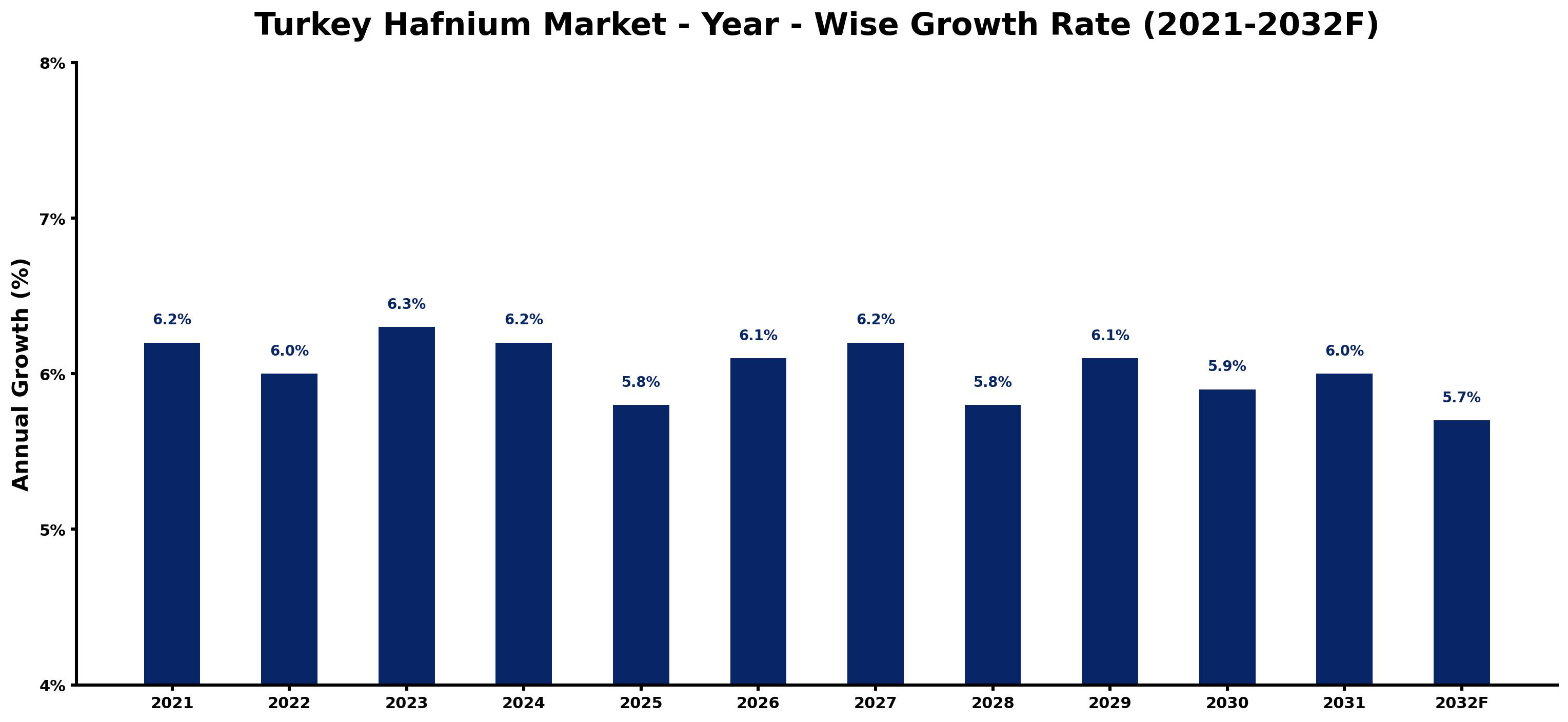
The table below presents the year‑wise growth rates along with the key drivers influencing the market
| Year | Growth Rate | Major Drivers |
| 2021 | 6.2% | Rising aerospace sector investments |
| 2022 | 6.0% | Increased demand from electronics |
| 2023 | 6.3% | Expansion in renewable energy projects |
| 2024 | 6.2% | Growth in defense manufacturing activities |
| 2025 | 5.8% | Emerging technologies driving investments |
| 2026 | 6.1% | Surge in automotive industry applications |
| 2027 | 6.2% | Increased research and development funding |
| 2028 | 5.8% | Growing demand for specialized alloys |
| 2029 | 6.1% | Expansion of semiconductor manufacturing |
| 2030 | 5.9% | Rising interest in advanced ceramics |
| 2031 | 6.0% | Increased applications in medical devices |
| 2032 | 5.7% | increased overall sector activity |
Note: Market size estimations and growth projections presented in this report are based on 6Wresearch's proprietary forecasting methodology, utilizing the latest available industry data, government publications, and primary research inputs.
Turkey Hafnium Market Synopsis
The primary force currently shaping the Turkey Hafnium Market is the burgeoning demand in aerospace applications. As the aviation industry increasingly adopts advanced materials to enhance performance and efficiency, hafnium's high melting point and corrosion resistance become indispensable. This heightened demand is not only a reflection of current technological advancements but also indicative of a broader trend towards high-performance materials across various industries.
In addition to aerospace, the electronics and nuclear sectors are substantially contributing to market dynamics. As hafnium is integral to the production of semiconductors and superconductors, ongoing investments in electronic technologies are expected to spur further growth. Simultaneously, Turkey's strategic focus on nuclear energy reinforces the relevance of hafnium in this market, enhancing its overall appeal to investors.
Turkey Hafnium Market Key Takeaways
- The market is projected to grow from USD 774 Million in 2025 to USD 1099 Million by 2032, at a CAGR of 5.1%.
- Aerospace and electronics are the primary sectors driving hafnium demand in Turkey.
- The growing emphasis on sustainable energy sources, especially in nuclear applications, is influencing market trends.
- Challenges include limited hafnium availability and dependency on imports, which affect price stability.
- Research and development investments are essential for enhancing hafnium applications and performance across industries.
Evaluation of Restraints in Turkey Hafnium Market
The Turkey Hafnium Market faces notable restraints, primarily stemming from the metal's limited availability in nature. Hafnium's relative scarcity leads to supply constraints, which can trigger price fluctuations that may hinder market expansion. Additionally, Turkeys dependency on imports to satisfy domestic hafnium demand is susceptible to geopolitical influences and trade regulations, further complicating the market landscape. The complexity of hafnium extraction and refinement processes adds another layer of difficulty, increasing production costs and limiting the scalability of operations in this niche market.
Turkey Hafnium Market Trends
Current trends in the Turkey Hafnium Market indicate an increasing integration of hafnium in high-performance materials, particularly in aerospace and nuclear applications. As manufacturers pursue innovation, research and development activities are being prioritized to enhance hafnium's utility in advanced electronic devices. Furthermore, the rise in renewable energy projects and a commitment to sustainability are encouraging the use of hafnium in solar technology and energy storage solutions, expanding its scope and potential within the market.
Turkey Hafnium Market Opportunities
The Turkey Hafnium Market offers considerable investment opportunities in hafnium extraction and processing companies, as well as firms involved in the production of specialized hafnium-based materials. Strategic partnerships with research institutions could lead to breakthroughs in hafnium applications, providing competitive advantages. Moreover, expanding into markets related to renewable energy and high-tech manufacturing can yield additional avenues for growth, capitalizing on the ongoing technological transformations within Turkeys industrial landscape.
Government Initiatives in the Turkey Hafnium Market
The Turkish government has taken significant steps to regulate the hafnium market, focusing on sustainable resource utilization and boosting domestic production capabilities. Licensing requirements for hafnium producers help ensure compliance with safety and environmental standards. Additionally, policies aimed at encouraging research and development in hafnium technology aim to enhance the nations competitiveness on a global scale while safeguarding critical resources for domestic industrial needs.
Future Insights of the Turkey Hafnium Market
The outlook for the Turkey Hafnium Market is promising, with substantial growth anticipated through 2032. As the demand for high-performance materials in aerospace and electronics escalates, hafnium's unique properties will be increasingly valued. Furthermore, Turkey's ongoing investments in infrastructure and technological innovation will likely sustain the upward trajectory of hafnium applications. The transition toward sustainable energy solutions, particularly in nuclear power, is expected to reinforce the market's robustness and attractiveness to investors.
Turkey Hafnium Market Latest Developments (2025 - 2026)
In the recent months, the Turkey Hafnium Market has seen a surge in research initiatives aimed at optimizing hafnium extraction and refining processes. This trend is indicative of a growing recognition of hafnium's critical role in advanced technologies. Additionally, collaborative efforts between industry players and academic institutions are on the rise, targeting innovations in hafnium-based materials for applications in aerospace and energy sectors, thus signaling a dynamic shift toward enhancing performance and sustainability.
Turkey Hafnium Market - Key Attractiveness of the Report
- 10 Years of Market Numbers
- Historical Data Starting from 2022 to 2025
- Base Year: 2025
- Forecast Data until 2032
- Key Performance Indicators Impacting the Market
- Major Upcoming Developments and Projects
Key Highlights of the Report:
- Turkey Hafnium Market Outlook
- Market Size of Turkey Hafnium Market, 2025
- Forecast of Turkey Hafnium Market, 2032
- Historical Data and Forecast of Turkey Hafnium Revenues & Volume for the Period 2022-2032F
- Turkey Hafnium Market Trend Evolution
- Turkey Hafnium Market Drivers and Challenges
- Turkey Hafnium Price Trends
- Turkey Hafnium Porter's Five Forces
- Turkey Hafnium Industry Life Cycle
- Historical Data and Forecast of Turkey Hafnium Market Revenues & Volume By Type for the Period 2022-2032F
- Historical Data and Forecast of Turkey Hafnium Market Revenues & Volume By Hafnium Oxide for the Period 2022-2032F
- Historical Data and Forecast of Turkey Hafnium Market Revenues & Volume By Hafnium Carbide for the Period 2022-2032F
- Historical Data and Forecast of Turkey Hafnium Market Revenues & Volume By Other for the Period 2022-2032F
- Historical Data and Forecast of Turkey Hafnium Market Revenues & Volume By Application for the Period 2022-2032F
- Historical Data and Forecast of Turkey Hafnium Market Revenues & Volume By Super Alloy for the Period 2022-2032F
- Historical Data and Forecast of Turkey Hafnium Market Revenues & Volume By Optical Coating for the Period 2022-2032F
- Historical Data and Forecast of Turkey Hafnium Market Revenues & Volume By Nuclear for the Period 2022-2032F
- Historical Data and Forecast of Turkey Hafnium Market Revenues & Volume By Plasma Cutting for the Period 2022-2032F
- Historical Data and Forecast of Turkey Hafnium Market Revenues & Volume By Other for the Period 2022-2032F
- Turkey Hafnium Import Export Trade Statistics
- Market Opportunity Assessment By Type
- Market Opportunity Assessment By Application
- Turkey Hafnium Top Companies Market Share
- Turkey Hafnium Competitive Benchmarking By Technical and Operational Parameters
- Turkey Hafnium Company Profiles
- Turkey Hafnium Key Strategic Recommendations






































