Turkey High Strength Steel Market Size, Share & Growth Rate
The Turkey High Strength Steel Market was estimated at USD 489 Million in 2025 and is projected to reach USD 661 Million by 2032, growing at a CAGR of 4.4% from 2026 to 2032. This positive trajectory is largely attributed to the burgeoning automotive sector's need for lightweight and fuel-efficient materials, as well as the construction industry's ongoing infrastructural developments. As manufacturers increasingly prioritize advanced materials for enhanced performance and reduced environmental impact, the demand for high strength steel is set to intensify.
Turkey High Strength Steel Market Year-wise Growth Rate and Key Drivers
This graph highlights how the Turkey High Strength Steel Market has steadily grown over the years, supported by major growth factors.
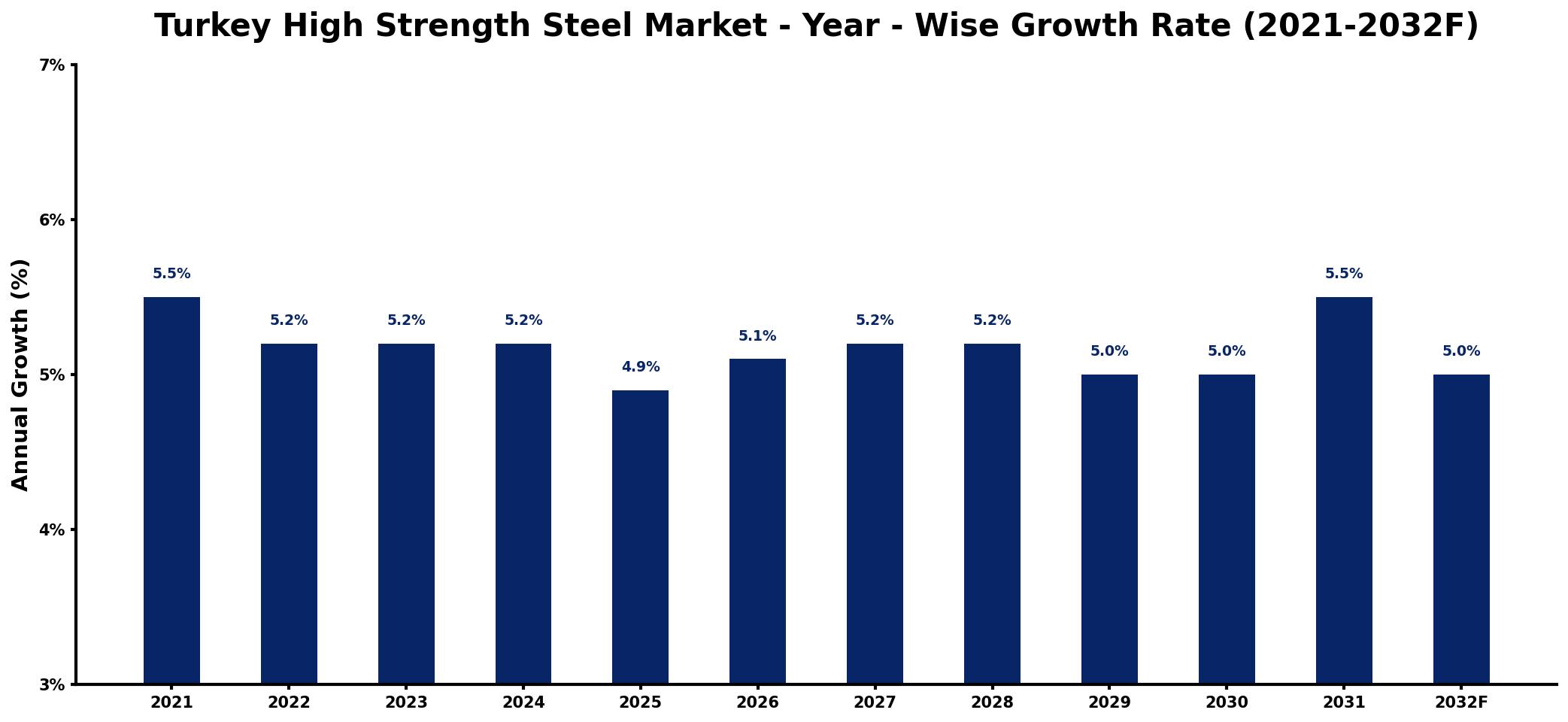
The table below presents the year‑wise growth rates along with the key drivers influencing the market
| Year | Growth Rate | Major Drivers |
| 2021 | 5.5% | Construction sector demand increases significantly |
| 2022 | 5.2% | Automotive industry expansion drives investments |
| 2023 | 5.2% | Infrastructure projects boost material usage |
| 2024 | 5.2% | Renewable energy initiatives create opportunities |
| 2025 | 4.9% | Manufacturing sector experiences strong recovery |
| 2026 | 5.1% | Technological advancements enhance production efficiency |
| 2027 | 5.2% | enhanced product quality standards |
| 2028 | 5.2% | Urbanization trends fuel construction activities |
| 2029 | 5.0% | Government policies support industrial growth |
| 2030 | 5.0% | Sustainability measures promote innovative applications |
| 2031 | 5.5% | rising procurement volume requirements |
| 2032 | 5.0% | Research and development initiatives accelerate |
Note: Market size estimations and growth projections presented in this report are based on 6Wresearch's proprietary forecasting methodology, utilizing the latest available industry data, government publications, and primary research inputs.
Turkey High Strength Steel Market Synopsis
Turkey's high strength steel market is currently experiencing a notable surge, influenced by the robust growth of key industries like automotive and construction. The shift towards sustainable practices and innovative technologies further underscores the market's potential, allowing it to play a pivotal role in the modernization of Turkey's industrial landscape.
In particular, the automotive sector's push for lighter materials to enhance fuel efficiency has propelled high strength steel into the spotlight. Coupled with increased investments in infrastructure, the market is well-positioned to capitalize on these dynamic developments, ensuring its relevance and growth in the coming years.
Turkey High Strength Steel Market Key Takeaways
- The market is driven by the automotive and construction sectors' demand for lightweight, high-strength materials.
- Government support through policies and financial incentives fosters innovation and quality in steel manufacturing.
- Fluctuations in key end-use industries introduce complexities to the market dynamics.
- Competition from alternative materials, such as aluminum, poses strategic challenges.
- Technological advancements are crucial to address high production costs and ensure product quality.
Evaluation of Restraints in Turkey High Strength Steel Market
The Turkey High Strength Steel Market faces several notable restraints that can impede its growth. High production costs often deter manufacturers from adopting advanced technologies, which are essential for maintaining product quality and performance. Additionally, competition from lighter alternatives such as aluminum and composite materials threatens market share, especially in cost-sensitive sectors. Stringent regulatory requirements relating to safety and environmental impact also compound these challenges, often resulting in increased operational costs that can hinder overall market progress.
Turkey High Strength Steel Market Trends
A key trend shaping the Turkey High Strength Steel Market is the increasing adoption of automation and smart manufacturing technologies. These advancements not only enhance production efficiency but also enable the integration of data analytics for quality assurance. Furthermore, the rising focus on sustainability is driving the development of eco-friendly steel production techniques, aligning with global sustainability goals and attracting investment.
Another emerging trend is the collaboration between industries to innovate high strength steel applications, particularly in construction and automotive sectors. This collaborative approach is expected to lead to the introduction of novel steel grades that cater to specific needs while enhancing overall performance in various applications.
Turkey High Strength Steel Market Opportunities
The Turkey High Strength Steel Market is ripe with opportunities, particularly in the realm of infrastructure development. As urbanization accelerates and the government prioritizes public spending on infrastructure projects, demand for high-quality steel is anticipated to surge. Moreover, the automotive industry's transition towards electric vehicles presents a unique avenue for high strength steel utilization, as manufacturers seek materials that contribute to lightweight and efficient vehicle designs. These opportunities are further bolstered by increased foreign investments and technology transfers aimed at enhancing local manufacturing capabilities.
Government Initiatives in the Turkey High Strength Steel Market
The Turkish government is actively nurturing the high strength steel market through various supportive initiatives. Financial incentives for research and development in advanced steel technologies underline the commitment to innovation and competitiveness. Additionally, tax breaks for manufacturers bolster the industry's financial viability while the enforcement of quality standards ensures that high strength steel meets rigorous performance and safety requirements. These initiatives collectively contribute to a more sustainable and technologically advanced steel industry in Turkey.
Future Insights of the Turkey High Strength Steel Market
Looking forward to the period from 2026 to 2032, the Turkey High Strength Steel Market is expected to witness significant advancements, driven by ongoing trends in sustainability and technological innovation. As industries increasingly pivot towards lightweight materials to enhance efficiency, high strength steel will likely see expanded applications across various sectors. Government support and investment in infrastructure will further accelerate growth, setting a foundation for a resilient and competitive market landscape.
Turkey High Strength Steel Market Latest Developments (2025 - 2026)
In recent months, the Turkey High Strength Steel Market has been characterized by a surge in research collaborations aimed at developing innovative steel formulations that improve performance while reducing environmental impact. There has also been an uptick in discussions surrounding sustainability certifications, encouraging manufacturers to adopt greener practices. The focus on quality improvement through advanced manufacturing technologies is evident, with many companies investing in automation to enhance efficiency and reduce costs.
Turkey High Strength Steel Market - Key Attractiveness of the Report
- 10 Years of Market Numbers
- Historical Data Starting from 2022 to 2025
- Base Year: 2025
- Forecast Data until 2032
- Key Performance Indicators Impacting the Market
- Major Upcoming Developments and Projects
Key Highlights of the Report:
- Turkey High Strength Steel Market Outlook
- Market Size of Turkey High Strength Steel Market, 2025
- Forecast of Turkey High Strength Steel Market, 2032
- Historical Data and Forecast of Turkey High Strength Steel Revenues & Volume for the Period 2022-2032F
- Turkey High Strength Steel Market Trend Evolution
- Turkey High Strength Steel Market Drivers and Challenges
- Turkey High Strength Steel Price Trends
- Turkey High Strength Steel Porter's Five Forces
- Turkey High Strength Steel Industry Life Cycle
- Historical Data and Forecast of Turkey High Strength Steel Market Revenues & Volume By Product Type for the Period 2022-2032F
- Historical Data and Forecast of Turkey High Strength Steel Market Revenues & Volume By Dual Phase Steel for the Period 2022-2032F
- Historical Data and Forecast of Turkey High Strength Steel Market Revenues & Volume By Bake Hardenable Steel for the Period 2022-2032F
- Historical Data and Forecast of Turkey High Strength Steel Market Revenues & Volume By Carbon Manganese Steel for the Period 2022-2032F
- Historical Data and Forecast of Turkey High Strength Steel Market Revenues & Volume By Other Product Types for the Period 2022-2032F
- Historical Data and Forecast of Turkey High Strength Steel Market Revenues & Volume By Application for the Period 2022-2032F
- Historical Data and Forecast of Turkey High Strength Steel Market Revenues & Volume By Automotive for the Period 2022-2032F
- Historical Data and Forecast of Turkey High Strength Steel Market Revenues & Volume By Construction for the Period 2022-2032F
- Historical Data and Forecast of Turkey High Strength Steel Market Revenues & Volume By Yellow Goods and Mining Equipment for the Period 2022-2032F
- Historical Data and Forecast of Turkey High Strength Steel Market Revenues & Volume By Aviation and Marine for the Period 2022-2032F
- Historical Data and Forecast of Turkey High Strength Steel Market Revenues & Volume By Other Applications for the Period 2022-2032F
- Turkey High Strength Steel Import Export Trade Statistics
- Market Opportunity Assessment By Product Type
- Market Opportunity Assessment By Application
- Turkey High Strength Steel Top Companies Market Share
- Turkey High Strength Steel Competitive Benchmarking By Technical and Operational Parameters
- Turkey High Strength Steel Company Profiles
- Turkey High Strength Steel Key Strategic Recommendations






































