Turkey Home Furnishings Market Summary
The turkey home furnishings market was estimated at USD 331 Million in 2025 and is projected to reach USD 445 Million by 2032, growing at a CAGR of 5.0% from 2026 to 2032.
Turkey Home Furnishings Market Year-wise Growth Rate and Key Drivers
This graph highlights how the Turkey Home Furnishings Market has steadily grown over the past five years, supported by major growth factors.
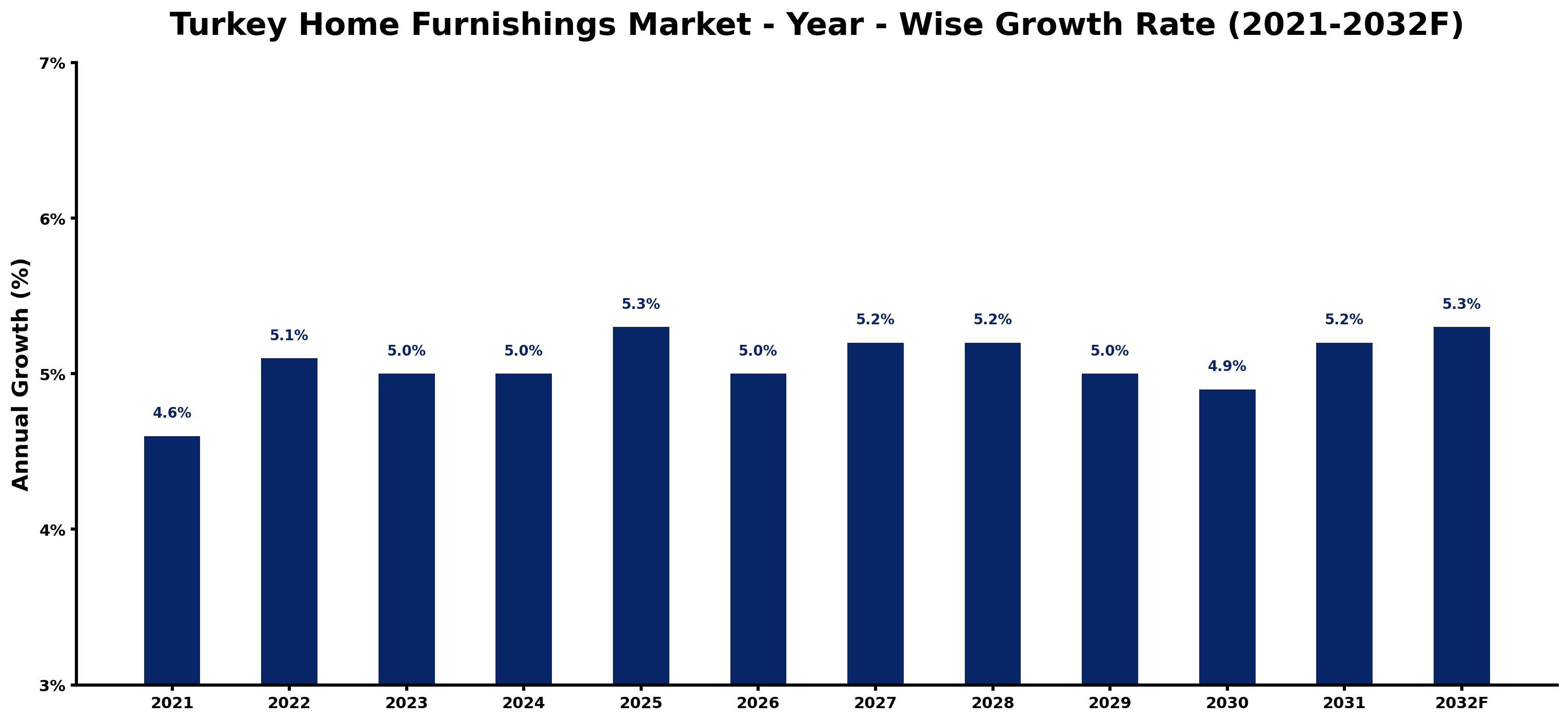
The table below presents the year wise growth rates along with the key drivers influencing the market
| Year | Growth Rate | Major Drivers |
| 2021 | 4.6% | Post-lockdown retail projects showed signs of recovery in consumer spending habits. |
| 2022 | 5.1% | Boutique furniture brands captured the interest of younger, design-conscious consumers. |
| 2023 | 5.0% | E-commerce platforms expanded their reach, enhancing home furnishings accessibility across regions. |
| 2024 | 5.0% | Local artisans gained popularity, emphasizing unique, handcrafted home decor options. |
| 2025 | 5.3% | Urbanization trends drove demand for multifunctional furniture in metropolitan areas. |
| 2026 | 5.0% | Sustainability became a key factor, with eco-friendly materials being preferred by consumers. |
| 2027 | 5.2% | Technological integration in home furnishings led to smart home solution offerings. |
| 2028 | 5.2% | Cultural shifts influenced preferences towards traditional designs in modern homes. |
| 2029 | 5.0% | Intense competition among retailers sparked innovative marketing strategies and customer engagement. |
| 2030 | 4.9% | Millennial homebuyers increasingly seek out personalized furnishings reflecting their lifestyle. |
| 2031 | 5.2% | Investment in local manufacturing improved product quality and reduced supply chain delays. |
| 2032 | 5.3% | Cross-border trade agreements enhanced the availability of global home furnishing brands. |
Note - Market size estimations and growth projections presented in this report are based on 6Wresearch's advanced forecasting approach, validated with industry datasets as of June 2026.
Turkey Home Furnishings Market Synopsis
The Turkey Home Furnishings Market is projected to reach 5.0% and witness significant growth during the forecast period (2026-2032). The market is underpinned by several key factors, including an increasing population, enhancing economic conditions, and a growing appetite for home décor that aligns with modern aesthetics. In addition, the commitment of manufacturers to invest in research and development is leading to innovative design patterns and material use, which will further stimulate sector growth. Furthermore, the rise of e-commerce platforms is poised to offer substantial opportunities for vendors engaged in the home furnishings space throughout this period.
Turkey Home Furnishings Market Growth Drivers
Several factors are driving the expansion of the Turkey Home Furnishings Market. Firstly, the increasing urban population is creating a higher demand for residential and commercial furnishings that cater to a diverse range of tastes and preferences. Secondly, improved economic conditions have made home furnishings more accessible to a greater segment of the population, further fuelling market growth. Additionally, shifts in lifestyle trends are placing a greater emphasis on home aesthetics, which is encouraging consumers to invest in quality home décor.
- Urbanization is leading to a rise in household formations, necessitating more home furnishings.
- Strengthening economic indicators are improving disposable incomes, allowing consumers to spend on home décor.
- There is a notable trend toward sustainability, with consumers seeking eco-friendly furniture options.
- Innovations in product design are appealing to younger demographics, who value unique furnishings.
- The growth of the rental market is leading to increased demand for flexible and stylish furnishing solutions.
Turkey Home Furnishings Market Trends and Opportunities
The Turkey Home Furnishings Market is currently experiencing various trends that signify its evolution. Eco-friendly and sustainable products are at the forefront, as consumers become more conscious of environmental impacts. Additionally, the digital transformation within the retail space is enhancing the shopping experience through augmented reality and virtual showrooms, which provide a more immersive purchasing process. These trends present a wealth of opportunities for vendors and manufacturers to differentiate themselves in a competitive market.
- The incorporation of smart technology into home furnishings is becoming increasingly popular, appealing to tech-savvy consumers.
- The rise of social media is influencing consumer choices, with platforms like Instagram showcasing innovative home décors.
- Customization options are gaining traction, allowing consumers to personalize their furnishings to match individual tastes.
- Collaborations between furniture designers and lifestyle brands are creating buzz and attracting new customer bases.
- Online sales channels are expanding rapidly, making it easier for consumers to access a wider variety of products.
Turkey Home Furnishings Market Government Investment and Initiatives
The Turkish government has recognized the importance of the home furnishings sector and has initiated various policies to stimulate growth. Investments aimed at improving infrastructure, specifically in urban areas, are paving the way for new residential developments which subsequently enhance market demands for furnishings. Additionally, there are incentives for manufacturers focusing on sustainable production methods and innovative designs that align with contemporary market needs. Public spending in housing projects is also expected to bolster the home furnishings industry. Government support for research and development is fostering innovation, providing long-term benefits to the market.
Turkey Home Furnishings Market Latest Developments (May 2025 - June 2026)
During the period from May 2025 to June 2026, the Turkey Home Furnishings Market has witnessed significant industry developments. Emphasis on sustainability has led to a notable shift in production methodologies, with more manufacturers adopting eco-friendly materials and practices. The integration of technology in retail, particularly through e-commerce platforms, has enhanced consumer access to a vast array of home furnishing options. Additionally, collaborations between local artisans and larger manufacturers are becoming more commonplace, resulting in unique product offerings that blend traditional craftsmanship with modern design aesthetics. Market participants are also focusing on customer experience, utilizing digital platforms to enhance engagement and drive sales.
Turkey Home Furnishings Market - Key Attractiveness of the Report
- 10 Years of Market Numbers
- Historical Data Starting from 2022 to 2025
- Base Year: 2025
- Forecast Data until 2032
- Key Performance Indicators Impacting the Market
- Major Upcoming Developments and Projects
Key Highlights of the Report:
- Turkey Home Furnishings Market Outlook
- Market Size of Turkey Home Furnishings Market, 2025
- Forecast of Turkey Home Furnishings Market, 2032F
- Historical Data and Forecast of Turkey Home Furnishings Revenues & Volume for the Period 2022-2032F
- Turkey Home Furnishings Market Trend Evolution
- Turkey Home Furnishings Market Drivers and Challenges
- Turkey Home Furnishings Price Trends
- Turkey Home Furnishings Porter's Five Forces
- Turkey Home Furnishings Industry Life Cycle
- Historical Data and Forecast of Turkey Home Furnishings Market Revenues & Volume By Product Type for the Period 2022-2032F
- Historical Data and Forecast of Turkey Home Furnishings Market Revenues & Volume By Home furniture market for the Period 2022-2032F
- Historical Data and Forecast of Turkey Home Furnishings Market Revenues & Volume By Home textiles market for the Period 2022-2032F
- Historical Data and Forecast of Turkey Home Furnishings Market Revenues & Volume By Floor coverings market for the Period 2022-2032F
- Historical Data and Forecast of Turkey Home Furnishings Market Revenues & Volume By Distribution Channel for the Period 2022-2032F
- Historical Data and Forecast of Turkey Home Furnishings Market Revenues & Volume By Offline Retail for the Period 2022-2032F
- Historical Data and Forecast of Turkey Home Furnishings Market Revenues & Volume By Online Retail for the Period 2022-2032F
- Turkey Home Furnishings Import Export Trade Statistics
- Market Opportunity Assessment By Product Type
- Market Opportunity Assessment By Distribution Channel
- Turkey Home Furnishings Top Companies Market Share
- Turkey Home Furnishings Competitive Benchmarking By Technical and Operational Parameters
- Turkey Home Furnishings Company Profiles
- Turkey Home Furnishings Key Strategic Recommendations






































