Turkey Industrial Furnace Market Size, Share & Growth Rate
The Turkey Industrial Furnace Market was estimated at USD 314 Million in 2025 and is projected to reach USD 439 Million by 2032, growing at a CAGR of 4.9% from 2026 to 2032. This growth is primarily fueled by the country's ongoing industrialization, particularly in sectors like metal processing, ceramics, and glass manufacturing. As companies increasingly seek to modernize their production capabilities, the demand for energy-efficient, automated industrial furnaces is surging, pushing the market towards a robust expansion phase.
Turkey Industrial Furnace Market Year-wise Growth Rate and Key Drivers
This graph highlights how the Turkey Industrial Furnace Market has steadily grown over the years, supported by major growth factors.
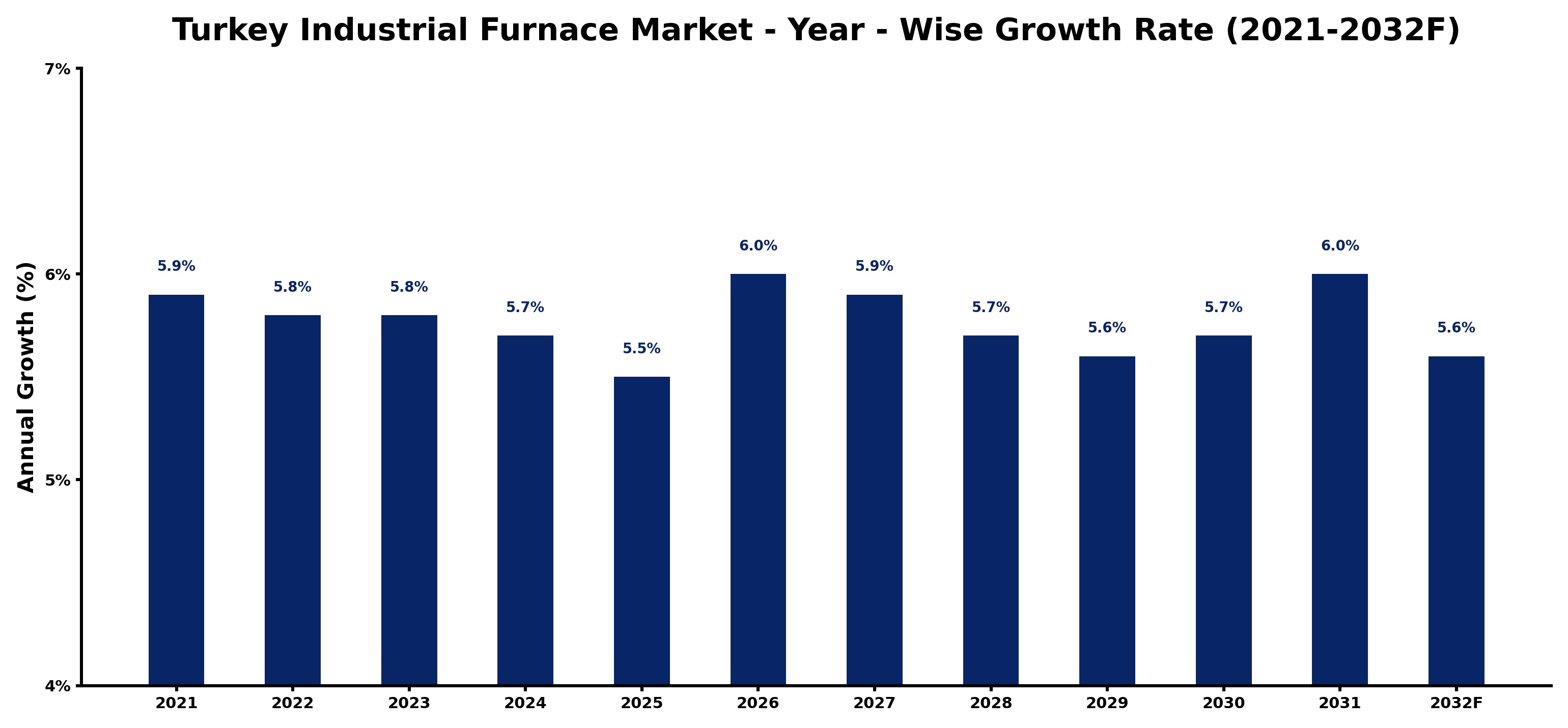
The table below presents the year‑wise growth rates along with the key drivers influencing the market
| Year | Growth Rate | Major Drivers |
| 2021 | 5.9% | Increased local steel production fuels demand for industrial furnaces |
| 2022 | 5.8% | Export driven investments boosted local furnace production capacity utilization |
| 2023 | 5.8% | Increased investment in energy efficient furnaces boosts production capabilities |
| 2024 | 5.7% | Strengthened local steel production boosts furnace demand in construction |
| 2025 | 5.5% | Technological upgrades in furnaces drive energy efficiency improvements |
| 2026 | 6.0% | Rebounding construction sector boosted demand for thermal processing solutions |
| 2027 | 5.9% | Heavy manufacturing investments boost demand for advanced furnace technology |
| 2028 | 5.7% | Higher steel production rates drove furnace technology investments |
| 2029 | 5.6% | Technology integration boosted energy efficiency in heat treatment processes |
| 2030 | 5.7% | Turkish automotive sector expansion drives demand for furnace manufacturing |
| 2031 | 6.0% | Infrastructure projects boost demand for high capacity melting furnaces |
| 2032 | 5.6% | Energy efficiency upgrades in furnace systems boosted production reliability |
Note - Market size estimations and growth projections presented in this report are based on 6Wresearch's advanced forecasting approach, validated with industry datasets as of June 2026.
Turkey Industrial Furnace Market Synopsis
The most significant force shaping the Turkey Industrial Furnace Market is the increasing focus on energy efficiency and automation in manufacturing processes. As industries strive to optimize operational costs, the demand for innovative and sustainable furnace solutions is on the rise.
Additionally, government initiatives aimed at promoting sustainable manufacturing practices play a crucial role in this market. Such policies not only encourage the adoption of eco-friendly technologies but also propel investments into research and development for advanced furnace systems.
Turkey Industrial Furnace Market Key Takeaways
- Strong growth projected due to rising industrialization across key sectors.
- Increased adoption of energy-efficient and automated furnace technologies.
- Government policies promoting sustainability are influencing market dynamics.
- Customization of furnace solutions is becoming a key driver for innovation.
- Competitive landscape characterized by product quality and after-sales service excellence.
Evaluation of Restraints in Turkey Industrial Furnace Market
While the Turkey Industrial Furnace Market is poised for growth, several restraints may hinder its full potential. One primary concern is the increasing energy costs, which can impact overall operational expenses for industries relying heavily on furnace technology. Moreover, stringent environmental regulations necessitate significant investments in compliance technologies and emission control systems. Companies also face the continuous challenge of upgrading to meet the growing demand for more efficient and advanced furnace solutions, which requires strategic resource allocation and planning.
Turkey Industrial Furnace Market Trends
The Turkey Industrial Furnace Market is witnessing a trend towards energy-efficient and environmentally friendly solutions as manufacturers seek to comply with regulatory standards while reducing operational costs. The integration of advanced technologies, such as automation, IoT, and data analytics, is increasingly popular for enhancing operational efficiency and productivity. Furthermore, there's a growing preference for customized industrial furnaces designed for specific applications, promoting innovation in both design and functionality.
Turkey Industrial Furnace Market Opportunities
Investment opportunities abound in the Turkey Industrial Furnace Market, particularly as the manufacturing sector expands. There's a notable demand for energy-efficient, technologically advanced furnaces across industries like steel and automotive. Investors can capitalize on the trend toward sustainability by developing eco-friendly furnace solutions. Collaborating with local manufacturers and establishing strong distribution networks also presents strategic advantages for both domestic and international investors.
Government Initiatives in the Turkey Industrial Furnace Market
The Turkish government has implemented several policies aimed at regulating the industrial furnace market. Energy efficiency regulations focus on minimizing energy consumption and reducing greenhouse gas emissions. Additionally, stringent environmental standards are enforced to ensure compliance with air quality and emissions controls. Incentives are also provided to encourage companies to adopt cleaner and more efficient technologies, reinforcing the commitment to sustainable industrial practices in Turkey.
Future Insights of the Turkey Industrial Furnace Market
Looking ahead to 2026-2032, the Turkey Industrial Furnace Market is positioned for steady growth as industries continue to modernize their manufacturing processes. The increasing emphasis on energy efficiency and automation will further drive the demand for industrial furnaces. Technological advancements that lead to more innovative and sustainable furnace solutions will also play a pivotal role in shaping the market. Additionally, government initiatives will likely continue to support this growth trajectory, bolstering the appeal of investments in this sector.
Turkey Industrial Furnace Market Latest Developments (May 2025 - June 2026)
Recent developments in the Turkey Industrial Furnace Market indicate a shift towards more advanced technologies and sustainability initiatives. Manufacturers are increasingly investing in research and development to integrate automation and digital solutions into their furnace operations. Moreover, there is a growing focus on remote monitoring capabilities that allow for real-time management of furnace processes, enhancing both efficiency and control.
Turkey Industrial Furnace Market - Key Attractiveness of the Report
- 10 Years of Market Numbers
- Historical Data Starting from 2022 to 2025
- Base Year: 2025
- Forecast Data until 2032
- Key Performance Indicators Impacting the Market
- Major Upcoming Developments and Projects
Key Highlights of the Report:
- Turkey Industrial Furnace Market Outlook
- Market Size of Turkey Industrial Furnace Market, 2025
- Forecast of Turkey Industrial Furnace Market, 2032
- Historical Data and Forecast of Turkey Industrial Furnace Revenues & Volume for the Period 2022-2032F
- Turkey Industrial Furnace Market Trend Evolution
- Turkey Industrial Furnace Market Drivers and Challenges
- Turkey Industrial Furnace Price Trends
- Turkey Industrial Furnace Porter's Five Forces
- Turkey Industrial Furnace Industry Life Cycle
- Historical Data and Forecast of Turkey Industrial Furnace Market Revenues & Volume By Furnace Type for the Period 2022-2032F
- Historical Data and Forecast of Turkey Industrial Furnace Market Revenues & Volume By Gas/fuel Operated Industrial Furnace for the Period 2022-2032F
- Historical Data and Forecast of Turkey Industrial Furnace Market Revenues & Volume By Electrically Operated Industrial Furnace for the Period 2022-2032F
- Historical Data and Forecast of Turkey Industrial Furnace Market Revenues & Volume By Arrangement for the Period 2022-2032F
- Historical Data and Forecast of Turkey Industrial Furnace Market Revenues & Volume By Tube or Clamshell Type for the Period 2022-2032F
- Historical Data and Forecast of Turkey Industrial Furnace Market Revenues & Volume By Box Type for the Period 2022-2032F
- Historical Data and Forecast of Turkey Industrial Furnace Market Revenues & Volume By Bottom Loading & Car Bottom Furnace for the Period 2022-2032F
- Historical Data and Forecast of Turkey Industrial Furnace Market Revenues & Volume By Top Loading Furnace for the Period 2022-2032F
- Historical Data and Forecast of Turkey Industrial Furnace Market Revenues & Volume By Others for the Period 2022-2032F
- Historical Data and Forecast of Turkey Industrial Furnace Market Revenues & Volume By End-User for the Period 2022-2032F
- Historical Data and Forecast of Turkey Industrial Furnace Market Revenues & Volume By Metals & Mining for the Period 2022-2032F
- Historical Data and Forecast of Turkey Industrial Furnace Market Revenues & Volume By Transportation for the Period 2022-2032F
- Historical Data and Forecast of Turkey Industrial Furnace Market Revenues & Volume By Oil & Gas for the Period 2022-2032F
- Historical Data and Forecast of Turkey Industrial Furnace Market Revenues & Volume By Chemicals for the Period 2022-2032F
- Historical Data and Forecast of Turkey Industrial Furnace Market Revenues & Volume By Others for the Period 2022-2032F
- Turkey Industrial Furnace Import Export Trade Statistics
- Market Opportunity Assessment By Furnace Type
- Market Opportunity Assessment By Arrangement
- Market Opportunity Assessment By End-User
- Turkey Industrial Furnace Top Companies Market Share
- Turkey Industrial Furnace Competitive Benchmarking By Technical and Operational Parameters
- Turkey Industrial Furnace Company Profiles
- Turkey Industrial Furnace Key Strategic Recommendations






































