Turkey Inorganic Pigments Market Size, Share & Growth Rate
The Turkey Inorganic Pigments Market was estimated at USD 448 Million in 2025 and is projected to reach USD 626 Million by 2032, growing at a CAGR of 4.9% from 2026 to 2032. This positive trajectory is largely driven by increasing demand across various industries, notably construction and automotive coatings. The growing emphasis on environmentally sustainable pigments is also influencing market dynamics, as industries look to adopt high-performance and durable alternatives.
Turkey Inorganic Pigments Market Year-wise Growth Rate and Key Drivers
This graph highlights how the Turkey Inorganic Pigments Market has steadily grown over the years, supported by major growth factors.
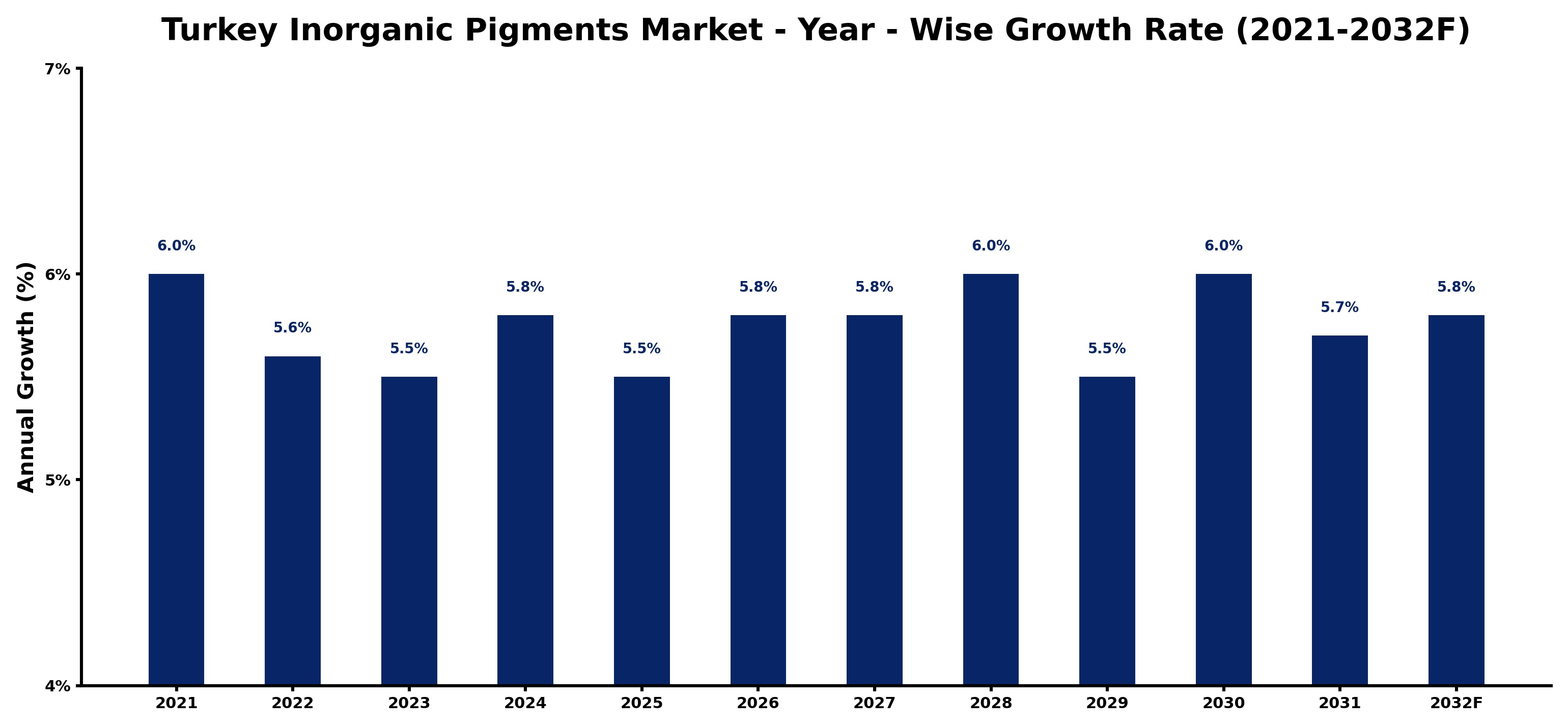
The table below presents the year‑wise growth rates along with the key drivers influencing the market
| Year | Growth Rate | Major Drivers |
| 2021 | 6.0% | Increased construction activities stimulated demand |
| 2022 | 5.6% | Automotive sector growth drove usage |
| 2023 | 5.5% | Paint industry expansion enhanced sales |
| 2024 | 5.8% | Rising demand for eco-friendly pigments |
| 2025 | 5.5% | Technological advancements improved production |
| 2026 | 5.8% | Export opportunities expanded market reach |
| 2027 | 5.8% | Consumer preferences shifted towards sustainability |
| 2028 | 6.0% | Industrial activity supported growth |
| 2029 | 5.5% | Market expansion drove consumption |
| 2030 | 6.0% | Regulatory support encouraged innovation investments |
| 2031 | 5.7% | Market diversification opened new channels |
| 2032 | 5.8% | Collaborations with manufacturers enhanced offerings |
Note - Market size estimations and growth projections presented in this report are based on 6Wresearch’s advanced forecasting approach, validated with industry datasets as of June 2026.
Turkey Inorganic Pigments Market Synopsis
In Turkey, the construction sector is a significant demand driver for inorganic pigments, owing to its expansive growth in recent years. As infrastructure projects continue to proliferate, the need for robust colorants that provide longevity and resistance to weathering has surged.
Moreover, the automotive coatings industry is increasingly adopting inorganic pigments due to their superior lightfastness and durability. These attributes make them particularly suitable for high-performance applications, aligning with the evolving preferences of manufacturers and consumers alike.
Turkey Inorganic Pigments Market Key Takeaways
- The market exhibits a strong growth outlook with significant contributions from the construction and automotive industries.
- Increased focus on environmentally sustainable production methods is reshaping the market landscape.
- Government policies are fostering advancements in pigment technologies and promoting research and development.
- Market players are navigating challenges related to regulatory compliance and raw material price fluctuations.
- Investment in cleaner technologies is essential for meeting environmental standards and enhancing operational efficiency.
Evaluation of Restraints in Turkey Inorganic Pigments Market
Despite the growth potential, the Turkey Inorganic Pigments Market faces several restraints. Environmental regulations impose stringent controls on production processes, often leading to increased operational costs. Companies must invest significantly in cleaner technologies to mitigate hazardous waste and emissions, making it challenging for smaller players to compete. Furthermore, fluctuations in raw material prices and disruptions in the supply chain can contribute to market volatility, impacting pricing strategies and profit margins for manufacturers.
Turkey Inorganic Pigments Market Trends
A prominent trend influencing the Turkey Inorganic Pigments Market is the shift towards more sustainable pigment solutions. Many manufacturers are exploring new formulations that reduce environmental impact while enhancing performance characteristics. Additionally, the integration of advanced technologies in pigment production is fostering innovation, leading to the development of pigments that offer superior qualities such as better opacity and enhanced color stability.
Turkey Inorganic Pigments Market Opportunities
There lies significant potential for growth in the Turkey Inorganic Pigments Market, particularly through the development of eco-friendly pigments. As global demand shifts towards sustainability, companies that invest in the research and development of innovative pigment solutions will stand to benefit. Furthermore, expanding applications in the plastics sector and the increasing use of inorganic pigments in advanced coatings present avenues for investment and growth.
Government Initiatives in the Turkey Inorganic Pigments Market
The Turkish government actively supports the inorganic pigments market through various initiatives aimed at boosting research and development. Financial incentives, such as grants and tax breaks, are available for projects focused on the development of advanced pigment technologies. Additionally, stringent quality and safety standards enforced by the government ensure that inorganic pigments used across different industries meet performance expectations, thereby enhancing overall market reliability.
Future Insights of the Turkey Inorganic Pigments Market
Looking ahead to 2026-2032, the Turkey Inorganic Pigments Market is poised for considerable growth driven by ongoing urbanization and industrialization trends. The anticipated rise in infrastructure projects and automotive production will sustain demand for high-performance pigments. As companies continue to innovate and prioritize environmental sustainability, the market is likely to witness the introduction of new, eco-friendly formulations that will further enhance its appeal.
Turkey Inorganic Pigments Market Latest Developments (May 2025 - June 2026)
Recent developments in the Turkey Inorganic Pigments Market indicate a focus on enhancing production efficiency and reducing environmental footprints. Many companies are initiating collaborations with research institutions to pioneer sustainable pigment solutions. Additionally, industry players are ramping up efforts to adopt advanced manufacturing technologies to optimize their processes while meeting regulatory requirements.
Turkey Inorganic Pigments Market - Key Attractiveness of the Report
- 10 Years of Market Numbers
- Historical Data Starting from 2022 to 2025
- Base Year: 2025
- Forecast Data until 2032
- Key Performance Indicators Impacting the Market
- Major Upcoming Developments and Projects
Key Highlights of the Report:
- Turkey Inorganic Pigments Market Outlook
- Market Size of Turkey Inorganic Pigments Market, 2025
- Forecast of Turkey Inorganic Pigments Market, 2032
- Historical Data and Forecast of Turkey Inorganic Pigments Revenues & Volume for the Period 2022-2032F
- Turkey Inorganic Pigments Market Trend Evolution
- Turkey Inorganic Pigments Market Drivers and Challenges
- Turkey Inorganic Pigments Price Trends
- Turkey Inorganic Pigments Porter's Five Forces
- Turkey Inorganic Pigments Industry Life Cycle
- Historical Data and Forecast of Turkey Inorganic Pigments Market Revenues & Volume By Type for the Period 2022-2032F
- Historical Data and Forecast of Turkey Inorganic Pigments Market Revenues & Volume By Titanium Dioxide for the Period 2022-2032F
- Historical Data and Forecast of Turkey Inorganic Pigments Market Revenues & Volume By Iron Oxide, Cadmium for the Period 2022-2032F
- Historical Data and Forecast of Turkey Inorganic Pigments Market Revenues & Volume By Carbon Blank for the Period 2022-2032F
- Historical Data and Forecast of Turkey Inorganic Pigments Market Revenues & Volume By Lead Chromate for the Period 2022-2032F
- Historical Data and Forecast of Turkey Inorganic Pigments Market Revenues & Volume By Chromium Oxide for the Period 2022-2032F
- Historical Data and Forecast of Turkey Inorganic Pigments Market Revenues & Volume By Others for the Period 2022-2032F
- Historical Data and Forecast of Turkey Inorganic Pigments Market Revenues & Volume By Colour for the Period 2022-2032F
- Historical Data and Forecast of Turkey Inorganic Pigments Market Revenues & Volume By Red for the Period 2022-2032F
- Historical Data and Forecast of Turkey Inorganic Pigments Market Revenues & Volume By Yellow for the Period 2022-2032F
- Historical Data and Forecast of Turkey Inorganic Pigments Market Revenues & Volume By Orange for the Period 2022-2032F
- Historical Data and Forecast of Turkey Inorganic Pigments Market Revenues & Volume By Green for the Period 2022-2032F
- Historical Data and Forecast of Turkey Inorganic Pigments Market Revenues & Volume By Blue for the Period 2022-2032F
- Historical Data and Forecast of Turkey Inorganic Pigments Market Revenues & Volume By Black for the Period 2022-2032F
- Historical Data and Forecast of Turkey Inorganic Pigments Market Revenues & Volume By White for the Period 2022-2032F
- Historical Data and Forecast of Turkey Inorganic Pigments Market Revenues & Volume By Others for the Period 2022-2032F
- Historical Data and Forecast of Turkey Inorganic Pigments Market Revenues & Volume By Chemistry for the Period 2022-2032F
- Historical Data and Forecast of Turkey Inorganic Pigments Market Revenues & Volume By Oxide for the Period 2022-2032F
- Historical Data and Forecast of Turkey Inorganic Pigments Market Revenues & Volume By Silicate for the Period 2022-2032F
- Historical Data and Forecast of Turkey Inorganic Pigments Market Revenues & Volume By Carbonate for the Period 2022-2032F
- Historical Data and Forecast of Turkey Inorganic Pigments Market Revenues & Volume By Sulphate for the Period 2022-2032F
- Historical Data and Forecast of Turkey Inorganic Pigments Market Revenues & Volume By Sulphide for the Period 2022-2032F
- Historical Data and Forecast of Turkey Inorganic Pigments Market Revenues & Volume By Others for the Period 2022-2032F
- Historical Data and Forecast of Turkey Inorganic Pigments Market Revenues & Volume By Grade for the Period 2022-2032F
- Historical Data and Forecast of Turkey Inorganic Pigments Market Revenues & Volume By Food Grade for the Period 2022-2032F
- Historical Data and Forecast of Turkey Inorganic Pigments Market Revenues & Volume By Pharmaceutical Grade for the Period 2022-2032F
- Historical Data and Forecast of Turkey Inorganic Pigments Market Revenues & Volume By Industrial Grade for the Period 2022-2032F
- Historical Data and Forecast of Turkey Inorganic Pigments Market Revenues & Volume By Others for the Period 2022-2032F
- Historical Data and Forecast of Turkey Inorganic Pigments Market Revenues & Volume By Form for the Period 2022-2032F
- Historical Data and Forecast of Turkey Inorganic Pigments Market Revenues & Volume By Powder for the Period 2022-2032F
- Historical Data and Forecast of Turkey Inorganic Pigments Market Revenues & Volume By Liquid for the Period 2022-2032F
- Historical Data and Forecast of Turkey Inorganic Pigments Market Revenues & Volume By Application for the Period 2022-2032F
- Historical Data and Forecast of Turkey Inorganic Pigments Market Revenues & Volume By Plastics for the Period 2022-2032F
- Historical Data and Forecast of Turkey Inorganic Pigments Market Revenues & Volume By Paints & Coatings for the Period 2022-2032F
- Historical Data and Forecast of Turkey Inorganic Pigments Market Revenues & Volume By Printing Inks for the Period 2022-2032F
- Historical Data and Forecast of Turkey Inorganic Pigments Market Revenues & Volume By Glass & Ceramics for the Period 2022-2032F
- Historical Data and Forecast of Turkey Inorganic Pigments Market Revenues & Volume By Cosmetics for the Period 2022-2032F
- Historical Data and Forecast of Turkey Inorganic Pigments Market Revenues & Volume By Paper Industry for the Period 2022-2032F
- Historical Data and Forecast of Turkey Inorganic Pigments Market Revenues & Volume By Food Industry for the Period 2022-2032F
- Historical Data and Forecast of Turkey Inorganic Pigments Market Revenues & Volume By Others for the Period 2022-2032F
- Turkey Inorganic Pigments Import Export Trade Statistics
- Market Opportunity Assessment By Type
- Market Opportunity Assessment By Colour
- Market Opportunity Assessment By Chemistry
- Market Opportunity Assessment By Grade
- Market Opportunity Assessment By Form
- Market Opportunity Assessment By Application
- Turkey Inorganic Pigments Top Companies Market Share
- Turkey Inorganic Pigments Competitive Benchmarking By Technical and Operational Parameters
- Turkey Inorganic Pigments Company Profiles
- Turkey Inorganic Pigments Key Strategic Recommendations






































