Turkey Lithium compounds Market Size, Share & Growth Rate
The Turkey Lithium compounds Market was estimated at USD 458 Million in 2025 and is projected to reach USD 599 Million by 2032, growing at a CAGR of 3.9% from 2026 to 2032. This growth trajectory is primarily driven by the expansion of the electronics, ceramics, and pharmaceutical sectors, which increasingly rely on lithium compounds for their enhanced performance and sustainability. Additionally, the rise of energy storage applications and specialty chemicals is also contributing to the market's upward momentum.
Turkey Lithium compounds Market Year-wise Growth Rate and Key Drivers
This graph highlights how the Turkey Lithium compounds Market has steadily grown over the years, supported by major growth factors.
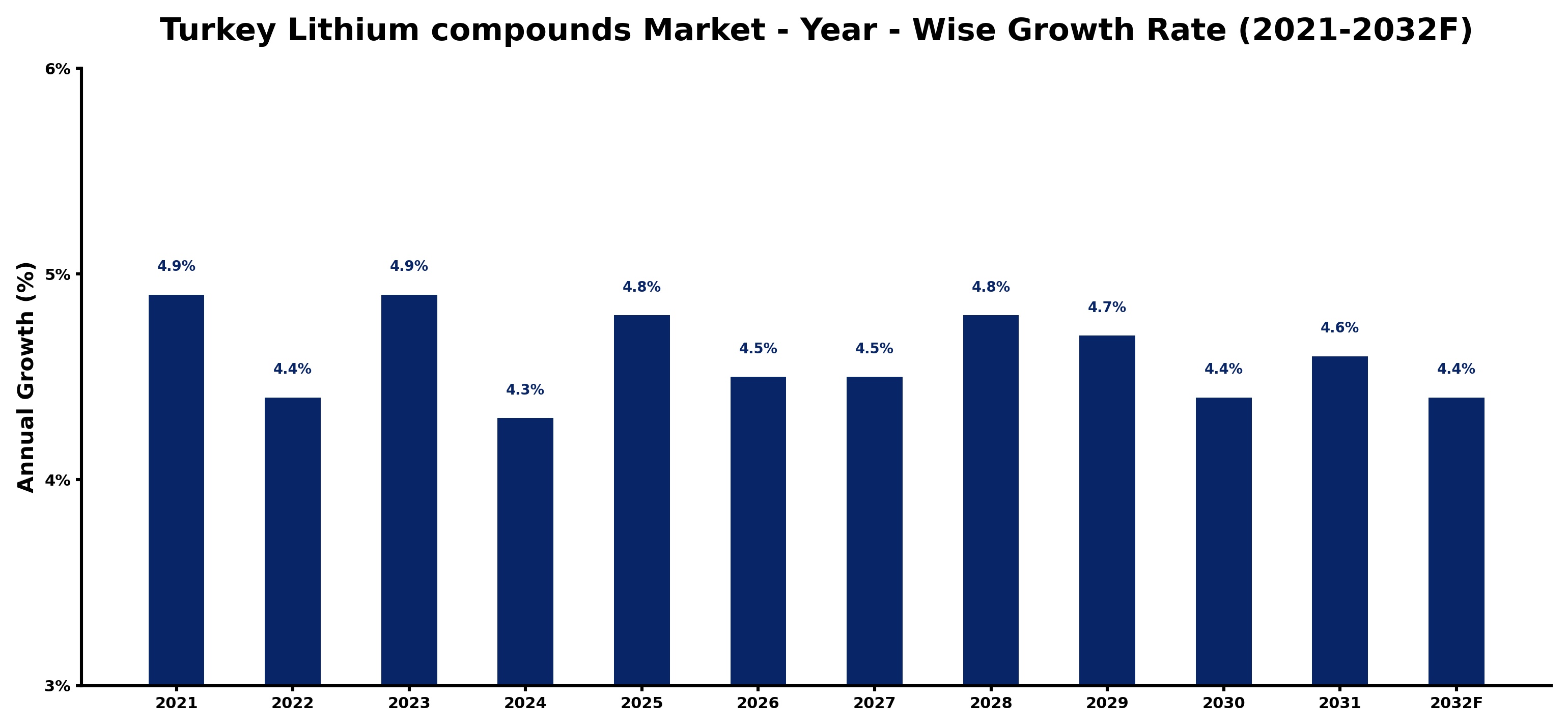
The table below presents the year‑wise growth rates along with the key drivers influencing the market
| Year | Growth Rate | Major Drivers |
| 2021 | 4.9% | Government infrastructure modernization initiatives |
| 2022 | 4.4% | Rising electricity demand across industries |
| 2023 | 4.9% | Increasing industrial infrastructure investments |
| 2024 | 4.3% | Growing renewable energy integration projects |
| 2025 | 4.8% | Rising electricity demand across industries |
| 2026 | 4.5% | Growing urbanization and commercial development |
| 2027 | 4.5% | Government infrastructure modernization initiatives |
| 2028 | 4.8% | Rising electricity demand across industries |
| 2029 | 4.7% | Expansion of manufacturing activities |
| 2030 | 4.4% | Increasing adoption of advanced technologies |
| 2031 | 4.6% | Rising electricity demand across industries |
| 2032 | 4.4% | Rising electricity demand across industries |
Note - Market size estimations and growth projections presented in this report are based on 6Wresearch’s advanced forecasting approach, validated with industry datasets as of June 2026.
Turkey Lithium compounds Market Synopsis
The strongest force shaping the Turkey Lithium compounds Market is the burgeoning demand from the electronics and automotive sectors. With the increasing shift towards electric vehicles and portable electronics, lithium-based materials are becoming essential for energy storage and high-performance components.
Furthermore, technological advancements in lithium extraction and processing are set to enhance product offerings and improve production efficiencies. This push towards innovation aligns with the growing need for sustainable practices in the industry, reinforcing Turkey's strategic position in the global lithium supply chain.
Turkey Lithium compounds Market Key Takeaways
- The market is experiencing steady growth fueled by rising demands from various industrial sectors.
- Technological innovations are shaping the future of lithium compound applications.
- Government policies are increasingly focusing on sustainable practices within the lithium industry.
- Manufacturers face competition from alternative chemicals and regulatory challenges.
- Market expansion is closely linked to advancements in energy storage technologies.
Evaluation of Restraints in Turkey Lithium compounds Market
Despite the promising growth potential, the Turkey Lithium compounds Market encounters several constraints that could hinder its expansion. High production costs associated with extracting and processing lithium remain a significant challenge. Additionally, the market must navigate complex regulations, which can vary across applications. These factors, combined with the necessity for sustainable raw materials, underscore the urgent need for innovation in both processes and sourcing within the industry.
Turkey Lithium compounds Market Trends
Several trends are currently influencing the Turkey Lithium compounds Market. There is a marked shift towards developing more environmentally friendly extraction and manufacturing processes, as consumers and industries increasingly prioritize sustainability. Moreover, the integration of lithium compounds in advanced ceramics and glass applications is on the rise, driven by their enhanced mechanical properties and thermal stability.
Another notable trend is the growing interest in energy storage solutions, particularly in renewable energy systems. Lithium hydroxide and lithium chloride are becoming critical components in battery production, catering to the increasing global demand for efficient energy storage technologies.
Turkey Lithium compounds Market Opportunities
The future presents multiple growth opportunities within the Turkey Lithium compounds Market, particularly in the realms of battery production and renewable energy applications. As electric vehicle adoption increases, manufacturers of lithium batteries are likely to require more lithium-based materials. Furthermore, advancements in recycling technologies for lithium compounds could also pave the way for new markets and sustainable practices, attracting both domestic and international investments.
Government Initiatives in the Turkey Lithium compounds Market
Turkey's government is actively promoting sustainable mining practices and innovation within the lithium sector through various policies and initiatives. These include public investments in research and development to enhance lithium extraction techniques and the overall sustainability of production processes. Additionally, programs aimed at fostering partnerships between industry and academic institutions are facilitating the development of new technologies and applications in lithium compounds.
Future Insights of the Turkey Lithium compounds Market
Looking ahead to 2026-2032, the Turkey Lithium compounds Market is poised for substantial growth, bolstered by ongoing technological advancements and increasing global demand for lithium-based products. The synergy between government policy, industry innovation, and market needs will be vital in shaping the future landscape. As Turkey strengthens its role in the global lithium supply chain, opportunities for investment and expansion will likely emerge, particularly in energy storage and specialty chemicals.
Turkey Lithium compounds Market Latest Developments (May 2025 - June 2026)
Recent industry developments indicate a shift towards more sustainable lithium extraction methods, with several initiatives aimed at reducing the environmental impact of production processes. Furthermore, collaborations between government bodies and research institutions are fostering innovation, particularly in battery technology, which is expected to drive demand for lithium compounds in the coming years.
Turkey Lithium compounds Market - Key Attractiveness of the Report
- 10 Years of Market Numbers
- Historical Data Starting from 2022 to 2025
- Base Year: 2025
- Forecast Data until 2032
- Key Performance Indicators Impacting the Market
- Major Upcoming Developments and Projects
Key Highlights of the Report:
- Turkey Lithium compounds Market Outlook
- Market Size of Turkey Lithium compounds Market, 2025
- Forecast of Turkey Lithium compounds Market, 2032
- Historical Data and Forecast of Turkey Lithium compounds Revenues & Volume for the Period 2022-2032F
- Turkey Lithium compounds Market Trend Evolution
- Turkey Lithium compounds Market Drivers and Challenges
- Turkey Lithium compounds Price Trends
- Turkey Lithium compounds Porter's Five Forces
- Turkey Lithium compounds Industry Life Cycle
- Historical Data and Forecast of Turkey Lithium compounds Market Revenues & Volume By Derivative for the Period 2022-2032F
- Historical Data and Forecast of Turkey Lithium compounds Market Revenues & Volume By Hydrides for the Period 2022-2032F
- Historical Data and Forecast of Turkey Lithium compounds Market Revenues & Volume By Fluorides for the Period 2022-2032F
- Historical Data and Forecast of Turkey Lithium compounds Market Revenues & Volume By Chlorides for the Period 2022-2032F
- Historical Data and Forecast of Turkey Lithium compounds Market Revenues & Volume By Bromides for the Period 2022-2032F
- Historical Data and Forecast of Turkey Lithium compounds Market Revenues & Volume By Iodides for the Period 2022-2032F
- Historical Data and Forecast of Turkey Lithium compounds Market Revenues & Volume By Oxides for the Period 2022-2032F
- Historical Data and Forecast of Turkey Lithium compounds Market Revenues & Volume By Carbonates for the Period 2022-2032F
- Historical Data and Forecast of Turkey Hydrides Lithium compounds Market Revenues & Volume By Others for the Period 2022-2032F
- Historical Data and Forecast of Turkey Lithium compounds Market Revenues & Volume By Application for the Period 2022-2032F
- Historical Data and Forecast of Turkey Lithium compounds Market Revenues & Volume By Rechargeable & Non-Rechargeable Batteries for the Period 2022-2032F
- Historical Data and Forecast of Turkey Lithium compounds Market Revenues & Volume By Air Conditioning for the Period 2022-2032F
- Historical Data and Forecast of Turkey Lithium compounds Market Revenues & Volume By Industrial Drying System for the Period 2022-2032F
- Historical Data and Forecast of Turkey Lithium compounds Market Revenues & Volume By Glass & Ceramics for the Period 2022-2032F
- Historical Data and Forecast of Turkey Lithium compounds Market Revenues & Volume By Metallurgy for the Period 2022-2032F
- Historical Data and Forecast of Turkey Lithium compounds Market Revenues & Volume By Polymers for the Period 2022-2032F
- Historical Data and Forecast of Turkey Lithium compounds Market Revenues & Volume By Others for the Period 2022-2032F
- Historical Data and Forecast of Turkey Lithium compounds Market Revenues & Volume By Industry Vertical for the Period 2022-2032F
- Historical Data and Forecast of Turkey Lithium compounds Market Revenues & Volume By Aerospace and Defense for the Period 2022-2032F
- Historical Data and Forecast of Turkey Lithium compounds Market Revenues & Volume By Automobile for the Period 2022-2032F
- Historical Data and Forecast of Turkey Lithium compounds Market Revenues & Volume By Energy for the Period 2022-2032F
- Historical Data and Forecast of Turkey Lithium compounds Market Revenues & Volume By Chemicals for the Period 2022-2032F
- Historical Data and Forecast of Turkey Lithium compounds Market Revenues & Volume By Engineering Machinery for the Period 2022-2032F
- Historical Data and Forecast of Turkey Lithium compounds Market Revenues & Volume By Pharmaceuticals for the Period 2022-2032F
- Historical Data and Forecast of Turkey Lithium compounds Market Revenues & Volume By Others for the Period 2022-2032F
- Turkey Lithium compounds Import Export Trade Statistics
- Market Opportunity Assessment By Derivative
- Market Opportunity Assessment By Application
- Market Opportunity Assessment By Industry Vertical
- Turkey Lithium compounds Top Companies Market Share
- Turkey Lithium compounds Competitive Benchmarking By Technical and Operational Parameters
- Turkey Lithium compounds Company Profiles
- Turkey Lithium compounds Key Strategic Recommendations






































