Turkey Log Management Market Size & Growth Rate (2026-2032)
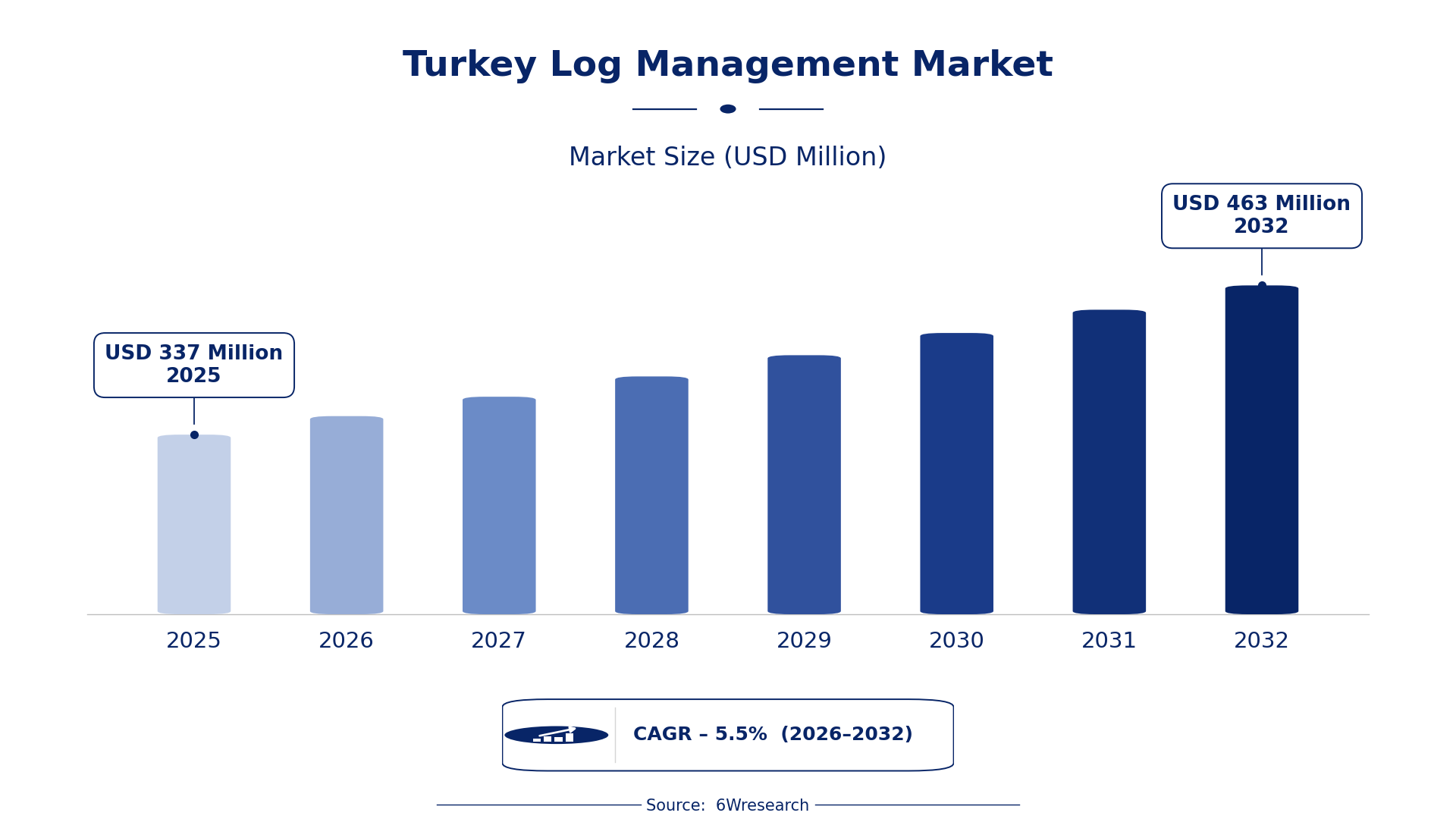
The Turkey Log Management Market was estimated at USD 337 Million in 2025 and is projected to reach USD 463 Million by 2032, growing at a CAGR of 5.5% from 2026 to 2032.
Turkey Log Management Market Synopsis
As organizations in Turkey increasingly recognize the importance of safeguarding their digital assets, the demand for log management solutions has surged. This spike is largely driven by heightened cybersecurity threats and regulatory pressures that compel businesses to adopt comprehensive log management strategies.
The Turkish market is characterized by its diverse industry applications, from finance to healthcare, where log management is critical for ensuring compliance and enhancing operational efficiency. With the rise of digital transformation initiatives, there’s an ongoing push for advanced log aggregation and analysis tools to improve threat detection and incident response.
Turkey Log Management Market Year-wise Growth Rate and Key Drivers
This graph illustrates the annual growth rates of the Turkey Log Management Market from 2021 to 2032, highlighting a steady upward trajectory and projected expansion over the forecast period.
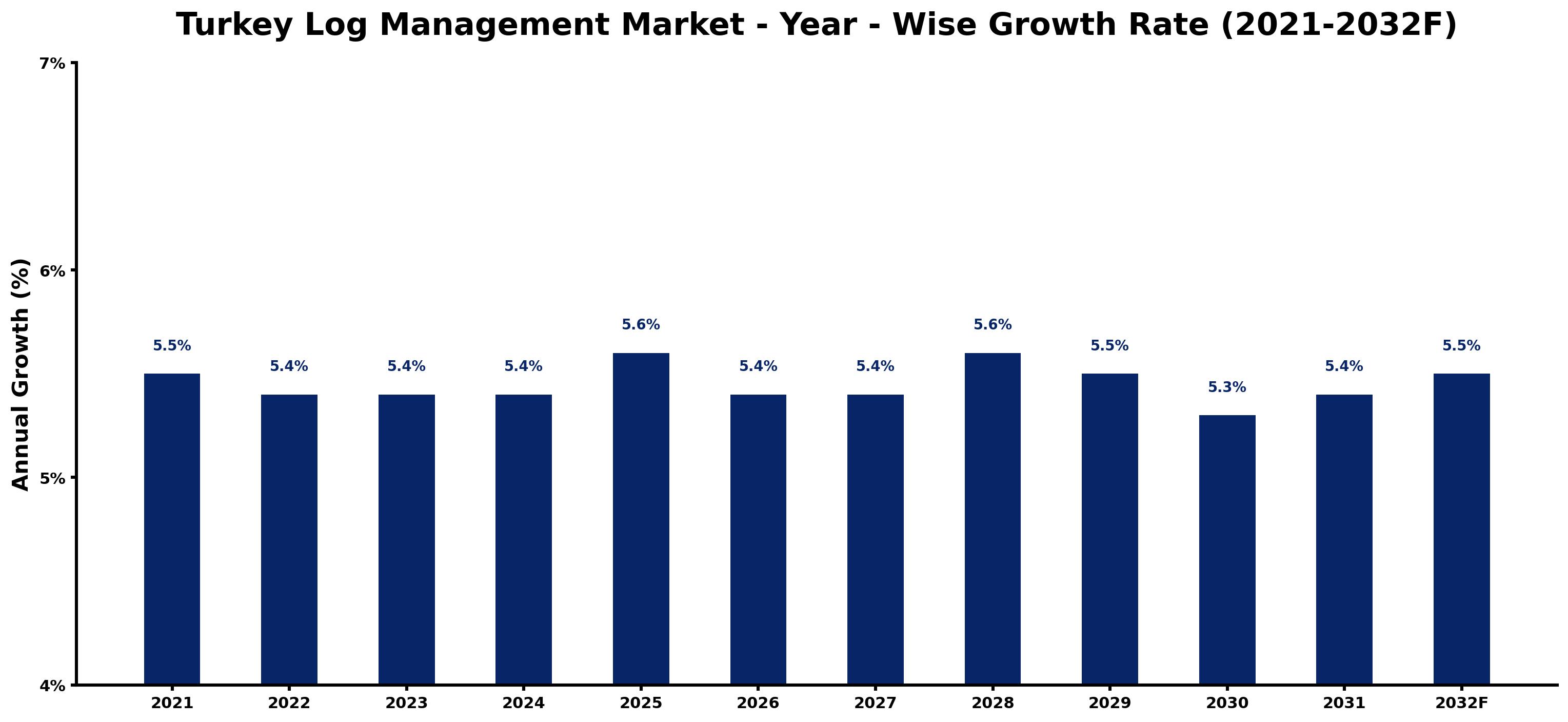
The table below presents the year‑wise growth rates along with the key drivers influencing the market
| Year | Growth Rate | Major Drivers |
| 2021 | 5.5% | Increased cybersecurity regulations by Türkiye's Personal Data Protection Authority. |
| 2022 | 5.4% | Growing adoption of cloud services within Turkish enterprises. |
| 2023 | 5.4% | Surge in digital transformation efforts among local businesses. |
| 2024 | 5.4% | Implementation of EU-compatible data privacy frameworks in Turkey. |
| 2025 | 5.6% | Rising investment in IT infrastructure by Turkish government. |
| 2026 | 5.4% | Expanding fintech sector demanding enhanced log management solutions. |
| 2027 | 5.4% | Increasing threat of cyberattacks prompting security log monitoring. |
| 2028 | 5.6% | Growing collaboration with international cybersecurity firms in Turkey. |
| 2029 | 5.5% | Emergence of local start-ups focusing on log analytics. |
| 2030 | 5.3% | Regulatory pressure on data storage compliance in Turkey. |
| 2031 | 5.4% | Local universities enhancing cybersecurity curriculum for workforce. |
| 2032 | 5.5% | Demand for real-time monitoring due to e-commerce growth. |
Note: Market size estimations and growth projections presented in this report are based on 6Wresearch's proprietary forecasting methodology, utilizing the latest available industry data, government publications, and primary research inputs.
Turkey Log Management Market Key Takeaways
Below are some of the specific key takeaways from the market, including:
- Increasing emphasis on cybersecurity is driving the growth of log management solutions across sectors.
- Regulatory compliance requirements are motivating organizations to adopt advanced log management practices.
- The complexity of integrating log management solutions with existing IT infrastructures remains a challenge.
- Real-time monitoring and analysis capabilities are becoming crucial for effective log management.
- Data protection initiatives and digital transformation efforts are key factors supporting market expansion.
Evaluation of Restraints in Turkey Log Management Market
Despite the promising growth trajectory, the Turkey Log Management Market faces significant hurdles. A notable constraint is the need for high-performance and scalable log management solutions that can effectively handle vast volumes of data generated by modern IT environments. Integration complexities with existing IT systems can deter organizations from investing in new technologies, leading to a gap between potential and actual implementation. Additionally, concerns surrounding data security and regulatory compliance add layers of complexity that companies must navigate to establish a reliable log management framework.
Turkey Log Management Market Trends
Several trends are shaping the Turkey Log Management Market. First, the adoption of cloud-based solutions is rising, enabling organizations to access scalable and flexible log management capabilities. Second, there’s an increasing focus on automation in log analysis processes, allowing for quicker incident responses. Finally, organizations are prioritizing data privacy and protection measures, which are influencing how log data is managed and retained.
Turkey Log Management Market Opportunities
The market presents genuine growth opportunities, particularly in sectors that are heavily regulated, such as finance and healthcare. Companies can capitalize on the increasing demand for tailored log management solutions that address specific compliance requirements. on top of that, with digital transformation accelerating, investments in AI-driven log analytics and integrated cybersecurity solutions are likely to gain traction, providing a strong avenue for innovation and growth.
Government Initiatives in the Turkey Log Management Market
Government policies are playing an integral role in shaping the Turkey Log Management Market. The Turkish government has been actively promoting enhanced cybersecurity measures, particularly as businesses digitize their operations. Regulations are being introduced to ensure data integrity, privacy protection, and adherence to data retention policies, creating a structured environment that is conducive to growth in log management solutions.
- A regulatory framework introduced in 2023 mandates stronger cybersecurity protocols in log management systems.
- Currently ongoing efforts include a national initiative focusing on improving digital infrastructure security across all sectors.
- Upcoming plans involve a public-private collaboration aimed at enhancing cybersecurity capabilities within small and medium enterprises (SMEs) by 2025.
- Recent policies have established guidelines for compliance auditing, emphasizing the need for reliable log management practices.
- The government is expected to roll out awareness programs in 2024 to educate organizations on the importance of log management in maintaining data security.
Future Insights of the Turkey Log Management Market
Looking ahead to 2026-2032, the Turkey Log Management Market is expected to evolve significantly, fueled by ongoing digital transformation initiatives and an increasing focus on cybersecurity. As businesses continue to adapt to new technologies, the demand for sophisticated log management solutions will likely escalate. Additionally, tighter regulations will further reinforce the necessity for organizations to implement comprehensive log management strategies to maintain compliance and protect sensitive information.
Turkey Log Management Market Latest Developments
Over the past 12-14 months, the Turkey Log Management Market has witnessed considerable activity, particularly in response to increasing cybersecurity threats and regulatory changes. Companies are focusing on enhancing their log management capabilities to comply with new government policies and meet evolving business needs.
- A major technology vendor launched a new log management platform in early 2025, incorporating advanced analytics and machine learning features.
- An initiative that began in mid-2025 aims to provide SMEs with resources to implement effective log management solutions is currently underway.
- In Q3 2025, several organizations will participate in a collaborative program designed to enhance log management practices in critical industries.
- By late 2025, a new compliance certification for log management systems will be introduced, requiring companies to meet specific standards.
- In early 2026, a rollout is expected for an integrated cybersecurity solution that combines log management and threat detection functionalities.
Turkey Log Management Market - Key Attractiveness of the Report
- 10 Years of Market Numbers
- Historical Data Starting from 2022 to 2025
- Base Year: 2025
- Forecast Data until 2032
- Key Performance Indicators Impacting the Market
- Major Upcoming Developments and Projects
Key Highlights of the Report:
- Turkey Log Management Market Outlook
- Market Size of Turkey Log Management Market, 2025
- Forecast of Turkey Log Management Market, 2032
- Historical Data and Forecast of Turkey Log Management Revenues & Volume for the Period 2022-2032F
- Turkey Log Management Market Trend Evolution
- Turkey Log Management Market Drivers and Challenges
- Turkey Log Management Price Trends
- Turkey Log Management Porter's Five Forces
- Turkey Log Management Industry Life Cycle
- Historical Data and Forecast of Turkey Log Management Market Revenues & Volume By Component for the Period 2022-2032F
- Historical Data and Forecast of Turkey Log Management Market Revenues & Volume By Solution for the Period 2022-2032F
- Historical Data and Forecast of Turkey Log Management Market Revenues & Volume By Services for the Period 2022-2032F
- Historical Data and Forecast of Turkey Log Management Market Revenues & Volume By Organization Size for the Period 2022-2032F
- Historical Data and Forecast of Turkey Log Management Market Revenues & Volume By Large Enterprises for the Period 2022-2032F
- Historical Data and Forecast of Turkey Log Management Market Revenues & Volume By SMEs for the Period 2022-2032F
- Historical Data and Forecast of Turkey Log Management Market Revenues & Volume By Deployment Mode for the Period 2022-2032F
- Historical Data and Forecast of Turkey Log Management Market Revenues & Volume By Cloud for the Period 2022-2032F
- Historical Data and Forecast of Turkey Log Management Market Revenues & Volume By On-premises for the Period 2022-2032F
- Historical Data and Forecast of Turkey Log Management Market Revenues & Volume By Vertical for the Period 2022-2032F
- Historical Data and Forecast of Turkey Log Management Market Revenues & Volume By IT and ITeS for the Period 2022-2032F
- Historical Data and Forecast of Turkey Log Management Market Revenues & Volume By BFSI for the Period 2022-2032F
- Historical Data and Forecast of Turkey Log Management Market Revenues & Volume By Healthcare for the Period 2022-2032F
- Historical Data and Forecast of Turkey Log Management Market Revenues & Volume By Telecom, and Education for the Period 2022-2032F
- Turkey Log Management Import Export Trade Statistics
- Market Opportunity Assessment By Component
- Market Opportunity Assessment By Organization Size
- Market Opportunity Assessment By Deployment Mode
- Market Opportunity Assessment By Vertical
- Turkey Log Management Top Companies Market Share
- Turkey Log Management Competitive Benchmarking By Technical and Operational Parameters
- Turkey Log Management Company Profiles
- Turkey Log Management Key Strategic Recommendations






































