Turkey Mass Spectrometry Market Size, Share & Growth Rate
The Turkey Mass Spectrometry Market was estimated at USD 263 Million in 2025 and is projected to reach USD 364 Million by 2032, growing at a CAGR of 4.8% from 2026 to 2032. This growth trajectory is fueled by the rising demand for precise analytical techniques across various sectors, including pharmaceuticals and biotechnology. The increasing emphasis on research and development, coupled with government initiatives to enhance healthcare infrastructure, further propels market expansion.
Turkey Mass Spectrometry Market Year-wise Growth Rate and Key Drivers
This graph highlights how the Turkey Mass Spectrometry Market has steadily grown over the years, supported by major growth factors.
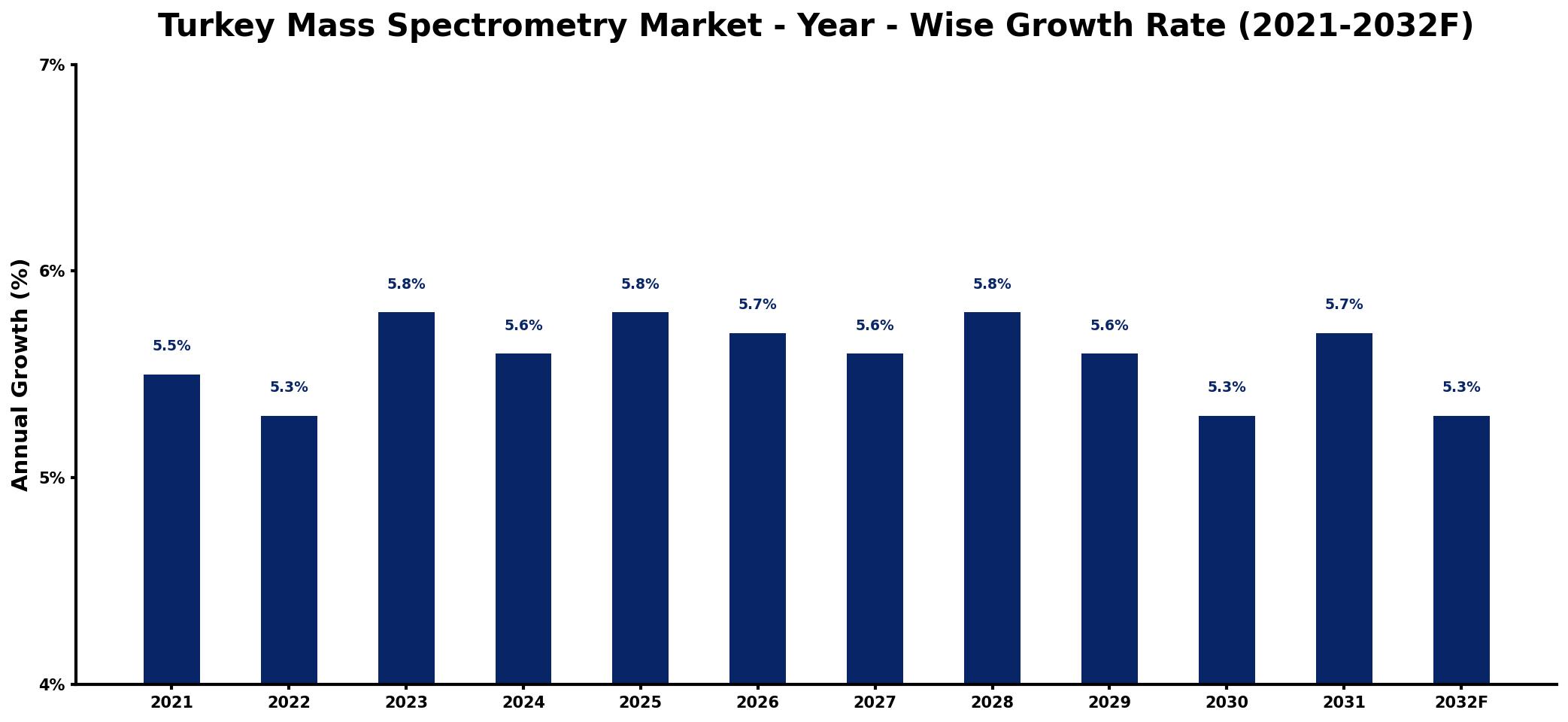
The table below presents the year‑wise growth rates along with the key drivers influencing the market
| Year | Growth Rate | Major Drivers |
| 2021 | 5.5% | Rising healthcare investment trends |
| 2022 | 5.3% | Pharmaceutical research funding growth |
| 2023 | 5.8% | Increased environmental testing requirements |
| 2024 | 5.6% | Expansion in food safety regulations |
| 2025 | 5.8% | Growing interest in proteomics applications |
| 2026 | 5.7% | Enhanced academic research initiatives |
| 2027 | 5.6% | Surge in clinical diagnostics demand |
| 2028 | 5.8% | Boost in biotechnology advancements |
| 2029 | 5.6% | Strengthened regulatory compliance needs |
| 2030 | 5.3% | Emerging technologies driving innovations |
| 2031 | 5.7% | Wider adoption in agricultural practices |
| 2032 | 5.3% | Continuous development in analytics sector |
Note: Market size estimations and growth projections presented in this report are based on 6Wresearch's proprietary forecasting methodology, utilizing the latest available industry data, government publications, and primary research inputs.
Turkey Mass Spectrometry Market Synopsis
In recent years, the Turkey Mass Spectrometry Market has gained significant momentum due to the increasing utilization of mass spectrometry technologies for in-depth analysis in critical applications such as drug discovery, environmental monitoring, and food safety. Research institutions and laboratories are increasingly adopting these systems to obtain accurate, reliable results.
With a focus on innovation, manufacturers are developing advanced mass spectrometry systems that offer enhanced sensitivity and speed, addressing the evolving requirements of researchers. This shift towards sophisticated technologies is transforming how scientists approach complex analyses, thereby expanding the market's potential.
Turkey Mass Spectrometry Market Key Takeaways
- The market is experiencing robust growth driven by increased demand in pharmaceutical and biotechnology sectors.
- Technological advancements are leading to the development of high-resolution and portable mass spectrometry systems.
- The focus on personalized medicine and biomarker discovery is propelling the adoption of mass spectrometry.
- Government initiatives are fostering research and innovation in the analytical instrumentation field.
- High costs of instruments and a shortage of skilled professionals present ongoing challenges for market stakeholders.
Evaluation of Restraints in Turkey Mass Spectrometry Market
Despite the promising growth of the Turkey Mass Spectrometry Market, certain restraints inhibit its potential. One primary factor is the high initial costs associated with mass spectrometry instruments, which can deter smaller laboratories from investing in this technology. Additionally, a significant skill gap exists, as many professionals lack the necessary expertise to operate these complex systems effectively. This shortage can hinder the efficient adoption and utilization of mass spectrometry, thereby affecting overall market growth. Furthermore, regulatory hurdles and compliance requirements can complicate operations for businesses in this sector, necessitating strategic navigation to ensure success.
Turkey Mass Spectrometry Market Trends
The Turkey Mass Spectrometry Market is witnessing several key trends that shape its landscape. Notably, there is an increasing reliance on mass spectrometry for drug discovery and development, which is essential for the pharmaceutical industry. Additionally, the application of mass spectrometry in proteomics research and environmental monitoring is gaining traction. Technological advancements, such as high-resolution mass spectrometers and portable systems, are being embraced to enhance analytical capabilities. The rising focus on personalized medicine and biomarker discovery further amplifies the demand for mass spectrometry instruments and services.
Turkey Mass Spectrometry Market Opportunities
The Turkey Mass Spectrometry Market presents significant investment opportunities driven by a growing emphasis on advanced analytical techniques across various sectors. This includes an uptick in research and development efforts in pharmaceuticals and biotechnology, where strict regulations for quality control are paramount. Investors can explore the surging adoption of mass spectrometry for applications in drug discovery, proteomics, metabolomics, and environmental analysis. Collaborations between academic institutions and industry players are further enhancing the growth prospects, making this market an attractive avenue for investment.
Government Initiatives in the Turkey Mass Spectrometry Market
The Turkish government has introduced several initiatives aimed at bolstering the Mass Spectrometry Market. These policies include financial support for scientific research projects and programs designed to stimulate collaboration between academia and industry. Additionally, the government has established regulations to ensure the quality and safety of mass spectrometry equipment and associated products. Tax incentives and subsidies for businesses investing in the development of mass spectrometry technologies also play a crucial role in fostering innovation and enhancing competitiveness within the market.
Future Insights of the Turkey Mass Spectrometry Market
Looking ahead to 2026-2032, the Turkey Mass Spectrometry Market is set for steady growth, propelled by increased investment in R&D activities across sectors such as pharmaceuticals, biotechnology, and food safety. The demand for advanced analytical techniques continues to rise, as stakeholders recognize the benefits of mass spectrometry for disease diagnosis and drug discovery. Furthermore, ongoing technological advancements promise improved accuracy, sensitivity, and speed of mass spectrometry instruments, creating substantial opportunities for development and innovation in the market.
Turkey Mass Spectrometry Market Latest Developments (2025 - 2026)
Recent developments in the Turkey Mass Spectrometry Market indicate a shift towards adopting innovative solutions. Companies are focusing on enhancing their product offerings to meet the growing demand for high-resolution and portable mass spectrometry systems. Research collaborations between universities and industry players are becoming more prevalent, driving advancements in technology and analytical capabilities. As a result, the market is evolving to accommodate the increasing needs of various sectors while ensuring compliance with emerging regulations.
Turkey Mass Spectrometry Market - Key Attractiveness of the Report
- 10 Years of Market Numbers
- Historical Data Starting from 2022 to 2025
- Base Year: 2025
- Forecast Data until 2032
- Key Performance Indicators Impacting the Market
- Major Upcoming Developments and Projects
Key Highlights of the Report:
- Turkey Mass Spectrometry Market Outlook
- Market Size of Turkey Mass Spectrometry Market, 2025
- Forecast of Turkey Mass Spectrometry Market, 2032
- Historical Data and Forecast of Turkey Mass Spectrometry Revenues & Volume for the Period 2022-2032F
- Turkey Mass Spectrometry Market Trend Evolution
- Turkey Mass Spectrometry Market Drivers and Challenges
- Turkey Mass Spectrometry Price Trends
- Turkey Mass Spectrometry Porter's Five Forces
- Turkey Mass Spectrometry Industry Life Cycle
- Historical Data and Forecast of Turkey Mass Spectrometry Market Revenues & Volume By Technology for the Period 2022-2032F
- Historical Data and Forecast of Turkey Mass Spectrometry Market Revenues & Volume By Hybrid Mass Spectrometry for the Period 2022-2032F
- Historical Data and Forecast of Turkey Mass Spectrometry Market Revenues & Volume By Single Mass Spectrometry for the Period 2022-2032F
- Historical Data and Forecast of Turkey Mass Spectrometry Market Revenues & Volume By Application for the Period 2022-2032F
- Historical Data and Forecast of Turkey Mass Spectrometry Market Revenues & Volume By Pharmaceutical for the Period 2022-2032F
- Historical Data and Forecast of Turkey Mass Spectrometry Market Revenues & Volume By Biotechnology for the Period 2022-2032F
- Historical Data and Forecast of Turkey Mass Spectrometry Market Revenues & Volume By Security for the Period 2022-2032F
- Historical Data and Forecast of Turkey Mass Spectrometry Market Revenues & Volume By Industrial chemistry for the Period 2022-2032F
- Historical Data and Forecast of Turkey Mass Spectrometry Market Revenues & Volume By Environmental testing for the Period 2022-2032F
- Historical Data and Forecast of Turkey Mass Spectrometry Market Revenues & Volume By Food & beverage testing for the Period 2022-2032F
- Historical Data and Forecast of Turkey Mass Spectrometry Market Revenues & Volume By Forensic for the Period 2022-2032F
- Historical Data and Forecast of Turkey Mass Spectrometry Market Revenues & Volume By Clinical for the Period 2022-2032F
- Turkey Mass Spectrometry Import Export Trade Statistics
- Market Opportunity Assessment By Technology
- Market Opportunity Assessment By Application
- Turkey Mass Spectrometry Top Companies Market Share
- Turkey Mass Spectrometry Competitive Benchmarking By Technical and Operational Parameters
- Turkey Mass Spectrometry Company Profiles
- Turkey Mass Spectrometry Key Strategic Recommendations






































