Turkey Meat Packaging Market Summary
The turkey meat packaging market was estimated at USD 1193 Million in 2025 and is projected to reach USD 1693 Million by 2032, growing at a CAGR of 6.1% from 2026 to 2032.
Turkey Meat Packaging Market Year-wise Growth Rate and Key Drivers
This graph highlights how the Turkey Meat Packaging Market has steadily grown over the past five years, supported by major growth factors.
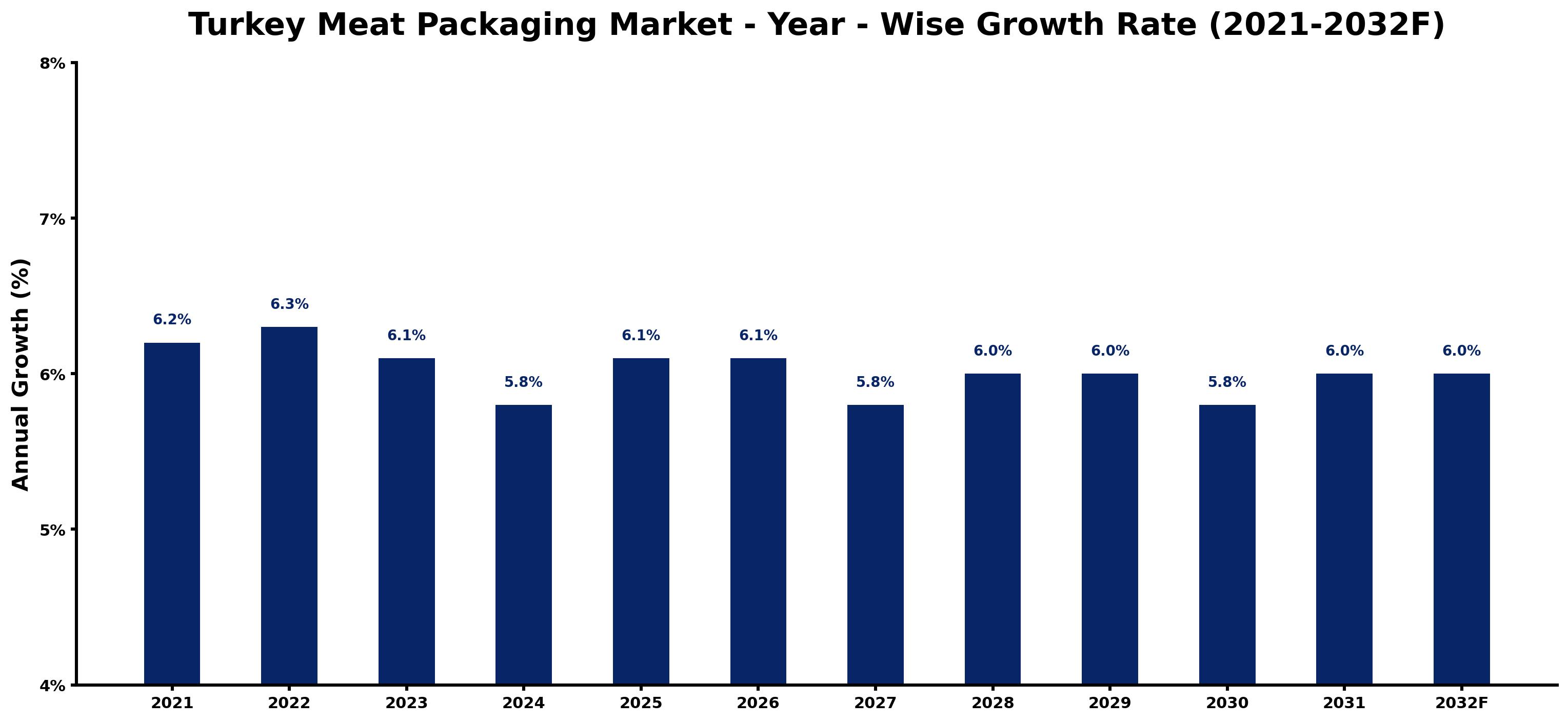
The table below presents the year wise growth rates along with the key drivers influencing the market
| Year | Growth Rate | Major Drivers |
| 2021 | 6.2% | Turkey's poultry consumption remains high, influencing meat packaging innovations steadily. |
| 2022 | 6.3% | Increased health awareness among consumers boosts demand for sustainable packaging solutions. |
| 2023 | 6.1% | Technological advancements enhance efficiency in meat processing and packaging operations. |
| 2024 | 5.8% | Rising urbanization trends contribute to higher convenience food preferences within households. |
| 2025 | 6.1% | Growing retail sector investments promote better shelf-life and packaging aesthetics. |
| 2026 | 6.1% | Turkey's export potential in poultry products creates opportunities for specialized packaging. |
| 2027 | 5.8% | Consumer preference shifts toward eco-friendly materials reshape traditional packaging approaches. |
| 2028 | 6.0% | Increased online food delivery services elevate demand for secure meat packaging. |
| 2029 | 6.0% | Competition among local brands drives innovations in packaging technology and design. |
| 2030 | 5.8% | Emerging market players challenge established brands with novel packaging solutions. |
| 2031 | 6.0% | Sustainability certifications influence purchasing decisions, prompting packaging industry transformations. |
| 2032 | 6.0% | Technological integration in supply chains improves traceability and quality assurance for packaged meat. |
Note - Market size estimations and growth projections presented in this report are based on 6Wresearch's advanced forecasting approach, validated with industry datasets as of June 2026.
Turkey Meat Packaging Market Synopsis
The Turkey Meat Packaging Market is projected to reach 6.1% and witness significant growth during the forecast period (2026-2032). This growth is driven by the increasing global consumption of turkey meat and the rising consumer preference for healthier protein sources. Market dynamics are influenced by evolving packaging technologies, sustainability initiatives, and changing consumer lifestyles, which necessitate the adoption of advanced packaging solutions to maintain product freshness and quality.
Turkey Meat Packaging Market Growth Drivers
Several factors are propelling the Turkey Meat Packaging Market forward. Firstly, the shift in consumer preferences towards leaner protein options has significantly boosted the demand for turkey meat. Secondly, the introduction of innovative packaging formats, including flexible and vacuum packaging, ensures prolonged shelf life and enhances food safety, aligning with consumer expectations. Thirdly, the emphasis on sustainable packaging solutions is gaining momentum, as manufacturers increasingly use eco-friendly materials to meet environmental standards.
- Rising health consciousness among consumers is prompting a shift towards turkey meat as a nutritious alternative to red meat.
- The development of advanced packaging technologies, such as modified atmosphere packaging (MAP), plays a crucial role in preserving product quality and extending shelf life.
- Increasing preference for convenient and ready-to-eat turkey products caters to busy lifestyles, driving market expansion.
- Growing concerns regarding food safety and hygiene are prompting investments in higher-quality packaging materials that ensure product integrity.
- The trend towards online food delivery services necessitates robust packaging solutions to withstand transport challenges while maintaining freshness.
Turkey Meat Packaging Market Trends and Opportunities
The Turkey Meat Packaging Market is currently experiencing transformative trends. One prominent trend is the increasing consumer demand for sustainability in packaging. Eco-friendly options that reduce environmental impact are now prioritized by consumers and manufacturers alike. Furthermore, the rising popularity of portion-controlled and ready-to-cook packaging formats is responding to the demand for convenience. Another significant trend is the adoption of smart packaging technologies that enhance user engagement and provide additional safety guarantees.
- There is a strong push for sustainable materials, encouraging the development of biodegradable and recyclable packaging solutions.
- Consumers are gravitating towards ready-to-eat turkey products, prompting innovations in packaging that emphasize convenience and ease of preparation.
- The integration of interactive packaging features, such as QR codes, offers consumers additional information about product sourcing and nutritional value.
- Advanced sealing technologies are being adopted to enhance product freshness and safety during transportation and storage.
- Market players are focusing on developing packaging solutions that are lighter and more resource-efficient to reduce overall waste.
Turkey Meat Packaging Market Challenges and Restraints
The Turkey Meat Packaging Market is not without its challenges. Maintaining product quality throughout the supply chain remains a significant concern, as does compliance with stringent food safety regulations. Rising costs of packaging materials pose another obstacle, particularly as sustainability becomes a more significant factor in materials selection. Additionally, fierce competition from alternative protein sources is affecting market dynamics, presenting challenges for traditional meat products.
- Ensuring product freshness during transportation and storage is crucial to meeting consumer expectations regarding quality.
- Compliance with evolving regulatory requirements can add complexity and cost to the packaging process.
- Increasing raw material prices for eco-friendly packaging may discourage some manufacturers from transitioning to sustainable options.
- Competition from plant-based protein alternatives challenges the market's growth, as consumers explore diverse dietary choices.
- Shifting consumer preferences towards healthier and more convenient food options may require constant innovation to stay relevant.
Turkey Meat Packaging Market Investment Opportunities
The Turkey Meat Packaging Market presents numerous investment opportunities, particularly driven by changing consumer preferences. With an increasing preference for ready-to-cook turkey products, there is a distinct opportunity for companies to invest in innovative and sustainable packaging solutions. The ongoing demand for eco-friendly materials presents lucrative avenues for businesses focusing on recyclable and biodegradable options. Moreover, advancements in packaging technology offer potential for improved shelf life and consumer satisfaction.
- Investing in packaging solutions that align with sustainability trends can provide a competitive edge in the marketplace.
- There is a growing market for vacuum skin packaging (VSP) and MAP, which enhances the freshness of turkey products while extending shelf life.
- Exploring partnerships with tech firms to develop smart packaging could lead to significant innovations in consumer engagement and safety.
- Opportunities exist in developing lightweight packaging materials that reduce shipping costs and environmental impact.
- Investing in research and development for advanced preservation technologies can address the key challenge of maintaining product quality.
Turkey Meat Packaging Market Government Investment and Initiatives
Government policies play a pivotal role in shaping the Turkey Meat Packaging Market. Regulatory frameworks emphasize food safety, quality assurance, and traceability throughout the supply chain. The Ministry of Agriculture and Forestry enforces regulations that govern labeling standards, ensuring that products meet consumer expectations while mitigating risks of contamination. Initiatives aimed at encouraging the use of sustainable practices are also prominent, with incentives for companies that adopt eco-friendly packaging solutions.
- Regulations focus on maintaining hygiene standards in packaging materials to protect consumer health.
- Guidelines for proper storage and transportation practices are established to ensure the integrity of turkey meat products.
- The government promotes transparency in labeling, allowing consumers to make informed choices.
- Incentives for research into sustainable packaging materials support the industry's transition to eco-friendly solutions.
- Ongoing public spending in agriculture underlines the importance of maintaining quality standards across the food supply chain.
Turkey Meat Packaging Market Latest Developments (May 2025 - June 2026)
Recent developments in the Turkey Meat Packaging Market underscore a shift towards innovation and sustainability. Manufacturers are increasingly focusing on implementing sustainable practices while enhancing product safety through advanced packaging technologies. The trend of eco-friendly materials continues to influence manufacturing processes, with many companies exploring biodegradable options to reduce their environmental footprint. Additionally, there is a growing shift towards online food shopping, leading to the evolution of packaging solutions catered to e-commerce logistics.
Turkey Meat Packaging Market - Key Attractiveness of the Report
- 10 Years of Market Numbers
- Historical Data Starting from 2022 to 2025
- Base Year: 2025
- Forecast Data until 2032
- Key Performance Indicators Impacting the Market
- Major Upcoming Developments and Projects
Key Highlights of the Report:
- Turkey Meat Packaging Market Outlook
- Market Size of Turkey Meat Packaging Market, 2025
- Forecast of Turkey Meat Packaging Market, 2032F
- Historical Data and Forecast of Turkey Meat Packaging Revenues & Volume for the Period 2022-2032F
- Turkey Meat Packaging Market Trend Evolution
- Turkey Meat Packaging Market Drivers and Challenges
- Turkey Meat Packaging Price Trends
- Turkey Meat Packaging Porter's Five Forces
- Turkey Meat Packaging Industry Life Cycle
- Historical Data and Forecast of Turkey Meat Packaging Market Revenues & Volume By Material Type for the Period 2022-2032F
- Historical Data and Forecast of Turkey Meat Packaging Market Revenues & Volume By Plastic for the Period 2022-2032F
- Historical Data and Forecast of Turkey Meat Packaging Market Revenues & Volume By Rigid? for the Period 2022-2032F
- Historical Data and Forecast of Turkey Meat Packaging Market Revenues & Volume By Metal for the Period 2022-2032F
- Historical Data and Forecast of Turkey Meat Packaging Market Revenues & Volume By Meat Type for the Period 2022-2032F
- Historical Data and Forecast of Turkey Meat Packaging Market Revenues & Volume By Fresh and Frozen for the Period 2022-2032F
- Historical Data and Forecast of Turkey Meat Packaging Market Revenues & Volume By Processed for the Period 2022-2032F
- Historical Data and Forecast of Turkey Meat Packaging Market Revenues & Volume By Ready to Eat for the Period 2022-2032F
- Turkey Meat Packaging Import Export Trade Statistics
- Market Opportunity Assessment By Material Type
- Market Opportunity Assessment By Meat Type
- Turkey Meat Packaging Top Companies Market Share
- Turkey Meat Packaging Competitive Benchmarking By Technical and Operational Parameters
- Turkey Meat Packaging Company Profiles
- Turkey Meat Packaging Key Strategic Recommendations






































