Turkey Medical Tubing Market Size, Share & Growth Rate
The Turkey Medical Tubing Market was estimated at USD 471 Million in 2025 and is projected to reach USD 623 Million by 2032, growing at a CAGR of 4.1% from 2026 to 2032. This trajectory is primarily driven by the increasing prevalence of chronic diseases and the ongoing expansion of the healthcare infrastructure in Turkey. Furthermore, technological advancements in material science are paving the way for superior medical tubing solutions, enhancing their applicability across a variety of medical devices.
Turkey Medical Tubing Market Year-wise Growth Rate and Key Drivers
This graph highlights how the Turkey Medical Tubing Market has steadily grown over the years, supported by major growth factors.
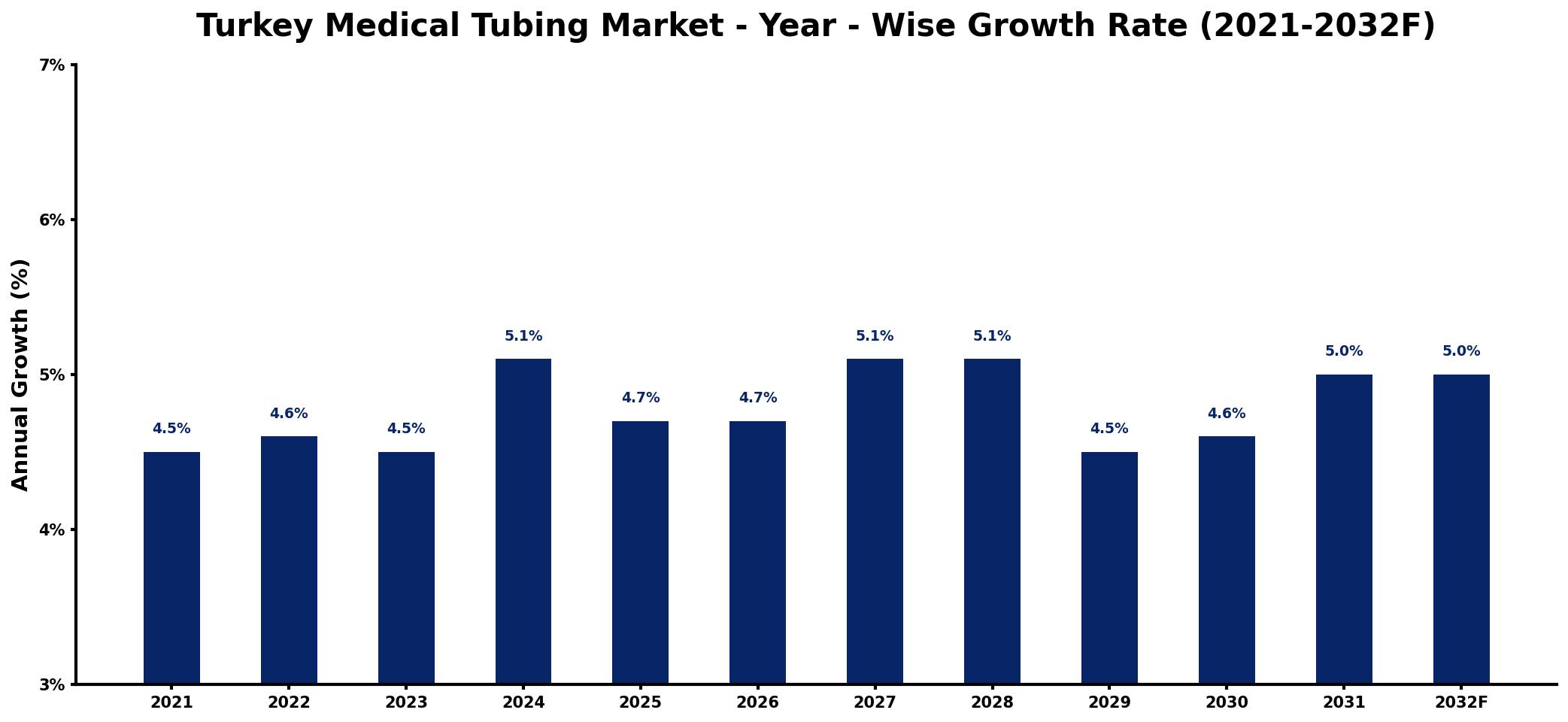
The table below presents the year‑wise growth rates along with the key drivers influencing the market
| Year | Growth Rate | Major Drivers |
| 2021 | 4.5% | Rising healthcare infrastructure investments |
| 2022 | 4.6% | Growing adoption of advanced technologies |
| 2023 | 4.5% | Increasing prevalence of chronic diseases |
| 2024 | 5.1% | Expansion of healthcare facilities network |
| 2025 | 4.7% | Surge in regulatory compliance requirements |
| 2026 | 4.7% | growing downstream application demand |
| 2027 | 5.1% | Increase in aging population demographics |
| 2028 | 5.1% | Development of innovative healthcare solutions |
| 2029 | 4.5% | Rising public health awareness campaigns |
| 2030 | 4.6% | Growth in outpatient surgical procedures |
| 2031 | 5.0% | rising infrastructure development spending |
| 2032 | 5.0% | Investment in research and development |
Note: Market size estimations and growth projections presented in this report are based on 6Wresearch's proprietary forecasting methodology, utilizing the latest available industry data, government publications, and primary research inputs.
Turkey Medical Tubing Market Synopsis
The most significant force shaping the Turkey Medical Tubing Market today is the burgeoning demand for medical-grade tubing, prompted by rising healthcare needs. As the healthcare sector rapidly evolves, a strong emphasis on quality and innovation is driving manufacturers to develop more efficient tubing solutions.
This market encompasses diverse products, including catheters, intravenous tubing, and respiratory tubing, among others. As Turkey strengthens its healthcare systems, the quality of medical devices is increasingly under scrutiny, making regulatory compliance an essential focus for manufacturers.
Turkey Medical Tubing Market Key Takeaways
- Growing demand for medical devices is boosting the medical tubing market in Turkey.
- Technological advancements are leading to innovative materials and manufacturing processes.
- Sustainable practices are becoming integral to the production of medical tubing.
- Strict regulatory compliance is paramount for market players to ensure quality and safety.
- The aging population is a significant driver of increased medical tubing usage.
Evaluation of Restraints in Turkey Medical Tubing Market
Despite its robust growth potential, the Turkey Medical Tubing Market faces several challenges. Competitive pressures are escalating as both domestic and international manufacturers vie for market share. Fluctuating raw material prices can adversely affect production costs, while stringent regulatory frameworks necessitate ongoing investments in quality assurance and compliance. Additionally, economic uncertainties and geopolitical factors can create fluctuations in market stability, compelling businesses to adapt their strategies continually.
Turkey Medical Tubing Market Trends
Several trends are emerging within the Turkey Medical Tubing Market. A noteworthy trend is the increased focus on innovative materials, such as biocompatible and biodegradable options that cater to environmental concerns. Manufacturers are also investing in smart tubing technologies that enhance patient safety and comfort. This shift aligns with a broader industry trend toward sustainability, as companies seek to minimize their environmental footprint while complying with evolving regulations.
Turkey Medical Tubing Market Opportunities
There are significant investment opportunities within the Turkey Medical Tubing Market, particularly in areas where technological innovations are taking root. The ongoing development of advanced medical devices, coupled with an aging population that necessitates more healthcare solutions, creates an enticing landscape for investors. Moreover, manufacturers focused on cutting-edge materials and sustainable production practices will likely capture market share as healthcare standards continue to rise.
Government Initiatives in the Turkey Medical Tubing Market
The Turkish government plays an active role in shaping the medical tubing market through policies aimed at ensuring compliance with international quality standards. Regulations, such as the Medical Device Regulation (MDR), govern aspects of manufacturing and distribution, focusing on quality management and post-market surveillance. Additionally, government incentives to stimulate innovation and investment in the healthcare sector further bolster the growth prospects of medical tubing manufacturers.
Future Insights of the Turkey Medical Tubing Market
Looking ahead to 2026-2032, the Turkey Medical Tubing Market is set to experience consistent growth. Factors such as a continually expanding healthcare infrastructure, increased healthcare spending, and a demographic shift towards an aging population will underpin demand. Additionally, advancements in medical technology will likely drive the adoption of new medical tubing solutions, enhancing performance and patient outcomes.
Turkey Medical Tubing Market Latest Developments (2025 - 2026)
Recent industry developments indicate a strong push towards innovation in medical tubing. Companies are focusing on advanced manufacturing techniques and exploring new materials that enhance safety and performance. Additionally, there is a noticeable trend toward sustainability, with organizations adopting greener practices in production to comply with regulatory standards. These directions signal a dynamic market poised for further transformation.
Turkey Medical Tubing Market - Key Attractiveness of the Report
- 10 Years of Market Numbers
- Historical Data Starting from 2022 to 2025
- Base Year: 2025
- Forecast Data until 2032
- Key Performance Indicators Impacting the Market
- Major Upcoming Developments and Projects
Key Highlights of the Report:
- Turkey Medical Tubing Market Outlook
- Market Size of Turkey Medical Tubing Market, 2025
- Forecast of Turkey Medical Tubing Market, 2032
- Historical Data and Forecast of Turkey Medical Tubing Revenues & Volume for the Period 2022-2032F
- Turkey Medical Tubing Market Trend Evolution
- Turkey Medical Tubing Market Drivers and Challenges
- Turkey Medical Tubing Price Trends
- Turkey Medical Tubing Porter's Five Forces
- Turkey Medical Tubing Industry Life Cycle
- Historical Data and Forecast of Turkey Medical Tubing Market Revenues & Volume By Material for the Period 2022-2032F
- Historical Data and Forecast of Turkey Medical Tubing Market Revenues & Volume By Plastics for the Period 2022-2032F
- Historical Data and Forecast of Turkey Medical Tubing Market Revenues & Volume By Rubbers for the Period 2022-2032F
- Historical Data and Forecast of Turkey Medical Tubing Market Revenues & Volume By Specialty Polymers for the Period 2022-2032F
- Historical Data and Forecast of Turkey Medical Tubing Market Revenues & Volume By Structure for the Period 2022-2032F
- Historical Data and Forecast of Turkey Medical Tubing Market Revenues & Volume By Single-lumen for the Period 2022-2032F
- Historical Data and Forecast of Turkey Medical Tubing Market Revenues & Volume By Co-extruded for the Period 2022-2032F
- Historical Data and Forecast of Turkey Medical Tubing Market Revenues & Volume By Multi-lumen for the Period 2022-2032F
- Historical Data and Forecast of Turkey Medical Tubing Market Revenues & Volume By Tapered Or Bump Tubing for the Period 2022-2032F
- Historical Data and Forecast of Turkey Medical Tubing Market Revenues & Volume By Braided Tubing for the Period 2022-2032F
- Historical Data and Forecast of Turkey Medical Tubing Market Revenues & Volume By Application for the Period 2022-2032F
- Historical Data and Forecast of Turkey Medical Tubing Market Revenues & Volume By Bulk Disposable Tubing for the Period 2022-2032F
- Historical Data and Forecast of Turkey Medical Tubing Market Revenues & Volume By Catheters & Cannulas for the Period 2022-2032F
- Historical Data and Forecast of Turkey Medical Tubing Market Revenues & Volume By Drug Delivery System for the Period 2022-2032F
- Historical Data and Forecast of Turkey Medical Tubing Market Revenues & Volume By Special Applications for the Period 2022-2032F
- Turkey Medical Tubing Import Export Trade Statistics
- Market Opportunity Assessment By Material
- Market Opportunity Assessment By Structure
- Market Opportunity Assessment By Application
- Turkey Medical Tubing Top Companies Market Share
- Turkey Medical Tubing Competitive Benchmarking By Technical and Operational Parameters
- Turkey Medical Tubing Company Profiles
- Turkey Medical Tubing Key Strategic Recommendations






































