Turkey Medicinal Herbs Market Size, Share & Growth Rate
The Turkey Medicinal Herbs Market was estimated at USD 374 Million in 2025 and is projected to reach USD 518 Million by 2032, growing at a CAGR of 4.8% from 2026 to 2032. This growth is propelled by an increasing consumer preference for natural remedies, a deep-rooted tradition of herbal usage, and heightened awareness about the health benefits associated with medicinal herbs. The shift towards organic and sustainably sourced products further underscores a positive trajectory for this sector.
Turkey Medicinal Herbs Market Year-wise Growth Rate and Key Drivers
This graph highlights how the Turkey Medicinal Herbs Market has steadily grown over the years, supported by major growth factors.
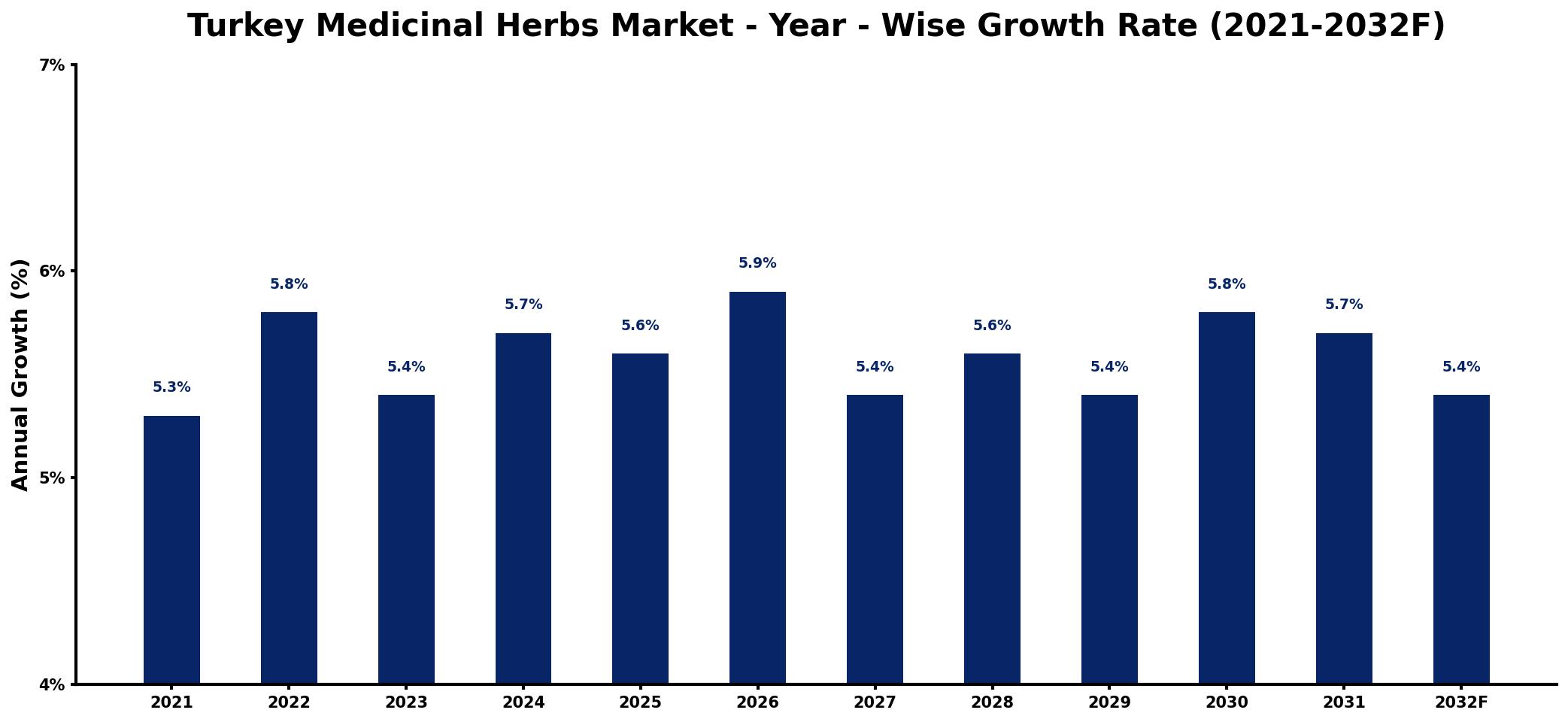
The table below presents the year‑wise growth rates along with the key drivers influencing the market
| Year | Growth Rate | Major Drivers |
| 2021 | 5.3% | Rising consumer health awareness |
| 2022 | 5.8% | Expansion of natural remedies market |
| 2023 | 5.4% | Increased demand for alternative treatments |
| 2024 | 5.7% | Growth in online health platforms |
| 2025 | 5.6% | Surge in wellness tourism industry |
| 2026 | 5.9% | Investment in organic farming practices |
| 2027 | 5.4% | Emergence of holistic health trends |
| 2028 | 5.6% | Popularity of sustainable sourcing methods |
| 2029 | 5.4% | Boost in local farmer cooperatives |
| 2030 | 5.8% | Enhancement of research funding initiatives |
| 2031 | 5.7% | Strengthening of regulatory frameworks |
| 2032 | 5.4% | Development of consumer education programs |
Note: Market size estimations and growth projections presented in this report are based on 6Wresearch's proprietary forecasting methodology, utilizing the latest available industry data, government publications, and primary research inputs.
Turkey Medicinal Herbs Market Synopsis
The Turkey Medicinal Herbs Market is gaining momentum as consumers increasingly turn to herbal solutions for their health and wellness needs. The markets foundation rests on a rich array of indigenous herbs, such as sage and chamomile, known for their longstanding medicinal properties.
As the trend towards self-care and holistic health practices continues to rise, Turkish consumers are becoming more discerning in their choice of herbal products. This evolution is not only fostering a greater appreciation for traditional remedies but also stimulating the local economy through enhanced cultivation and processing practices.
Turkey Medicinal Herbs Market Key Takeaways
- The market is experiencing significant growth driven by rising consumer interest in natural remedies.
- There is an increasing demand for sustainably sourced, organic medicinal herbs.
- Key herbal products are being integrated into various industries, including pharmaceuticals and cosmetics.
- Government initiatives are supporting sustainable practices and quality assurance in herbal production.
- Online retail is reshaping the distribution landscape, providing wider access to herbal products.
Evaluation of Restraints in Turkey Medicinal Herbs Market
While the Turkey Medicinal Herbs Market is on a promising growth path, it faces several restraints that could impede its progress. One significant issue is the lack of consistent regulatory frameworks governing quality control and standardization of herbal products. This inconsistency can lead to consumer skepticism about the efficacy and safety of these remedies. Additionally, over-harvesting and habitat destruction threaten the sustainability of wild herb populations, complicating the supply chain. Furthermore, competition from synthetic pharmaceuticals can overshadow the appeal of herbal solutions for certain consumer segments, affecting market expansion. Addressing these challenges is crucial for harnessing the market's full potential.
Turkey Medicinal Herbs Market Trends
A notable trend within the Turkey Medicinal Herbs Market is the increasing consumer preference for organic and natural products. This shift is reflective of a broader wellness movement that favors holistic practices over conventional medicine. Additionally, niche herbs with specialized health benefits are gaining traction, as consumers seek out adaptogens and immune-boosting herbs. Product innovation is also a critical trend, as companies strive to differentiate their offerings through quality control measures and certifications. Moreover, the expansion of the online retail landscape has made it easier for consumers to access a diverse range of herbal products and information, further stimulating demand.
Turkey Medicinal Herbs Market Opportunities
The Turkey Medicinal Herbs Market is ripe with investment opportunities, driven by consumer awareness of the health benefits of herbal remedies. Investors can explore avenues in cultivating and processing popular herbs such as thyme and mint, as well as developing value-added products like herbal supplements and essential oils. The growing trend towards organic and sustainable practices presents another lucrative avenue, encouraging investments in eco-friendly cultivation methods. Collaborations with local farmers, capitalizing on Turkeys rich biodiversity of medicinal plants, can create strategic advantages for those looking to penetrate this expanding market.
Government Initiatives in the Turkey Medicinal Herbs Market
The Turkish government, through the Ministry of Food, Agriculture, and Livestock, plays an active role in regulating the Medicinal Herbs Market. Various policies and initiatives have been introduced to ensure the safety, quality, and efficacy of herbal products. These measures include setting standards for cultivation, harvesting, and processing practices, as well as licensing regulations for herbal products and traditional medicine practitioners. Additionally, the government is promoting sustainable cultivation practices to protect both the environment and the biodiversity of herbal resources, fostering a supportive landscape for the growth of the market.
Future Insights of the Turkey Medicinal Herbs Market
Looking ahead to 2026-2032, the Turkey Medicinal Herbs Market is poised for steady growth. The ongoing trend of consumers gravitating towards natural and organic products will likely maintain momentum, driving demand for herbal remedies. Furthermore, the increasing incorporation of herbs in pharmaceuticals, cosmetics, and food industries will continue to bolster market expansion. However, addressing challenges related to regulation and quality control will be essential for unlocking the full potential of this burgeoning market. The future landscape appears promising as health-conscious consumers further embrace the benefits of traditional herbal medicine.
Turkey Medicinal Herbs Market Latest Developments (2025 - 2026)
Recent developments in the Turkey Medicinal Herbs Market reflect a dynamic response to growing consumer demands. A surge in e-commerce platforms has expanded access to a diverse range of herbal products. Initiatives to enhance sustainable farming practices are gaining traction, with more companies adopting eco-friendly certifications. Moreover, the exploration of innovative product formulations and partnerships within the wellness sector is becoming more prevalent, indicating a robust shift towards integrating traditional herbal knowledge with modern consumer preferences.
Turkey Medicinal Herbs Market - Key Attractiveness of the Report
- 10 Years of Market Numbers
- Historical Data Starting from 2022 to 2025
- Base Year: 2025
- Forecast Data until 2032
- Key Performance Indicators Impacting the Market
- Major Upcoming Developments and Projects
Key Highlights of the Report:
- Turkey Medicinal Herbs Market Outlook
- Market Size of Turkey Medicinal Herbs Market, 2025
- Forecast of Turkey Medicinal Herbs Market, 2032
- Historical Data and Forecast of Turkey Medicinal Herbs Revenues & Volume for the Period 2022-2032F
- Turkey Medicinal Herbs Market Trend Evolution
- Turkey Medicinal Herbs Market Drivers and Challenges
- Turkey Medicinal Herbs Price Trends
- Turkey Medicinal Herbs Porter's Five Forces
- Turkey Medicinal Herbs Industry Life Cycle
- Historical Data and Forecast of Turkey Medicinal Herbs Market Revenues & Volume By Type for the Period 2022-2032F
- Historical Data and Forecast of Turkey Medicinal Herbs Market Revenues & Volume By Horsetail for the Period 2022-2032F
- Historical Data and Forecast of Turkey Medicinal Herbs Market Revenues & Volume By Dandelion for the Period 2022-2032F
- Historical Data and Forecast of Turkey Medicinal Herbs Market Revenues & Volume By Echinacea for the Period 2022-2032F
- Historical Data and Forecast of Turkey Medicinal Herbs Market Revenues & Volume By Valerian for the Period 2022-2032F
- Historical Data and Forecast of Turkey Medicinal Herbs Market Revenues & Volume By St. John??s Wort for the Period 2022-2032F
- Historical Data and Forecast of Turkey Medicinal Herbs Market Revenues & Volume By Lemon Balm for the Period 2022-2032F
- Historical Data and Forecast of Turkey Medicinal Herbs Market Revenues & Volume By Yarrow for the Period 2022-2032F
- Historical Data and Forecast of Turkey Horsetail Medicinal Herbs Market Revenues & Volume By Calendula for the Period 2022-2032F
- Historical Data and Forecast of Turkey Medicinal Herbs Market Revenues & Volume By Nature for the Period 2022-2032F
- Historical Data and Forecast of Turkey Medicinal Herbs Market Revenues & Volume By Organic for the Period 2022-2032F
- Historical Data and Forecast of Turkey Medicinal Herbs Market Revenues & Volume By Conventional for the Period 2022-2032F
- Historical Data and Forecast of Turkey Medicinal Herbs Market Revenues & Volume By Form for the Period 2022-2032F
- Historical Data and Forecast of Turkey Medicinal Herbs Market Revenues & Volume By Whole for the Period 2022-2032F
- Historical Data and Forecast of Turkey Medicinal Herbs Market Revenues & Volume By Powder for the Period 2022-2032F
- Historical Data and Forecast of Turkey Medicinal Herbs Market Revenues & Volume By Liquid for the Period 2022-2032F
- Historical Data and Forecast of Turkey Medicinal Herbs Market Revenues & Volume By End-Use for the Period 2022-2032F
- Historical Data and Forecast of Turkey Medicinal Herbs Market Revenues & Volume By Medicinal Tea for the Period 2022-2032F
- Historical Data and Forecast of Turkey Medicinal Herbs Market Revenues & Volume By Health Supplement for the Period 2022-2032F
- Historical Data and Forecast of Turkey Medicinal Herbs Market Revenues & Volume By Nutritive Jams for the Period 2022-2032F
- Historical Data and Forecast of Turkey Medicinal Herbs Market Revenues & Volume By Herbal Medicines for the Period 2022-2032F
- Historical Data and Forecast of Turkey Medicinal Herbs Market Revenues & Volume By Cosmeceuticals for the Period 2022-2032F
- Historical Data and Forecast of Turkey Medicinal Herbs Market Revenues & Volume By Other Uses for the Period 2022-2032F
- Turkey Medicinal Herbs Import Export Trade Statistics
- Market Opportunity Assessment By Type
- Market Opportunity Assessment By Nature
- Market Opportunity Assessment By Form
- Market Opportunity Assessment By End-Use
- Turkey Medicinal Herbs Top Companies Market Share
- Turkey Medicinal Herbs Competitive Benchmarking By Technical and Operational Parameters
- Turkey Medicinal Herbs Company Profiles
- Turkey Medicinal Herbs Key Strategic Recommendations






































