Turkey Metal Fabrication Market Size, Share & Growth Rate
The Turkey Metal Fabrication Market was estimated at USD 443 Million in 2025 and is projected to reach USD 595 Million by 2032, growing at a CAGR of 4.3% from 2026 to 2032. This growth trajectory is primarily fueled by rising demand across several sectors, particularly in construction and automotive manufacturing. Infrastructure investments and a shift toward customized metal components are integral to this expansion, alongside technological advancements that enhance production efficiency.
Turkey Metal Fabrication Market Year-wise Growth Rate and Key Drivers
This graph highlights how the Turkey Metal Fabrication Market has steadily grown over the years, supported by major growth factors.
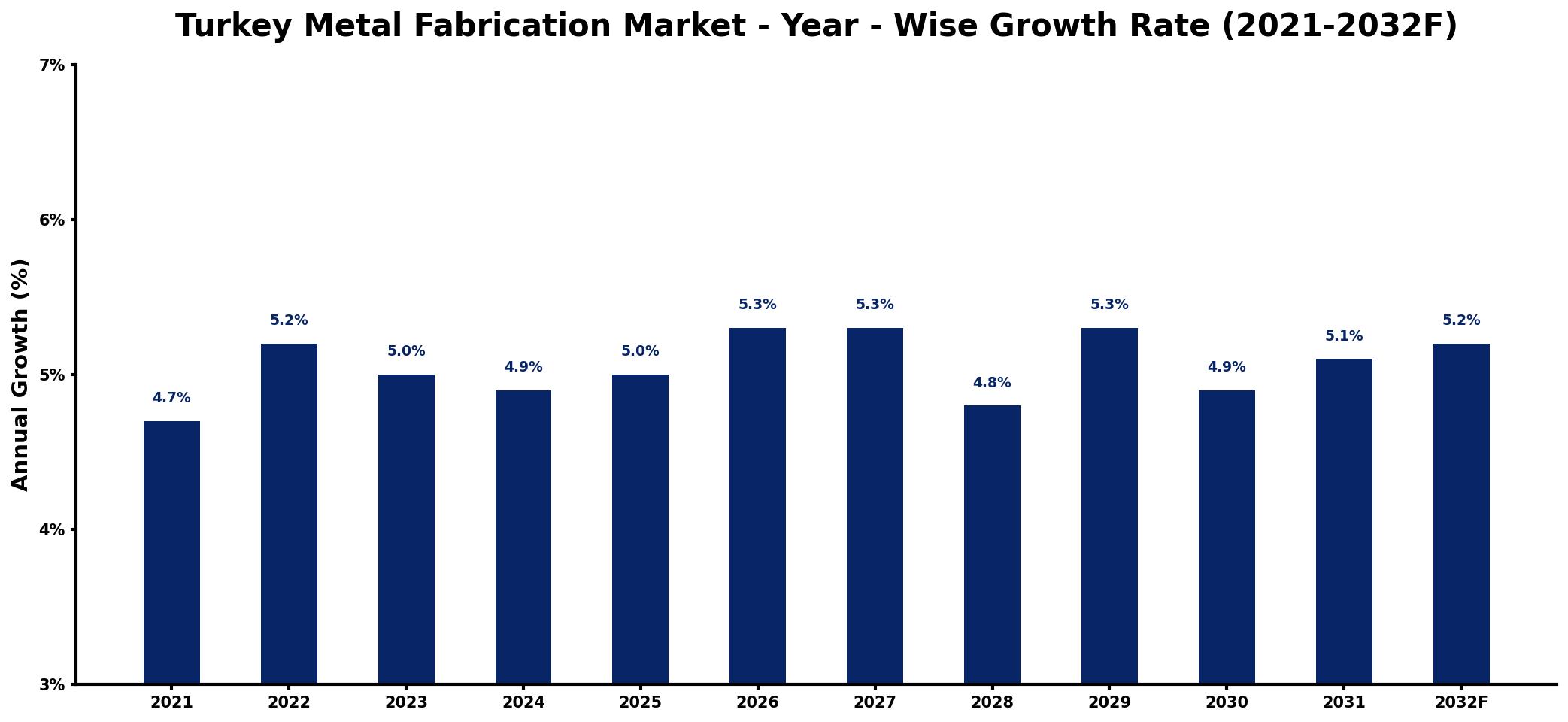
The table below presents the year‑wise growth rates along with the key drivers influencing the market
| Year | Growth Rate | Major Drivers |
| 2021 | 4.7% | Rising construction sector activities |
| 2022 | 5.2% | Increased investments in infrastructure |
| 2023 | 5.0% | Growing automotive manufacturing demand |
| 2024 | 4.9% | Surge in renewable energy projects |
| 2025 | 5.0% | Expansion of aerospace industry needs |
| 2026 | 5.3% | Boost in home renovation projects |
| 2027 | 5.3% | Heightened demand for machinery parts |
| 2028 | 4.8% | Emerging technology sector growth |
| 2029 | 5.3% | Increase in export opportunities |
| 2030 | 4.9% | Rising consumer electronics production |
| 2031 | 5.1% | Growing urbanization and housing needs |
| 2032 | 5.2% | Strengthened logistics and supply chains |
Note: Market size estimations and growth projections presented in this report are based on 6Wresearch's proprietary forecasting methodology, utilizing the latest available industry data, government publications, and primary research inputs.
Turkey Metal Fabrication Market Synopsis
The demand for fabricated metal products, such as structural steel and welding assemblies, has surged, highlighting a notable shift towards quality and customization in Turkey's manufacturing landscape. As industries increasingly adopt advanced fabrication techniques, including CNC machining and robotic welding, the market is positioned for significant growth.
Additionally, Turkey's geographical advantage as a bridge between Europe and Asia enhances its role in the global supply chain. The confluence of local manufacturing capabilities and international partnerships supports robust market development, meeting both domestic and export requirements.
Turkey Metal Fabrication Market Key Takeaways
- Significant growth in construction and automotive sectors is propelling the market.
- Technological innovations in fabrication processes are enhancing production efficiency.
- The need for customized metal solutions is rising, driving demand for diverse products.
- Infrastructure investments by the government are positively influencing market dynamics.
- Fluctuations in global metal prices represent ongoing challenges to market stability.
Evaluation of Restraints in Turkey Metal Fabrication Market
Despite its positive outlook, the Turkey Metal Fabrication Market faces several restraints. The integration of advanced automation technologies is critical, yet many companies struggle with implementation costs and training skilled personnel. Additionally, the market grapples with the need to adhere to stringent quality standards across various applications, which can hinder operational efficiency. Furthermore, geopolitical factors influencing supply chains and volatile metal prices can disrupt production, complicating long-term planning for manufacturers.
Turkey Metal Fabrication Market Trends
Currently, the market is witnessing a significant shift toward digital transformation, with automation and data analytics reshaping fabrication processes. Companies are increasingly adopting smart technologies that enhance precision and reduce waste. Furthermore, sustainable practices are becoming a priority, as industries focus on minimizing their environmental impact through energy-efficient fabrication techniques.
The rise of Industry 4.0 is also influencing the landscape, where interconnected machinery and real-time data sharing enable manufacturers to optimize operations. This trend is expected to continue reshaping the Turkey Metal Fabrication Market, driving demand for innovative solutions that prioritize productivity and sustainability.
Turkey Metal Fabrication Market Opportunities
The Turkey Metal Fabrication Market presents numerous growth opportunities, particularly in sectors like renewable energy and smart infrastructure. Investments in green technologies offer manufacturers the chance to diversify their offerings and meet evolving customer demands. Additionally, expanding export markets in Europe and Asia can facilitate increased revenues for local companies willing to innovate and adapt to international standards.
Government Initiatives in the Turkey Metal Fabrication Market
The Turkish government has implemented various initiatives to support the metal fabrication sector, particularly through public spending on infrastructure and manufacturing enhancements. Regulatory frameworks are in place to promote quality standards in welding and machining processes, aiming to improve safety and efficiency across industries. Such policies create a conducive environment for investment, encouraging both domestic and foreign players to participate actively in this growing market.
Future Insights of the Turkey Metal Fabrication Market
Looking ahead to 2026-2032, the Turkey Metal Fabrication Market is poised for substantial growth, driven by continuous advancements in technology and rising demand for customized solutions. The ongoing urbanization and industrialization trends in Turkey will further enhance market opportunities. Additionally, as companies increasingly prioritize sustainability and efficiency, the adaptation of innovative practices will likely define competitive advantage, ensuring the market's robust trajectory.
Turkey Metal Fabrication Market Latest Developments (2025 - 2026)
In recent months, the Turkey Metal Fabrication Market has seen an uptick in investments aimed at modernizing production facilities, with many companies focusing on advanced automation technologies. Concurrently, there has been a noticeable trend toward strategic collaborations among firms to enhance technological capabilities and expand their product offerings. These directions reflect an industry keen to adapt to changing consumer demands and capitalize on emerging market opportunities.
Turkey Metal Fabrication Market - Key Attractiveness of the Report
- 10 Years of Market Numbers
- Historical Data Starting from 2022 to 2025
- Base Year: 2025
- Forecast Data until 2032
- Key Performance Indicators Impacting the Market
- Major Upcoming Developments and Projects
Key Highlights of the Report:
- Turkey Metal Fabrication Market Outlook
- Market Size of Turkey Metal Fabrication Market, 2025
- Forecast of Turkey Metal Fabrication Market, 2032
- Historical Data and Forecast of Turkey Metal Fabrication Revenues & Volume for the Period 2022-2032F
- Turkey Metal Fabrication Market Trend Evolution
- Turkey Metal Fabrication Market Drivers and Challenges
- Turkey Metal Fabrication Price Trends
- Turkey Metal Fabrication Porter's Five Forces
- Turkey Metal Fabrication Industry Life Cycle
- Historical Data and Forecast of Turkey Metal Fabrication Market Revenues & Volume By End-user Industry for the Period 2022-2032F
- Historical Data and Forecast of Turkey Metal Fabrication Market Revenues & Volume By Manufacturing for the Period 2022-2032F
- Historical Data and Forecast of Turkey Metal Fabrication Market Revenues & Volume By Power and Utilities for the Period 2022-2032F
- Historical Data and Forecast of Turkey Metal Fabrication Market Revenues & Volume By Construction for the Period 2022-2032F
- Historical Data and Forecast of Turkey Metal Fabrication Market Revenues & Volume By Oil and Gas for the Period 2022-2032F
- Historical Data and Forecast of Turkey Metal Fabrication Market Revenues & Volume By Other End-user Industries for the Period 2022-2032F
- Historical Data and Forecast of Turkey Metal Fabrication Market Revenues & Volume By Metal Folding for the Period 2022-2032F
- Historical Data and Forecast of Turkey Metal Fabrication Market Revenues & Volume By Product category for the Period 2022-2032F
- Historical Data and Forecast of Turkey Metal Fabrication Market Revenues & Volume By Structural steel fabrication for the Period 2022-2032F
- Historical Data and Forecast of Turkey Metal Fabrication Market Revenues & Volume By Process Equipment Fabrication for the Period 2022-2032F
- Turkey Metal Fabrication Import Export Trade Statistics
- Market Opportunity Assessment By End-user Industry
- Market Opportunity Assessment By Product category
- Turkey Metal Fabrication Top Companies Market Share
- Turkey Metal Fabrication Competitive Benchmarking By Technical and Operational Parameters
- Turkey Metal Fabrication Company Profiles
- Turkey Metal Fabrication Key Strategic Recommendations






































