Turkey Milk Protein Market Size, Share & Growth Rate
The Turkey Milk Protein Market was estimated at USD 274 Million in 2025 and is projected to reach USD 375 Million by 2032, growing at a CAGR of 4.6% from 2026 to 2032. This growth is primarily fueled by a rising consumer consciousness regarding health and nutrition, specifically the benefits of incorporating protein-rich products into diets. Increasing demand for milk protein concentrates and isolates, particularly in dietary supplements and functional foods, is further bolstering this market's expansion.
Turkey Milk Protein Market Year-wise Growth Rate and Key Drivers
This graph highlights how the Turkey Milk Protein Market has steadily grown over the years, supported by major growth factors.
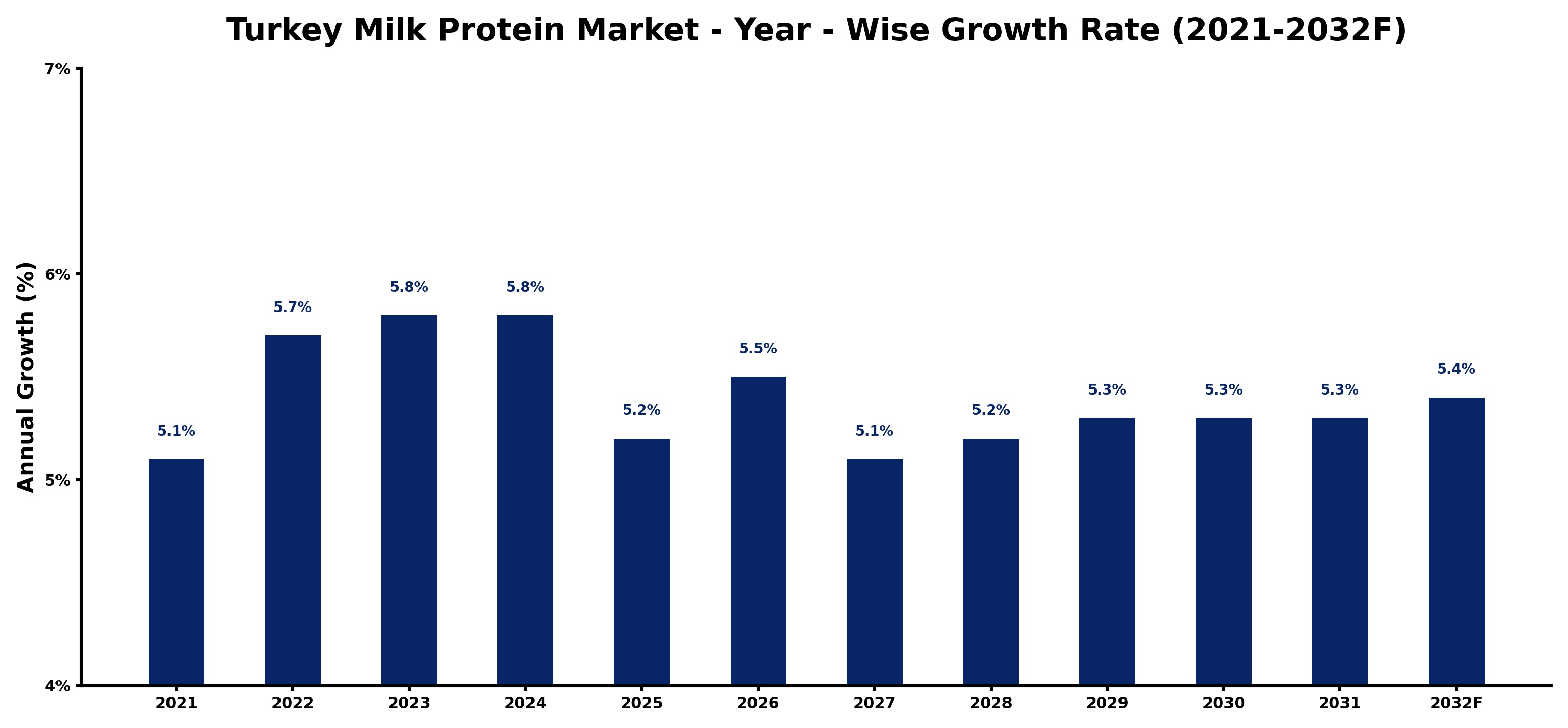
The table below presents the year‑wise growth rates along with the key drivers influencing the market
| Year | Growth Rate | Major Drivers |
| 2021 | 5.1% | New dairy processing facilities boost local milk protein supply chain |
| 2022 | 5.7% | Dairy processing upgrades boosted whey protein concentrate output efficiency |
| 2023 | 5.8% | New milk processing plants boost domestic whey protein production capacity |
| 2024 | 5.8% | New technologies streamline milk protein extraction processes in Turkey |
| 2025 | 5.2% | New dairy processing facilities boost milk protein output capabilities |
| 2026 | 5.5% | Technological upgrades in dairy processing enhance milk protein yields |
| 2027 | 5.1% | Manufacturing investments in dairy facilities boosted milk protein output |
| 2028 | 5.2% | Dairy product innovation drives Turkish milk protein production capacity upgrades |
| 2029 | 5.3% | Local dairy farms modernize equipment, boosting milk protein production capacity |
| 2030 | 5.3% | Improved production techniques boosted Turkish milk protein yield efficiency |
| 2031 | 5.3% | New milk processing facilities boost domestic protein production capacity |
| 2032 | 5.4% | Increased dairy processing capacity drives milk protein production efficiency |
Note - Market size estimations and growth projections presented in this report are based on 6Wresearch’s advanced forecasting approach, validated with industry datasets as of June 2026.
Turkey Milk Protein Market Synopsis
The Turkey milk protein market is witnessing a significant upswing, reflecting a growing appreciation for nutritional products. With more consumers gravitating towards health-centric diets, the popularity of dairy and non-dairy protein sources is on the rise.
As dietary patterns evolve, the demand for versatile protein applications in infant nutrition, sports nutrition, and functional foods is markedly increasing. This trend is further reinforced by advancements in protein extraction technologies, contributing to the overall competitiveness of the market.
Turkey Milk Protein Market Key Takeaways
- The market is projected to experience steady growth due to heightened consumer awareness regarding protein benefits.
- Technological innovations in protein extraction and formulation are enhancing product availability and quality.
- Government initiatives aimed at improving agricultural standards are supportive of domestic production.
- Health and wellness trends are driving up the demand for milk protein in various consumer segments.
- Challenges related to compliance with food safety regulations remain a focal point for producers.
Evaluation of Restraints in Turkey Milk Protein Market
Despite its promising growth trajectory, the Turkey milk protein market faces several challenges that could hinder its advancement. One of the primary restraints is the complexity involved in optimizing protein extraction techniques. Ensuring the purity and nutritional integrity of the proteins is crucial, as any compromise could lead to consumer mistrust. Additionally, producers must navigate a landscape of stringent food safety regulations which can complicate production processes and lead to increased operational costs.
Turkey Milk Protein Market Trends
The current market is shaped by several key trends. First, there is a notable shift towards plant-based proteins alongside traditional dairy options, reflecting consumer preferences for diverse dietary sources. Additionally, an increase in fitness and wellness activities has led to a surge in the popularity of sports nutrition products, which prominently feature milk proteins. These trends are supported by a growing body of research highlighting the benefits of protein intake for recovery and overall health.
Turkey Milk Protein Market Opportunities
Significant opportunities exist within the Turkey milk protein market, particularly in developing functional food products and dietary supplements that cater to specific health needs. With the rising incidence of lifestyle-related health issues, there is a demand for innovative products that can address nutrition deficiencies effectively. Furthermore, expanding distribution channels, including e-commerce, presents an avenue for producers to reach health-conscious consumers more efficiently.
Government Initiatives in the Turkey Milk Protein Market
The Turkish government is playing an active role in promoting the milk protein market through various agricultural subsidies aimed at enhancing dairy production. Policies are focused on setting nutritional standards that ensure the safety and quality of dairy products. Additionally, regulatory frameworks have been established to promote protein purity and bolster export competitiveness, which is vital for the ongoing growth of the sector.
Future Insights of the Turkey Milk Protein Market
Looking ahead to 2026-2032, the Turkey milk protein market is poised for robust growth driven by the sustained rise in health awareness and dietary shifts. As consumers continue to prioritize nutritional products, the market will likely see increased demand for innovative protein solutions that meet diverse consumer needs. Continued investment in technology will also pave the way for enhanced product offerings, catering to both traditional and emerging market segments.
Turkey Milk Protein Market Latest Developments (May 2025 - June 2026)
Recent developments in the Turkey milk protein market indicate a trend toward greater innovation in product formulation. Companies are increasingly focusing on improving the flavor profiles of milk protein products to attract a broader audience. Additionally, partnerships between producers and research institutions are emerging, aiming to enhance the nutritional value and functional properties of milk proteins.
Turkey Milk Protein Market - Key Attractiveness of the Report
- 10 Years of Market Numbers
- Historical Data Starting from 2022 to 2025
- Base Year: 2025
- Forecast Data until 2032
- Key Performance Indicators Impacting the Market
- Major Upcoming Developments and Projects
Key Highlights of the Report:
- Turkey Milk Protein Market Outlook
- Market Size of Turkey Milk Protein Market, 2025
- Forecast of Turkey Milk Protein Market, 2032
- Historical Data and Forecast of Turkey Milk Protein Revenues & Volume for the Period 2022-2032F
- Turkey Milk Protein Market Trend Evolution
- Turkey Milk Protein Market Drivers and Challenges
- Turkey Milk Protein Price Trends
- Turkey Milk Protein Porter's Five Forces
- Turkey Milk Protein Industry Life Cycle
- Historical Data and Forecast of Turkey Milk Protein Market Revenues & Volume By Type for the Period 2022-2032F
- Historical Data and Forecast of Turkey Milk Protein Market Revenues & Volume By Whey Protein Isolates for the Period 2022-2032F
- Historical Data and Forecast of Turkey Milk Protein Market Revenues & Volume By Whey Protein Concentrates for the Period 2022-2032F
- Historical Data and Forecast of Turkey Milk Protein Market Revenues & Volume By Milk Protein Hydrolysates for the Period 2022-2032F
- Historical Data and Forecast of Turkey Milk Protein Market Revenues & Volume By Milk Protein Isolates for the Period 2022-2032F
- Historical Data and Forecast of Turkey Milk Protein Market Revenues & Volume By Milk Protein Concentrates for the Period 2022-2032F
- Historical Data and Forecast of Turkey Milk Protein Market Revenues & Volume By Others for the Period 2022-2032F
- Historical Data and Forecast of Turkey Milk Protein Market Revenues & Volume By Form for the Period 2022-2032F
- Historical Data and Forecast of Turkey Milk Protein Market Revenues & Volume By Liquid for the Period 2022-2032F
- Historical Data and Forecast of Turkey Milk Protein Market Revenues & Volume By Dry for the Period 2022-2032F
- Historical Data and Forecast of Turkey Milk Protein Market Revenues & Volume By Applications for the Period 2022-2032F
- Historical Data and Forecast of Turkey Milk Protein Market Revenues & Volume By Dairy Products for the Period 2022-2032F
- Historical Data and Forecast of Turkey Milk Protein Market Revenues & Volume By Sports Nutrition for the Period 2022-2032F
- Historical Data and Forecast of Turkey Milk Protein Market Revenues & Volume By Infant Formula for the Period 2022-2032F
- Historical Data and Forecast of Turkey Milk Protein Market Revenues & Volume By Others for the Period 2022-2032F
- Turkey Milk Protein Import Export Trade Statistics
- Market Opportunity Assessment By Type
- Market Opportunity Assessment By Form
- Market Opportunity Assessment By Applications
- Turkey Milk Protein Top Companies Market Share
- Turkey Milk Protein Competitive Benchmarking By Technical and Operational Parameters
- Turkey Milk Protein Company Profiles
- Turkey Milk Protein Key Strategic Recommendations






































