Turkey Network as a Service Market Size & Growth Rate (2026-2032)
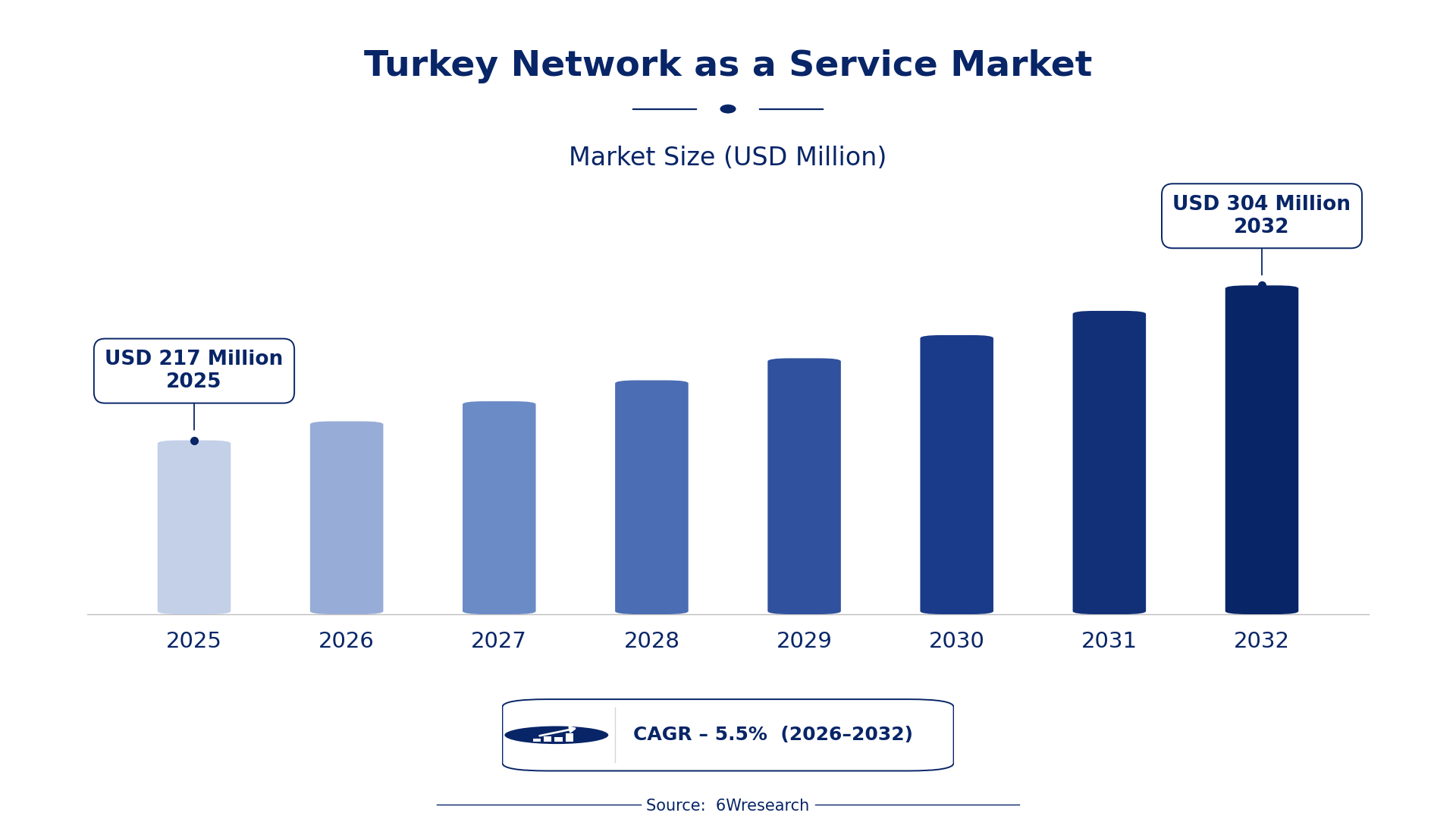
The Turkey Network as a Service Market was estimated at USD 217 Million in 2025 and is projected to reach USD 304 Million by 2032, growing at a CAGR of 5.5% from 2026 to 2032.
Turkey Network as a Service Market Synopsis
The Turkey Network as a Service market is witnessing a paradigm shift as businesses increasingly embrace cloud-based networking solutions. This transition is not merely a trend but a strategic move to enhance operational agility and drive digital transformation across various sectors.
With the growing demand for scalable and cost-effective network infrastructure, enterprises are finding value in NaaS offerings that allow them to optimize resource allocation. As companies pivot towards software-defined networking and virtualization technologies, the market is set for significant growth, backed by innovative service delivery models.
Turkey Network as a Service Market Year-wise Growth Rate and Key Drivers
This graph illustrates the annual growth rates of the Turkey Network as a Service Market from 2021 to 2032, highlighting a steady upward trajectory and projected expansion over the forecast period.
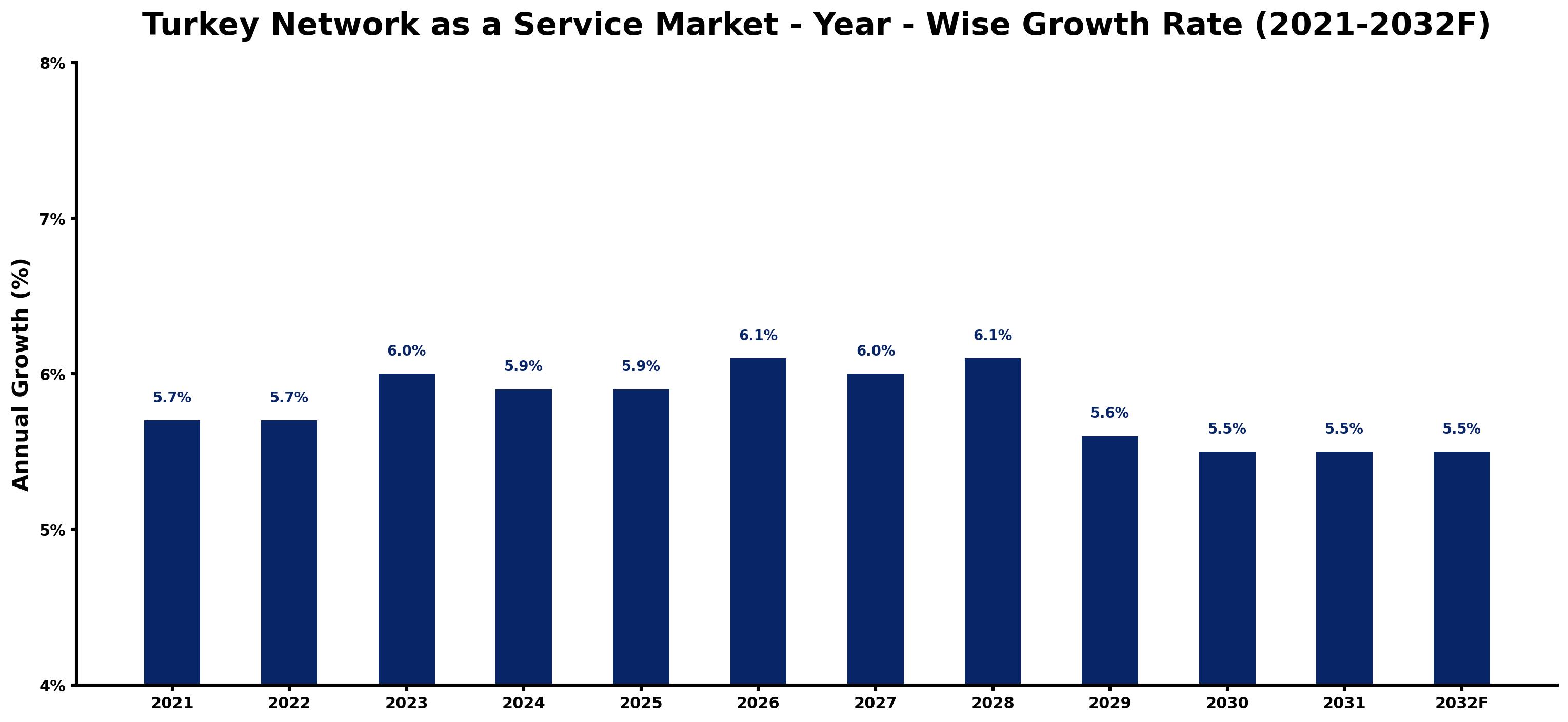
The table below presents the year‑wise growth rates along with the key drivers influencing the market
| Year | Growth Rate | Major Drivers |
| 2021 | 5.7% | Government's focus on enhancing digital infrastructure investments. |
| 2022 | 5.7% | Increased enterprise adoption of hybrid work models post-pandemic. |
| 2023 | 6.0% | Rising interest in IoT applications driving connectivity needs. |
| 2024 | 5.9% | Telecom Authority's initiatives promoting virtual network services. |
| 2025 | 5.9% | Growing cybersecurity regulations pushing demand for secure networks. |
| 2026 | 6.1% | Local startups leveraging NaaS for agile development solutions. |
| 2027 | 6.0% | Increased foreign investments in Turkey's tech sector. |
| 2028 | 6.1% | Rising competition among ISPs spurring innovative service offerings. |
| 2029 | 5.6% | Increasing urbanization leading to higher connectivity requirements. |
| 2030 | 5.5% | Demand for remote healthcare services driving network expansion. |
| 2031 | 5.5% | Government policies supporting digitization in education sectors. |
| 2032 | 5.5% | Emerging smart city projects requiring scalable network solutions. |
Note: Market size estimations and growth projections presented in this report are based on 6Wresearch's proprietary forecasting methodology, utilizing the latest available industry data, government publications, and primary research inputs.
Turkey Network as a Service Market Key Takeaways
Below are some of the specific key takeaways from the market, including:
- The shift to cloud-based networking is driving demand for flexible NaaS solutions.
- Enterprises are focusing on reducing capital expenditures by adopting NaaS offerings.
- Software-defined networking is becoming a critical component of NaaS implementations.
- Government initiatives are playing a supportive role in promoting NaaS adoption.
- Challenges related to service reliability and regulatory compliance persist in the market.
Evaluation of Restraints in Turkey Network as a Service Market
Despite the promising growth trajectory, Turkey's NaaS market faces several challenges that can impede its full potential. One major restraint is the complexity involved in deploying and managing virtualized network services. Many enterprises struggle with ensuring service reliability, which is essential for maintaining customer satisfaction. Additionally, navigating the regulatory landscape can be daunting, with legal considerations impacting NaaS agreements and service level agreements. These factors necessitate a careful approach to implementation, which may slow down adoption rates.
Turkey Network as a Service Market Trends
Several trends are shaping the future of NaaS in Turkey. The growing emphasis on digital transformation is prompting organizations to seek more agile networking solutions. Cloud computing adoption is accelerating, leading to increased interest in NaaS offerings that provide scalability and flexibility.
on top of that, the rise of Internet of Things (IoT) applications is creating new demands for network resources that can adapt to fluctuating usage patterns. As enterprises continue to embrace automation and data analytics, the need for efficient network management solutions will likely grow, driving further interest in NaaS.
Turkey Network as a Service Market Opportunities
The NaaS market in Turkey presents several growth opportunities for businesses looking to innovate. One area ripe for investment is the integration of advanced security features into NaaS solutions, addressing growing concerns around data protection. Additionally, partnerships between telecom providers and cloud service companies can facilitate faster deployments and broaden service offerings.
There is also potential for tailored NaaS solutions catering to specific industries, such as healthcare and finance, where regulatory compliance is critical. This targeted approach could enhance service value and attract a wider range of clients.
Government Initiatives in the Turkey Network as a Service Market
Government policy is actively shaping the Turkey Network as a Service market by promoting the adoption of cloud technologies and enhancing digital infrastructure. These initiatives are crucial as they create a conducive environment for businesses to transition to NaaS solutions, ultimately enhancing the country’s competitive edge in the global market.
- A national digital infrastructure upgrade programme launched in early 2025 aims to enhance connectivity across urban and rural areas.
- Currently ongoing regulatory reforms for telecom service providers are designed to streamline NaaS deployments and reduce bureaucratic hurdles.
- Incentives for NaaS innovation were introduced in 2026, encouraging startups and established companies to invest in advanced networking solutions.
- A planned public-private initiative is expected to expand telecom infrastructure access by 2028, facilitating broader NaaS adoption.
- The government is working on a regulatory framework for data privacy, anticipated to be finalized by late 2026, ensuring compliance in NaaS agreements.
Future Insights of the Turkey Network as a Service Market
Looking ahead to 2026-2032, the Turkey Network as a Service market is likely to expand as digital transformation initiatives gain momentum across industries. The focus on sustainable networking solutions will become increasingly relevant, as businesses seek to minimize their environmental impact while maximizing operational efficiency.
The integration of artificial intelligence into NaaS offerings will enable smarter resource allocation and improved service management. As customer expectations evolve, providers will need to enhance their offerings continuously, ensuring they remain competitive in a rapidly changing market.
Turkey Network as a Service Market Latest Developments
In the past year, activity in the Turkey Network as a Service market has intensified, marked by a series of strategic initiatives aimed at enhancing service delivery. Companies are increasingly focusing on partnerships and technology upgrades to meet the growing demand for flexible networking solutions.
- A leading regional operator launched a new NaaS platform in Q2 2025, providing businesses with enhanced control over their network resources.
- In mid-2025, a major technology vendor initiated a project to integrate AI capabilities into existing NaaS solutions, aiming to improve efficiency.
- A collaborative effort between telecom providers and cloud service companies is currently underway, set to expand service availability by late 2026.
- Plans for a new data center, expected to support NaaS deployments, are scheduled to begin construction in early 2026.
- An initiative to standardize service level agreements for NaaS offerings is expected to be rolled out by mid-2026, enhancing trust and reliability in the market.
Turkey Network as a Service Market - Key Attractiveness of the Report
- 10 Years of Market Numbers
- Historical Data Starting from 2022 to 2025
- Base Year: 2025
- Forecast Data until 2032
- Key Performance Indicators Impacting the Market
- Major Upcoming Developments and Projects
Key Highlights of the Report:
- Turkey Network as a Service Market Outlook
- Market Size of Turkey Network as a Service Market, 2025
- Forecast of Turkey Network as a Service Market, 2032
- Historical Data and Forecast of Turkey Network as a Service Revenues & Volume for the Period 2022-2032F
- Turkey Network as a Service Market Trend Evolution
- Turkey Network as a Service Market Drivers and Challenges
- Turkey Network as a Service Price Trends
- Turkey Network as a Service Porter's Five Forces
- Turkey Network as a Service Industry Life Cycle
- Historical Data and Forecast of Turkey Network as a Service Market Revenues & Volume By Type for the Period 2022-2032F
- Historical Data and Forecast of Turkey Network as a Service Market Revenues & Volume By Local Area Network and Wireless Local Area Network for the Period 2022-2032F
- Historical Data and Forecast of Turkey Network as a Service Market Revenues & Volume By Wire Area Network for the Period 2022-2032F
- Historical Data and Forecast of Turkey Network as a Service Market Revenues & Volume By Communication and Collaboration for the Period 2022-2032F
- Historical Data and Forecast of Turkey Network as a Service Market Revenues & Volume By Network Security for the Period 2022-2032F
- Historical Data and Forecast of Turkey Network as a Service Market Revenues & Volume By End User for the Period 2022-2032F
- Historical Data and Forecast of Turkey Network as a Service Market Revenues & Volume By Banking, Financial, Services, and Insurance for the Period 2022-2032F
- Historical Data and Forecast of Turkey Network as a Service Market Revenues & Volume By Manufacturing for the Period 2022-2032F
- Historical Data and Forecast of Turkey Network as a Service Market Revenues & Volume By Retail and eCommerce for the Period 2022-2032F
- Historical Data and Forecast of Turkey Network as a Service Market Revenues & Volume By Software and Technology for the Period 2022-2032F
- Historical Data and Forecast of Turkey Network as a Service Market Revenues & Volume By Media and Entertainment for the Period 2022-2032F
- Historical Data and Forecast of Turkey Network as a Service Market Revenues & Volume By Healthcare for the Period 2022-2032F
- Historical Data and Forecast of Turkey Network as a Service Market Revenues & Volume By Education for the Period 2022-2032F
- Historical Data and Forecast of Turkey Network as a Service Market Revenues & Volume By Government for the Period 2022-2032F
- Historical Data and Forecast of Turkey Network as a Service Market Revenues & Volume By Organization Size for the Period 2022-2032F
- Historical Data and Forecast of Turkey Network as a Service Market Revenues & Volume By Large Enterprises for the Period 2022-2032F
- Historical Data and Forecast of Turkey Network as a Service Market Revenues & Volume By SMEs for the Period 2022-2032F
- Historical Data and Forecast of Turkey Network as a Service Market Revenues & Volume By Application for the Period 2022-2032F
- Historical Data and Forecast of Turkey Network as a Service Market Revenues & Volume By UCaaS/Video Conferencing for the Period 2022-2032F
- Historical Data and Forecast of Turkey Network as a Service Market Revenues & Volume By Virtual Private Network for the Period 2022-2032F
- Historical Data and Forecast of Turkey Network as a Service Market Revenues & Volume By Cloud and SaaS Connectivity for the Period 2022-2032F
- Historical Data and Forecast of Turkey Network as a Service Market Revenues & Volume By Bandwidth on Demand for the Period 2022-2032F
- Historical Data and Forecast of Turkey Network as a Service Market Revenues & Volume By Multi-Branch Connectivity for the Period 2022-2032F
- Historical Data and Forecast of Turkey Network as a Service Market Revenues & Volume By WAN Optimization for the Period 2022-2032F
- Historical Data and Forecast of Turkey Network as a Service Market Revenues & Volume By Secure Web Gateway for the Period 2022-2032F
- Turkey Network as a Service Import Export Trade Statistics
- Market Opportunity Assessment By Type
- Market Opportunity Assessment By End User
- Market Opportunity Assessment By Organization Size
- Market Opportunity Assessment By Application
- Turkey Network as a Service Top Companies Market Share
- Turkey Network as a Service Competitive Benchmarking By Technical and Operational Parameters
- Turkey Network as a Service Company Profiles
- Turkey Network as a Service Key Strategic Recommendations






































