Turkey Non-ferrous Metal Market Summary
The turkey non-ferrous metal market was estimated at USD 210 Million in 2025 and is projected to reach USD 290 Million by 2032, growing at a CAGR of 5.8% from 2026 to 2032.
Turkey Non-ferrous Metal Market Year-wise Growth Rate and Key Drivers
This graph highlights how the Turkey Non-ferrous Metal Market has steadily grown over the past five years, supported by major growth factors.
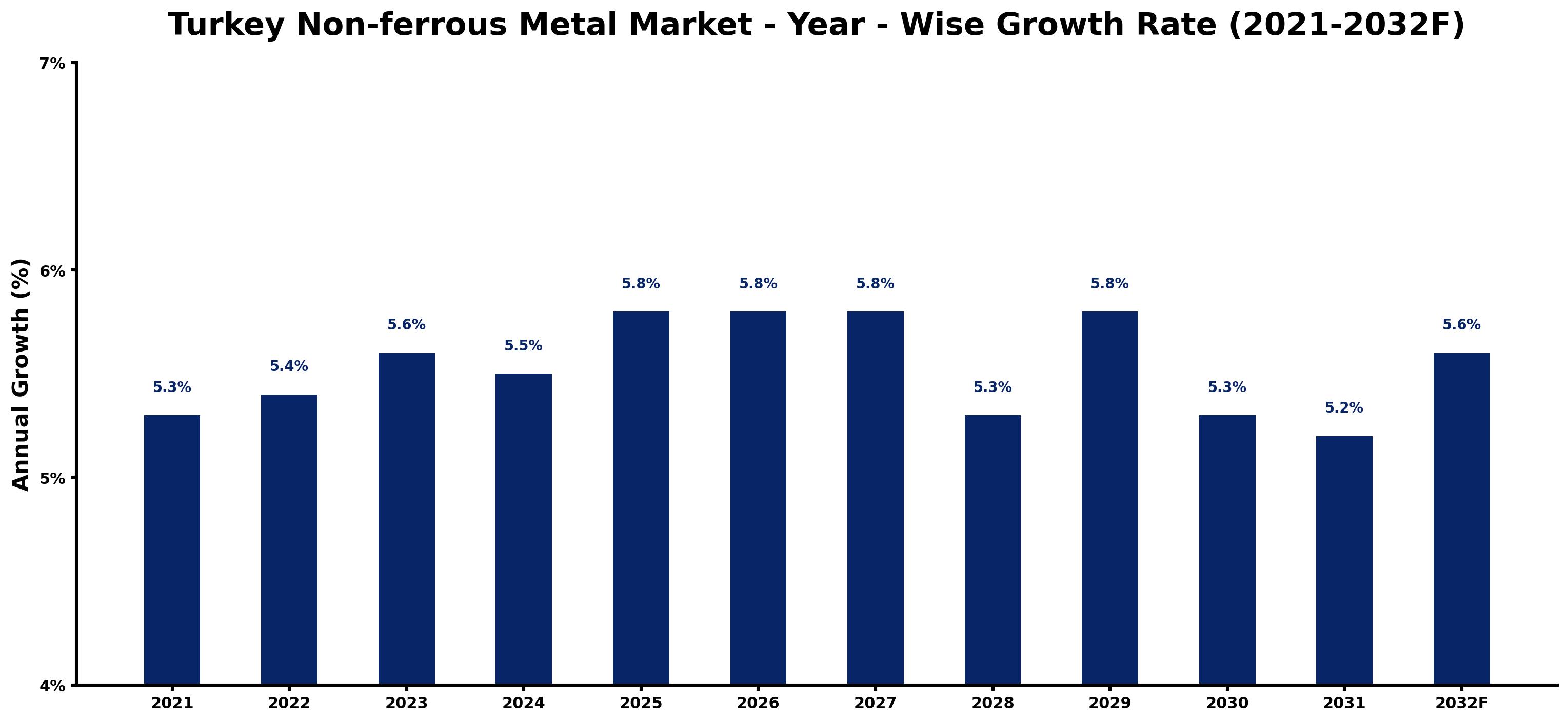
The table below presents the year wise growth rates along with the key drivers influencing the market
| Year | Growth Rate | Major Drivers |
| 2021 | 5.3% | Turkey's evolving construction sector demands innovative materials, boosting non-ferrous metal usage. |
| 2022 | 5.4% | Technological upgrades in manufacturing processes enhance efficiency and product quality for metals. |
| 2023 | 5.6% | Regional geopolitical shifts create new trade routes, expanding market accessibility for exporters. |
| 2024 | 5.5% | Local automakers increasingly rely on lightweight metals, driving consumption and market growth. |
| 2025 | 5.8% | Sustainable practices gain traction, encouraging recycled non-ferrous materials in various industries. |
| 2026 | 5.8% | Infrastructure investments throughout Turkey necessitate strong metal components for durability and safety. |
| 2027 | 5.8% | Growing urbanization in Turkey fuels demand for electrical systems using copper and aluminum. |
| 2028 | 5.3% | Consumer electronics sector experiences innovation cycles, amplifying demand for non-ferrous metal inputs. |
| 2029 | 5.8% | Expanding renewable energy projects highlight the need for aluminum in solar and wind applications. |
| 2030 | 5.3% | Emerging industries in Turkey adopt non-ferrous materials for enhanced product performance and longevity. |
| 2031 | 5.2% | Investment in research and development opens avenues for advanced metal alloys and applications. |
| 2032 | 5.6% | Global economic recovery post-pandemic stimulates exports, reinforcing Turkey's position in metal markets. |
Note - Market size estimations and growth projections presented in this report are based on 6Wresearch's advanced forecasting approach, validated with industry datasets as of June 2026.
Turkey Non-ferrous Metal Market Synopsis
The Turkey Non-ferrous Metal Market is projected to reach 5.8% and witness significant growth during the forecast period (2026-2032). This expansion is largely driven by the rising demand for essential non-ferrous metals such as aluminum, copper, and zinc across various industries, including automotive, construction, electronics, and packaging. Turkey's rich deposits of base metals, including bauxite ore, copper ore, and lead-zinc deposits, along with substantial reserves of gold, silver, and iron ores, underscore the nation's strategic importance in this market.
Turkey Non-ferrous Metal Market Growth Drivers
The growth trajectory of the Turkey Non-ferrous Metal Market is influenced by several key factors:
- Increasing industrial demand: As industries such as automotive and construction continue to expand, the demand for non-ferrous metals that are essential for manufacturing processes rises significantly.
- Investment in R&D: Leading companies in the non-ferrous metal sector are investing heavily in research and development, focusing on product innovation and enhancing the quality of non-ferrous materials.
- Global export opportunities: With Turkey's strategic location and trade agreements with developed countries, the country is well-positioned to export non-ferrous metals to markets that require cost-effective raw materials.
- Government initiatives: The Turkish government is promoting domestic production through various initiatives aimed at enhancing local enterprises' capabilities in high-quality metal production.
- Growth across end-user sectors: The rising utilization of non-ferrous metals in diverse applications—ranging from aerospace, medical technology, to agriculture—boosts the overall market demand.
Turkey Non-ferrous Metal Market Trends and Opportunities
Observing current trends reveals a significant shift towards sustainability within the Turkey Non-ferrous Metal Market. There is a growing focus on recycling and the development of eco-friendly mining practices, spurred by both environmental regulations and consumer preference for sustainable resources.
- Investments in recycling technologies are on the rise, reflecting a global trend toward sustainable practices that minimize waste and maximize resource efficiency.
- The ongoing digital transformation in manufacturing is leading to the adoption of smart technologies, enhancing operational efficiencies in metal production and processing.
- Turkey's strategic geographical position serves as an opportunity for businesses to access European and Asian markets effectively, providing an edge in logistics and distribution.
- Emerging applications for non-ferrous metals in high-tech industries, such as renewable energy systems and electric vehicles, create new avenues for growth.
- Strong government backing for innovation in the sector is likely to lead to advancements and competitiveness in the global market.
Turkey Non-ferrous Metal Market Challenges and Restraints
Despite the positive outlook, the Turkey Non-ferrous Metal Market also faces several challenges that could impact growth:
- Limited production capacities lead to substantial amounts of output being consumed domestically, restraining the potential for exports.
- Global market volatility, including fluctuations in prices for raw materials, can affect profitability for producers and impact investment decisions.
- Environmental concerns and stricter regulations are presenting operational challenges, necessitating compliance while maintaining productivity.
- Competition from multinational corporations can pose threats to local businesses, especially in technology and product innovation.
- Dependence on domestic consumption can hinder market responsiveness to international demand shifts, affecting overall growth.
Turkey Non-ferrous Metal Market Government Investment and Initiatives
The Turkish government has implemented various investment initiatives to bolster the non-ferrous metal industry. These include:
- Policies aimed at enhancing foreign direct investment (FDI) in production and processing initiatives, which are essential for fostering sectoral growth and technological advancement.
- Subsidies and tax incentives for companies investing in R&D and innovative manufacturing technologies, aimed at improving the quality and efficiency of non-ferrous metal production.
- Development plans that focus on expanding infrastructure, enhancing logistics, and improving supply chain efficiencies to better serve industrial needs.
- Support for sustainability initiatives within the industry, promoting environmentally responsible mining practices and recycling to mitigate ecological impacts.
- Encouragement of partnerships between public institutions and private companies to drive innovation, with a focus on developing high-quality products for both domestic use and export.
Turkey Non-ferrous Metal Market Latest Developments (May 2025 - June 2026)
Between May 2025 and June 2026, the Turkey Non-ferrous Metal Market has seen a range of developments that reflect its evolving landscape. The sector has embraced increased sustainability practices, with more companies investing in green technologies aimed at reducing environmental footprints. Additionally, collaborations between local enterprises and international partners have become more prominent, enhancing market reach and strengthening supply chains. The Turkish government has continued to introduce new policies that facilitate technological advancements and promote increased efficiency in metal processing and production. Finally, the demand for high-quality non-ferrous metals has grown steadily, driven by ongoing industrial expansion and the rising prominence of electric vehicle manufacturing.
Turkey Non-ferrous Metal Market - Key Attractiveness of the Report
- 10 Years of Market Numbers
- Historical Data Starting from 2022 to 2025
- Base Year: 2025
- Forecast Data until 2032
- Key Performance Indicators Impacting the Market
- Major Upcoming Developments and Projects
Key Highlights of the Report:
- Turkey Non-ferrous Metal Market Outlook
- Market Size of Turkey Non-ferrous Metal Market, 2025
- Forecast of Turkey Non-ferrous Metal Market, 2032F
- Historical Data and Forecast of Turkey Non-ferrous Metal Revenues & Volume for the Period 2022-2032F
- Turkey Non-ferrous Metal Market Trend Evolution
- Turkey Non-ferrous Metal Market Drivers and Challenges
- Turkey Non-ferrous Metal Price Trends
- Turkey Non-ferrous Metal Porter's Five Forces
- Turkey Non-ferrous Metal Industry Life Cycle
- Historical Data and Forecast of Turkey Non-ferrous Metal Market Revenues & Volume By Types for the Period 2022-2032F
- Historical Data and Forecast of Turkey Non-ferrous Metal Market Revenues & Volume By Aluminum for the Period 2022-2032F
- Historical Data and Forecast of Turkey Non-ferrous Metal Market Revenues & Volume By Copper for the Period 2022-2032F
- Historical Data and Forecast of Turkey Non-ferrous Metal Market Revenues & Volume By Lead for the Period 2022-2032F
- Historical Data and Forecast of Turkey Non-ferrous Metal Market Revenues & Volume By Tin for the Period 2022-2032F
- Historical Data and Forecast of Turkey Non-ferrous Metal Market Revenues & Volume By Nickel for the Period 2022-2032F
- Historical Data and Forecast of Turkey Non-ferrous Metal Market Revenues & Volume By Titanium for the Period 2022-2032F
- Historical Data and Forecast of Turkey Non-ferrous Metal Market Revenues & Volume By Zinc for the Period 2022-2032F
- Historical Data and Forecast of Turkey Non-ferrous Metal Market Revenues & Volume By Applications for the Period 2022-2032F
- Historical Data and Forecast of Turkey Non-ferrous Metal Market Revenues & Volume By Automobile Industry for the Period 2022-2032F
- Historical Data and Forecast of Turkey Non-ferrous Metal Market Revenues & Volume By Electronic Power Industry for the Period 2022-2032F
- Historical Data and Forecast of Turkey Non-ferrous Metal Market Revenues & Volume By Construction Industry for the Period 2022-2032F
- Historical Data and Forecast of Turkey Non-ferrous Metal Market Revenues & Volume By Other for the Period 2022-2032F
- Turkey Non-ferrous Metal Import Export Trade Statistics
- Market Opportunity Assessment By Types
- Market Opportunity Assessment By Applications
- Turkey Non-ferrous Metal Top Companies Market Share
- Turkey Non-ferrous Metal Competitive Benchmarking By Technical and Operational Parameters
- Turkey Non-ferrous Metal Company Profiles
- Turkey Non-ferrous Metal Key Strategic Recommendations






































