Turkey Perchloroethylene Market Size, Share & Growth Rate
The Turkey Perchloroethylene Market was estimated at USD 1224 Million in 2025 and is projected to reach USD 1736 Million by 2032, growing at a CAGR of 5.1% from 2026 to 2032. This growth trajectory is primarily driven by the robust expansion of the textile and dry cleaning sectors, which increasingly rely on perchloroethylene for efficient cleaning solutions. Furthermore, the rising adoption of eco-friendly practices is prompting manufacturers to explore innovative applications and sustainable alternatives, further fueling market dynamics.
Turkey Perchloroethylene Market Year-wise Growth Rate and Key Drivers
This graph highlights how the Turkey Perchloroethylene Market has steadily grown over the years, supported by major growth factors.
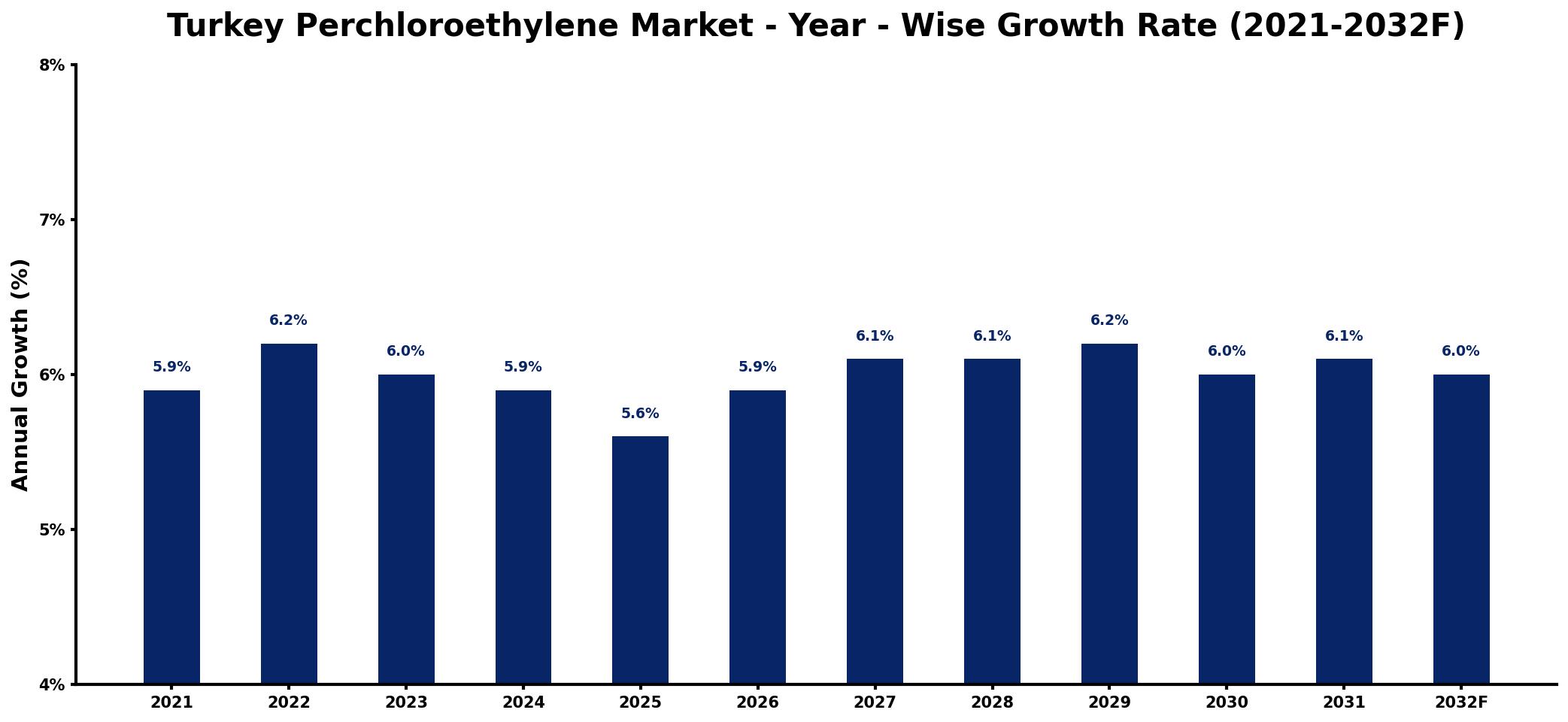
The table below presents the year‑wise growth rates along with the key drivers influencing the market
| Year | Growth Rate | Major Drivers |
| 2021 | 5.9% | Rising demand from dry cleaning |
| 2022 | 6.2% | Growth in industrial cleaning applications |
| 2023 | 6.0% | Expansion of automotive maintenance services |
| 2024 | 5.9% | Increased investments in manufacturing |
| 2025 | 5.6% | Emerging markets driving consumption |
| 2026 | 5.9% | Technological advancements in production |
| 2027 | 6.1% | Surge in environmental regulations compliance |
| 2028 | 6.1% | growing emerging market penetration |
| 2029 | 6.2% | Increasing focus on sustainable practices |
| 2030 | 6.0% | Rising automotive repair service demand |
| 2031 | 6.1% | growing automotive sector requirements |
| 2032 | 6.0% | enhanced product quality standards |
Note: Market size estimations and growth projections presented in this report are based on 6Wresearch's proprietary forecasting methodology, utilizing the latest available industry data, government publications, and primary research inputs.
Turkey Perchloroethylene Market Synopsis
A major driving force in the Turkey Perchloroethylene Market is the significant demand from the dry cleaning and textile industries. As Turkey's textile sector continues to flourish, the need for effective cleaning solvents like perchloroethylene has become essential for maintaining high-quality standards in garment care.
In addition, stringent environmental regulations are shaping industry practices, pushing companies towards sustainable solutions. The transition towards eco-friendly alternatives is not only a response to regulations but also aligns with consumer preferences, thereby influencing purchasing behaviors and strategic directions in the market.
Turkey Perchloroethylene Market Key Takeaways
- The market is driven primarily by the textile and dry cleaning sectors, with a focus on innovation and sustainability.
- Investment in research and development is increasing to meet the demand for eco-friendly alternatives.
- Regulatory pressures are prompting traditional manufacturers to adapt to changing market dynamics.
- Technological advancements are enhancing production efficiency and product quality.
- Turkey's government policies support environmental sustainability and occupational safety within the industry.
Evaluation of Restraints in Turkey Perchloroethylene Market
The Turkey Perchloroethylene Market is currently navigating several constraints that may hinder its full potential. Chief among these is the increasing scrutiny and regulation surrounding environmental and health impacts associated with perchloroethylene. Rising awareness of its detrimental effects on human health and the environment has led to a significant shift in consumer preferences towards safer alternatives.
In addition, fluctuations in raw material prices and disruptions in the supply chain can create volatility in the market, impacting both the cost and availability of perchloroethylene. As competition intensifies from imported alternatives, manufacturers are compelled to enhance their product offerings while maintaining competitive pricing, further complicating operational strategies.
Turkey Perchloroethylene Market Trends
Current trends indicate a robust shift towards sustainable practices within the Turkey Perchloroethylene Market. Companies are increasingly investing in eco-friendly solvents and technologies, responding to both consumer demands and regulatory requirements. The emphasis on digitalization and automation is also notable, as firms leverage technology to optimize operational efficiency and ensure consistent product quality.
Moreover, there is a growing awareness of the importance of reducing the carbon footprint in manufacturing processes. As a result, industries are likely to continue seeking innovations that marry efficiency with sustainability, reinforcing a commitment to responsible production practices.
Turkey Perchloroethylene Market Opportunities
The Turkey Perchloroethylene Market offers substantial investment opportunities across various sectors, particularly in dry cleaning and textile processing. The anticipated growth in these industries presents avenues for investors to explore production facilities or distribution channels. Furthermore, the demand for perchloroethylene will be bolstered by ongoing industrial growth and an increasing focus on sustainable chemical solutions.
Investments in research and development to create eco-friendly solvents can lead to long-term gains, positioning companies at the forefront of a transforming market. Investors who focus on understanding the regulatory landscape and align with sustainability initiatives will find particularly lucrative opportunities.
Government Initiatives in the Turkey Perchloroethylene Market
The Turkish government has implemented various policies aimed at ensuring environmental protection and occupational health regarding the use of perchloroethylene. Regulations governing the use, handling, and disposal of this chemical are designed to mitigate health risks and environmental pollution. Compliance with these policies is rigorously monitored to ensure adherence to best practices that promote sustainability and worker safety.
Future Insights of the Turkey Perchloroethylene Market
Looking ahead to the period between 2026 and 2032, the Turkey Perchloroethylene Market is poised for significant evolution. With an increased focus on environmental sustainability and a thriving textile industry, demand for perchloroethylene is expected to rise. Companies that successfully adapt to the changing landscape and invest in sustainable alternatives will likely thrive amid regulatory changes and shifting consumer preferences.
Turkey Perchloroethylene Market Latest Developments (2025 - 2026)
Recent developments in the Turkey Perchloroethylene Market have highlighted a trend towards adopting advanced technologies aimed at enhancing production efficiency. The drive for sustainability has led companies to explore innovative manufacturing processes that reduce waste and energy consumption. Concurrently, industry players are increasingly collaborating on initiatives to research and develop alternative solvents that align with environmental regulations.
Turkey Perchloroethylene Market - Key Attractiveness of the Report
- 10 Years of Market Numbers
- Historical Data Starting from 2022 to 2025
- Base Year: 2025
- Forecast Data until 2032
- Key Performance Indicators Impacting the Market
- Major Upcoming Developments and Projects
Key Highlights of the Report:
- Turkey Perchloroethylene Market Outlook
- Market Size of Turkey Perchloroethylene Market, 2025
- Forecast of Turkey Perchloroethylene Market, 2032
- Historical Data and Forecast of Turkey Perchloroethylene Revenues & Volume for the Period 2022-2032F
- Turkey Perchloroethylene Market Trend Evolution
- Turkey Perchloroethylene Market Drivers and Challenges
- Turkey Perchloroethylene Price Trends
- Turkey Perchloroethylene Porter's Five Forces
- Turkey Perchloroethylene Industry Life Cycle
- Historical Data and Forecast of Turkey Perchloroethylene Market Revenues & Volume By Type for the Period 2022-2032F
- Historical Data and Forecast of Turkey Perchloroethylene Market Revenues & Volume By Ethylene Oxychlorination for the Period 2022-2032F
- Historical Data and Forecast of Turkey Perchloroethylene Market Revenues & Volume By Acetylene Method for the Period 2022-2032F
- Historical Data and Forecast of Turkey Perchloroethylene Market Revenues & Volume By Ethylene Direct Chlorination for the Period 2022-2032F
- Historical Data and Forecast of Turkey Perchloroethylene Market Revenues & Volume By End-use for the Period 2022-2032F
- Historical Data and Forecast of Turkey Perchloroethylene Market Revenues & Volume By Dry Cleaning Agent for the Period 2022-2032F
- Historical Data and Forecast of Turkey Perchloroethylene Market Revenues & Volume By Solvent for the Period 2022-2032F
- Historical Data and Forecast of Turkey Perchloroethylene Market Revenues & Volume By Others for the Period 2022-2032F
- Turkey Perchloroethylene Import Export Trade Statistics
- Market Opportunity Assessment By Type
- Market Opportunity Assessment By End-use
- Turkey Perchloroethylene Top Companies Market Share
- Turkey Perchloroethylene Competitive Benchmarking By Technical and Operational Parameters
- Turkey Perchloroethylene Company Profiles
- Turkey Perchloroethylene Key Strategic Recommendations






































