Turkey Printed Circuit Boards Market Summary
The turkey printed circuit boards market was estimated at USD 329 Million in 2025 and is projected to reach USD 431 Million by 2032, growing at a CAGR of 4.5% from 2026 to 2032.
Turkey Printed Circuit Boards Market Year-wise Growth Rate and Key Drivers
This graph highlights how the Turkey Printed Circuit Boards Market has steadily grown over the past five years, supported by major growth factors.
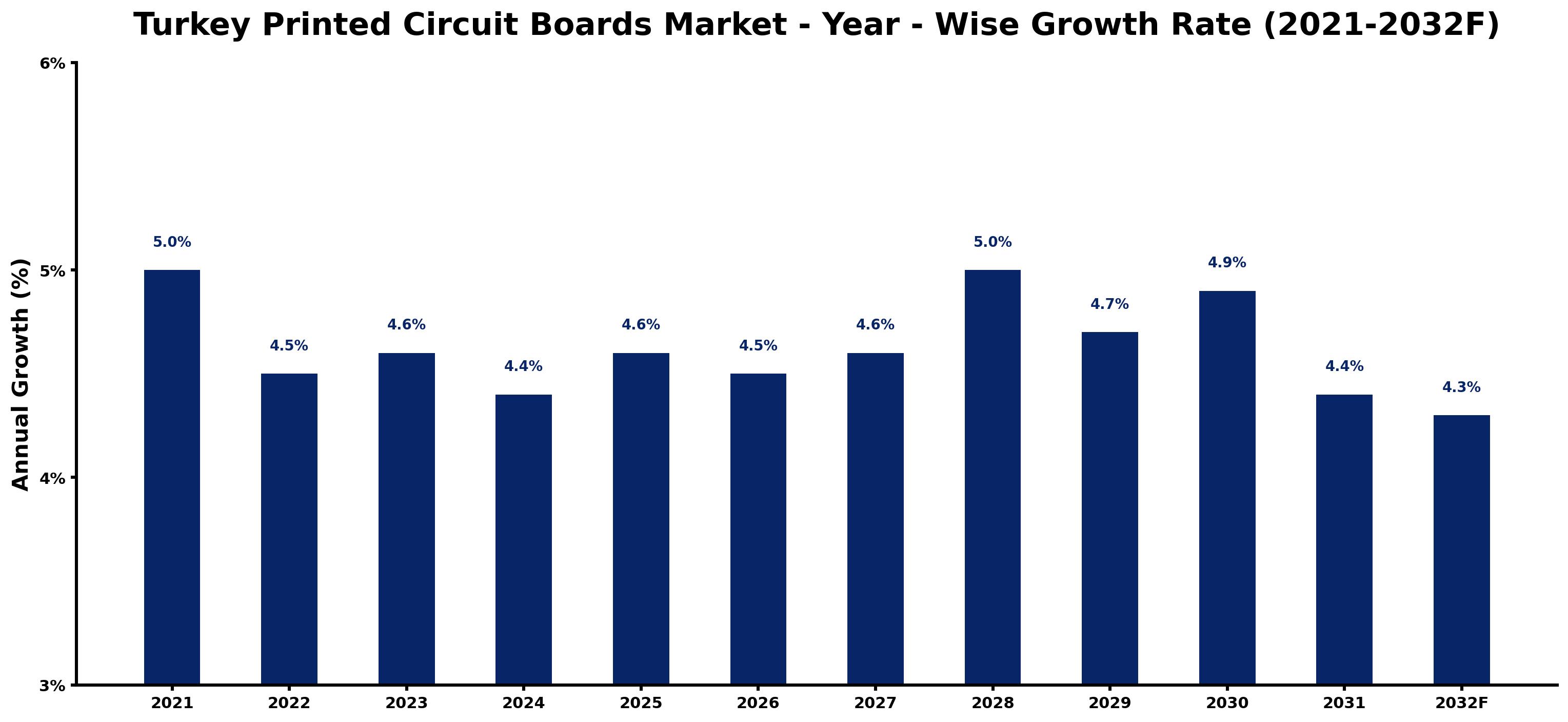
The table below presents the year wise growth rates along with the key drivers influencing the market
| Year | Growth Rate | Major Drivers |
| 2021 | 5.0% | Investments in domestic manufacturing reduce reliance on imported circuit boards significantly. |
| 2022 | 4.5% | Technological innovations boost production efficiency and product quality across the sector. |
| 2023 | 4.6% | Increased collaboration between local firms enhances competitive edge in PCB technology. |
| 2024 | 4.4% | Emerging startups introduce sustainable materials, aligning with environmental expectations. |
| 2025 | 4.6% | Regional trade agreements open new markets, expanding Turkish PCB export capabilities. |
| 2026 | 4.5% | Local demand for consumer electronics accelerates PCB production and design innovation. |
| 2027 | 4.6% | Adoption of smart technologies in manufacturing optimizes processes, lowering operational costs. |
| 2028 | 5.0% | Strong demand from automotive sectors fuels advanced PCB solutions and custom designs. |
| 2029 | 4.7% | Growing investments in telecommunications infrastructure drive diversification in PCB applications. |
| 2030 | 4.9% | Increased R&D funding leads to breakthroughs in flexible and embedded PCB technologies. |
| 2031 | 4.4% | Collaboration with international firms enhances knowledge transfer, elevating local expertise. |
| 2032 | 4.3% | Sustainability initiatives gain traction, influencing product development towards eco-friendly solutions. |
Note - Market size estimations and growth projections presented in this report are based on 6Wresearch's advanced forecasting approach, validated with industry datasets as of June 2026.
Turkey Printed Circuit Boards Market Synopsis
The Turkey Printed Circuit Boards Market is projected to reach 4.5% and witness significant growth during the forecast period (2026-2032). This market is positioned for robust expansion, with key growth drivers including an increasing demand for printed circuit boards (PCBs) across various industries such as automotive, consumer electronics, and telecommunications. The market dynamics are further enhanced by the rising adoption of electric vehicles, investments in 5G infrastructure, and proactive government initiatives designed to promote research and development activities.
Turkey Printed Circuit Boards Market Growth Drivers
The Turkey Printed Circuit Boards Market has been experiencing significant growth due to several factors:
- The automotive industry is rapidly transitioning towards advanced electronics, thereby necessitating a higher demand for PCBs to support innovations such as driver-assistance systems and electric powertrains.
- Consumer electronics are continually evolving, with smartphones and tablets becoming ubiquitous; this surge in electronic devices has led to an increased requirement for high-quality printed circuit boards.
- Telecommunications is witnessing a paradigm shift with the rollout of 5G networks, driving the need for PCBs that can meet the higher data rates and increased performance requirements.
- The growing trend of smart home devices and Internet of Things (IoT) technologies is contributing further to the demand for PCBs that can facilitate interconnected functionalities.
- Investments in research and development are anticipated to foster innovation in PCB manufacturing processes, enhancing product capabilities and efficiency.
Turkey Printed Circuit Boards Market Investment Opportunities
Investment opportunities within the Turkey Printed Circuit Boards Market are becoming increasingly attractive for stakeholders. This is largely driven by:
- A favorable manufacturing environment empowered by a skilled labor force and the easy availability of raw materials, which reduces operational costs for PCB manufacturers.
- Government initiatives aimed at promoting the electronics sector, offering incentives for companies that engage in sustainable practices and adopt advanced manufacturing technologies.
- The shift towards green energy sources is opening up new avenues for innovation, particularly in developing environmentally friendly PCBs.
- Collaborations between academia and industry are set to enhance R&D investments, yielding cutting-edge technologies that can redefine product offerings in the PCB market.
- Expanding international trade agreements will likely provide Turkish PCB manufacturers with access to broader markets, increasing export potential.
Turkey Printed Circuit Boards Market Challenges and Restraints
Despite the promising growth trajectory, the Turkey Printed Circuit Boards Market faces several challenges:
- Fluctuations in raw material prices can significantly impact production costs and pricing strategies for PCB manufacturers.
- High competitive pressure within the regional market may lead to price wars, which can affect profit margins and overall sustainability.
- The complexity of technology requirements in industries like automotive and aerospace necessitates substantial investment in R&D to meet safety and regulatory standards.
- Environmental regulations are becoming stricter, requiring manufacturers to adapt to new compliance measures, potentially increasing operational costs.
- Supply chain disruptions, particularly in the context of global events, can affect the timely availability of critical materials and components needed for PCB production.
Turkey Printed Circuit Boards Market Government Investment and Initiatives
The Turkish government's strategic initiatives play a crucial role in shaping the landscape of the printed circuit boards market. These initiatives include:
- Public spending on infrastructure improvements, particularly in telecommunications, which supports the demand for advanced PCBs.
- Incentives for local manufacturers to invest in sustainability measures, thereby promoting eco-friendly production practices within the PCB industry.
- Funding for research and innovation programs aimed at enhancing the capabilities of domestic PCB manufacturers.
- Efforts to attract foreign direct investment (FDI) in the electronics sector, which can lead to the establishment of new manufacturing facilities and technology transfer.
- Support for educational programs focused on developing a skilled workforce tailored for the electronics manufacturing industry.
Turkey Printed Circuit Boards Market Latest Developments (May 2025 - June 2026)
Recent developments in the Turkey Printed Circuit Boards Market indicate a proactive shift towards embracing advanced technologies and sustainable practices. During this period, the industry has seen:
- Increased investments in automation and digitization within PCB manufacturing processes, leading to improved efficiency and reduced lead times.
- Collaborations between technology firms and educational institutions aimed at driving innovation in PCB design and production methodologies.
- The introduction of new regulatory frameworks focused on enhancing environmental sustainability, compelling manufacturers to adapt to greener practices.
- A rise in partnerships within the supply chain to ensure a more resilient and efficient operations model, keeping up with global demand fluctuations.
- Enhancements in customer engagement strategies through the implementation of advanced analytics to better understand market needs and drive product development.
Turkey Printed Circuit Boards Market - Key Attractiveness of the Report
- 10 Years of Market Numbers
- Historical Data Starting from 2022 to 2025
- Base Year: 2025
- Forecast Data until 2032
- Key Performance Indicators Impacting the Market
- Major Upcoming Developments and Projects
Key Highlights of the Report:
- Turkey Printed Circuit Boards Market Outlook
- Market Size of Turkey Printed Circuit Boards Market, 2025
- Forecast of Turkey Printed Circuit Boards Market, 2032F
- Historical Data and Forecast of Turkey Printed Circuit Boards Revenues & Volume for the Period 2022-2032F
- Turkey Printed Circuit Boards Market Trend Evolution
- Turkey Printed Circuit Boards Market Drivers and Challenges
- Turkey Printed Circuit Boards Price Trends
- Turkey Printed Circuit Boards Porter's Five Forces
- Turkey Printed Circuit Boards Industry Life Cycle
- Historical Data and Forecast of Turkey Printed Circuit Boards Market Revenues & Volume By Types for the Period 2022-2032F
- Historical Data and Forecast of Turkey Printed Circuit Boards Market Revenues & Volume By Single Sided for the Period 2022-2032F
- Historical Data and Forecast of Turkey Printed Circuit Boards Market Revenues & Volume By Double Sided for the Period 2022-2032F
- Historical Data and Forecast of Turkey Printed Circuit Boards Market Revenues & Volume By Multi-Layer for the Period 2022-2032F
- Historical Data and Forecast of Turkey Printed Circuit Boards Market Revenues & Volume By HDI for the Period 2022-2032F
- Historical Data and Forecast of Turkey Printed Circuit Boards Market Revenues & Volume By Substrate for the Period 2022-2032F
- Historical Data and Forecast of Turkey Printed Circuit Boards Market Revenues & Volume By Rigid for the Period 2022-2032F
- Historical Data and Forecast of Turkey Printed Circuit Boards Market Revenues & Volume By Flexible for the Period 2022-2032F
- Historical Data and Forecast of Turkey Printed Circuit Boards Market Revenues & Volume By Rigid-Flex for the Period 2022-2032F
- Historical Data and Forecast of Turkey Printed Circuit Boards Market Revenues & Volume By End-users for the Period 2022-2032F
- Historical Data and Forecast of Turkey Printed Circuit Boards Market Revenues & Volume By Industrial Electronics for the Period 2022-2032F
- Historical Data and Forecast of Turkey Printed Circuit Boards Market Revenues & Volume By Healthcare for the Period 2022-2032F
- Historical Data and Forecast of Turkey Printed Circuit Boards Market Revenues & Volume By Aerospace & Defense for the Period 2022-2032F
- Historical Data and Forecast of Turkey Printed Circuit Boards Market Revenues & Volume By Automotive for the Period 2022-2032F
- Historical Data and Forecast of Turkey Printed Circuit Boards Market Revenues & Volume By IT & Telecom for the Period 2022-2032F
- Historical Data and Forecast of Turkey Printed Circuit Boards Market Revenues & Volume By Consumer Electronics for the Period 2022-2032F
- Historical Data and Forecast of Turkey Printed Circuit Boards Market Revenues & Volume By Others for the Period 2022-2032F
- Turkey Printed Circuit Boards Import Export Trade Statistics
- Market Opportunity Assessment By Types
- Market Opportunity Assessment By Substrate
- Market Opportunity Assessment By End-users
- Turkey Printed Circuit Boards Top Companies Market Share
- Turkey Printed Circuit Boards Competitive Benchmarking By Technical and Operational Parameters
- Turkey Printed Circuit Boards Company Profiles
- Turkey Printed Circuit Boards Key Strategic Recommendations






































