Turkey Procurement Analytics Market Size & Growth Rate (2026-2032)
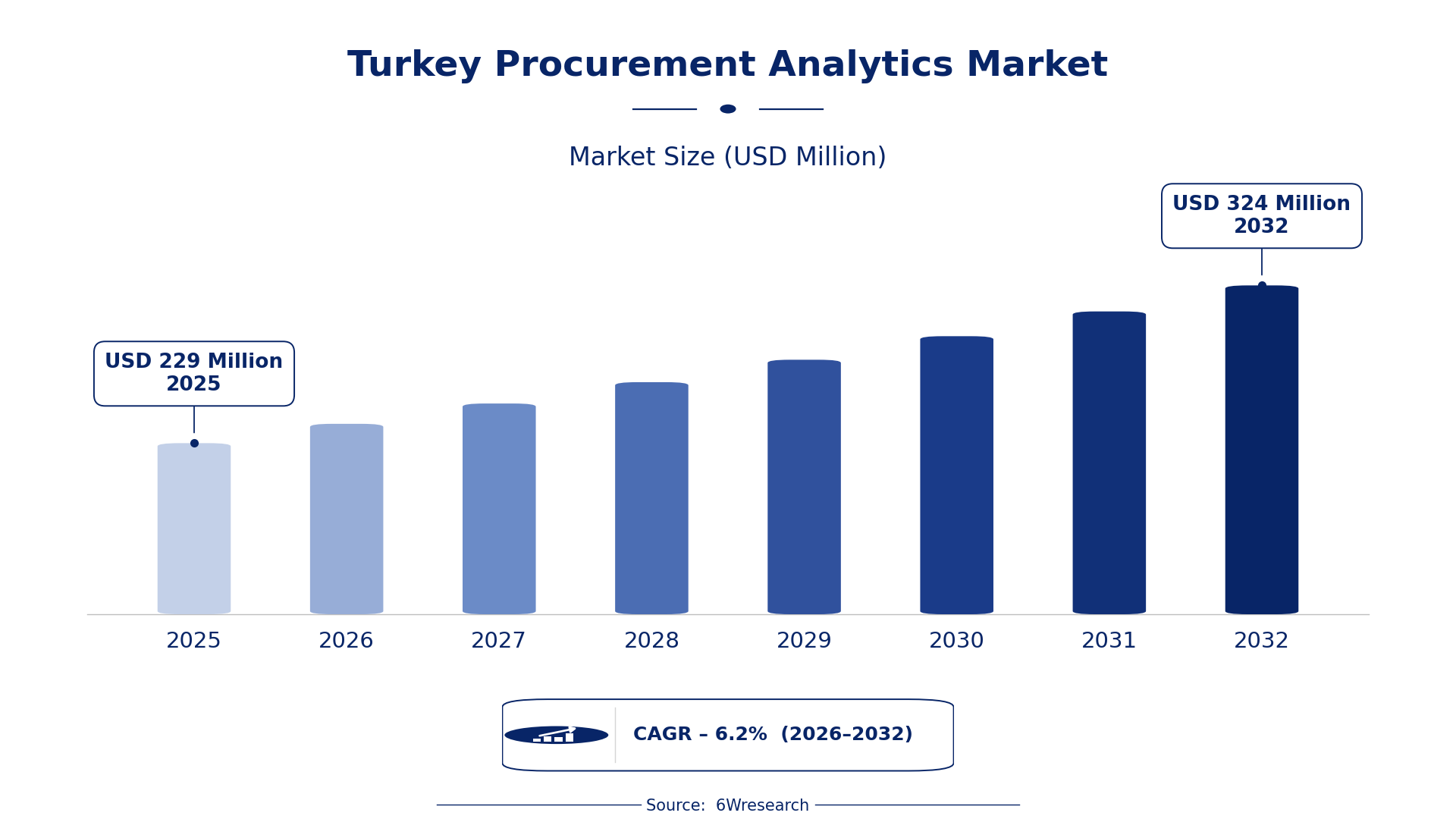
The Turkey Procurement Analytics Market was estimated at USD 229 Million in 2025 and is projected to reach USD 324 Million by 2032, growing at a CAGR of 6.2% from 2026 to 2032.
Turkey Procurement Analytics Market Synopsis
A surge in digital transformation initiatives is the primary force reshaping the Turkey Procurement Analytics Market. Organizations are increasingly recognizing the value of data-driven decision-making, using analytics tools to enhance purchasing processes and manage supplier relationships effectively.
As Turkish industries prioritize operational efficiency, the demand for procurement analytics solutions is on the rise. Businesses are leveraging technology to optimize costs, evaluate supplier performance, and mitigate risks, creating a fertile ground for market growth.
Turkey Procurement Analytics Market Year-wise Growth Rate and Key Drivers
This graph illustrates the annual growth rates of the Turkey Procurement Analytics Market from 2021 to 2032, highlighting a steady upward trajectory and projected expansion over the forecast period.
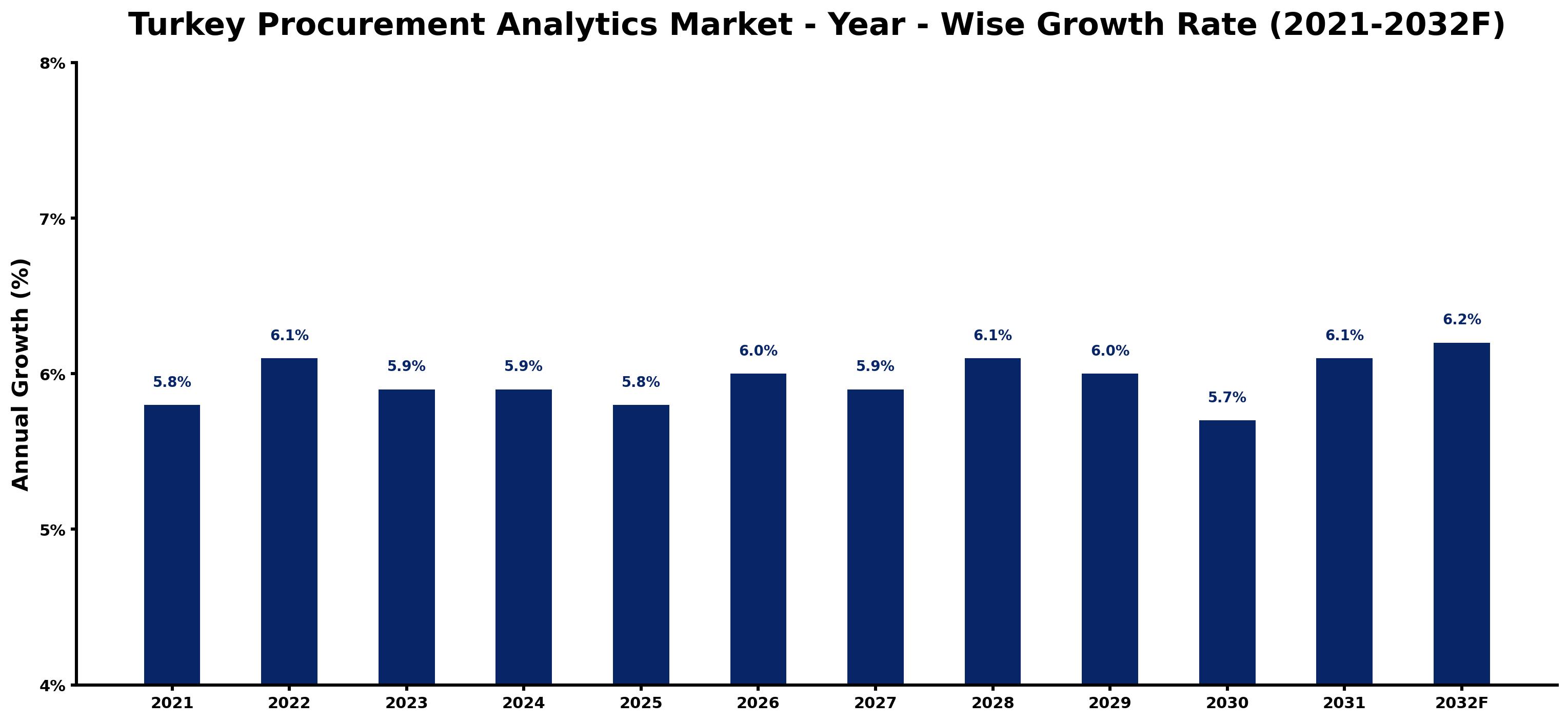
The table below presents the year‑wise growth rates along with the key drivers influencing the market
| Year | Growth Rate | Major Drivers |
| 2021 | 5.8% | Government digital transformation initiatives boosting procurement tech. |
| 2022 | 6.1% | Increased demand for data-driven supply chain optimization. |
| 2023 | 5.9% | Growth in e-commerce driving procurement analytics tools adoption. |
| 2024 | 5.9% | Investment in local startups enhancing data analytics capabilities. |
| 2025 | 5.8% | Rising emphasis on cost efficiency amid economic fluctuations. |
| 2026 | 6.0% | Public sector reforms prioritizing transparency in procurement processes. |
| 2027 | 5.9% | Integration of AI solutions in public procurement strategies. |
| 2028 | 6.1% | Supportive regulations encouraging digital bidding platforms utilization. |
| 2029 | 6.0% | Emergence of local procurement conferences fostering innovation discussions. |
| 2030 | 5.7% | Growing interest in sustainability driving analytics for Eco-friendly procurement. |
| 2031 | 6.1% | Increase in skilled workforce enhancing analytical service offerings. |
| 2032 | 6.2% | National initiatives promoting smart procurement practices and tools. |
Note: Market size estimations and growth projections presented in this report are based on 6Wresearch's proprietary forecasting methodology, utilizing the latest available industry data, government publications, and primary research inputs.
Turkey Procurement Analytics Market Key Takeaways
Below are some of the specific key takeaways from the market, including:
- Data-driven approaches are becoming essential for improving procurement efficiency and decision-making.
- Technological advancements in AI and machine learning are facilitating proactive procurement strategies.
- Real-time insights are increasingly demanded by organizations to comply with regulatory requirements.
- Integration with ERP systems is a critical component of successful analytics implementation.
- Increasing competition among analytics software providers is driving innovation and strategic partnerships.
Evaluation of Restraints in Turkey Procurement Analytics Market
Despite the positive trends, several restraints hinder the growth of the Turkey Procurement Analytics Market. A significant barrier is the challenge of integrating advanced analytics technologies into existing procurement frameworks. Many organizations struggle with the investment required for robust data infrastructure and skilled personnel capable of maximizing these tools.
on top of that, navigating the complex landscape of regulatory compliance adds layers of difficulty to analytics implementation. Companies must ensure adherence to procurement laws and vendor management standards, which can stall progress and increase operational costs.
Turkey Procurement Analytics Market Trends
The trend towards real-time analytics is gaining momentum, with businesses seeking instant insights to drive procurement strategies. This shift is not just about speed; it also reflects a deeper understanding of the need for agility in supply chain management.
In addition, the convergence of AI and machine learning with procurement analytics is transforming traditional processes. Companies are now able to predict market trends and supplier risks, thus enhancing their strategic planning capabilities.
Turkey Procurement Analytics Market Opportunities
The Turkey Procurement Analytics Market presents several promising growth avenues. As organizations increasingly prioritize efficiency and cost management, there is a clear opportunity for vendors offering tailored analytics solutions that address specific industry needs.
on top of that, the ongoing digital transformation provides a ripe environment for innovative technologies. Businesses looking to integrate advanced analytics with existing systems will find a growing demand for such services, especially in sectors like manufacturing and retail.
Government Initiatives in the Turkey Procurement Analytics Market
Government policies in Turkey are increasingly focused on promoting transparency and efficiency in procurement processes. The regulatory environment encourages the adoption of data analytics tools to enhance decision-making in both public and private sectors. These initiatives are essential for fostering a culture of compliance and innovation within the procurement domain.
- A national digital procurement initiative launched in early 2025 aims to enhance public sector procurement efficiency through data analytics tools.
- Current programs emphasize training and development for procurement professionals to improve analytics capabilities across industries.
- Upcoming regulations expected to be introduced by mid-2026 will mandate the integration of analytics platforms in public procurement processes.
- A public-private partnership initiative is underway to support the development of analytics technologies within local enterprises.
- Recent policy adjustments have streamlined compliance requirements, making it easier for businesses to implement analytics solutions.
Future Insights of the Turkey Procurement Analytics Market
Looking ahead to 2026-2032, the Turkey Procurement Analytics Market is set for substantial growth driven by increasing demand for efficiency and transparency. As organizations continue to adopt advanced analytics tools, the ability to make informed decisions will become a competitive differentiator.
The convergence of AI technologies with procurement analytics will further revolutionize the market, enabling organizations to address complex challenges and seize new opportunities. This evolution presents a clear path for both vendors and buyers, fostering a thriving ecosystem that prioritizes data-driven strategies.
Turkey Procurement Analytics Market Latest Developments
Recent activity in the Turkey Procurement Analytics Market highlights a strong commitment to innovation and efficiency. Over the past year, organizations have increasingly adopted advanced analytics solutions to enhance their procurement processes.
- A major technology vendor launched a new analytics platform in Q1 2025 designed to integrate seamlessly with existing ERP systems.
- An ongoing initiative started in mid-2025 focuses on enhancing supplier performance evaluation through real-time analytics tools.
- A collaboration between industry stakeholders was formed in late 2025 to develop best practices for implementing analytics in procurement.
- Upcoming developments include a planned rollout of an AI-driven procurement analytics solution expected to begin in early 2026.
- A recently completed pilot project demonstrated significant cost savings for a leading retail chain by utilizing predictive analytics for inventory management.
Turkey Procurement Analytics Market - Key Attractiveness of the Report
- 10 Years of Market Numbers
- Historical Data Starting from 2022 to 2025
- Base Year: 2025
- Forecast Data until 2032
- Key Performance Indicators Impacting the Market
- Major Upcoming Developments and Projects
Key Highlights of the Report:
- Turkey Procurement Analytics Market Outlook
- Market Size of Turkey Procurement Analytics Market, 2025
- Forecast of Turkey Procurement Analytics Market, 2032
- Historical Data and Forecast of Turkey Procurement Analytics Revenues & Volume for the Period 2022-2032F
- Turkey Procurement Analytics Market Trend Evolution
- Turkey Procurement Analytics Market Drivers and Challenges
- Turkey Procurement Analytics Price Trends
- Turkey Procurement Analytics Porter's Five Forces
- Turkey Procurement Analytics Industry Life Cycle
- Historical Data and Forecast of Turkey Procurement Analytics Market Revenues & Volume By Component for the Period 2022-2032F
- Historical Data and Forecast of Turkey Procurement Analytics Market Revenues & Volume By Solutions for the Period 2022-2032F
- Historical Data and Forecast of Turkey Procurement Analytics Market Revenues & Volume By Services for the Period 2022-2032F
- Historical Data and Forecast of Turkey Procurement Analytics Market Revenues & Volume By Organization Size for the Period 2022-2032F
- Historical Data and Forecast of Turkey Procurement Analytics Market Revenues & Volume By Large Enterprises for the Period 2022-2032F
- Historical Data and Forecast of Turkey Procurement Analytics Market Revenues & Volume By SMEs for the Period 2022-2032F
- Historical Data and Forecast of Turkey Procurement Analytics Market Revenues & Volume By Deployment Mode for the Period 2022-2032F
- Historical Data and Forecast of Turkey Procurement Analytics Market Revenues & Volume By Cloud for the Period 2022-2032F
- Historical Data and Forecast of Turkey Procurement Analytics Market Revenues & Volume By On-premises for the Period 2022-2032F
- Historical Data and Forecast of Turkey Procurement Analytics Market Revenues & Volume By Application for the Period 2022-2032F
- Historical Data and Forecast of Turkey Procurement Analytics Market Revenues & Volume By Supply Chain Analytics for the Period 2022-2032F
- Historical Data and Forecast of Turkey Procurement Analytics Market Revenues & Volume By Risk Analytics for the Period 2022-2032F
- Historical Data and Forecast of Turkey Procurement Analytics Market Revenues & Volume By Spend Analytics for the Period 2022-2032F
- Historical Data and Forecast of Turkey Procurement Analytics Market Revenues & Volume By Demand Forecasting for the Period 2022-2032F
- Historical Data and Forecast of Turkey Procurement Analytics Market Revenues & Volume By Contract Management for the Period 2022-2032F
- Historical Data and Forecast of Turkey Procurement Analytics Market Revenues & Volume By Vendor Management for the Period 2022-2032F
- Historical Data and Forecast of Turkey Procurement Analytics Market Revenues & Volume By Category Management for the Period 2022-2032F
- Historical Data and Forecast of Turkey Procurement Analytics Market Revenues & Volume By Industry Vertical for the Period 2022-2032F
- Historical Data and Forecast of Turkey Procurement Analytics Market Revenues & Volume By BFSI for the Period 2022-2032F
- Historical Data and Forecast of Turkey Procurement Analytics Market Revenues & Volume By Retail and eCommerce for the Period 2022-2032F
- Historical Data and Forecast of Turkey Procurement Analytics Market Revenues & Volume By Telecom and IT for the Period 2022-2032F
- Historical Data and Forecast of Turkey Procurement Analytics Market Revenues & Volume By Manufacturing for the Period 2022-2032F
- Historical Data and Forecast of Turkey Procurement Analytics Market Revenues & Volume By Healthcare and Life Sciences for the Period 2022-2032F
- Historical Data and Forecast of Turkey Procurement Analytics Market Revenues & Volume By Energy and Utilities for the Period 2022-2032F
- Historical Data and Forecast of Turkey Procurement Analytics Market Revenues & Volume By Government and Defense for the Period 2022-2032F
- Turkey Procurement Analytics Import Export Trade Statistics
- Market Opportunity Assessment By Component
- Market Opportunity Assessment By Organization Size
- Market Opportunity Assessment By Deployment Mode
- Market Opportunity Assessment By Application
- Market Opportunity Assessment By Industry Vertical
- Turkey Procurement Analytics Top Companies Market Share
- Turkey Procurement Analytics Competitive Benchmarking By Technical and Operational Parameters
- Turkey Procurement Analytics Company Profiles
- Turkey Procurement Analytics Key Strategic Recommendations






































