Turkey Recordable Optical Disc Market Size, Share & Growth Rate
The Turkey Recordable Optical Disc Market was estimated at USD 461 Million in 2025 and is projected to reach USD 666 Million by 2032, growing at a CAGR of 5.4% from 2026 to 2032. This growth is primarily driven by ongoing demand for physical storage solutions, particularly in sectors like entertainment and education, where reliability is paramount. Additionally, advancements in disc manufacturing and printing technologies are enabling market players to cater to niche applications, sustaining interest in recordable optical discs.
Turkey Recordable Optical Disc Market Year-wise Growth Rate and Key Drivers
This graph highlights how the Turkey Recordable Optical Disc Market has steadily grown over the years, supported by major growth factors.
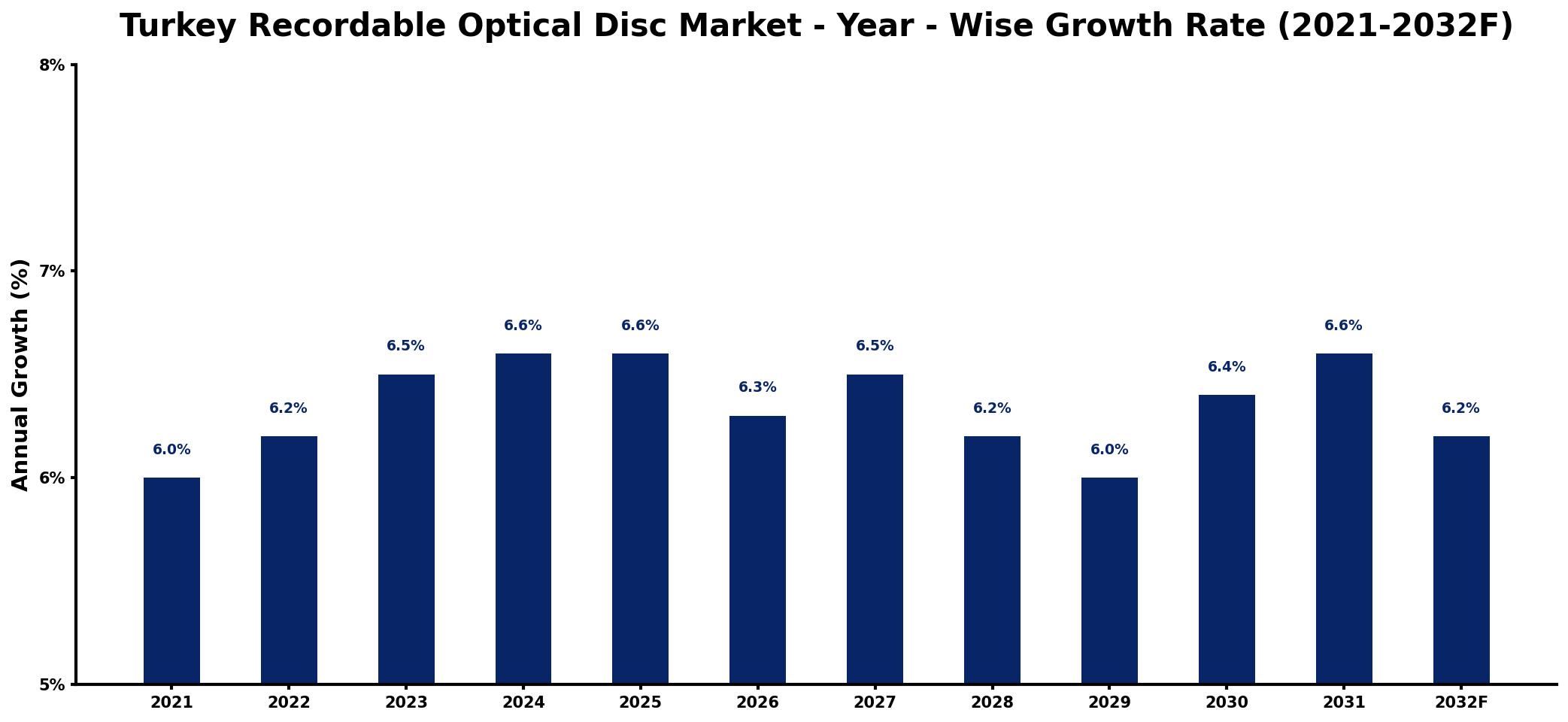
The table below presents the year‑wise growth rates along with the key drivers influencing the market
| Year | Growth Rate | Major Drivers |
| 2021 | 6.0% | Rising consumer electronics sales |
| 2022 | 6.2% | Growth in digital content creation |
| 2023 | 6.5% | Increased home entertainment spending |
| 2024 | 6.6% | Expansion of data storage needs |
| 2025 | 6.6% | Surge in educational resource usage |
| 2026 | 6.3% | Boost in archival media investments |
| 2027 | 6.5% | Growing demand for multimedia storage |
| 2028 | 6.2% | Increased interest in retro media |
| 2029 | 6.0% | Rise in small business applications |
| 2030 | 6.4% | Strengthened sales in gaming sector |
| 2031 | 6.6% | Heightened awareness of preservation |
| 2032 | 6.2% | Increased production of media content |
Note: Market size estimations and growth projections presented in this report are based on 6Wresearch's proprietary forecasting methodology, utilizing the latest available industry data, government publications, and primary research inputs.
Turkey Recordable Optical Disc Market Synopsis
In Turkey, the recordable optical disc market presents a unique landscape characterized by a blend of gradual decline and persistent relevance. While digital media continues to dominate, sectors that rely on physical media for archival purposes or professional content creation maintain robust demand for optical discs.
Furthermore, this market's resilience can be attributed to its cost-effectiveness and reliability, especially for large volumes of data storage. The drive towards sustainable manufacturing practices has also begun to influence purchasing decisions, leading to a renewed interest in eco-friendly disc options.
Turkey Recordable Optical Disc Market Key Takeaways
- The market is projected to grow significantly despite a backdrop of declining demand for physical media.
- Technological advancements in disc manufacturing are enhancing product offerings, driving niche applications.
- Government policies support innovation and protect intellectual property within the market.
- Competition from digital platforms is strong, necessitating adaptation among manufacturers.
- Sustainable practices in production are becoming increasingly relevant in shaping market dynamics.
Evaluation of Restraints in Turkey Recordable Optical Disc Market
Despite the projected growth, the Turkey recordable optical disc market grapples with significant challenges. Digitalization has shifted consumer preferences, leading to a tangible decline in demand for physical media. As manufacturers adapt production capacities to this reality, they face the dual challenge of managing inventory and production costs effectively. Additionally, the competition posed by digital streaming platforms and alternative storage solutions further complicates market dynamics, necessitating innovation and strategic realignment among stakeholders.
Turkey Recordable Optical Disc Market Trends
The market is witnessing a notable trend towards sustainability, with manufacturers exploring eco-friendly materials and production processes. This is coupled with a growing inclination among consumers and businesses to preserve legacy data in a physical format, particularly in industries like education and legal services. Enhanced disc burning technologies are also making it easier to produce high-quality media, encouraging continued use of recordable optical discs.
Turkey Recordable Optical Disc Market Opportunities
Opportunities in this market lie in the evolving landscape of archival needs and professional content creation. As businesses seek reliable, long-term storage solutions amidst digital proliferation, demand for high-capacity, durable optical discs remains strong. Additionally, leveraging advancements in sustainable manufacturing can open new avenues for market players, appealing to environmentally conscious consumers and businesses alike.
Government Initiatives in the Turkey Recordable Optical Disc Market
The Turkish government has implemented several policies aimed at bolstering the recordable optical disc market. These initiatives focus on fostering technological innovation and ensuring robust intellectual property protection, which is critical in a sector where piracy poses significant threats. Furthermore, regulatory efforts are in place to maintain fair competition, supporting local manufacturers in navigating the challenges posed by digital media.
Future Insights of the Turkey Recordable Optical Disc Market
Looking ahead to 2026-2032, the Turkey recordable optical disc market is poised for a nuanced evolution. The anticipated growth is likely to be fueled by continued reliance on physical media for specific applications, particularly in sectors with stringent data storage requirements. As technological advancements further enhance product offerings, market players must focus on niche markets and sustainable practices to capture new segments effectively.
Turkey Recordable Optical Disc Market Latest Developments (2025 - 2026)
Recent developments in the Turkey recordable optical disc market indicate a shift towards innovation in disc technology, with manufacturers increasingly focusing on sustainability. Initiatives aimed at reducing the carbon footprint of production processes are gaining traction. Additionally, collaborations between industry stakeholders and educational institutions are emerging to explore advanced applications for optical discs, ensuring that they remain relevant in a rapidly evolving media landscape.
Turkey Recordable Optical Disc Market - Key Attractiveness of the Report
- 10 Years of Market Numbers
- Historical Data Starting from 2022 to 2025
- Base Year: 2025
- Forecast Data until 2032
- Key Performance Indicators Impacting the Market
- Major Upcoming Developments and Projects
Key Highlights of the Report:
- Turkey Recordable Optical Disc Market Outlook
- Market Size of Turkey Recordable Optical Disc Market, 2025
- Forecast of Turkey Recordable Optical Disc Market, 2032
- Historical Data and Forecast of Turkey Recordable Optical Disc Revenues & Volume for the Period 2022-2032F
- Turkey Recordable Optical Disc Market Trend Evolution
- Turkey Recordable Optical Disc Market Drivers and Challenges
- Turkey Recordable Optical Disc Price Trends
- Turkey Recordable Optical Disc Porter's Five Forces
- Turkey Recordable Optical Disc Industry Life Cycle
- Historical Data and Forecast of Turkey Recordable Optical Disc Market Revenues & Volume By Product Type for the Period 2022-2032F
- Historical Data and Forecast of Turkey Recordable Optical Disc Market Revenues & Volume By Compact Discs (CD) for the Period 2022-2032F
- Historical Data and Forecast of Turkey Recordable Optical Disc Market Revenues & Volume By Digital Versatile Discs (DVD) for the Period 2022-2032F
- Historical Data and Forecast of Turkey Recordable Optical Disc Market Revenues & Volume By Sales Channel for the Period 2022-2032F
- Historical Data and Forecast of Turkey Recordable Optical Disc Market Revenues & Volume By Online Sales of Recordable Optical Discs for the Period 2022-2032F
- Historical Data and Forecast of Turkey Recordable Optical Disc Market Revenues & Volume By Offline Sales of Recordable Optical Discs for the Period 2022-2032F
- Historical Data and Forecast of Turkey Recordable Optical Disc Market Revenues & Volume By Sales of Recordable Optical Discs by Distributors for the Period 2022-2032F
- Historical Data and Forecast of Turkey Recordable Optical Disc Market Revenues & Volume By Sales of Recordable Optical Discs by Resellers for the Period 2022-2032F
- Historical Data and Forecast of Turkey Recordable Optical Disc Market Revenues & Volume By Direct Sales of Sales of Recordable Optical Discs for the Period 2022-2032F
- Historical Data and Forecast of Turkey Recordable Optical Disc Market Revenues & Volume By End Use for the Period 2022-2032F
- Historical Data and Forecast of Turkey Recordable Optical Disc Market Revenues & Volume By Consumers for the Period 2022-2032F
- Historical Data and Forecast of Turkey Recordable Optical Disc Market Revenues & Volume By Professionals for the Period 2022-2032F
- Historical Data and Forecast of Turkey Recordable Optical Disc Market Revenues & Volume By Storage Capacity for the Period 2022-2032F
- Historical Data and Forecast of Turkey Recordable Optical Disc Market Revenues & Volume By Below 5GB Recordable Optical Discs for the Period 2022-2032F
- Historical Data and Forecast of Turkey Recordable Optical Disc Market Revenues & Volume By 5-10 GB Recordable Optical Discs for the Period 2022-2032F
- Historical Data and Forecast of Turkey Recordable Optical Disc Market Revenues & Volume By Above 10 GB Recordable Optical Discs for the Period 2022-2032F
- Turkey Recordable Optical Disc Import Export Trade Statistics
- Market Opportunity Assessment By Product Type
- Market Opportunity Assessment By Sales Channel
- Market Opportunity Assessment By End Use
- Market Opportunity Assessment By Storage Capacity
- Turkey Recordable Optical Disc Top Companies Market Share
- Turkey Recordable Optical Disc Competitive Benchmarking By Technical and Operational Parameters
- Turkey Recordable Optical Disc Company Profiles
- Turkey Recordable Optical Disc Key Strategic Recommendations






































