Turkey Rubber Compound Market Size, Share & Growth Rate
The Turkey Rubber Compound Market was estimated at USD 719 Million in 2025 and is projected to reach USD 1052 Million by 2032, growing at a CAGR of 5.6% from 2026 to 2032. This growth is significantly fueled by the robust expansion of the automotive and construction sectors, both of which are increasingly relying on high-performance rubber compounds to enhance product quality and durability. Additionally, the growing industrial manufacturing base in Turkey further amplifies the demand for diverse rubber applications across various industries.
Turkey Rubber Compound Market Year-wise Growth Rate and Key Drivers
This graph highlights how the Turkey Rubber Compound Market has steadily grown over the years, supported by major growth factors.
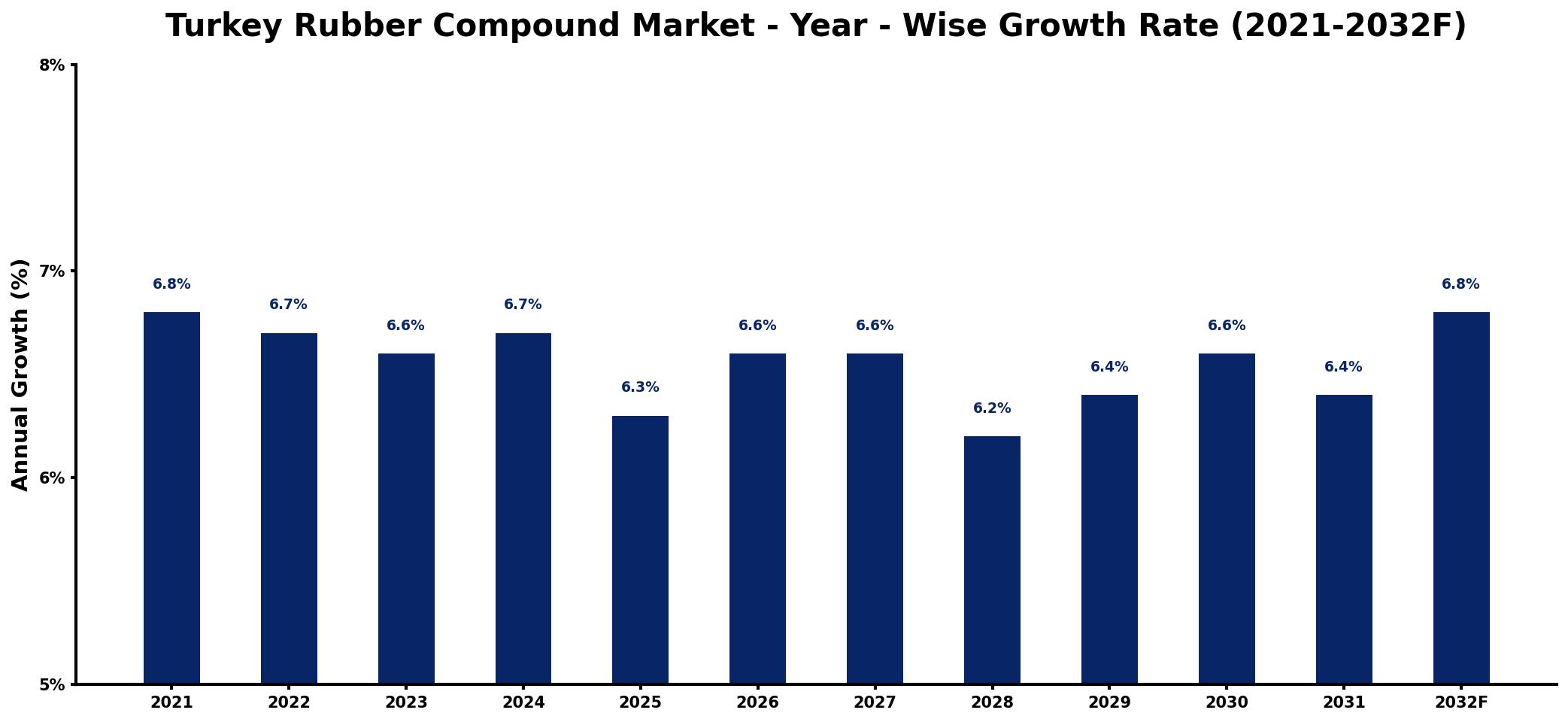
The table below presents the year‑wise growth rates along with the key drivers influencing the market
| Year | Growth Rate | Major Drivers |
| 2021 | 6.8% | Automotive sector demand increases |
| 2022 | 6.7% | Infrastructure projects drive growth |
| 2023 | 6.6% | Rising consumer goods production |
| 2024 | 6.7% | Export markets show expansion |
| 2025 | 6.3% | Investment in renewable energy |
| 2026 | 6.6% | Technological advancements in manufacturing |
| 2027 | 6.6% | Growing construction industry needs |
| 2028 | 6.2% | Increased demand for footwear |
| 2029 | 6.4% | Health and safety regulations tighten |
| 2030 | 6.6% | Sustainable materials adoption rises |
| 2031 | 6.4% | Enhanced automotive fuel efficiency standards |
| 2032 | 6.8% | Emerging markets expand consumption |
Note: Market size estimations and growth projections presented in this report are based on 6Wresearch's proprietary forecasting methodology, utilizing the latest available industry data, government publications, and primary research inputs.
Turkey Rubber Compound Market Synopsis
Currently, the Turkey rubber compound market is experiencing dynamic growth, largely driven by heightened demand from key sectors such as automotive and construction. Increased investments in infrastructure projects and a booming automotive sector are pivotal in shaping the market landscape. Concurrently, manufacturers are innovating to meet stringent regulatory standards, responding proactively to shifting consumer preferences.
As businesses recognize the importance of sustainable practices, there is a noticeable shift towards eco-friendly rubber compounds. The market is increasingly influenced by technological advancements, pushing companies to adopt more efficient production processes and improve overall product quality. This convergence of innovation, sustainability, and customer-focused customization is setting the stage for a thriving future.
Turkey Rubber Compound Market Key Takeaways
- The market is projected to grow significantly, from USD 719 Million in 2025 to USD 1052 Million by 2032.
- Increasing demand from the automotive and construction sectors is a primary driver of market growth.
- Sustainability trends are leading manufacturers to focus on developing eco-friendly and bio-based rubber compounds.
- Technological advancements in production processes are enhancing efficiency and product quality.
- Customization is becoming a key factor as various industries demand tailored rubber solutions.
Evaluation of Restraints in Turkey Rubber Compound Market
Despite the promising growth trajectory, the Turkey rubber compound market faces significant restraints that may impact its overall performance. Fluctuating raw material prices pose a constant threat, potentially squeezing profit margins for manufacturers. Additionally, increased competition from low-cost manufacturers in other regions is challenging local producers to maintain competitive pricing while upholding quality standards. The evolving regulatory landscape surrounding environmental sustainability and product safety further complicates compliance efforts for companies, requiring continuous adaptation and investment in innovative practices.
Turkey Rubber Compound Market Trends
A significant trend within the Turkey rubber compound market is the growing demand for sustainable products. As consumer awareness surrounding environmental issues rises, manufacturers are prioritizing the development of bio-based and recycled rubber compounds. Furthermore, the integration of advanced technologies and automation in production processes has gained traction, improving operational efficiencies and product quality.
Customization is also emerging as a noteworthy trend; companies are increasingly tailoring their rubber compounds to meet specific industry requirements, particularly in automotive and healthcare applications. This inclination towards innovation and customer-centric solutions is reshaping how businesses approach product development, ensuring they remain relevant in a competitive landscape.
Turkey Rubber Compound Market Opportunities
The Turkey rubber compound market presents various investment opportunities, particularly in the realm of sustainable and eco-friendly materials. Companies focusing on bio-based and recycled rubber compounds are likely to attract both consumer interest and investment. Additionally, the country's strategic location offers a unique advantage for export-oriented manufacturers, enabling access to broader markets in Europe and Asia. This positioning not only enhances growth potential but also encourages manufacturers to diversify their offerings to meet international demand.
Government Initiatives in the Turkey Rubber Compound Market
The Turkish government has implemented several policies aimed at fostering growth within the rubber compound sector. These include trade regulations that protect domestic manufacturers while promoting local production. Environmental initiatives are also a focus, with regulations encouraging the adoption of sustainable practices in manufacturing processes. Furthermore, governmental support for research and development in the rubber compound industry is stimulating innovation, enhancing competitiveness, and positioning Turkey as a key player in the global market.
Future Insights of the Turkey Rubber Compound Market
Looking ahead to 2026-2032, the Turkey rubber compound market is set to experience steady expansion, bolstered by the continual growth of the automotive and construction industries. Rising demand for superior rubber properties, such as durability and flexibility, will further drive market developments. However, the industry must navigate challenges like fluctuating raw material costs and the need for continuous innovation to remain competitive. Overall, the combination of technological advancements and evolving consumer preferences will shape the future landscape of this market.
Turkey Rubber Compound Market Latest Developments (2025 - 2026)
Recent developments in the Turkey rubber compound market indicate a strong focus on innovation and sustainability. Manufacturers are increasingly introducing new formulations that leverage advanced technologies to enhance product performance while minimizing environmental impact. Moreover, collaborative efforts between industry players and research institutions are fostering breakthroughs in sustainable materials, thereby responding to the evolving market demand. Additionally, government incentives aimed at encouraging eco-friendly practices are further pushing the industry towards greener solutions.
Turkey Rubber Compound Market - Key Attractiveness of the Report
- 10 Years of Market Numbers
- Historical Data Starting from 2022 to 2025
- Base Year: 2025
- Forecast Data until 2032
- Key Performance Indicators Impacting the Market
- Major Upcoming Developments and Projects
Key Highlights of the Report:
- Turkey Rubber Compound Market Outlook
- Market Size of Turkey Rubber Compound Market, 2025
- Forecast of Turkey Rubber Compound Market, 2032
- Historical Data and Forecast of Turkey Rubber Compound Revenues & Volume for the Period 2022-2032F
- Turkey Rubber Compound Market Trend Evolution
- Turkey Rubber Compound Market Drivers and Challenges
- Turkey Rubber Compound Price Trends
- Turkey Rubber Compound Porter's Five Forces
- Turkey Rubber Compound Industry Life Cycle
- Historical Data and Forecast of Turkey Rubber Compound Market Revenues & Volume By Rubber Type for the Period 2022-2032F
- Historical Data and Forecast of Turkey Rubber Compound Market Revenues & Volume By Silicone Rubber for the Period 2022-2032F
- Historical Data and Forecast of Turkey Rubber Compound Market Revenues & Volume By Fluoro Rubber for the Period 2022-2032F
- Historical Data and Forecast of Turkey Rubber Compound Market Revenues & Volume By Butyronitrile Rubber for the Period 2022-2032F
- Historical Data and Forecast of Turkey Rubber Compound Market Revenues & Volume By EPDM Rubber for the Period 2022-2032F
- Historical Data and Forecast of Turkey Rubber Compound Market Revenues & Volume By Chloroprene Rubber for the Period 2022-2032F
- Historical Data and Forecast of Turkey Rubber Compound Market Revenues & Volume By Others for the Period 2022-2032F
- Historical Data and Forecast of Turkey Rubber Compound Market Revenues & Volume By End-User for the Period 2022-2032F
- Historical Data and Forecast of Turkey Rubber Compound Market Revenues & Volume By Tires for the Period 2022-2032F
- Historical Data and Forecast of Turkey Rubber Compound Market Revenues & Volume By Hose & Belting for the Period 2022-2032F
- Historical Data and Forecast of Turkey Rubber Compound Market Revenues & Volume By Roofing & Geo Membranes for the Period 2022-2032F
- Historical Data and Forecast of Turkey Rubber Compound Market Revenues & Volume By Footwear for the Period 2022-2032F
- Historical Data and Forecast of Turkey Rubber Compound Market Revenues & Volume By Wire & Cable Insulation for the Period 2022-2032F
- Historical Data and Forecast of Turkey Rubber Compound Market Revenues & Volume By Others for the Period 2022-2032F
- Turkey Rubber Compound Import Export Trade Statistics
- Market Opportunity Assessment By Rubber Type
- Market Opportunity Assessment By End-User
- Turkey Rubber Compound Top Companies Market Share
- Turkey Rubber Compound Competitive Benchmarking By Technical and Operational Parameters
- Turkey Rubber Compound Company Profiles
- Turkey Rubber Compound Key Strategic Recommendations






































