Turkey Security Door Market Size, Share & Growth Rate
The Turkey Security Door Market was estimated at USD 166 Million in 2025 and is projected to reach USD 232 Million by 2032, growing at a CAGR of 4.9% from 2026 to 2032. This upward trajectory is fueled by a rising urban population that is increasingly concerned about safety, alongside the burgeoning middle-class segment that prioritizes investing in quality security solutions. Additionally, the rapid pace of residential construction is driving demand for innovative security doors equipped with advanced features.
Turkey Security Door Market Year-wise Growth Rate and Key Drivers
This graph highlights how the Turkey Security Door Market has steadily grown over the years, supported by major growth factors.
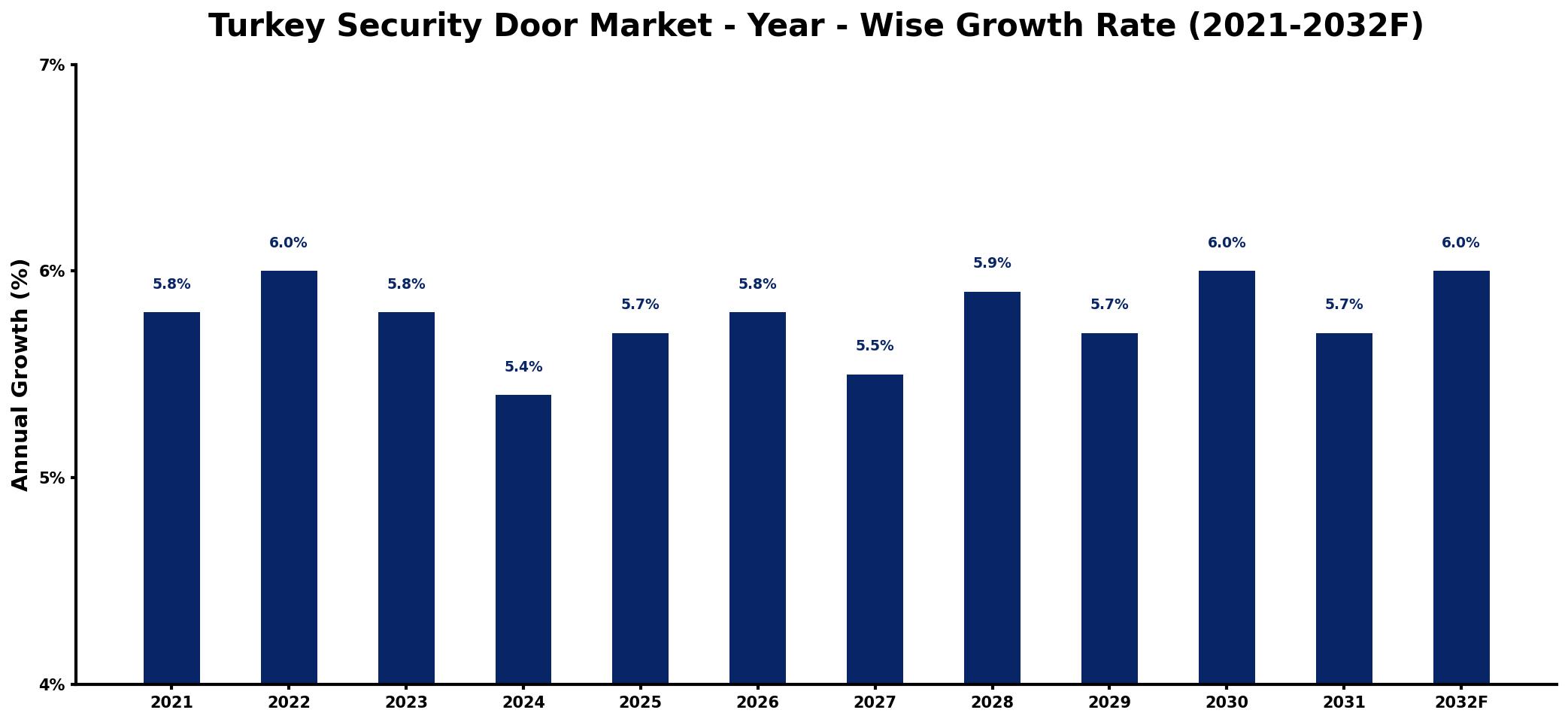
The table below presents the year‑wise growth rates along with the key drivers influencing the market
| Year | Growth Rate | Major Drivers |
| 2021 | 5.8% | Rising home renovation investments |
| 2022 | 6.0% | Increased urban population density |
| 2023 | 5.8% | Growing awareness of safety |
| 2024 | 5.4% | Expansion of construction projects |
| 2025 | 5.7% | Surge in residential demand |
| 2026 | 5.8% | Higher disposable income levels |
| 2027 | 5.5% | Emergence of smart technology |
| 2028 | 5.9% | increased overall sector activity |
| 2029 | 5.7% | expanding healthcare application demand |
| 2030 | 6.0% | Boost in foreign investments |
| 2031 | 5.7% | Growing rental market trends |
| 2032 | 6.0% | Enhanced focus on aesthetics |
Note: Market size estimations and growth projections presented in this report are based on 6Wresearch's proprietary forecasting methodology, utilizing the latest available industry data, government publications, and primary research inputs.
Turkey Security Door Market Synopsis
In recent years, the Turkey Security Door Market has shown dynamic growth, largely influenced by heightened awareness of home security needs among consumers. This change is underscored by rising incidences of burglary and unauthorized access, prompting households to prioritize robust protective measures. Security doors are no longer viewed merely as barriers; they are increasingly seen as essential investments in safety.
Urbanization continues to reshape Turkey's residential landscape, creating a conducive environment for security door solutions. As people transition to urban living, there is a growing demand for aesthetically pleasing, technologically advanced security doors that align with modern lifestyle preferences. Manufacturers are adapting to these trends, integrating features such as biometric access and smart technology, further enhancing consumer interest.
Turkey Security Door Market Key Takeaways
- Increasing urbanization and a rising middle-class population are driving demand for security doors.
- Technological advancements are paving the way for innovative solutions like smart locks and biometric systems.
- Sustainability trends are influencing product development, with a shift towards eco-friendly materials.
- Customization and aesthetic considerations are gaining importance among consumers seeking security doors.
- Government initiatives aimed at enhancing home security are bolstering market growth.
Evaluation of Restraints in Turkey Security Door Market
Despite its promising outlook, the Turkey Security Door Market faces significant restraints that could impede growth. Intense competition among manufacturers often leads to price wars, pressuring margins and profitability. Moreover, fluctuations in raw material costs, along with varying currency exchange rates, can adversely affect production expenses. Companies must also navigate stringent safety and quality standards that require constant innovation and adaptation, further complicating operational dynamics. Lastly, political instability and economic uncertainties may impact investment decisions and overall market demand.
Turkey Security Door Market Trends
The market is currently witnessing an increasing trend toward smart security doors, which feature advanced technologies such as remote monitoring capabilities and biometric access controls. Consumers are not only looking for security solutions but are also keen on doors that incorporate design elements to enhance their home's aesthetics. Furthermore, there is a notable shift toward sustainability, with both manufacturers and consumers focusing on energy-efficient features and eco-friendly materials in door designs. Customization options are also becoming increasingly popular as buyers seek unique solutions tailored to their specific needs.
Turkey Security Door Market Opportunities
The Turkey Security Door Market offers substantial investment opportunities, particularly in the residential sector driven by a surge in new construction. As urban populations grow and consumers become more security-conscious, there is an escalating demand for high-quality security solutions. The burgeoning trend toward smart technology in home security provides avenues for innovation, allowing manufacturers to develop products that not only meet security needs but also offer convenience and adaptability. Furthermore, as the market continues to evolve, investors can capitalize on the opportunity to create differentiated, high-value offerings that appeal to discerning consumers.
Government Initiatives in the Turkey Security Door Market
Government policies in Turkey are increasingly focused on enhancing consumer safety and ensuring security standards in the market. These regulations encompass manufacturing and installation standards designed to protect consumers and maintain product quality. Enforcement of these standards through regular inspections and certifications aims to ensure compliance, thereby fostering a more secure environment. Additionally, government initiatives may include public spending to promote advanced security solutions as part of broader strategies to improve overall safety in residential and commercial spaces.
Future Insights of the Turkey Security Door Market
Looking ahead to the years 2026-2032, the Turkey Security Door Market is set to experience steady growth driven by several key factors. A growing awareness of safety and security will continue to fuel demand, especially among urban homeowners. Technological advancements are expected to enhance the sophistication of security solutions, integrating not only traditional security features but also smart technologies. Aesthetics will remain a priority, with consumers increasingly interested in products that blend security with design. Government initiatives promoting security will likely play a vital role in shaping the market's trajectory, ensuring a robust environment for growth.
Turkey Security Door Market Latest Developments (2025 - 2026)
In the recent months leading up to mid-2026, the Turkey Security Door Market has seen a shift towards integrating smart technologies into traditional security door designs. Manufacturers are focusing on providing added value through features like remote access and monitoring solutions. The emphasis on sustainable production practices is also increasing, with companies exploring eco-friendly materials that appeal to environmentally conscious consumers. Concurrently, new regulations aimed at enhancing security standards are being introduced, setting the stage for potential growth and innovation in this vital sector.
Turkey Security Door Market - Key Attractiveness of the Report
- 10 Years of Market Numbers
- Historical Data Starting from 2022 to 2025
- Base Year: 2025
- Forecast Data until 2032
- Key Performance Indicators Impacting the Market
- Major Upcoming Developments and Projects
Key Highlights of the Report:
- Turkey Security Door Market Outlook
- Market Size of Turkey Security Door Market, 2025
- Forecast of Turkey Security Door Market, 2032
- Historical Data and Forecast of Turkey Security Door Revenues & Volume for the Period 2022-2032F
- Turkey Security Door Market Trend Evolution
- Turkey Security Door Market Drivers and Challenges
- Turkey Security Door Price Trends
- Turkey Security Door Porter's Five Forces
- Turkey Security Door Industry Life Cycle
- Historical Data and Forecast of Turkey Security Door Market Revenues & Volume By Product Type for the Period 2022-2032F
- Historical Data and Forecast of Turkey Security Door Market Revenues & Volume By Wood Security Door for the Period 2022-2032F
- Historical Data and Forecast of Turkey Security Door Market Revenues & Volume By Metal Security Door for the Period 2022-2032F
- Historical Data and Forecast of Turkey Security Door Market Revenues & Volume By Industry for the Period 2022-2032F
- Historical Data and Forecast of Turkey Security Door Market Revenues & Volume By Individual Purchaser for the Period 2022-2032F
- Historical Data and Forecast of Turkey Security Door Market Revenues & Volume By Corporate Buyers for the Period 2022-2032F
- Historical Data and Forecast of Turkey Security Door Market Revenues & Volume By Channel for the Period 2022-2032F
- Historical Data and Forecast of Turkey Security Door Market Revenues & Volume By Direct Sales for the Period 2022-2032F
- Historical Data and Forecast of Turkey Security Door Market Revenues & Volume By Distributor for the Period 2022-2032F
- Turkey Security Door Import Export Trade Statistics
- Market Opportunity Assessment By Product Type
- Market Opportunity Assessment By Industry
- Market Opportunity Assessment By Channel
- Turkey Security Door Top Companies Market Share
- Turkey Security Door Competitive Benchmarking By Technical and Operational Parameters
- Turkey Security Door Company Profiles
- Turkey Security Door Key Strategic Recommendations






































