Turkey Shapewear Market Size, Share & Growth Rate
The Turkey Shapewear Market was estimated at USD 335 Million in 2025 and is projected to reach USD 447 Million by 2032, growing at a CAGR of 4.2% from 2026 to 2032. This growth is propelled by a significant cultural shift towards body positivity and an increasing interest in personal wellness and fitness among Turkish consumers. As societal attitudes evolve, more individuals are embracing body-shaping products, which are seen as tools for boosting confidence and enhancing personal style.
Turkey Shapewear Market Year-wise Growth Rate and Key Drivers
This graph highlights how the Turkey Shapewear Market has steadily grown over the years, supported by major growth factors.
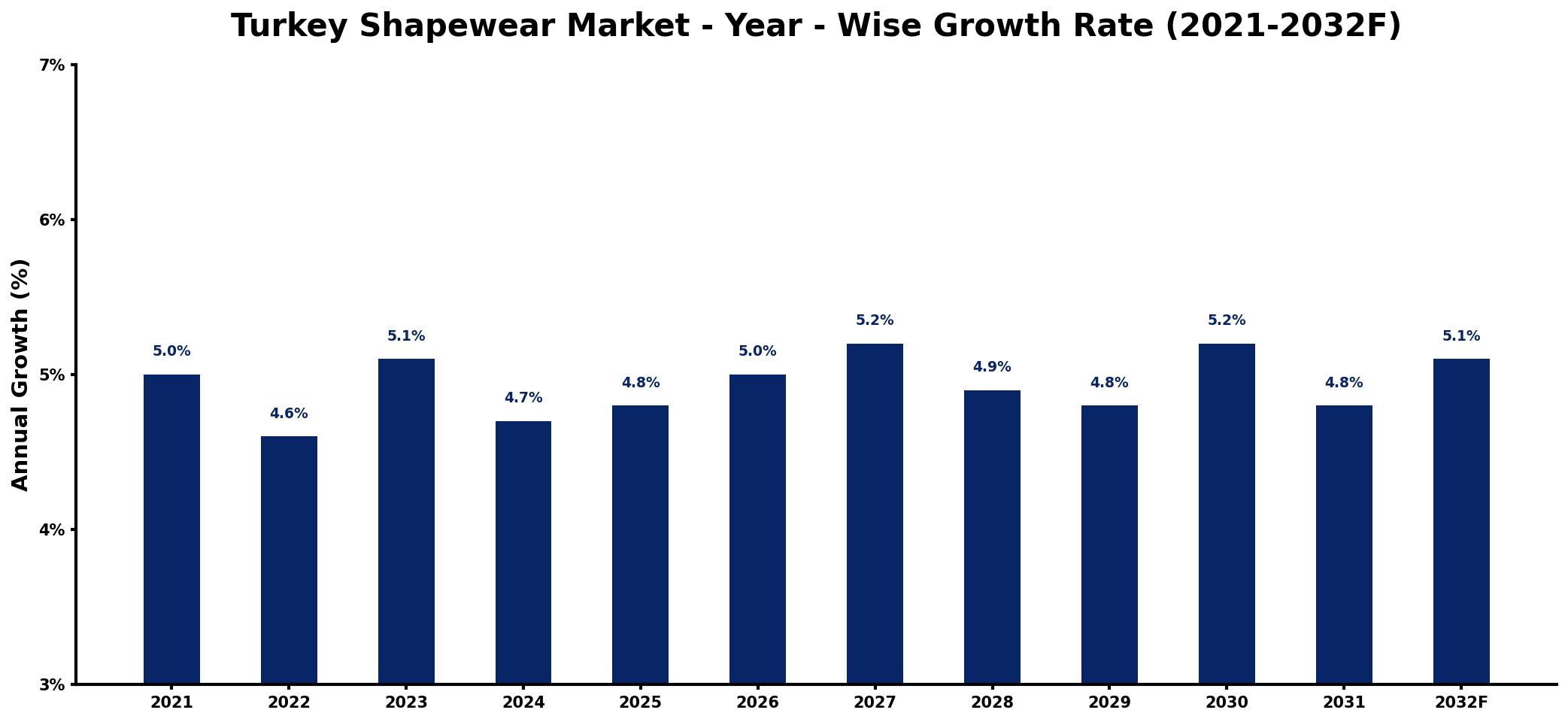
The table below presents the year‑wise growth rates along with the key drivers influencing the market
| Year | Growth Rate | Major Drivers |
| 2021 | 5.0% | Rising consumer health awareness |
| 2022 | 4.6% | Increased online shopping adoption |
| 2023 | 5.1% | Growing fitness lifestyle trends |
| 2024 | 4.7% | Expansion of retail distribution channels |
| 2025 | 4.8% | Increasing disposable income levels |
| 2026 | 5.0% | Surge in influencer marketing strategies |
| 2027 | 5.2% | Emergence of eco-friendly materials |
| 2028 | 4.9% | Growth in body positivity movements |
| 2029 | 4.8% | Rise in athleisure fashion popularity |
| 2030 | 5.2% | improved raw material availability |
| 2031 | 4.8% | Diversification of product offerings |
| 2032 | 5.1% | Strengthened brand loyalty initiatives |
Note: Market size estimations and growth projections presented in this report are based on 6Wresearch's proprietary forecasting methodology, utilizing the latest available industry data, government publications, and primary research inputs.
Turkey Shapewear Market Synopsis
Recent years have seen a marked increase in the demand for shapewear in Turkey, characterized by heightened consumer awareness and a burgeoning beauty culture. As the market continues to expand, it is increasingly catering to a diverse range of body types, ensuring inclusivity and innovation in product offerings.
The future trajectory of the Turkey shapewear market indicates a robust landscape, with brands innovating to enhance comfort and functionality. The focus on eco-friendly materials is also becoming more pronounced, reflecting broader consumer values that prioritize sustainability without compromising on style or performance.
Turkey Shapewear Market Key Takeaways
- Rising disposable income and changing lifestyles are significantly influencing consumer spending on shapewear.
- Seamless and lightweight designs are increasingly popular as they offer comfort along with the desired body-shaping effects.
- There is a noticeable trend towards sustainable and eco-friendly shapewear options, aligning with growing environmental concerns.
- Social media and influencer marketing are powerful forces driving consumer interest in shapewear products.
- The market is witnessing a shift towards inclusive sizing to cater to diverse consumer preferences.
Evaluation of Restraints in Turkey Shapewear Market
The Turkey shapewear market faces several constraints that may limit its potential growth. One of the primary challenges is the shifting consumer preferences towards body positivity, which can sometimes lead to decreased demand for traditional shapewear. Moreover, increasing competition from international brands introduces pricing pressures, potentially making it difficult for local manufacturers to maintain market share. Economic fluctuations may also influence discretionary spending, as shapewear is often viewed as a non-essential item. Additionally, cultural factors and societal norms can shape consumer attitudes and demand for specific product types, necessitating that brands remain attuned to these dynamics.
Turkey Shapewear Market Trends
Current trends in the Turkey shapewear market indicate a strong consumer preference for products that balance aesthetics with comfort. There is a growing demand for shapewear that offers breathability and flexibility, which reflects an understanding of wellness that extends beyond mere appearance. Furthermore, the emergence of social media influencers advocating for body acceptance and comfort-driven fashion is steering demand towards products that promote not just shaping, but overall well-being.
Turkey Shapewear Market Opportunities
Significant opportunities exist for investment in the Turkey shapewear market, particularly in innovative product development. Brands that can leverage advanced materials to enhance comfort and performance will likely capture consumer interest. Additionally, the rise of e-commerce presents a fertile ground for expanding sales channels, as online shopping continues to grow in popularity across Turkey. Collaborations with local manufacturers or the pursuit of strategic partnerships can further strengthen market presence and adapt to evolving consumer preferences.
Government Initiatives in the Turkey Shapewear Market
The Turkish government has instituted several policies aimed at regulating the shapewear market to ensure consumer safety and product quality. The Ministry of Trade plays a crucial role in overseeing market compliance with safety standards and quality certifications. Additionally, the government's focus on transparent pricing and fair competition helps foster a healthy market environment for shapewear businesses. Such policies not only protect consumers but also encourage ethical practices within the industry.
Future Insights of the Turkey Shapewear Market
As we look towards the period from 2026 to 2032, the Turkey shapewear market is poised for continued growth driven by evolving consumer preferences and the ongoing influence of social media. The increasing emphasis on fitness, wellness, and body positivity will likely fuel demand for shapewear that is both functional and stylish. Innovative fabric technologies and design enhancements are expected to emerge, enabling brands to offer products that resonate with the diverse needs of consumers. With these trends, the market's expansion appears assured as individuals increasingly prioritize self-expression and confidence in their apparel choices.
Turkey Shapewear Market Latest Developments (2025 - 2026)
In the recent months, the Turkey shapewear market has seen notable advancements as brands introduce enhanced product lines that focus on comfort and sustainability. Innovations in fabric technology are allowing for lighter, more breathable materials, catering to an increasingly health-conscious consumer base. Marketing efforts are increasingly embracing body positivity narratives, while also leveraging online platforms to reach younger audiences. These developments underscore a dynamic market landscape where adaptability and responsiveness to consumer preferences are crucial.
Turkey Shapewear Market - Key Attractiveness of the Report
- 10 Years of Market Numbers
- Historical Data Starting from 2022 to 2025
- Base Year: 2025
- Forecast Data until 2032
- Key Performance Indicators Impacting the Market
- Major Upcoming Developments and Projects
Key Highlights of the Report:
- Turkey Shapewear Market Outlook
- Market Size of Turkey Shapewear Market, 2025
- Forecast of Turkey Shapewear Market, 2032
- Historical Data and Forecast of Turkey Shapewear Revenues & Volume for the Period 2022-2032F
- Turkey Shapewear Market Trend Evolution
- Turkey Shapewear Market Drivers and Challenges
- Turkey Shapewear Price Trends
- Turkey Shapewear Porter's Five Forces
- Turkey Shapewear Industry Life Cycle
- Historical Data and Forecast of Turkey Shapewear Market Revenues & Volume By End-user for the Period 2022-2032F
- Historical Data and Forecast of Turkey Shapewear Market Revenues & Volume By Male for the Period 2022-2032F
- Historical Data and Forecast of Turkey Shapewear Market Revenues & Volume By Female for the Period 2022-2032F
- Historical Data and Forecast of Turkey Shapewear Market Revenues & Volume By Distribution Channel for the Period 2022-2032F
- Historical Data and Forecast of Turkey Shapewear Market Revenues & Volume By Hypermarkets & Supermarkets for the Period 2022-2032F
- Historical Data and Forecast of Turkey Shapewear Market Revenues & Volume By Specialty Stores for the Period 2022-2032F
- Historical Data and Forecast of Turkey Shapewear Market Revenues & Volume By Online for the Period 2022-2032F
- Historical Data and Forecast of Turkey Shapewear Market Revenues & Volume By Others for the Period 2022-2032F
- Turkey Shapewear Import Export Trade Statistics
- Market Opportunity Assessment By End-user
- Market Opportunity Assessment By Distribution Channel
- Turkey Shapewear Top Companies Market Share
- Turkey Shapewear Competitive Benchmarking By Technical and Operational Parameters
- Turkey Shapewear Company Profiles
- Turkey Shapewear Key Strategic Recommendations






































