Turkey Smart Airport Market Size, Share & Growth Rate
The Turkey Smart Airport Market was estimated at USD 378 Million in 2025 and is projected to reach USD 695 Million by 2032, growing at a CAGR of 9.1% from 2026 to 2032. This robust growth trajectory is fueled by Turkey's commitment to enhancing airport efficiency and passenger experiences through the integration of cutting-edge technologies. As travel demand rebounds and the government prioritizes modernization, investments in smart infrastructure are poised to reshape the airport landscape.
Turkey Smart Airport Market Year-wise Growth Rate and Key Drivers
This graph highlights how the Turkey Smart Airport Market has steadily grown over the years, supported by major growth factors.
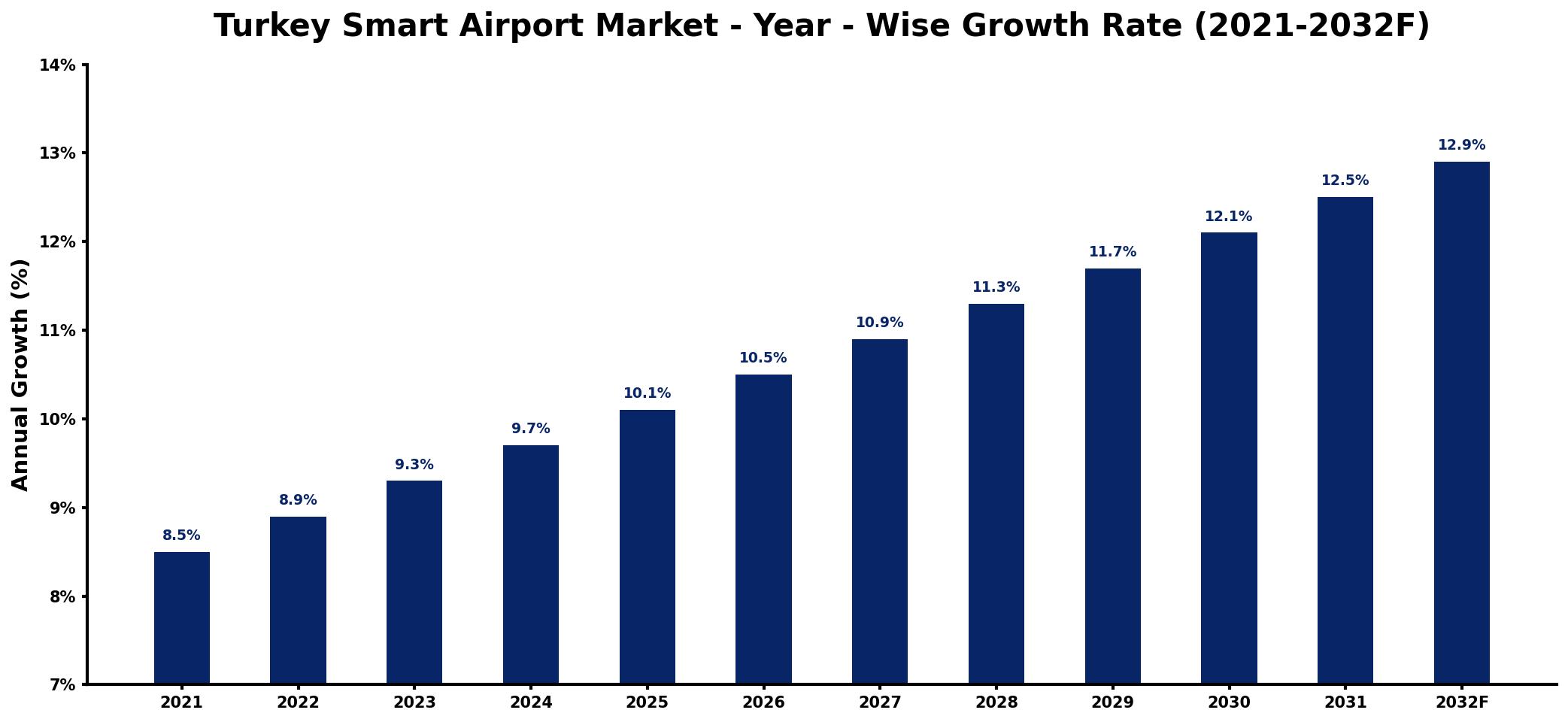
The table below presents the year‑wise growth rates along with the key drivers influencing the market
| Year | Growth Rate | Major Drivers |
| 2021 | 8.5% | Increased travel demand post pandemic |
| 2022 | 8.9% | Investment in digital infrastructure |
| 2023 | 9.3% | Expansion of international flights |
| 2024 | 9.7% | Growth in tourism sector |
| 2025 | 10.1% | Rising interest in automation technology |
| 2026 | 10.5% | Focus on sustainability initiatives |
| 2027 | 10.9% | Emergence of new airlines |
| 2028 | 11.3% | Adoption of contactless solutions |
| 2029 | 11.7% | Enhancement of passenger experiences |
| 2030 | 12.1% | Development of logistics partnerships |
| 2031 | 12.5% | Integration of advanced analytics |
| 2032 | 12.9% | Collaboration with tech startups |
Note: Market size estimations and growth projections presented in this report are based on 6Wresearch's proprietary forecasting methodology, utilizing the latest available industry data, government publications, and primary research inputs.
Turkey Smart Airport Market Synopsis
In Turkey, the increasing adoption of self-service kiosks and biometric solutions is revolutionizing how passengers interact with airport systems, significantly enhancing operational efficiency. The nation's airports are rapidly modernizing their facilities to accommodate the growing influx of domestic and international travelers while prioritizing security and convenience.
Additionally, initiatives aimed at incorporating IoT and automation are becoming critical, as they offer real-time monitoring capabilities that streamline operations. With ongoing government support and strategic investments, Turkey's smart airport initiatives aim to create a seamless, user-friendly experience for passengers while optimizing airport management.
Turkey Smart Airport Market Key Takeaways
- The market is projected to experience significant growth, reaching USD 695 Million by 2032.
- Technological integration, such as biometrics and IoT, is reshaping airport operations and passenger experiences.
- Government initiatives are aligned with efforts to modernize airport infrastructure and enhance operational efficiency.
- Investment opportunities exist in advanced security systems and passenger experience technologies.
- The emphasis on sustainability will drive the adoption of green technologies within smart airports.
Evaluation of Restraints in Turkey Smart Airport Market
Despite the promising growth, several restraints are impacting the Turkey Smart Airport Market. The integration of diverse technologies can present compatibility challenges, complicating the development of a cohesive smart airport system. Moreover, data security and privacy concerns require stringent measures, especially as reliance on digital solutions increases. The substantial initial investments needed for implementing smart technologies pose a barrier to entry for some stakeholders. Additionally, achieving effective collaboration among various airport authorities, airlines, and technology providers is crucial, yet often hindered by bureaucratic complexities. Overcoming these challenges will necessitate strategic alliances and comprehensive planning.
Turkey Smart Airport Market Trends
The Turkey Smart Airport Market is witnessing a notable trend towards digitization, with an increasing emphasis on automated passenger processing systems. Self-service solutions are becoming commonplace, as they reduce wait times and enhance the traveler experience. The integration of artificial intelligence and machine learning technologies is expected to optimize operational efficiency, allowing for smarter resource allocation and improved decision-making. Furthermore, a growing focus on sustainable practices is prompting airports to implement eco-friendly solutions, including energy-efficient systems and green building practices that minimize their environmental footprint.
Turkey Smart Airport Market Opportunities
The Turkey Smart Airport Market offers numerous growth and investment opportunities, particularly in the domains of smart security systems and passenger experience enhancements. The rising demand for advanced biometric identification systems and AI-powered security screening technologies presents lucrative prospects for technology providers. Moreover, investments in smart parking solutions and IoT-enabled maintenance systems can greatly improve operational efficiency. As the market continues to evolve, innovations that prioritize safety and streamline passenger flow will be critical in capturing the interest of stakeholders looking to invest in the sector.
Government Initiatives in the Turkey Smart Airport Market
Government policies in Turkey are focusing on bolstering the smart airport landscape through strategic investments and development programs. The National Smart Airport Concept and the Civil Aviation Master Plan lay the groundwork for enhanced airport infrastructure, promoting the integration of digital technologies. Regulatory frameworks introduced by the General Directorate of State Airports Authority (DHMI) aim to standardize smart airport operations while ensuring compliance with international aviation standards. This proactive approach underscores Turkey's ambition to establish itself as a leading regional aviation hub and improve overall connectivity.
Future Insights of the Turkey Smart Airport Market
Looking ahead to 2026-2032, the Turkey Smart Airport Market is poised for robust growth, driven by sustained investments in innovative technologies. The implementation of IoT devices, biometrics, and AI will continue to streamline airport processes, enhancing passenger experiences and operational efficiencies. Furthermore, the focus on sustainable practices will likely accelerate, with airports adopting solutions to mitigate their environmental impacts. As Turkey enhances its position in the global aviation sector, the ongoing advancements in smart airport technologies will play a vital role in fostering a modern and efficient travel ecosystem.
Turkey Smart Airport Market Latest Developments (2025 - 2026)
Recent industry developments highlight an increasing shift toward automation and digitalization within Turkey's smart airport sector. Airports are exploring partnerships with technology providers to implement innovative solutions, such as real-time tracking systems and enhanced security protocols. This period has also seen a growing emphasis on passenger-centric services, with digital tools designed to improve the travel experience becoming a priority for airports aiming to retain competitiveness. Additionally, discussions around integrating blockchain technology for enhanced security and operational transparency are gaining traction among industry stakeholders.
Turkey Smart Airport Market - Key Attractiveness of the Report
- 10 Years of Market Numbers
- Historical Data Starting from 2022 to 2025
- Base Year: 2025
- Forecast Data until 2032
- Key Performance Indicators Impacting the Market
- Major Upcoming Developments and Projects
Key Highlights of the Report:
- Turkey Smart Airport Market Outlook
- Market Size of Turkey Smart Airport Market, 2025
- Forecast of Turkey Smart Airport Market, 2032
- Historical Data and Forecast of Turkey Smart Airport Revenues & Volume for the Period 2022-2032F
- Turkey Smart Airport Market Trend Evolution
- Turkey Smart Airport Market Drivers and Challenges
- Turkey Smart Airport Price Trends
- Turkey Smart Airport Porter's Five Forces
- Turkey Smart Airport Industry Life Cycle
- Historical Data and Forecast of Turkey Smart Airport Market Revenues & Volume By System for the Period 2022-2032F
- Historical Data and Forecast of Turkey Smart Airport Market Revenues & Volume By Communication and Network Systems for the Period 2022-2032F
- Historical Data and Forecast of Turkey Smart Airport Market Revenues & Volume By Endpoint Devices for the Period 2022-2032F
- Historical Data and Forecast of Turkey Smart Airport Market Revenues & Volume By Data Storage for the Period 2022-2032F
- Historical Data and Forecast of Turkey Smart Airport Market Revenues & Volume By Software and Solutions for the Period 2022-2032F
- Historical Data and Forecast of Turkey Smart Airport Market Revenues & Volume By End User for the Period 2022-2032F
- Historical Data and Forecast of Turkey Smart Airport Market Revenues & Volume By Implementation for the Period 2022-2032F
- Historical Data and Forecast of Turkey Smart Airport Market Revenues & Volume By Upgrades and Services for the Period 2022-2032F
- Historical Data and Forecast of Turkey Smart Airport Market Revenues & Volume By Location for the Period 2022-2032F
- Historical Data and Forecast of Turkey Smart Airport Market Revenues & Volume By Landside for the Period 2022-2032F
- Historical Data and Forecast of Turkey Smart Airport Market Revenues & Volume By Airside for the Period 2022-2032F
- Historical Data and Forecast of Turkey Smart Airport Market Revenues & Volume By Terminal Side for the Period 2022-2032F
- Turkey Smart Airport Import Export Trade Statistics
- Market Opportunity Assessment By System
- Market Opportunity Assessment By End User
- Market Opportunity Assessment By Location
- Turkey Smart Airport Top Companies Market Share
- Turkey Smart Airport Competitive Benchmarking By Technical and Operational Parameters
- Turkey Smart Airport Company Profiles
- Turkey Smart Airport Key Strategic Recommendations






































