Turkey Soft Drinks Packaging Market Size, Share & Growth Rate
The Turkey Soft Drinks Packaging Market was estimated at USD 1461 Million in 2025 and is projected to reach USD 2121 Million by 2032, growing at a CAGR of 5.5% from 2026 to 2032. This growth trajectory is primarily driven by the increasing consumer inclination towards healthier beverage choices and greater disposable incomes. Additionally, the rising demand for convenience and innovative packaging solutions is further propelling the market forward, as companies adapt to changing lifestyles and environmental considerations.
Turkey Soft Drinks Packaging Market Year-wise Growth Rate and Key Drivers
This graph highlights how the Turkey Soft Drinks Packaging Market has steadily grown over the years, supported by major growth factors.
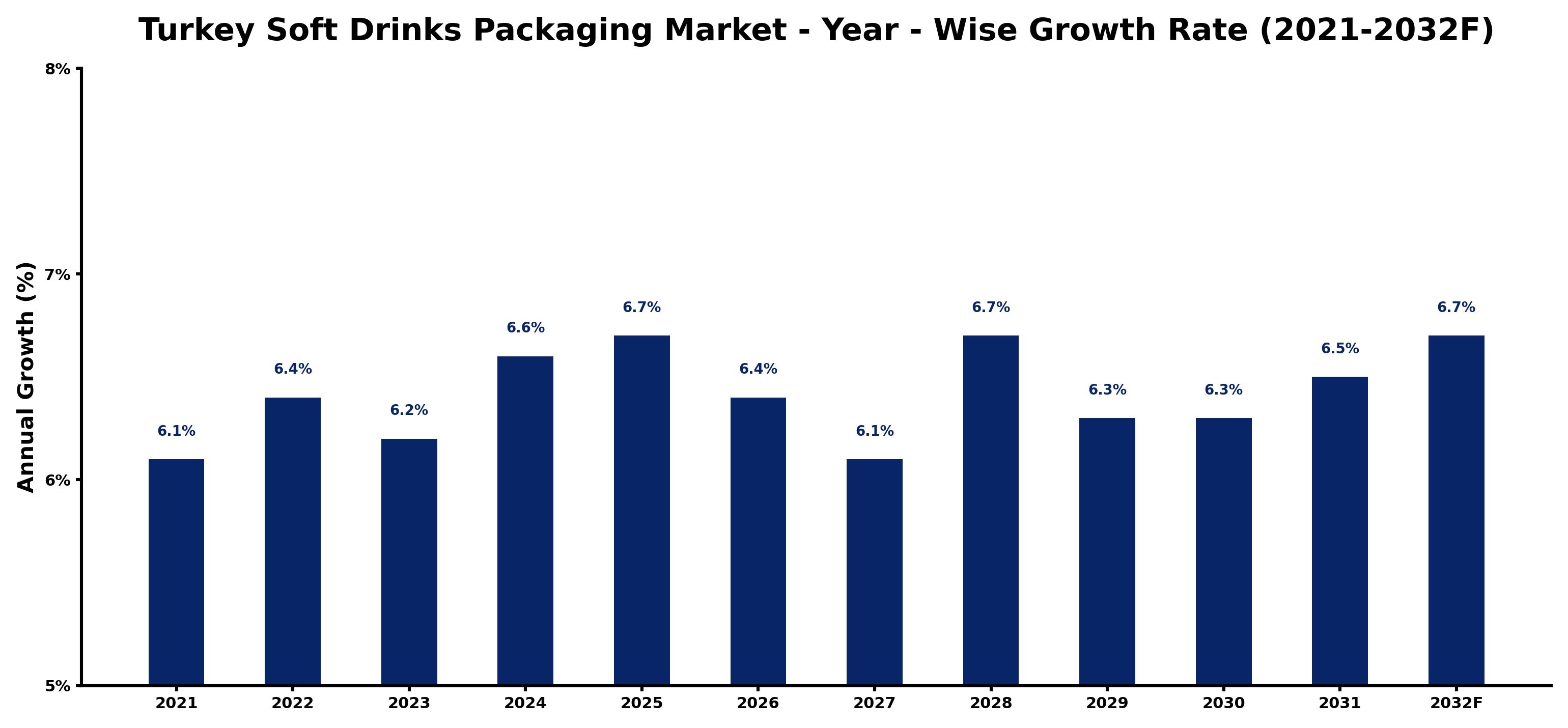
The table below presents the year‑wise growth rates along with the key drivers influencing the market
| Year | Growth Rate | Major Drivers |
| 2021 | 6.1% | Increased health consciousness among consumers |
| 2022 | 6.4% | Sustainability trends influenced packaging choices |
| 2023 | 6.2% | Rise in e-commerce beverage sales |
| 2024 | 6.6% | Innovative packaging designs attracted buyers |
| 2025 | 6.7% | Demand for convenience packaging grew |
| 2026 | 6.4% | Focus on premium product offerings |
| 2027 | 6.1% | Expansion of local beverage brands |
| 2028 | 6.7% | Consumer preference for eco-friendly materials |
| 2029 | 6.3% | Growth in flavored beverage options |
| 2030 | 6.3% | Technological advancements in packaging solutions |
| 2031 | 6.5% | Increased marketing efforts for beverages |
| 2032 | 6.7% | Rising disposable income among consumers |
Note - Market size estimations and growth projections presented in this report are based on 6Wresearch’s advanced forecasting approach, validated with industry datasets as of June 2026.
Turkey Soft Drinks Packaging Market Synopsis
In recent years, the Turkey soft drinks packaging market has gained momentum, fueled by consumer preferences shifting towards sustainable options and personalized packaging. This shift stands in stark contrast to traditional packaging methods, which often prioritized cost over environmental impact. As companies respond to these evolving demands, they are increasingly investing in recyclable and biodegradable materials.
Looking ahead, the market is poised for even more significant transformation. Companies are likely to explore advanced technologies and unique designs that enhance product appeal while adhering to sustainability mandates. The focus on convenience packaging will remain strong, especially as consumers continue to seek out on-the-go solutions that align with their dynamic lifestyles.
Turkey Soft Drinks Packaging Market Key Takeaways
- The market is responding to a growing demand for eco-friendly packaging solutions.
- Innovation in packaging formats, including single-serve options, is on the rise.
- Consumer awareness around sustainability is reshaping packaging strategies.
- Investment opportunities are centered around developing biodegradable materials.
- Government regulations are pushing for higher standards in packaging sustainability.
Evaluation of Restraints in Turkey Soft Drinks Packaging Market
Despite its promising growth, the Turkey soft drinks packaging market faces certain restraints. Increasing environmental concerns over plastic waste have led consumers to demand more sustainable alternatives. This shift is compelling companies to re-evaluate their packaging strategies in order to remain competitive. Additionally, regulatory pressures, such as the Extended Producer Responsibility (EPR) system, complicate packaging choices and may inhibit rapid innovation as companies navigate compliance while striving to meet consumer expectations.
Turkey Soft Drinks Packaging Market Trends
Current trends within the Turkey soft drinks packaging market indicate a pronounced move towards sustainability. Eco-friendly materials, such as recyclable plastics and biodegradable alternatives, are becoming increasingly popular as companies strive to reduce their environmental footprints. Concurrently, the demand for convenient packaging formats, including PET bottles and cans, is surging as lifestyles evolve.
Moreover, personalized packaging solutions are gaining traction, allowing brands to create a unique connection with consumers. Such customization not only enhances brand loyalty but also caters to the growing desire for individuality among buyers. These trends indicate a market that is rapidly adapting to both consumer preferences and broader environmental imperatives.
Turkey Soft Drinks Packaging Market Opportunities
The Turkey soft drinks packaging market is rife with growth and investment opportunities. A key area of focus is the development of eco-friendly packaging options that meet the increasing consumer demand for sustainability. Biodegradable and recyclable materials represent a promising avenue for companies willing to innovate. Additionally, investments in advanced packaging technologies that enhance freshness and extend shelf life are poised to deliver substantial returns.
Strategic partnerships with soft drink manufacturers can also yield lucrative opportunities by providing customized packaging solutions that align with specific brand needs. As the market continues to evolve, those who are proactive in embracing these opportunities stand to benefit significantly.
Government Initiatives in the Turkey Soft Drinks Packaging Market
The Turkish government has implemented several initiatives aimed at promoting sustainability in the soft drinks packaging sector. This includes regulations that advocate for the use of eco-friendly materials and the reduction of single-use plastics. The Extended Producer Responsibility (EPR) system places the onus on producers to manage packaging waste effectively, incentivizing manufacturers to adopt more sustainable practices. Additionally, public spending on environmental initiatives is reinforcing the shift towards responsible packaging solutions across the industry.
Future Insights of the Turkey Soft Drinks Packaging Market
Looking ahead to the period from 2026 to 2032, the Turkey soft drinks packaging market is projected to continue its positive trajectory, driven by increased disposable income and an ongoing focus on healthier beverage options. The market is likely to further embrace sustainable packaging formats in response to heightened consumer awareness about environmental impact. Moreover, technological advancements in packaging design will likely play a critical role in enhancing product appeal, as companies seek to differentiate themselves in a competitive landscape. Overall, the market appears well-positioned for growth, adapting to the rapidly changing consumer landscape and regulatory environment.
Turkey Soft Drinks Packaging Market Latest Developments (May 2025 - June 2026)
In the recent months, the Turkey soft drinks packaging market has witnessed various trends aimed at enhancing sustainability. Companies are increasingly adopting innovative materials and designs that align with eco-conscious consumer preferences. There has also been a rise in collaborations between packaging producers and soft drink brands to create customized solutions that cater to specific market demands. Furthermore, regulatory changes continue to emerge, with the government actively promoting initiatives that encourage the use of sustainable packaging across the industry.
Turkey Soft Drinks Packaging Market - Key Attractiveness of the Report
- 10 Years of Market Numbers
- Historical Data Starting from 2022 to 2025
- Base Year: 2025
- Forecast Data until 2032
- Key Performance Indicators Impacting the Market
- Major Upcoming Developments and Projects
Key Highlights of the Report:
- Turkey Soft Drinks Packaging Market Outlook
- Market Size of Turkey Soft Drinks Packaging Market, 2025
- Forecast of Turkey Soft Drinks Packaging Market, 2032
- Historical Data and Forecast of Turkey Soft Drinks Packaging Revenues & Volume for the Period 2022-2032F
- Turkey Soft Drinks Packaging Market Trend Evolution
- Turkey Soft Drinks Packaging Market Drivers and Challenges
- Turkey Soft Drinks Packaging Price Trends
- Turkey Soft Drinks Packaging Porter's Five Forces
- Turkey Soft Drinks Packaging Industry Life Cycle
- Historical Data and Forecast of Turkey Soft Drinks Packaging Market Revenues & Volume By Material for the Period 2022-2032F
- Historical Data and Forecast of Turkey Soft Drinks Packaging Market Revenues & Volume By Paper for the Period 2022-2032F
- Historical Data and Forecast of Turkey Soft Drinks Packaging Market Revenues & Volume By Plastic for the Period 2022-2032F
- Historical Data and Forecast of Turkey Soft Drinks Packaging Market Revenues & Volume By Metal for the Period 2022-2032F
- Historical Data and Forecast of Turkey Soft Drinks Packaging Market Revenues & Volume By Glass for the Period 2022-2032F
- Historical Data and Forecast of Turkey Soft Drinks Packaging Market Revenues & Volume By for the Period 2022-2032F
- Historical Data and Forecast of Turkey Soft Drinks Packaging Market Revenues & Volume By for the Period 2022-2032F
- Historical Data and Forecast of Turkey Soft Drinks Packaging Market Revenues & Volume By Product Type for the Period 2022-2032F
- Historical Data and Forecast of Turkey Soft Drinks Packaging Market Revenues & Volume By Cans for the Period 2022-2032F
- Historical Data and Forecast of Turkey Soft Drinks Packaging Market Revenues & Volume By Boxes for the Period 2022-2032F
- Historical Data and Forecast of Turkey Soft Drinks Packaging Market Revenues & Volume By Bottles for the Period 2022-2032F
- Historical Data and Forecast of Turkey Soft Drinks Packaging Market Revenues & Volume By Cartons for the Period 2022-2032F
- Historical Data and Forecast of Turkey Soft Drinks Packaging Market Revenues & Volume By for the Period 2022-2032F
- Historical Data and Forecast of Turkey Soft Drinks Packaging Market Revenues & Volume By for the Period 2022-2032F
- Historical Data and Forecast of Turkey Soft Drinks Packaging Market Revenues & Volume By Capacity for the Period 2022-2032F
- Historical Data and Forecast of Turkey Soft Drinks Packaging Market Revenues & Volume By Up to 100 ml for the Period 2022-2032F
- Historical Data and Forecast of Turkey Soft Drinks Packaging Market Revenues & Volume By 100 to 250 ml for the Period 2022-2032F
- Historical Data and Forecast of Turkey Soft Drinks Packaging Market Revenues & Volume By 250 to 500 ml for the Period 2022-2032F
- Historical Data and Forecast of Turkey Soft Drinks Packaging Market Revenues & Volume By 500 to 1000 ml for the Period 2022-2032F
- Historical Data and Forecast of Turkey Soft Drinks Packaging Market Revenues & Volume By 1000 to 2000 ml for the Period 2022-2032F
- Historical Data and Forecast of Turkey Soft Drinks Packaging Market Revenues & Volume By Above 2000 ml for the Period 2022-2032F
- Historical Data and Forecast of Turkey Soft Drinks Packaging Market Revenues & Volume By Application for the Period 2022-2032F
- Historical Data and Forecast of Turkey Soft Drinks Packaging Market Revenues & Volume By Carbonated soft drinks for the Period 2022-2032F
- Historical Data and Forecast of Turkey Soft Drinks Packaging Market Revenues & Volume By Functional Drinks for the Period 2022-2032F
- Historical Data and Forecast of Turkey Soft Drinks Packaging Market Revenues & Volume By Sport Drinks for the Period 2022-2032F
- Historical Data and Forecast of Turkey Soft Drinks Packaging Market Revenues & Volume By Energy Drinks for the Period 2022-2032F
- Historical Data and Forecast of Turkey Soft Drinks Packaging Market Revenues & Volume By Others for the Period 2022-2032F
- Historical Data and Forecast of Turkey Soft Drinks Packaging Market Revenues & Volume By Juices for the Period 2022-2032F
- Turkey Soft Drinks Packaging Import Export Trade Statistics
- Market Opportunity Assessment By Material
- Market Opportunity Assessment By Product Type
- Market Opportunity Assessment By Capacity
- Market Opportunity Assessment By Application
- Turkey Soft Drinks Packaging Top Companies Market Share
- Turkey Soft Drinks Packaging Competitive Benchmarking By Technical and Operational Parameters
- Turkey Soft Drinks Packaging Company Profiles
- Turkey Soft Drinks Packaging Key Strategic Recommendations






































