Turkey Sports Apparel Market Summary
The turkey sports apparel market was estimated at USD 1392 Million in 2025 and is projected to reach USD 2033 Million by 2032, growing at a CAGR of 6.5% from 2026 to 2032.
Turkey Sports Apparel Market Year-wise Growth Rate and Key Drivers
This graph highlights how the Turkey Sports Apparel Market has steadily grown over the past five years, supported by major growth factors.
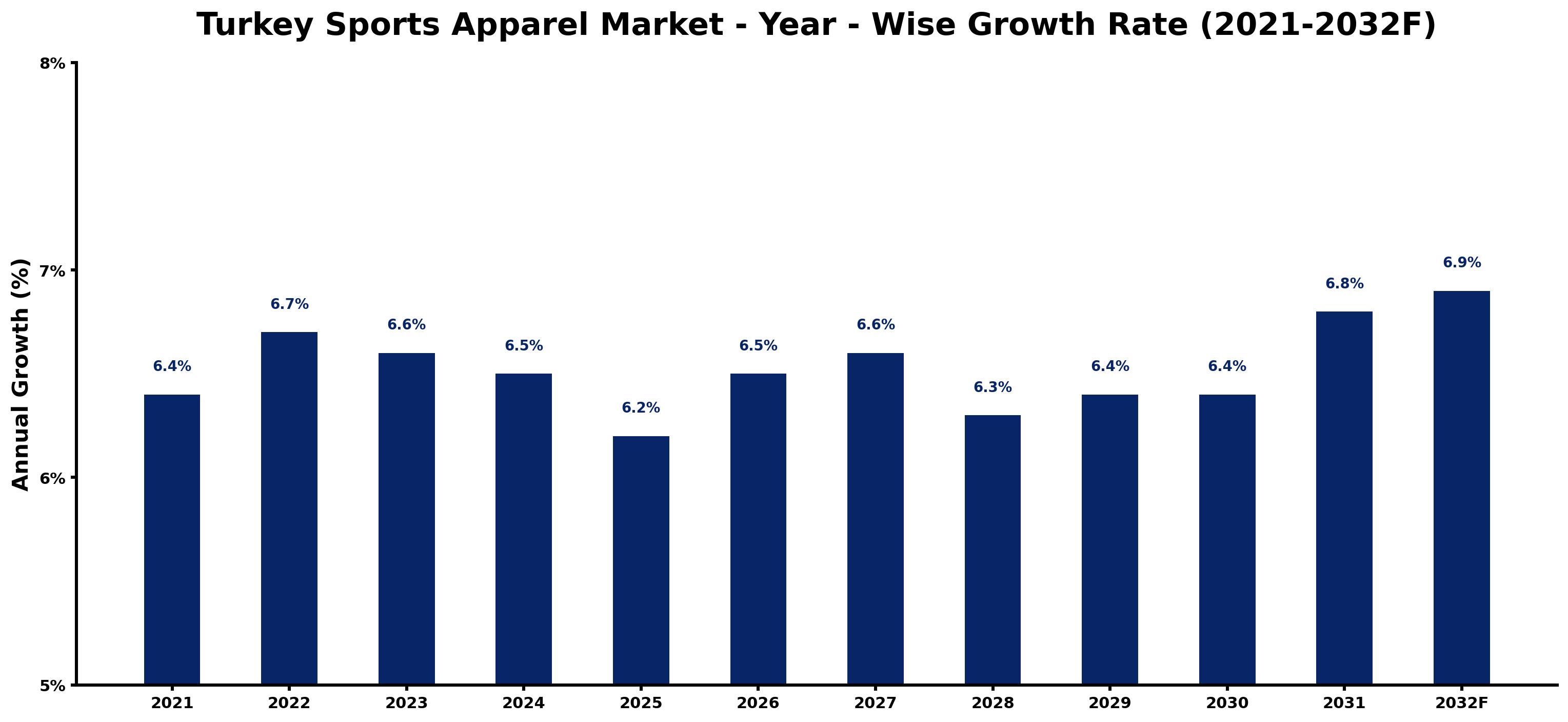
The table below presents the year wise growth rates along with the key drivers influencing the market
| Year | Growth Rate | Major Drivers |
| 2021 | 6.4% | Emerging fitness trends have reshaped consumer preferences towards sports apparel styles. |
| 2022 | 6.7% | Popular sports events fostered increased interest in branded sports apparel among youth. |
| 2023 | 6.6% | Digital retail growth enabled convenient purchases, enhancing customer engagement and loyalty. |
| 2024 | 6.5% | Social media influencers effectively promote athletic lifestyles and associated apparel brands. |
| 2025 | 6.2% | Sustainability practices in production attract environmentally conscious consumers and enhance brand reputation. |
| 2026 | 6.5% | Local manufacturing initiatives boost economic resilience and cater to regional consumer preferences. |
| 2027 | 6.6% | Technological innovations in fabric enhance performance and comfort, appealing to athletes. |
| 2028 | 6.3% | Health consciousness drives participation in sports, increasing apparel demand among diverse demographics. |
| 2029 | 6.4% | Collaborations between sports teams and apparel brands create exclusive collections with high demand. |
| 2030 | 6.4% | Urbanization leads to more recreational spaces, increasing the visibility and usage of sports apparel. |
| 2031 | 6.8% | Market expansion into women's sports apparel sees significant growth in previously underrepresented categories. |
| 2032 | 6.9% | E-commerce platforms diversify offerings, providing personalized shopping experiences for consumers. |
Note - Market size estimations and growth projections presented in this report are based on 6Wresearch's advanced forecasting approach, validated with industry datasets as of June 2026.
Turkey Sports Apparel Market Synopsis
The Turkey Sports Apparel Market is projected to reach 6.5% and witness significant growth during the forecast period (2026-2032). This upward trend is primarily driven by a heightened awareness surrounding health and fitness among consumers, coupled with the increasing popularity of sports and fitness activities. The market encompasses a wide array of products, including activewear, athletic footwear, and various accessories tailored for different sporting events. This growth reflects the evolving needs and preferences of consumers who are now gravitating towards innovative and high-quality sportswear options.
Turkey Sports Apparel Market Growth Drivers
Several factors are significantly contributing to the growth of the Turkey Sports Apparel Market. One of the primary drivers is the increasing health consciousness among the population, leading to a rise in participation in fitness activities and sports. This inclining demand promotes a corresponding growth in the procurement of sports apparel.
- Consumer preferences are shifting towards athleisure wear, which supports a versatile lifestyle that blends workout attire with casual wear.
- The expansion of e-commerce platforms is enhancing consumer accessibility, enabling easier shopping options and expanding market reach.
- Innovative product offerings that focus on performance, comfort, and style are meeting the evolving desires of health-focused consumers.
- Sustainable practices are becoming critical, with eco-friendly products gaining traction among a demographic that prioritizes ethical consumption.
- Social media influence and celebrity endorsements are driving brand visibility and consumer engagement, thereby propelling sales in the market.
Turkey Sports Apparel Market Trends and Opportunities
Current trends within the Turkey Sports Apparel Market indicate a shift towards multifunctional garments that combine style with practicality. Consumers are increasingly looking for apparel that can transition from gym to street seamlessly, thus bolstering the demand for athleisure wear. Moreover, sustainability is at the forefront of consumer priorities, prompting brands to adopt environmentally friendly production methods.
- The rise of digitalization has introduced new opportunities, with online marketplaces allowing brands to reach larger demographics effectively.
- Customization options are becoming popular, enabling consumers to purchase tailored apparel that meets their individual preferences.
- Collaborative ventures between sports brands and renowned designers are producing exclusive collections that cater to evolving fashion trends.
- Fitness awareness campaigns by public and private sectors are encouraging communities to engage more actively, creating a direct correlation with increased sportswear consumption.
- The integration of technological advancements, such as moisture-wicking fabrics and smart textiles, is shaping the future of sports apparel, enhancing performance and comfort.
Turkey Sports Apparel Market Challenges and Restraints
Despite the promising growth trajectory, the Turkey Sports Apparel Market faces challenges that could potentially hinder progress. A significant concern is the intensified competition among domestic and international brands, leading to pricing pressures and the need for product differentiation.
- Economic uncertainties and consumer spending patterns are unpredictable, making it difficult for companies to project demand accurately.
- The rapid evolution of fashion trends necessitates that brands remain agile, continuously innovating to stay relevant.
- Supply chain disruptions, owing to global circumstances, are posing logistical challenges that can affect timely product deliveries.
- Fluctuating raw material costs associated with sustainable practices may further complicate pricing strategies for manufacturers.
- Consumer expectations are rising, with an increasing demand for quality and performance, which can place added pressure on production standards.
Turkey Sports Apparel Market Investment Opportunities
The Turkey Sports Apparel Market offers multiple avenues for investment, driven by the ongoing trends in health and fitness awareness. Investors should consider opportunities in high-quality sports apparel brands that align with the preferences of health-conscious consumers.
- The athleisure market segment presents a lucrative opportunity, appealing to consumers who seek garments for both physical activities and everyday wear.
- Diving into e-commerce strategies is essential, as digital platforms can significantly amplify market penetration and brand exposure.
- Partnerships with local influencers or sports entities can strengthen brand recognition and credibility.
- Investing in sustainable practices not only aligns with consumer preferences but also enhances brand loyalty and reputation.
- Market expansion efforts, particularly in underrepresented regions, could lead to significant growth in customer base and sales volume.
Turkey Sports Apparel Market Government Investment and Initiatives
The Turkish government has enacted various policies aimed at bolstering the sports apparel market, creating a conducive environment for both local manufacturers and exporters. These initiatives include financial incentives to support domestic production and innovation, promoting technology adoption within the industry.
- The government emphasizes quality standards and regulatory compliance, ensuring that local products meet international benchmarks for safety and reliability.
- Investment in infrastructure designed to enhance logistics and supply chains is being prioritized to facilitate smoother operations for manufacturers.
- Public campaigns encouraging sports participation and healthy lifestyles contribute to increased consumer interest in sports apparel, thereby indirectly benefiting the market.
- Collaborative frameworks between local and international companies are encouraged, fostering knowledge transfer and enhancing competitive capabilities.
- Overall, these governmental initiatives aim to stimulate economic growth within the sports apparel sector while promoting consumer welfare and safety.
Turkey Sports Apparel Market Latest Developments (May 2025 - June 2026)
The Turkey Sports Apparel Market is experiencing significant momentum as of mid-2026, characterized by a variety of developments affecting both consumer behavior and industry practices. Notably, advancements in fabric technology continue to enhance product quality, leading to increased consumer demand for high-performance apparel.
- There has been a noticeable uptick in collaborations between sports apparel brands and fitness influencers, amplifying marketing efforts and brand exposure.
- Consumer interest in sustainable products has surged, prompting many brands to diversify their offerings to meet this demand.
- The integration of augmented reality in e-commerce platforms is improving the shopping experience, allowing consumers to visualize products more effectively before purchase.
- Continued emphasis on expanding online retail capabilities has resulted in the establishment of new digital marketing strategies tailored to engage younger consumers.
- Market resilience is being tested as brands navigate ongoing supply chain challenges while striving to maintain product quality and availability.
Turkey Sports Apparel Market - Key Attractiveness of the Report
- 10 Years of Market Numbers
- Historical Data Starting from 2022 to 2025
- Base Year: 2025
- Forecast Data until 2032
- Key Performance Indicators Impacting the Market
- Major Upcoming Developments and Projects
Key Highlights of the Report:
- Turkey Sports Apparel Market Outlook
- Market Size of Turkey Sports Apparel Market, 2025
- Forecast of Turkey Sports Apparel Market, 2032F
- Historical Data and Forecast of Turkey Sports Apparel Revenues & Volume for the Period 2022-2032F
- Turkey Sports Apparel Market Trend Evolution
- Turkey Sports Apparel Market Drivers and Challenges
- Turkey Sports Apparel Price Trends
- Turkey Sports Apparel Porter's Five Forces
- Turkey Sports Apparel Industry Life Cycle
- Historical Data and Forecast of Turkey Sports Apparel Market Revenues & Volume By End-users for the Period 2022-2032F
- Historical Data and Forecast of Turkey Sports Apparel Market Revenues & Volume By Children for the Period 2022-2032F
- Historical Data and Forecast of Turkey Sports Apparel Market Revenues & Volume By Men for the Period 2022-2032F
- Historical Data and Forecast of Turkey Sports Apparel Market Revenues & Volume By Women for the Period 2022-2032F
- Historical Data and Forecast of Turkey Sports Apparel Market Revenues & Volume By Distribution Channel for the Period 2022-2032F
- Historical Data and Forecast of Turkey Sports Apparel Market Revenues & Volume By E-commerce for the Period 2022-2032F
- Historical Data and Forecast of Turkey Sports Apparel Market Revenues & Volume By Supermarket/Hypermarket for the Period 2022-2032F
- Historical Data and Forecast of Turkey Sports Apparel Market Revenues & Volume By Brand Outlets for the Period 2022-2032F
- Historical Data and Forecast of Turkey Sports Apparel Market Revenues & Volume By Discount Stores for the Period 2022-2032F
- Turkey Sports Apparel Import Export Trade Statistics
- Market Opportunity Assessment By End-users
- Market Opportunity Assessment By Distribution Channel
- Turkey Sports Apparel Top Companies Market Share
- Turkey Sports Apparel Competitive Benchmarking By Technical and Operational Parameters
- Turkey Sports Apparel Company Profiles
- Turkey Sports Apparel Key Strategic Recommendations






































