Turkey Three Wheeler Market Size, Share & Growth Rate
The Turkey Three Wheeler Market was estimated at USD 433 Million in 2025 and is projected to reach USD 589 Million by 2032, growing at a CAGR of 4.5% from 2026 to 2032. This growth trajectory is primarily driven by the increasing demand for cost-effective and fuel-efficient transportation solutions, particularly in urban settings where traffic congestion is prevalent. The rising adoption of electric and hybrid models, facilitated by government initiatives, further underscores the market's potential for expansion.
Turkey Three Wheeler Market Year-wise Growth Rate and Key Drivers
This graph highlights how the Turkey Three Wheeler Market has steadily grown over the years, supported by major growth factors.
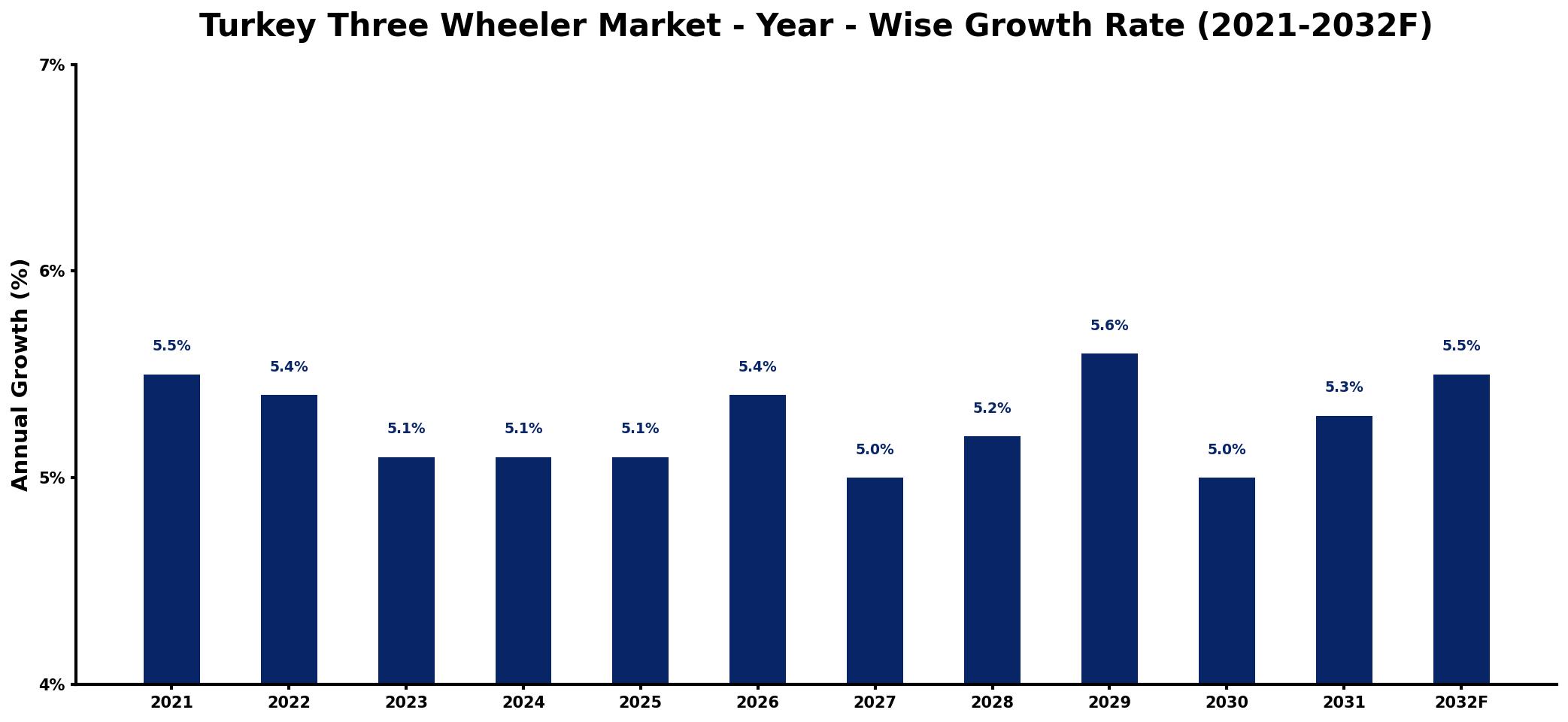
The table below presents the year‑wise growth rates along with the key drivers influencing the market
| Year | Growth Rate | Major Drivers |
| 2021 | 5.5% | Increase in urban transportation needs |
| 2022 | 5.4% | Rising demand for eco-friendly solutions |
| 2023 | 5.1% | Growth in last-mile delivery services |
| 2024 | 5.1% | Expansion of ride-sharing platforms |
| 2025 | 5.1% | Investment in local manufacturing facilities |
| 2026 | 5.4% | expanding healthcare application demand |
| 2027 | 5.0% | Emergence of new logistics applications |
| 2028 | 5.2% | Technological advancements in vehicle efficiency |
| 2029 | 5.6% | Increased government support for alternatives |
| 2030 | 5.0% | growing commercial sector adoption |
| 2031 | 5.3% | Rising consumer preference for mobility |
| 2032 | 5.5% | rising end-use demand growth |
Note: Market size estimations and growth projections presented in this report are based on 6Wresearch's proprietary forecasting methodology, utilizing the latest available industry data, government publications, and primary research inputs.
Turkey Three Wheeler Market Synopsis
The most significant force currently shaping the Turkey Three Wheeler Market is the shift toward environmentally friendly transportation options. As urbanization accelerates and environmental concerns gain prominence, consumers are increasingly gravitating towards electric and hybrid three-wheelers as viable alternatives to traditional vehicles.
Additionally, the demand for three-wheelers in commercial applications is surging, particularly for last-mile delivery and logistics services. This rise is bolstered by the growth of e-commerce, driving businesses to seek efficient solutions for goods transportation within urban areas.
Turkey Three Wheeler Market Key Takeaways
- The Turkey Three Wheeler Market is projected to grow from USD 433 Million in 2025 to USD 589 Million by 2032, at a CAGR of 4.5%.
- Increasing environmental awareness is propelling the shift towards electric and hybrid three-wheelers.
- Urban logistics and last-mile delivery services are creating new demand for commercial three-wheelers.
- Technological advancements, including smart features and enhanced safety systems, are reshaping consumer preferences.
- Government incentives aimed at promoting eco-friendly vehicles are fostering market growth.
Evaluation of Restraints in Turkey Three Wheeler Market
Despite the growth potential, several key restraints exist within the Turkey Three Wheeler Market. Regulatory challenges, particularly regarding stringent emission standards and licensing requirements, can impede the market's expansion. Additionally, competition from well-established modes of transportation, such as traditional cars and motorcycles, poses significant hurdles for market penetration. Limited infrastructure tailored to three-wheelers, including designated lanes and parking facilities, further complicates their operational viability. Lastly, the prevailing perception of three-wheelers as less modern or less safe than other vehicles can deter potential users and limit broader market acceptance.
Turkey Three Wheeler Market Trends
Current trends indicate a robust move towards electric vehicles within the Turkey Three Wheeler Market, driven by heightened environmental consciousness and supportive governmental policies. Manufacturers are increasingly focusing on developing electric three-wheelers to cater to the growing demand for sustainable transportation options. Furthermore, the modernization of traditional three-wheelers with advanced features, such as digital interfaces and improved safety mechanisms, is gaining traction, enhancing both driver and passenger experiences.
There is also a noticeable increase in the use of three-wheelers for commercial applications, particularly for goods delivery and logistics. As urban environments continue to evolve, three-wheelers are emerging as efficient, nimble solutions for navigating congested city streets, thereby solidifying their role in last-mile delivery services.
Turkey Three Wheeler Market Opportunities
The Turkey Three Wheeler Market offers substantial investment opportunities, particularly in the manufacturing and supply of electric and eco-friendly models. The rising consumer demand for efficient and affordable transportation solutions opens avenues for investors focused on sustainable mobility. Additionally, investing in technology and innovation within the sector, such as enhancing safety features or integrating smart technologies, presents lucrative prospects. Partnerships with local governments for fleet modernization initiatives or financing solutions for operators can further bolster investment potential in this growing market.
Government Initiatives in the Turkey Three Wheeler Market
The Turkish government has been proactive in shaping the three-wheeler market through various policies aimed at promoting safe and environmentally friendly transportation. These regulations include stringent safety and emission standards, ensuring that vehicles comply with necessary requirements for road operation. Additionally, the government offers incentives such as tax breaks and subsidies to encourage the adoption of electric or hybrid three-wheelers, creating a favorable regulatory environment for market growth while prioritizing safety and sustainability.
Future Insights of the Turkey Three Wheeler Market
Looking ahead to 2026-2032, the Turkey Three Wheeler Market appears poised for continued growth. The demand for cost-effective, fuel-efficient transportation, particularly in urban settings, is likely to remain strong. Moreover, government initiatives promoting electric and eco-friendly vehicle adoption are expected to create significant opportunities for the integration of electric three-wheelers into the market. The increasing popularity of e-commerce and last-mile delivery solutions will further fuel demand, making three-wheelers an increasingly attractive option for both consumers and businesses seeking sustainable and efficient mobility solutions.
Turkey Three Wheeler Market Latest Developments (2025 - 2026)
In recent months, the Turkey Three Wheeler Market has seen a heightened focus on technological advancements aimed at enhancing vehicle performance and safety. Additionally, manufacturers are increasingly rolling out new electric models that align with the growing demand for greener transportation options. There are also reports of collaborative efforts between private companies and local governments to promote fleet modernization, which is expected to further transform the urban transportation landscape in Turkey.
Turkey Three Wheeler Market - Key Attractiveness of the Report
- 10 Years of Market Numbers
- Historical Data Starting from 2022 to 2025
- Base Year: 2025
- Forecast Data until 2032
- Key Performance Indicators Impacting the Market
- Major Upcoming Developments and Projects
Key Highlights of the Report:
- Turkey Three Wheeler Market Outlook
- Market Size of Turkey Three Wheeler Market, 2025
- Forecast of Turkey Three Wheeler Market, 2032
- Historical Data and Forecast of Turkey Three Wheeler Revenues & Volume for the Period 2022-2032F
- Turkey Three Wheeler Market Trend Evolution
- Turkey Three Wheeler Market Drivers and Challenges
- Turkey Three Wheeler Price Trends
- Turkey Three Wheeler Porter's Five Forces
- Turkey Three Wheeler Industry Life Cycle
- Historical Data and Forecast of Turkey Three Wheeler Market Revenues & Volume By Fuel Type for the Period 2022-2032F
- Historical Data and Forecast of Turkey Three Wheeler Market Revenues & Volume By Petrol/CNG for the Period 2022-2032F
- Historical Data and Forecast of Turkey Three Wheeler Market Revenues & Volume By Diesel for the Period 2022-2032F
- Historical Data and Forecast of Turkey Three Wheeler Market Revenues & Volume By Electric for the Period 2022-2032F
- Historical Data and Forecast of Turkey Three Wheeler Market Revenues & Volume By Vehicle Type for the Period 2022-2032F
- Historical Data and Forecast of Turkey Three Wheeler Market Revenues & Volume By Passenger Carrier for the Period 2022-2032F
- Historical Data and Forecast of Turkey Three Wheeler Market Revenues & Volume By Load Carrier for the Period 2022-2032F
- Turkey Three Wheeler Import Export Trade Statistics
- Market Opportunity Assessment By Fuel Type
- Market Opportunity Assessment By Vehicle Type
- Turkey Three Wheeler Top Companies Market Share
- Turkey Three Wheeler Competitive Benchmarking By Technical and Operational Parameters
- Turkey Three Wheeler Company Profiles
- Turkey Three Wheeler Key Strategic Recommendations






































