Turkey Transaction Monitoring Market Size & Growth Rate (2026-2032)
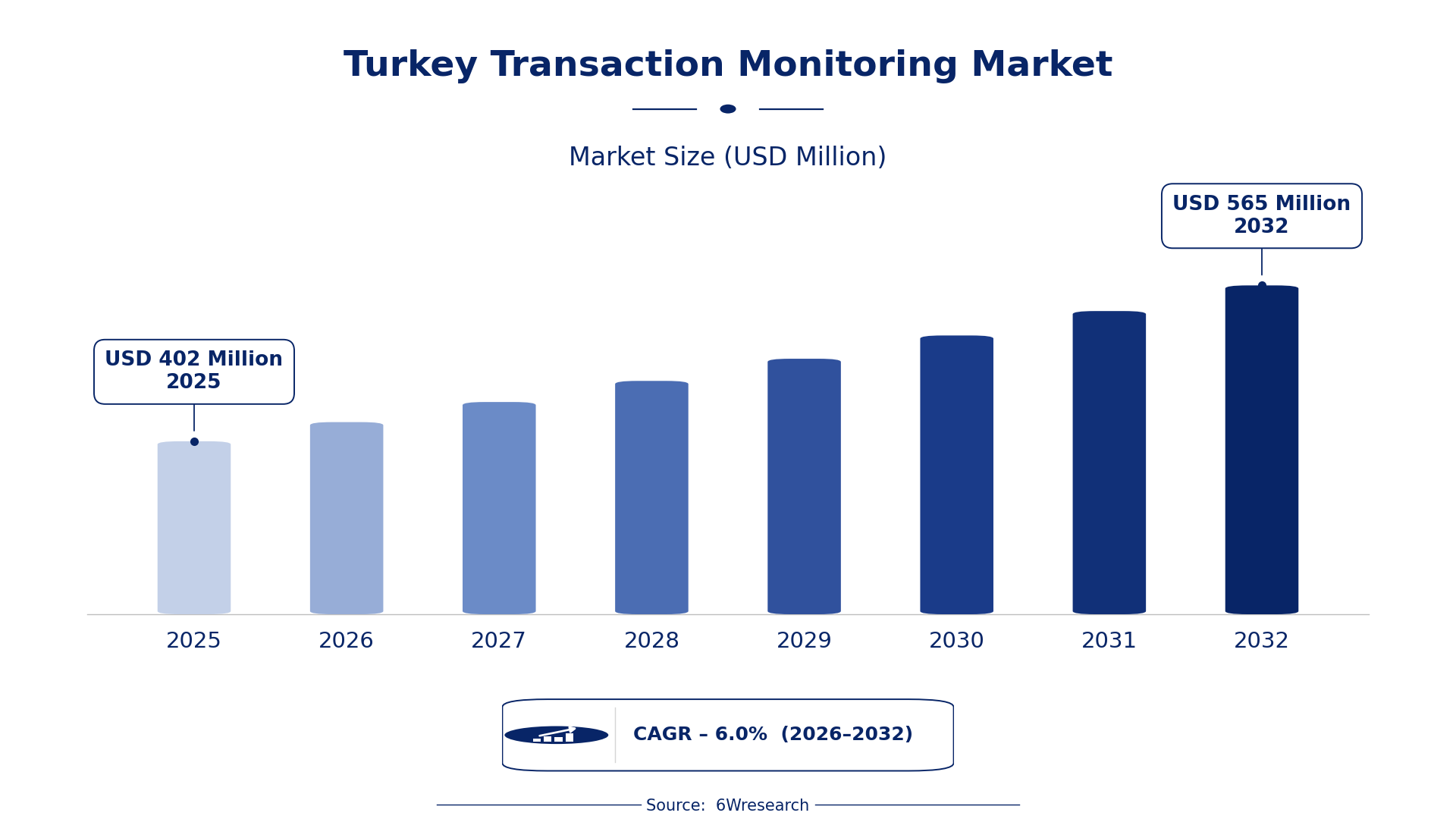
The Turkey Transaction Monitoring Market was estimated at USD 402 Million in 2025 and is projected to reach USD 565 Million by 2032, growing at a CAGR of 6.0% from 2026 to 2032.
Turkey Transaction Monitoring Market Synopsis
The Turkey Transaction Monitoring Market is experiencing notable growth, driven by stringent regulations aimed at addressing financial crimes. With an increase in money laundering and fraud incidents, financial institutions are compelled to adopt sophisticated monitoring solutions to stay compliant and protect their reputation.
Regulatory bodies in Turkey are enforcing comprehensive policies that mandate real-time monitoring, pushing organizations to enhance their technological capabilities. As a result, the market is shifting towards advanced analytics and AI-driven platforms to detect suspicious activities efficiently.
Turkey Transaction Monitoring Market Year-wise Growth Rate and Key Drivers
This graph illustrates the annual growth rates of the Turkey Transaction Monitoring Market from 2021 to 2032, highlighting a steady upward trajectory and projected expansion over the forecast period.
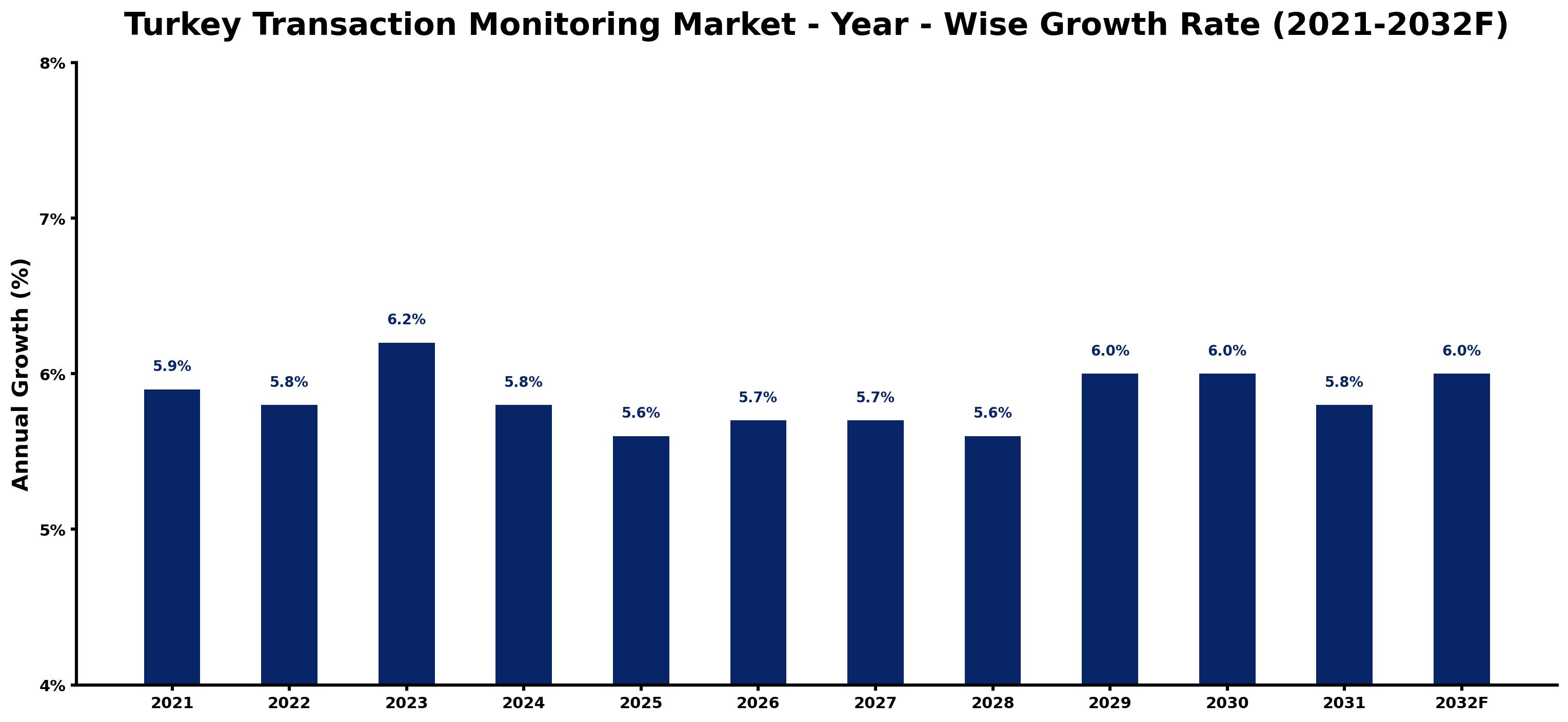
The table below presents the year‑wise growth rates along with the key drivers influencing the market
| Year | Growth Rate | Major Drivers |
| 2021 | 5.9% | Increasing regulations by MASAK on financial transactions. |
| 2022 | 5.8% | Rising e-commerce transactions triggering advanced monitoring requirements. |
| 2023 | 6.2% | Implementation of new cybersecurity laws enhances transaction scrutiny. |
| 2024 | 5.8% | Growth of digital banking services boosts transaction monitoring needs. |
| 2025 | 5.6% | Regulatory push for KYC improvements among financial institutions. |
| 2026 | 5.7% | Growth in remittance services increases compliance monitoring demands. |
| 2027 | 5.7% | Consumer electronics sales surge leading to fraud prevention focus. |
| 2028 | 5.6% | Enhanced focus on fintech innovations drives transaction regulation. |
| 2029 | 6.0% | Digital identity adoption creates demand for compliance solutions. |
| 2030 | 6.0% | Increased focus on cross-border transactions heightens monitoring needs. |
| 2031 | 5.8% | Turkey's digital transformation strategy promotes secure financial operations. |
| 2032 | 6.0% | Rising cryptocurrency interest leads to stricter monitoring guidelines. |
Note: Market size estimations and growth projections presented in this report are based on 6Wresearch's proprietary forecasting methodology, utilizing the latest available industry data, government publications, and primary research inputs.
Turkey Transaction Monitoring Market Key Takeaways
Below are some of the specific key takeaways from the market, including:
- The market is primarily driven by regulatory requirements focused on mitigating financial crimes.
- Financial institutions are increasingly investing in technology to enhance compliance and operational efficiency.
- Advanced analytical tools are becoming standard for real-time transaction monitoring.
- Integration with existing systems remains a crucial challenge for many institutions.
- Government policies are shaping the market, emphasizing the need for stringent monitoring protocols.
Evaluation of Restraints in Turkey Transaction Monitoring Market
The Turkey Transaction Monitoring Market faces several restraints that can hinder its growth. A significant challenge is the evolving regulatory framework, which requires institutions to continuously adapt their monitoring practices. Many financial organizations struggle with integrating new systems with legacy technologies, which can complicate the transition to more sophisticated monitoring solutions.
Scalability is another concern, as financial institutions deal with increasing transaction volumes. Ensuring accuracy and efficiency while managing this growth is critical. These hurdles necessitate a clear strategy that addresses regulatory compliance while fostering technological innovation.
Turkey Transaction Monitoring Market Trends
Several trends are shaping the Turkey Transaction Monitoring Market. Firstly, there is a marked shift towards automation, allowing institutions to handle vast amounts of data efficiently. Financial organizations are increasingly adopting machine learning algorithms to enhance detection capabilities and reduce false positives.
on top of that, the integration of blockchain technology is emerging as a viable solution for ensuring transparency and traceability in transactions. This technology can streamline compliance processes while providing a clear audit trail, which is highly attractive to regulators and institutions alike.
Turkey Transaction Monitoring Market Opportunities
The Turkey Transaction Monitoring Market presents significant growth opportunities. As financial institutions continue to face pressure from regulators, there is an urgent need for enhanced compliance solutions. This scenario opens doors for vendors offering innovative, scalable transaction monitoring systems.
on top of that, partnerships with technology providers can lead to the development of tailored solutions that meet specific institutional needs. Institutions that invest in AI and machine learning capabilities will likely gain a competitive edge, enhancing their ability to combat fraud and money laundering effectively.
Government Initiatives in the Turkey Transaction Monitoring Market
Government policies are crucial in shaping the Turkey Transaction Monitoring Market, with an emphasis on rigorous compliance measures to tackle financial crimes. The Turkish government has implemented various regulatory frameworks that necessitate real-time transaction monitoring and reporting of suspicious activities. These initiatives aim to align national practices with international standards, fostering greater security in the financial sector.
- A comprehensive regulatory framework was introduced in 2025 mandating enhanced transaction monitoring systems across financial institutions.
- Currently, the government is conducting audits to ensure compliance with established monitoring protocols.
- A planned public-private initiative aims to improve data sharing between financial institutions and regulatory bodies by 2027.
- Recent training programs have been rolled out for compliance officers to enhance their skills in identifying suspicious transactions.
- Ongoing evaluations of existing regulations will determine potential adjustments to improve the effectiveness of monitoring systems.
Future Insights of the Turkey Transaction Monitoring Market
Looking ahead to 2026-2032, the Turkey Transaction Monitoring Market is set to evolve significantly. The push for compliance will drive further investments in cutting-edge technologies, including AI and analytics. Institutions that embrace these innovations will enhance their ability to detect suspicious activities promptly.
on top of that, as regulatory requirements become increasingly stringent, the demand for integrated solutions that provide seamless compliance will rise. Companies that can effectively combine regulatory knowledge with technological prowess will thrive in this dynamic environment.
Turkey Transaction Monitoring Market Latest Developments
The last 12 months have seen a surge in activity within the Turkey Transaction Monitoring Market, driven largely by government mandates and financial institutions' commitments to enhance compliance capabilities. Organizations are now more focused on integrating advanced technology solutions into their monitoring systems.
- A major technology vendor launched an AI-based transaction monitoring system in Q1 2025, aiming to minimize false positives.
- An ongoing initiative began in mid-2025 to upgrade the infrastructure used by key financial institutions for better compliance management.
- A partnership between regulatory bodies and fintech firms is currently underway to develop a national framework for data sharing, expected to roll out in late 2026.
- In early 2025, a bank implemented a blockchain solution to enhance transaction transparency and ensure compliance with regulatory standards.
- A planned system upgrade targeting legacy platforms is expected to commence in Q2 2026, aiming to improve real-time monitoring capabilities.
Turkey Transaction Monitoring Market - Key Attractiveness of the Report
- 10 Years of Market Numbers
- Historical Data Starting from 2022 to 2025
- Base Year: 2025
- Forecast Data until 2032
- Key Performance Indicators Impacting the Market
- Major Upcoming Developments and Projects
Key Highlights of the Report:
- Turkey Transaction Monitoring Market Outlook
- Market Size of Turkey Transaction Monitoring Market, 2025
- Forecast of Turkey Transaction Monitoring Market, 2032
- Historical Data and Forecast of Turkey Transaction Monitoring Revenues & Volume for the Period 2022-2032F
- Turkey Transaction Monitoring Market Trend Evolution
- Turkey Transaction Monitoring Market Drivers and Challenges
- Turkey Transaction Monitoring Price Trends
- Turkey Transaction Monitoring Porter's Five Forces
- Turkey Transaction Monitoring Industry Life Cycle
- Historical Data and Forecast of Turkey Transaction Monitoring Market Revenues & Volume By Application Area for the Period 2022-2032F
- Historical Data and Forecast of Turkey Transaction Monitoring Market Revenues & Volume By AML for the Period 2022-2032F
- Historical Data and Forecast of Turkey Transaction Monitoring Market Revenues & Volume By FDP for the Period 2022-2032F
- Historical Data and Forecast of Turkey Transaction Monitoring Market Revenues & Volume By Compliance Management for the Period 2022-2032F
- Historical Data and Forecast of Turkey Transaction Monitoring Market Revenues & Volume By Customer Identity Management for the Period 2022-2032F
- Historical Data and Forecast of Turkey Transaction Monitoring Market Revenues & Volume By Component for the Period 2022-2032F
- Historical Data and Forecast of Turkey Transaction Monitoring Market Revenues & Volume By Solution for the Period 2022-2032F
- Historical Data and Forecast of Turkey Transaction Monitoring Market Revenues & Volume By Services for the Period 2022-2032F
- Historical Data and Forecast of Turkey Transaction Monitoring Market Revenues & Volume By Function for the Period 2022-2032F
- Historical Data and Forecast of Turkey Transaction Monitoring Market Revenues & Volume By Case Management for the Period 2022-2032F
- Historical Data and Forecast of Turkey Transaction Monitoring Market Revenues & Volume By KYC/Customer Onboarding for the Period 2022-2032F
- Historical Data and Forecast of Turkey Transaction Monitoring Market Revenues & Volume By Dashboard and Reporting for the Period 2022-2032F
- Historical Data and Forecast of Turkey Transaction Monitoring Market Revenues & Volume By Watch List Screening for the Period 2022-2032F
- Historical Data and Forecast of Turkey Transaction Monitoring Market Revenues & Volume By Deployment Mode for the Period 2022-2032F
- Historical Data and Forecast of Turkey Transaction Monitoring Market Revenues & Volume By On-Premises for the Period 2022-2032F
- Historical Data and Forecast of Turkey Transaction Monitoring Market Revenues & Volume By Cloud for the Period 2022-2032F
- Historical Data and Forecast of Turkey Transaction Monitoring Market Revenues & Volume By Organization Size for the Period 2022-2032F
- Historical Data and Forecast of Turkey Transaction Monitoring Market Revenues & Volume By SMEs for the Period 2022-2032F
- Historical Data and Forecast of Turkey Transaction Monitoring Market Revenues & Volume By Large Enterprises for the Period 2022-2032F
- Historical Data and Forecast of Turkey Transaction Monitoring Market Revenues & Volume By Vertical for the Period 2022-2032F
- Historical Data and Forecast of Turkey Transaction Monitoring Market Revenues & Volume By Banking, Financial Services, and Insurance for the Period 2022-2032F
- Historical Data and Forecast of Turkey Transaction Monitoring Market Revenues & Volume By Government and Defense for the Period 2022-2032F
- Historical Data and Forecast of Turkey Transaction Monitoring Market Revenues & Volume By IT and Telecom for the Period 2022-2032F
- Historical Data and Forecast of Turkey Transaction Monitoring Market Revenues & Volume By Retail for the Period 2022-2032F
- Historical Data and Forecast of Turkey Transaction Monitoring Market Revenues & Volume By Healthcare for the Period 2022-2032F
- Historical Data and Forecast of Turkey Transaction Monitoring Market Revenues & Volume By Energy and Utilities for the Period 2022-2032F
- Historical Data and Forecast of Turkey Transaction Monitoring Market Revenues & Volume By Manufacturing for the Period 2022-2032F
- Historical Data and Forecast of Turkey Transaction Monitoring Market Revenues & Volume By Others for the Period 2022-2032F
- Turkey Transaction Monitoring Import Export Trade Statistics
- Market Opportunity Assessment By Application Area
- Market Opportunity Assessment By Component
- Market Opportunity Assessment By Function
- Market Opportunity Assessment By Deployment Mode
- Market Opportunity Assessment By Organization Size
- Market Opportunity Assessment By Vertical
- Turkey Transaction Monitoring Top Companies Market Share
- Turkey Transaction Monitoring Competitive Benchmarking By Technical and Operational Parameters
- Turkey Transaction Monitoring Company Profiles
- Turkey Transaction Monitoring Key Strategic Recommendations






































