Turkey Vetiver Oil Market Size, Share & Growth Rate
The Turkey Vetiver Oil Market was estimated at USD 320 Million in 2025 and is projected to reach USD 465 Million by 2032, growing at a CAGR of 5.5% from 2026 to 2032. This promising trajectory is largely driven by the surging demand for natural and organic products, particularly in personal care and aromatherapy sectors. Additionally, the increasing expansion of the fragrance industry, coupled with a growing awareness of vetiver oil's therapeutic benefits, is significantly contributing to this market growth.
Turkey Vetiver Oil Market Year-wise Growth Rate and Key Drivers
This graph highlights how the Turkey Vetiver Oil Market has steadily grown over the years, supported by major growth factors.
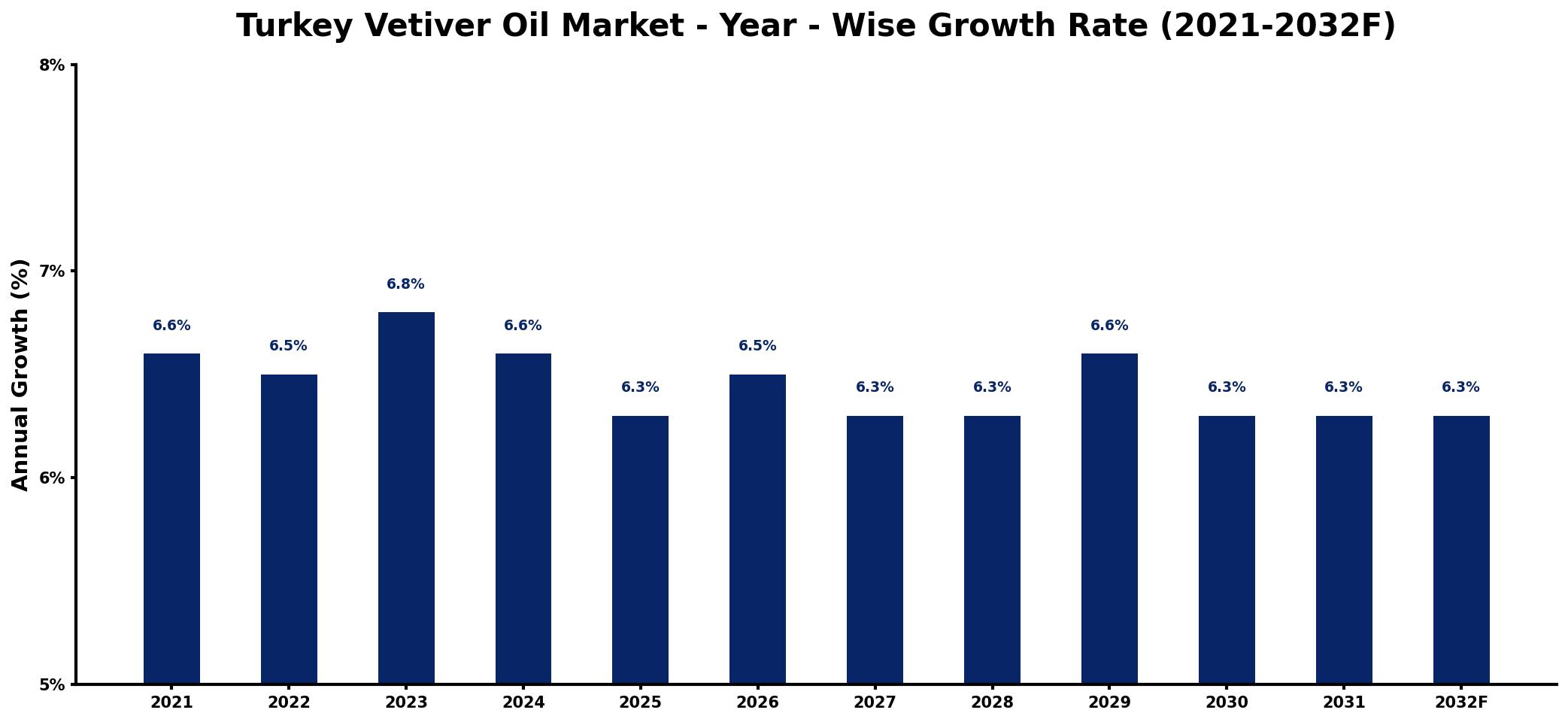
The table below presents the year‑wise growth rates along with the key drivers influencing the market
| Year | Growth Rate | Major Drivers |
| 2021 | 6.6% | Rising demand for natural fragrances |
| 2022 | 6.5% | Increased investment in aromatherapy |
| 2023 | 6.8% | Growth in organic personal care |
| 2024 | 6.6% | Expansion of wellness tourism sector |
| 2025 | 6.3% | Higher consumer preference for sustainability |
| 2026 | 6.5% | Boost in herbal medicine applications |
| 2027 | 6.3% | Surge in home fragrance market |
| 2028 | 6.3% | Increased awareness of holistic health |
| 2029 | 6.6% | increased capital investment inflows |
| 2030 | 6.3% | Rising popularity of eco-friendly products |
| 2031 | 6.3% | strengthening international trade flows |
| 2032 | 6.3% | Increased collaborations with perfumers |
Note: Market size estimations and growth projections presented in this report are based on 6Wresearch's proprietary forecasting methodology, utilizing the latest available industry data, government publications, and primary research inputs.
Turkey Vetiver Oil Market Synopsis
The strongest force shaping the Turkey vetiver oil market right now is the rising consumer inclination towards natural ingredients in beauty and wellness products. As consumers become more conscious of the potential harmful effects of synthetic additives, the demand for organic vetiver oil is seeing remarkable growth, fostering innovation within the sector.
Moreover, the traditional and alternative medicine practices are gaining momentum in Turkey, further boosting interest in vetiver oil for its calming and grounding properties. The growing acceptance of holistic wellness approaches is pivotal in expanding the market's footprint, positioning Turkey as a key player in the global vetiver oil landscape.
Turkey Vetiver Oil Market Key Takeaways
- The market is set for robust growth driven by increasing consumer demand for natural and organic products.
- Vetiver oil's calming properties are pivotal in its application across aromatherapy and cosmetics.
- Government initiatives are supporting the cultivation and export of vetiver oil, enhancing market dynamics.
- Awareness of vetiver oil's therapeutic benefits is gradually increasing among consumers and professionals alike.
- Challenges such as limited cultivation and competition from synthetic alternatives remain critical factors to address.
Evaluation of Restraints in Turkey Vetiver Oil Market
Despite the promising growth trajectory, the Turkey vetiver oil market faces significant restraints. Limited cultivation of vetiver grass poses a challenge to meet the rising demand, often leading to supply constraints. Furthermore, high production costs, primarily due to labor-intensive extraction processes, limit profitability for producers. The competition from synthetic alternatives, which can be produced at a lower cost, continues to threaten the market's growth. Finally, a lack of widespread awareness regarding the benefits of vetiver oil restricts its potential consumer base, emphasizing the need for enhanced educational efforts.
Turkey Vetiver Oil Market Trends
Current trends in the Turkey vetiver oil market indicate a strong shift towards sustainability, with increasing emphasis on eco-friendly production practices. The fragrance industry is becoming more focused on sourcing natural ingredients, as consumers increasingly demand transparency in product formulations. Additionally, there is a growing trend of combining vetiver oil with other essential oils, enhancing its therapeutic applications and expanding its reach within the aromatherapy sector.
Moreover, the rise of e-commerce platforms has transformed how consumers access vetiver oil products, making it more convenient to purchase natural ingredients. This trend is encouraging small producers and artisans to enter the market, promoting diversity and innovation in product offerings.
Turkey Vetiver Oil Market Opportunities
Significant growth opportunities lie in expanding the applications of vetiver oil beyond traditional uses. With the ongoing trend towards natural and organic solutions, there is a burgeoning market for vetiver-infused personal care products, including skin and hair care formulations. Furthermore, leveraging the therapeutic benefits of vetiver oil in wellness tourism and holistic health practices presents avenues for strategic investment and development.
Government Initiatives in the Turkey Vetiver Oil Market
The Turkish government is actively supporting the cultivation and production of vetiver oil through various agricultural policies. Financial support and technical assistance are provided to farmers, facilitating the growth of this sector. Furthermore, export incentives are being introduced to stimulate international trade, ensuring that Turkish vetiver oil meets international quality standards while promoting sustainable farming practices.
Future Insights of the Turkey Vetiver Oil Market
Looking ahead to 2026-2032, the Turkey vetiver oil market is poised for significant expansion, driven by the ongoing shift towards natural products. As awareness of the therapeutic benefits of vetiver oil continues to grow, coupled with the global trend towards sustainable sourcing, demand is expected to rise steadily. Companies that adapt to these evolving consumer preferences and invest in innovation will likely secure a competitive edge in this dynamic market landscape.
Turkey Vetiver Oil Market Latest Developments (2025 - 2026)
Recent developments in the Turkey vetiver oil market suggest a growing collaboration between producers and research institutions to enhance cultivation techniques and oil extraction methods. There has been an uptick in promotional activities aimed at educating consumers about the benefits of vetiver oil, which is expected to further boost market demand. Additionally, more firms are exploring partnerships to integrate vetiver oil into innovative product formulations, particularly in the cosmetics and wellness sectors.
Turkey Vetiver Oil Market - Key Attractiveness of the Report
- 10 Years of Market Numbers
- Historical Data Starting from 2022 to 2025
- Base Year: 2025
- Forecast Data until 2032
- Key Performance Indicators Impacting the Market
- Major Upcoming Developments and Projects
Key Highlights of the Report:
- Turkey Vetiver Oil Market Outlook
- Market Size of Turkey Vetiver Oil Market, 2025
- Forecast of Turkey Vetiver Oil Market, 2032
- Historical Data and Forecast of Turkey Vetiver Oil Revenues & Volume for the Period 2022-2032F
- Turkey Vetiver Oil Market Trend Evolution
- Turkey Vetiver Oil Market Drivers and Challenges
- Turkey Vetiver Oil Price Trends
- Turkey Vetiver Oil Porter's Five Forces
- Turkey Vetiver Oil Industry Life Cycle
- Historical Data and Forecast of Turkey Vetiver Oil Market Revenues & Volume By Application for the Period 2022-2032F
- Historical Data and Forecast of Turkey Vetiver Oil Market Revenues & Volume By Medical for the Period 2022-2032F
- Historical Data and Forecast of Turkey Vetiver Oil Market Revenues & Volume By Food & Beverage for the Period 2022-2032F
- Historical Data and Forecast of Turkey Vetiver Oil Market Revenues & Volume By Spa & Relaxation for the Period 2022-2032F
- Turkey Vetiver Oil Import Export Trade Statistics
- Market Opportunity Assessment By Application
- Turkey Vetiver Oil Top Companies Market Share
- Turkey Vetiver Oil Competitive Benchmarking By Technical and Operational Parameters
- Turkey Vetiver Oil Company Profiles
- Turkey Vetiver Oil Key Strategic Recommendations






































