Turkey Water Treatment Market Summary
The turkey water treatment market was estimated at USD 180 Million in 2025 and is projected to reach USD 246 Million by 2032, growing at a CAGR of 5.7% from 2026 to 2032.
Turkey Water Treatment Market Year-wise Growth Rate and Key Drivers
This graph highlights how the Turkey Water Treatment Market has steadily grown over the past five years, supported by major growth factors.
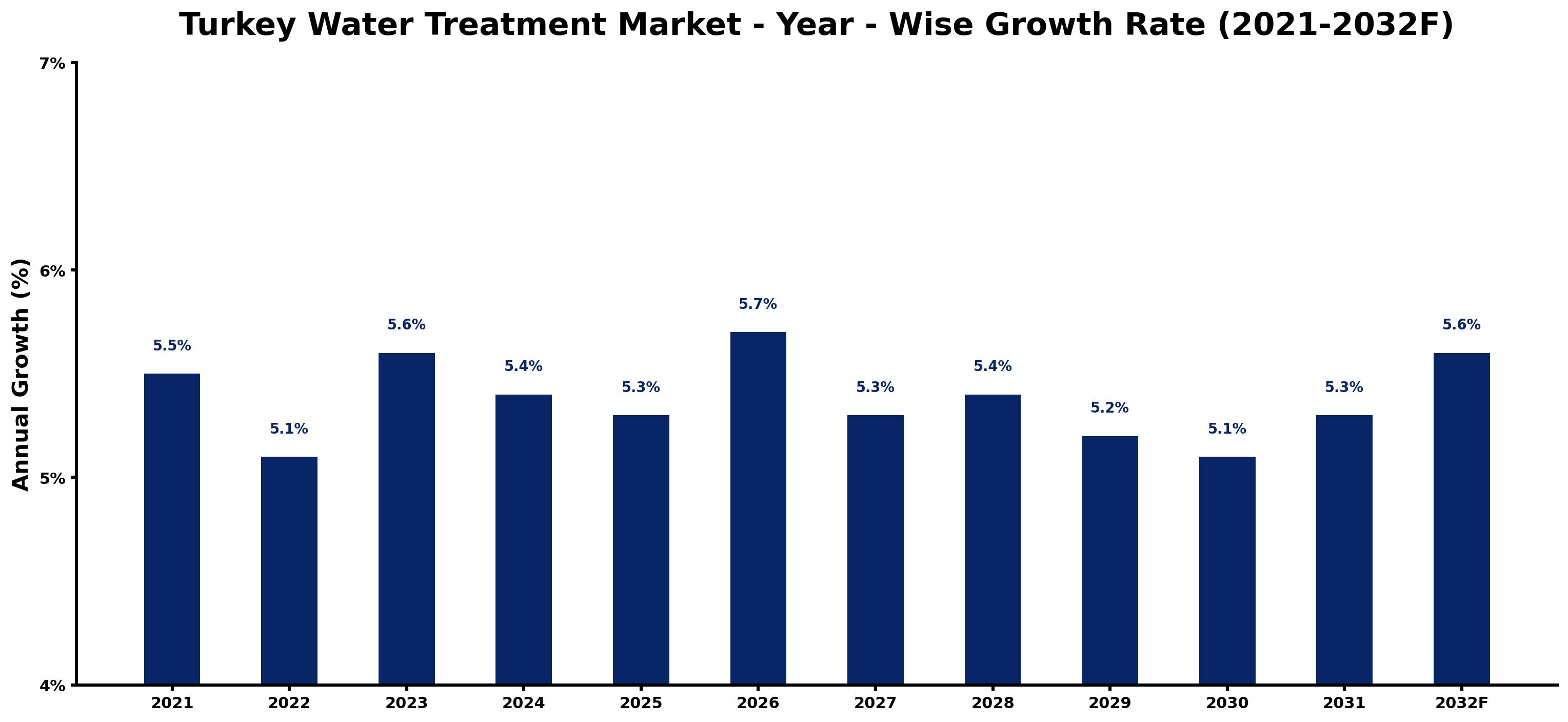
The table below presents the year wise growth rates along with the key drivers influencing the market
| Year | Growth Rate | Major Drivers |
| 2021 | 5.5% | Increased awareness of water scarcity challenges highlighted the need for treatment technologies. |
| 2022 | 5.1% | Investment in sustainable infrastructure became critical for urban development projects across Turkey. |
| 2023 | 5.6% | The impact of climate change prompted municipalities to prioritize water conservation measures. |
| 2024 | 5.4% | Corporate social responsibility initiatives began emphasizing water stewardship in industrial operations. |
| 2025 | 5.3% | Demand for advanced filtration systems increased due to stricter water quality regulations. |
| 2026 | 5.7% | Partnerships between public and private sectors emerged, enhancing technological innovation in treatment. |
| 2027 | 5.3% | Emerging startups in water tech began attracting significant venture capital funding and interest. |
| 2028 | 5.4% | Research and development focused on eco-friendly chemicals gained traction within the industry. |
| 2029 | 5.2% | Tourism expansion highlighted the importance of reliable water treatment in hospitality services. |
| 2030 | 5.1% | Smart city initiatives integrated water management systems, optimizing usage and treatment processes. |
| 2031 | 5.3% | Environmental NGOs increased advocacy for better water management and pollution reduction strategies. |
| 2032 | 5.6% | Digital transformation reshaped maintenance practices, improving operational efficiency in treatment plants. |
Note - Market size estimations and growth projections presented in this report are based on 6Wresearch's advanced forecasting approach, validated with industry datasets as of June 2026.
Turkey Water Treatment Market Synopsis
The Turkey Water Treatment Market is projected to reach 5.7% and witness significant growth during the forecast period (2026-2032). This growth is largely driven by several interrelated factors including population growth, rapid industrialization, and an increasing demand from both residential and commercial sectors for efficient water treatment solutions. The challenges posed by rising environmental pollution, primarily due to urban expansion, are prompting stricter regulations around water management and disposal, further stimulating the market. Additionally, the need for sophisticated wastewater treatment systems across various industries such as chemical manufacturing, pharmaceuticals, and food beverage processing is driving the demand for advanced technology in water treatment.
Turkey Water Treatment Market Growth Drivers
The expanding population in Turkey is a significant driver of the water treatment market. As communities grow, the necessity for clean and safe drinking water becomes more pressing.
- The rapid urbanization in Turkey has led to a notable increase in residential developments, which in turn elevates the demand for comprehensive water treatment solutions.
- Industrialization across multiple sectors is a crucial contributor, as industries utilize extensive amounts of water and require sophisticated treatment processes to manage wastewater.
- As health awareness rises, residential customers are increasingly prioritizing the need for high-quality water treatment systems to ensure safe water consumption.
- The government's focus on enforcing regulations regarding water quality and waste disposal underscores the importance of water treatment solutions in the market.
- Investment in research and development for innovative water treatment technologies also propels the sector forward, aiming to enhance efficiency and sustainability.
Turkey Water Treatment Market Trends and Opportunities
Turkey is witnessing rising trends in the adoption of advanced water treatment technologies, such as membrane filtration and advanced oxidation processes. These technologies are becoming increasingly popular due to their effectiveness in handling various types of contaminants.
- The integration of smart technology into water treatment systems is gaining traction, enabling real-time monitoring and improving operational efficiency.
- There is a growing emphasis on sustainable practices within industries, prompting the shift towards eco-friendly water treatment solutions that minimize environmental impact.
- Public-private partnerships are becoming a viable model for funding water treatment projects, easing the financial burden on the government and enhancing service availability.
- Innovative solutions targeting specific contaminants, such as pharmaceuticals and microplastics, are seen as crucial opportunities for market players looking to differentiate themselves.
- Efforts to develop decentralized water treatment solutions are on the rise, particularly in rural areas where traditional centralized systems may not be feasible.
Turkey Water Treatment Market Challenges and Restraints
While the Turkey Water Treatment Market presents numerous opportunities, it faces significant challenges that could impede growth.
- Inadequate infrastructure in certain regions proves problematic for effective water treatment solutions, leaving areas underserved.
- The high initial investment required for modern water treatment technologies can deter small enterprises from upgrading their systems.
- Lack of awareness regarding the benefits of advanced water treatment technologies among smaller businesses can hinder market expansion.
- Regulatory hurdles and bureaucratic delays can slow the development process for new water treatment projects.
- Economic fluctuations impacting public and private funding capabilities may affect the execution of water treatment initiatives.
Turkey Water Treatment Market Government Investment and Initiatives
The Turkish government is taking active steps to enhance the water treatment landscape through various investment programs and initiatives. Public spending on water infrastructure has been prioritized to address the increasing demand for clean water and wastewater management. This includes funding for technological upgrades in existing treatment plants and the construction of new facilities to meet the needs of both urban and rural populations. Moreover, government policies aimed at reducing groundwater contamination have further incentivized companies to innovate and improve their water treatment solutions.
- The introduction of regulatory frameworks to promote sustainable water use and treatment practices showcases the government's commitment to long-term water management strategies.
- National campaigns aimed at raising public awareness about the importance of water conservation are contributing to a demand for cleaner water systems.
- Subsidies and financial incentives for companies investing in advanced water treatment technologies are stimulating growth in the sector.
- Collaboration with international organizations for best practices in water treatment is facilitating knowledge transfer and technology sharing.
- The government's focus on achieving compliance with international water quality standards helps create a competitive market environment, driving innovation.
Turkey Water Treatment Market Latest Developments (May 2025 - June 2026)
Recent developments in the Turkey Water Treatment Market indicate a shift towards innovation and sustainability. Companies are increasingly adopting advanced technologies, such as IoT and AI, to create smarter water treatment solutions. This transformation is being supported by government initiatives aimed at improving infrastructure and boosting investment in the sector. Furthermore, collaborations with research institutions are fostering the development of new treatment methods and technologies designed to address the specific challenges posed by Turkey's diverse water quality issues. These advancements are expected to enhance the operational efficiency of water treatment processes and expand access to clean drinking water across the country.
Turkey Water Treatment Market - Key Attractiveness of the Report
- 10 Years of Market Numbers
- Historical Data Starting from 2022 to 2025
- Base Year: 2025
- Forecast Data until 2032
- Key Performance Indicators Impacting the Market
- Major Upcoming Developments and Projects
Key Highlights of the Report:
- Turkey Water Treatment Market Outlook
- Market Size of Turkey Water Treatment Market, 2025
- Forecast of Turkey Water Treatment Market, 2032F
- Historical Data and Forecast of Turkey Water Treatment Revenues & Volume for the Period 2022-2032F
- Turkey Water Treatment Market Trend Evolution
- Turkey Water Treatment Market Drivers and Challenges
- Turkey Water Treatment Price Trends
- Turkey Water Treatment Porter's Five Forces
- Turkey Water Treatment Industry Life Cycle
- Historical Data and Forecast of Turkey Water Treatment Market Revenues & Volume By Types for the Period 2022-2032F
- Historical Data and Forecast of Turkey Water Treatment Market Revenues & Volume By Distillation? for the Period 2022-2032F
- Historical Data and Forecast of Turkey Water Treatment Market Revenues & Volume By Filtration? for the Period 2022-2032F
- Historical Data and Forecast of Turkey Water Treatment Market Revenues & Volume By Disinfection for the Period 2022-2032F
- Historical Data and Forecast of Turkey Water Treatment Market Revenues & Volume By Reverse Osmosis for the Period 2022-2032F
- Historical Data and Forecast of Turkey Water Treatment Market Revenues & Volume By Applications for the Period 2022-2032F
- Historical Data and Forecast of Turkey Water Treatment Market Revenues & Volume By Residential? for the Period 2022-2032F
- Historical Data and Forecast of Turkey Water Treatment Market Revenues & Volume By Non-Residential? for the Period 2022-2032F
- Historical Data and Forecast of Turkey Water Treatment Market Revenues & Volume By Installations for the Period 2022-2032F
- Historical Data and Forecast of Turkey Water Treatment Market Revenues & Volume By Point Of Use for the Period 2022-2032F
- Historical Data and Forecast of Turkey Water Treatment Market Revenues & Volume By Point Of Entry for the Period 2022-2032F
- Turkey Water Treatment Import Export Trade Statistics
- Market Opportunity Assessment By Types
- Market Opportunity Assessment By Applications
- Market Opportunity Assessment By Installations
- Turkey Water Treatment Top Companies Market Share
- Turkey Water Treatment Competitive Benchmarking By Technical and Operational Parameters
- Turkey Water Treatment Company Profiles
- Turkey Water Treatment Key Strategic Recommendations






































