Turkey Website Builder Market Size, Share & Growth Rate
The Turkey Website Builder Market was estimated at USD 303 Million in 2025 and is projected to reach USD 403 Million by 2032, growing at a CAGR of 4.2% from 2026 to 2032. This growth trajectory is primarily fueled by the increasing number of small and medium-sized enterprises (SMEs) and individual entrepreneurs eager to establish a digital footprint. As businesses seek to minimize operational costs while enhancing their online presence, the demand for user-friendly, no-code platforms is intensifying.
Turkey Website Builder Market Year-wise Growth Rate and Key Drivers
This graph highlights how the Turkey Website Builder Market has steadily grown over the years, supported by major growth factors.
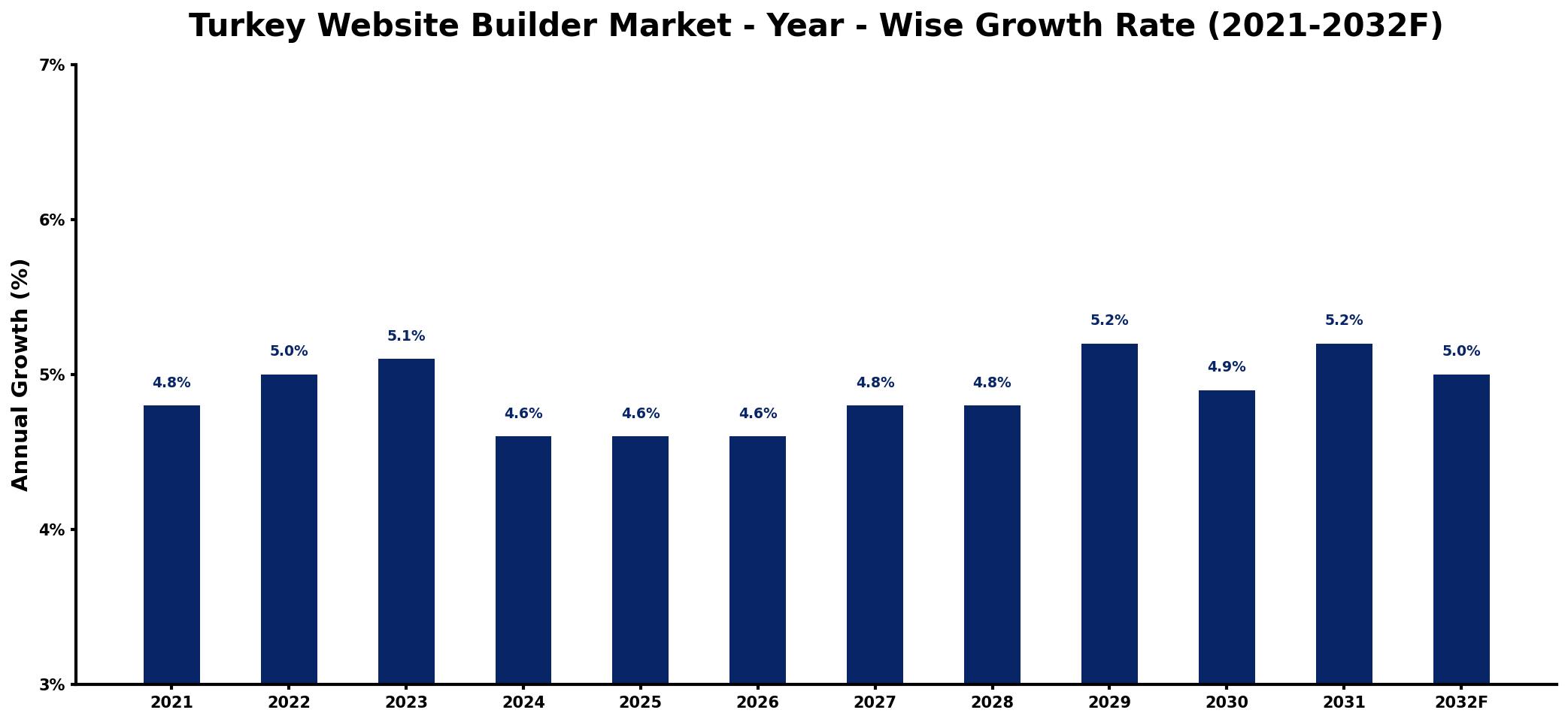
The table below presents the year‑wise growth rates along with the key drivers influencing the market
| Year | Growth Rate | Major Drivers |
| 2021 | 4.8% | Rising digital marketing investments |
| 2022 | 5.0% | Increased small business presence |
| 2023 | 5.1% | Growing e-commerce platform adoption |
| 2024 | 4.6% | Expansion of online education services |
| 2025 | 4.6% | Surge in freelance opportunities |
| 2026 | 4.6% | Enhanced mobile internet accessibility |
| 2027 | 4.8% | Boost in social media engagement |
| 2028 | 4.8% | Demand for personalized content solutions |
| 2029 | 5.2% | Growth in remote work tools |
| 2030 | 4.9% | Emergence of new tech startups |
| 2031 | 5.2% | Increase in DIY online projects |
| 2032 | 5.0% | enhanced product quality standards |
Note: Market size estimations and growth projections presented in this report are based on 6Wresearch's proprietary forecasting methodology, utilizing the latest available industry data, government publications, and primary research inputs.
Turkey Website Builder Market Synopsis
In Turkey, the landscape of website creation is evolving rapidly, driven by an increasing digital entrepreneurship spirit. As more SMEs emerge, the need for accessible and efficient website builder tools that require minimal technical expertise has never been greater.
Platforms featuring drag-and-drop functionalities and customizable templates are gaining popularity, making it easier for users to create mobile-responsive websites. This trend not only empowers individual users but also democratizes digital marketing efforts across various sectors.
Turkey Website Builder Market Key Takeaways
- The market is experiencing significant growth due to the rise of SMEs and individual entrepreneurs in Turkey.
- Integration with e-commerce and digital marketing tools is becoming essential for website builders to remain competitive.
- User-friendly interfaces are crucial, as many users possess limited technical skills.
- Government initiatives are focused on fostering digital entrepreneurship and providing affordable access to web development tools.
- Technological advancements present both opportunities and challenges for market players.
Evaluation of Restraints in Turkey Website Builder Market
The Turkey Website Builder Market faces challenges related to rapid technological advancements and the need for continuous user experience optimization. Service providers must navigate a landscape where customer expectations evolve quickly, and integrating new functionalities without sacrificing platform scalability can be a significant restraint. Additionally, competitive pressure from emerging web development technologies can impede established players from retaining market share.
Turkey Website Builder Market Trends
Several trends are shaping the Turkey Website Builder Market, including the shift towards mobile-first design and the increased adoption of artificial intelligence in website creation. Users are prioritizing platforms that offer advanced features such as automated SEO tools, analytics integration, and personalized templates. Furthermore, the push for enhanced user experience drives the demand for intuitive interfaces and seamless customer support.
Turkey Website Builder Market Opportunities
The expansion of e-commerce presents a significant opportunity for website builders to integrate specialized tools tailored for online retail. Additionally, as more businesses seek to digitize their operations, there is potential for growth in subscription-based models that offer scalable solutions. Targeting underrepresented market segments, such as non-profits and regional businesses, also holds promise for new avenues of development and partnership.
Government Initiatives in the Turkey Website Builder Market
The Turkish government actively promotes digital entrepreneurship through various initiatives aimed at enhancing online presence for businesses. Programs designed to provide training in web development and digital marketing are being implemented to support SMEs in their digital transformation journeys. Moreover, efforts are being made to ensure accessible hosting services, reinforcing the commitment to nurture a competitive website builder environment.
Future Insights of the Turkey Website Builder Market
Looking ahead to 2026-2032, the Turkey Website Builder Market is poised for continued growth as digital adoption escalates. The emphasis on user empowerment through sophisticated yet intuitive tools will dominate market dynamics. Expect to see an influx of features aimed at enhancing user engagement and conversion rates, as well as an increasing focus on niche markets tailored to specific industries.
Turkey Website Builder Market Latest Developments (2025 - 2026)
Recent developments in the Turkey Website Builder Market indicate a strong focus on enhancing user experience and integrating advanced technologies. Many platforms are prioritizing mobile optimization and enhancing their e-commerce capabilities. Additionally, there is a noticeable trend towards collaborative features that facilitate teamwork in website creation, reflecting the growing importance of remote working and digital collaboration tools.
Turkey Website Builder Market - Key Attractiveness of the Report
- 10 Years of Market Numbers
- Historical Data Starting from 2022 to 2025
- Base Year: 2025
- Forecast Data until 2032
- Key Performance Indicators Impacting the Market
- Major Upcoming Developments and Projects
Key Highlights of the Report:
- Turkey Website Builder Market Outlook
- Market Size of Turkey Website Builder Market, 2025
- Forecast of Turkey Website Builder Market, 2032
- Historical Data and Forecast of Turkey Website Builder Revenues & Volume for the Period 2022-2032F
- Turkey Website Builder Market Trend Evolution
- Turkey Website Builder Market Drivers and Challenges
- Turkey Website Builder Price Trends
- Turkey Website Builder Porter's Five Forces
- Turkey Website Builder Industry Life Cycle
- Historical Data and Forecast of Turkey Website Builder Market Revenues & Volume By Deployment Type for the Period 2022-2032F
- Historical Data and Forecast of Turkey Website Builder Market Revenues & Volume By Cloud-Based for the Period 2022-2032F
- Historical Data and Forecast of Turkey Website Builder Market Revenues & Volume By On-Premise for the Period 2022-2032F
- Historical Data and Forecast of Turkey Website Builder Market Revenues & Volume By Type for the Period 2022-2032F
- Historical Data and Forecast of Turkey Website Builder Market Revenues & Volume By Mobile Website Builders for the Period 2022-2032F
- Historical Data and Forecast of Turkey Website Builder Market Revenues & Volume By PC Website Builders for the Period 2022-2032F
- Historical Data and Forecast of Turkey Website Builder Market Revenues & Volume By End Users for the Period 2022-2032F
- Historical Data and Forecast of Turkey Website Builder Market Revenues & Volume By Individuals for the Period 2022-2032F
- Historical Data and Forecast of Turkey Website Builder Market Revenues & Volume By SMEs for the Period 2022-2032F
- Historical Data and Forecast of Turkey Website Builder Market Revenues & Volume By Large Enterprises for the Period 2022-2032F
- Turkey Website Builder Import Export Trade Statistics
- Market Opportunity Assessment By Deployment Type
- Market Opportunity Assessment By Type
- Market Opportunity Assessment By End Users
- Turkey Website Builder Top Companies Market Share
- Turkey Website Builder Competitive Benchmarking By Technical and Operational Parameters
- Turkey Website Builder Company Profiles
- Turkey Website Builder Key Strategic Recommendations






































