Turkey Whipping Cream Market Size, Share & Growth Rate
The Turkey Whipping Cream Market was estimated at USD 419 Million in 2025 and is projected to reach USD 592 Million by 2032, growing at a CAGR of 5.1% from 2026 to 2032. This promising growth trajectory is primarily driven by an increasing consumer inclination towards premium dairy products and a burgeoning interest in home baking and gourmet cooking. The expansion of e-commerce and modern retail channels further enhances accessibility, catering to diverse consumer preferences.
Turkey Whipping Cream Market Growth Rate Analysis (2021-2032)
The Turkey whipping cream market has shown a stable growth pattern, with annual increases fluctuating between 5.6% and 6.2% from 2021 to 2032. Notable growth rates include 6.2% in 2024 and 2026, attributed to rising consumer demand for diverse culinary applications and premium dessert products. The slight decline to 5.6% in 2023 can be linked to economic pressures and shifts in consumer spending preferences, as well as disruptions in supply chains. Looking ahead, technology advancements in packaging and distribution, alongside ongoing investments in infrastructure, are expected to support sustained growth, with a projected 6.1% increase in 2028 reflecting a rebound in consumer confidence and spending.
Turkey Whipping Cream Market Year-wise Growth Rate and Key Drivers
This graph highlights how the Turkey Whipping Cream Market has steadily grown over the past five years, supported by major growth factors.
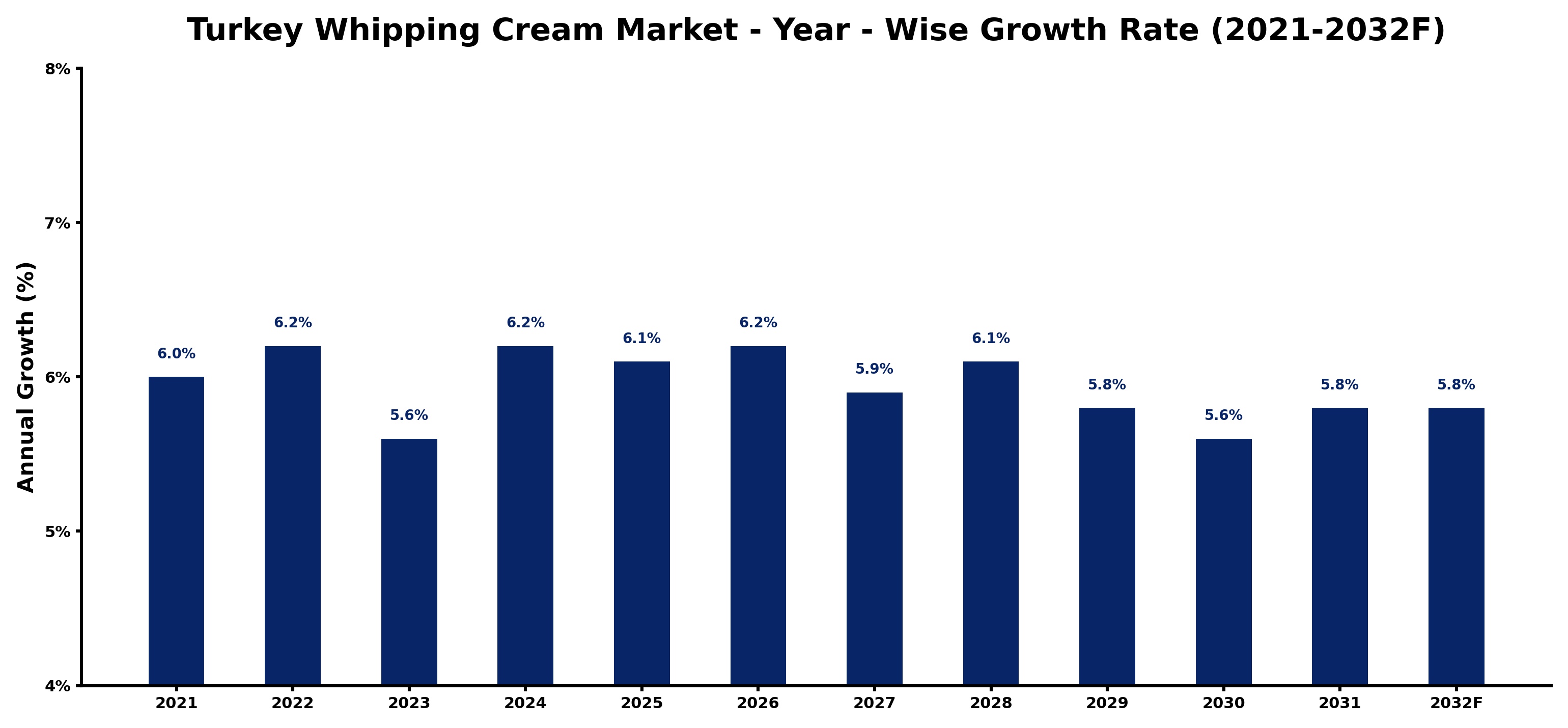
The table below presents the year‑wise growth rates along with the key drivers influencing the market
| Year | Growth Rate | Major Drivers |
| 2021 | 6.0% | Increased demand for desserts |
| 2022 | 6.2% | Growth in home baking trends |
| 2023 | 5.6% | Rise in coffee shop offerings |
| 2024 | 6.2% | Expansion of dairy alternatives market |
| 2025 | 6.1% | Culinary innovation in recipes |
| 2026 | 6.2% | Health-conscious consumer preferences rise |
| 2027 | 5.9% | Increased use in catering services |
| 2028 | 6.1% | Popularity of cooking shows increases |
| 2029 | 5.8% | Adoption of premium products rises |
| 2030 | 5.6% | Industrial activity supported growth |
| 2031 | 5.8% | Seasonal product launches attract customers |
| 2032 | 5.8% | Social media influence on recipes |
Note - Market size estimations and growth projections presented in this report are based on 6Wresearch’s advanced forecasting approach, validated with industry datasets as of June 2026.
Turkey Whipping Cream Market Synopsis
The demand for premium whipping cream in Turkey is surging, particularly among consumers seeking indulgent desserts and artisanal baking ingredients. This trend reflects a significant cultural shift, as more households embrace gourmet cooking and baking, leading to a greater usage of high-quality whipping cream in various culinary applications.
On the supply side, the market showcases a wide variety of offerings from domestic and international brands. These products cater to varying consumer preferences concerning fat content, flavor, and packaging size, which is increasingly becoming a focal point for manufacturers aiming to attract discerning customers.
Turkey Whipping Cream Market Key Takeaways
- The Turkey whipping cream market is experiencing robust growth due to rising demand for premium dairy ingredients.
- Consumer trends favor indulgent desserts and home baking, creating a fertile ground for whipping cream utilization.
- Innovation in product offerings, including organic and flavored options, is reshaping market dynamics.
- Accessibility through modern retail and e-commerce platforms is expanding market reach.
- Health-conscious consumers are driving the demand for natural and organic whipping cream alternatives.
Evaluation of Restraints in Turkey Whipping Cream Market
The Turkey whipping cream market does face several restraints that could impede its growth potential. Increasing competition from both local and global brands intensifies market dynamics, making differentiation crucial. Additionally, fluctuating raw material prices, particularly dairy inputs, pose a significant challenge for manufacturers. Changing consumer preferences towards healthier or dairy-free alternatives require continuous adaptation and innovation. Furthermore, stringent regulations regarding product quality and labeling necessitate compliance, which can complicate operations for companies.
Turkey Whipping Cream Market Trends
Emerging trends within the Turkey whipping cream market reveal a shift towards natural and organic products as consumers prioritize healthier options. The growth of social media and cooking shows has inspired many to experiment in the kitchen, amplifying the demand for high-quality whipping cream. Additionally, smaller, convenient packaging sizes are becoming more popular among consumers, reflecting a lifestyle trend focused on practicality and portion control.
Turkey Whipping Cream Market Opportunities
Significant growth opportunities exist for investors within the Turkey whipping cream market. As interest in Western culinary practices continues to rise, opportunities arise for companies producing high-quality whipping cream or those looking to innovate with niche offerings such as lactose-free and organic variants. Collaborations with food service providers and bakeries could further amplify market presence and yield profitable returns.
Government Initiatives in the Turkey Whipping Cream Market
Government initiatives surrounding the Turkey whipping cream market are primarily focused on ensuring food safety and quality control. Strict regulations mandate that all dairy products, including whipping cream, meet health standards before reaching consumers. These policies are designed to protect public health and promote fair competition in the marketplace, making compliance essential for manufacturers aiming to succeed in this sector.
Future Insights of the Turkey Whipping Cream Market
Looking ahead to 2026-2032, the Turkey whipping cream market is projected to continue its expansion, propelled by rising disposable incomes and an ongoing affinity for premium culinary experiences. The increasing popularity of bakery products, desserts, and beverages that incorporate whipping cream will play a pivotal role in driving demand. Companies will likely respond to evolving consumer preferences by diversifying their product lines, particularly with organic and innovative offerings, positioning themselves effectively in an increasingly competitive landscape.
Turkey Whipping Cream Market Latest Developments (May 2025 - June 2026)
In recent months, the Turkey whipping cream market has seen notable advancements, particularly in product innovation and packaging. Manufacturers are introducing a wider array of flavors and formats, appealing to a diverse consumer base that increasingly values variety. Moreover, online retail channels have expanded, significantly boosting product visibility and accessibility. As consumers continue to embrace gourmet cooking, the market is expected to adapt swiftly to meet these changing demands.
Turkey Whipping Cream Market - Key Attractiveness of the Report
- 10 Years of Market Numbers
- Historical Data Starting from 2022 to 2025
- Base Year: 2025
- Forecast Data until 2032
- Key Performance Indicators Impacting the Market
- Major Upcoming Developments and Projects
Key Highlights of the Report:
- Turkey Whipping Cream Market Outlook
- Market Size of Turkey Whipping Cream Market, 2025
- Forecast of Turkey Whipping Cream Market, 2032
- Historical Data and Forecast of Turkey Whipping Cream Revenues & Volume for the Period 2022-2032F
- Turkey Whipping Cream Market Trend Evolution
- Turkey Whipping Cream Market Drivers and Challenges
- Turkey Whipping Cream Price Trends
- Turkey Whipping Cream Porter's Five Forces
- Turkey Whipping Cream Industry Life Cycle
- Historical Data and Forecast of Turkey Whipping Cream Market Revenues & Volume By Product for the Period 2022-2032F
- Historical Data and Forecast of Turkey Whipping Cream Market Revenues & Volume By Dairy for the Period 2022-2032F
- Historical Data and Forecast of Turkey Whipping Cream Market Revenues & Volume By Non-Dairy for the Period 2022-2032F
- Historical Data and Forecast of Turkey Whipping Cream Market Revenues & Volume By Application for the Period 2022-2032F
- Historical Data and Forecast of Turkey Whipping Cream Market Revenues & Volume By B2B for the Period 2022-2032F
- Historical Data and Forecast of Turkey Whipping Cream Market Revenues & Volume By B2C for the Period 2022-2032F
- Historical Data and Forecast of Turkey Whipping Cream Market Revenues & Volume By Distribution Channel for the Period 2022-2032F
- Historical Data and Forecast of Turkey Whipping Cream Market Revenues & Volume By Warehouse Clubs for the Period 2022-2032F
- Historical Data and Forecast of Turkey Whipping Cream Market Revenues & Volume By Variety Stores for the Period 2022-2032F
- Historical Data and Forecast of Turkey Whipping Cream Market Revenues & Volume By Department Stores for the Period 2022-2032F
- Historical Data and Forecast of Turkey Whipping Cream Market Revenues & Volume By Online Retail for the Period 2022-2032F
- Historical Data and Forecast of Turkey Whipping Cream Market Revenues & Volume By Convenience Stores for the Period 2022-2032F
- Historical Data and Forecast of Turkey Whipping Cream Market Revenues & Volume By Supermarkets and Hypermarket for the Period 2022-2032F
- Historical Data and Forecast of Turkey Whipping Cream Market Revenues & Volume By Specialist Retailers for the Period 2022-2032F
- Historical Data and Forecast of Turkey Whipping Cream Market Revenues & Volume By Others for the Period 2022-2032F
- Turkey Whipping Cream Import Export Trade Statistics
- Market Opportunity Assessment By Product
- Market Opportunity Assessment By Application
- Market Opportunity Assessment By Distribution Channel
- Turkey Whipping Cream Top Companies Market Share
- Turkey Whipping Cream Competitive Benchmarking By Technical and Operational Parameters
- Turkey Whipping Cream Company Profiles
- Turkey Whipping Cream Key Strategic Recommendations






































