Turkey Winding Wire Market Size, Share & Growth Rate
The Turkey Winding Wire Market was estimated at USD 486 Million in 2025 and is projected to reach USD 642 Million by 2032, growing at a CAGR of 4.1% from 2026 to 2032. This trajectory is propelled by robust investments in infrastructure and the burgeoning demand for electrical applications across various industries, particularly automotive and industrial automation. Additionally, the emphasis on energy-efficient solutions is further solidifying the market's growth prospects.
Turkey Winding Wire Market Growth Rate Analysis (2021-2032)
The Turkey Winding Wire Market has exhibited stable growth, highlighted by an average increase of 4.9% from 2021 through 2023. This momentum is expected to continue, with projected growth rates of 5.1% in 2024 and 5.0% in 2030. Various factors, such as rising demand in the electrical and electronics industries and an ongoing energy transition, have driven this expansion. Additionally, increased investments in infrastructure and advancements in manufacturing technology have bolstered production capabilities. While growth slightly dips to 4.5% in 2025 and 2032, the overall demand trajectory remains robust, reflecting the sector's adaptability to evolving consumer needs and regulatory environments.
Turkey Winding Wire Market Year-wise Growth Rate and Key Drivers
This graph highlights how the Turkey Winding Wire Market has steadily grown over the past five years, supported by major growth factors.
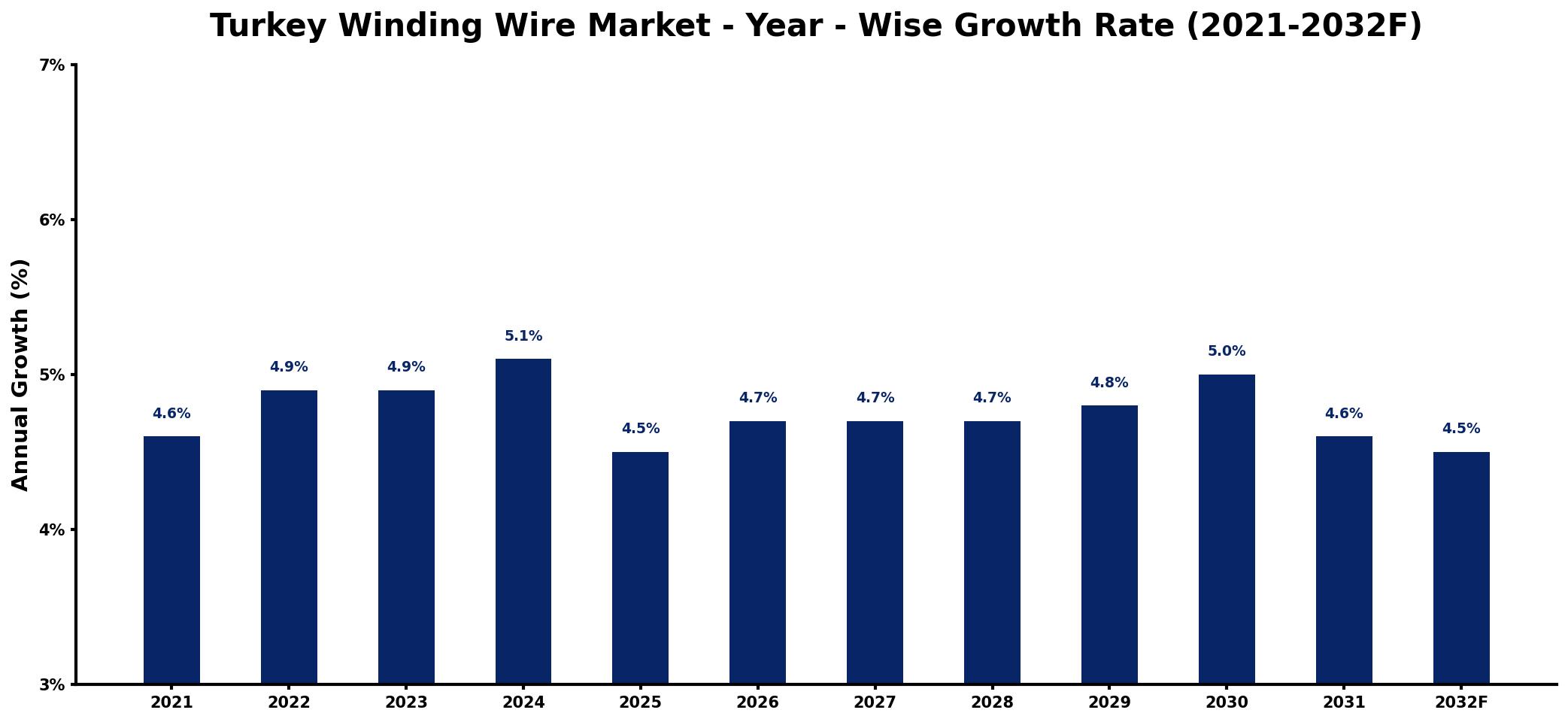
The table below presents the year‑wise growth rates along with the key drivers influencing the market
| Year | Growth Rate | Major Drivers |
| 2021 | 4.6% | Increased demand from automotive sector |
| 2022 | 4.9% | Growth in renewable energy investments |
| 2023 | 4.9% | Expansion of industrial automation projects |
| 2024 | 5.1% | Rising construction and infrastructure projects |
| 2025 | 4.5% | Emerging technologies driving new applications |
| 2026 | 4.7% | growing regional consumption patterns |
| 2027 | 4.7% | Increased consumer electronics production |
| 2028 | 4.7% | Surge in electric vehicle manufacturing |
| 2029 | 4.8% | Development of smart grid technologies |
| 2030 | 5.0% | growing emerging market penetration |
| 2031 | 4.6% | Boost in global export opportunities |
| 2032 | 4.5% | Increase in energy efficiency initiatives |
Note: Market size estimations and growth projections presented in this report are based on 6Wresearch's proprietary forecasting methodology, utilizing the latest available industry data, government publications, and primary research inputs.
Turkey Winding Wire Market Synopsis
The Turkey winding wire market stands as a pivotal component within the nation's electrical sector. As the demand for transformers, motors, and generators escalates, manufacturers are actively seeking innovative solutions that adhere to evolving regulatory requirements.
The increasing integration of automation in various industries and a shift towards sustainable materials are reshaping market dynamics. Copper remains the preferred choice for winding wire; however, the rising inclination towards aluminum for its cost advantages highlights a significant shift in material selection.
Turkey Winding Wire Market Key Takeaways
- The market is driven by escalating demand in the automotive and electronics sectors.
- Product innovation and energy efficiency are key focal points for manufacturers.
- Sustainability trends are encouraging the use of recycled materials in production.
- Technological advancements are fostering the development of high-performance winding wires.
- Government policies are shaping market dynamics, promoting quality and environmental standards.
Evaluation of Restraints in Turkey Winding Wire Market
Despite its positive outlook, the Turkey winding wire market faces significant constraints. Fluctuating raw material prices create uncertainty for manufacturers, affecting cost management and pricing strategies. Additionally, the influx of imported winding wire products intensifies competition, often pressuring local manufacturers to innovate continuously. Compliance with stringent regulations further complicates operational processes, necessitating investments in quality assurance and environmental sustainability. Consequently, these challenges may hinder the growth trajectory of the market.
Turkey Winding Wire Market Trends
The Turkey winding wire market is currently witnessing a decisive shift towards eco-friendly manufacturing practices. This is reflected in the increasing demand for winding wires produced from recycled materials, aligning with global sustainability efforts. Technological advancements are also pivotal, as manufacturers strive to develop high-performance products that enhance efficiency and durability. A notable trend is the customization of winding wires to meet specific application requirements across various sectors, from automotive to energy.
Turkey Winding Wire Market Opportunities
Investment opportunities within the Turkey winding wire market are promising, particularly in light of the government's focus on infrastructure development and the renewable energy sector. As demand for high-quality winding wires escalates, manufacturers are encouraged to invest in R&D for innovative materials and processes. Moreover, forming strategic partnerships and expanding distribution networks can empower players to capitalize on the growing market demand, thereby solidifying their presence in this evolving landscape.
Government Initiatives in the Turkey Winding Wire Market
The Turkish government plays a pivotal role in shaping the winding wire market through regulations aimed at ensuring product quality and environmental sustainability. Policies are in place to uphold safety and performance standards, thus safeguarding consumer interests. Import-export duties are strategically implemented to maintain a balanced trade environment. Furthermore, initiatives encouraging the use of eco-friendly materials contribute to promoting sustainable practices within the industry.
Future Insights of the Turkey Winding Wire Market
Looking ahead to 2026-2032, the Turkey winding wire market is anticipated to flourish, spurred by continued urbanization and industrialization. The escalating need for electricity, coupled with advancements in automotive and consumer electronics, will further boost demand. While challenges such as raw material price volatility and intense competition remain, the overall outlook remains optimistic, driven by innovation and evolving consumer needs.
Turkey Winding Wire Market Latest Developments (2025 - 2026)
Recent developments in the Turkey winding wire market indicate a proactive approach toward sustainability and innovation. Industry stakeholders are increasingly prioritizing the implementation of eco-friendly manufacturing processes, alongside investing in advanced technologies. Additionally, collaborations among manufacturers are emerging, aimed at enhancing product offerings and meeting specific customer demands within varied sectors.
Turkey Winding Wire Market - Key Attractiveness of the Report
- 10 Years of Market Numbers
- Historical Data Starting from 2022 to 2025
- Base Year: 2025
- Forecast Data until 2032
- Key Performance Indicators Impacting the Market
- Major Upcoming Developments and Projects
Key Highlights of the Report:
- Turkey Winding Wire Market Outlook
- Market Size of Turkey Winding Wire Market, 2025
- Forecast of Turkey Winding Wire Market, 2032
- Historical Data and Forecast of Turkey Winding Wire Revenues & Volume for the Period 2022-2032F
- Turkey Winding Wire Market Trend Evolution
- Turkey Winding Wire Market Drivers and Challenges
- Turkey Winding Wire Price Trends
- Turkey Winding Wire Porter's Five Forces
- Turkey Winding Wire Industry Life Cycle
- Historical Data and Forecast of Turkey Winding Wire Market Revenues & Volume By Product for the Period 2022-2032F
- Historical Data and Forecast of Turkey Winding Wire Market Revenues & Volume By Copper Winding Wire for the Period 2022-2032F
- Historical Data and Forecast of Turkey Winding Wire Market Revenues & Volume By Aluminum Winding Wire for the Period 2022-2032F
- Turkey Winding Wire Import Export Trade Statistics
- Market Opportunity Assessment By Product
- Turkey Winding Wire Top Companies Market Share
- Turkey Winding Wire Competitive Benchmarking By Technical and Operational Parameters
- Turkey Winding Wire Company Profiles
- Turkey Winding Wire Key Strategic Recommendations






































