Turkey Wood Pellets Market Summary
The turkey wood pellets market was estimated at USD 379 Million in 2025 and is projected to reach USD 507 Million by 2032, growing at a CAGR of 5.1% from 2026 to 2032.
Turkey Wood Pellets Market Year-wise Growth Rate and Key Drivers
This graph highlights how the Turkey Wood Pellets Market has steadily grown over the past five years, supported by major growth factors.
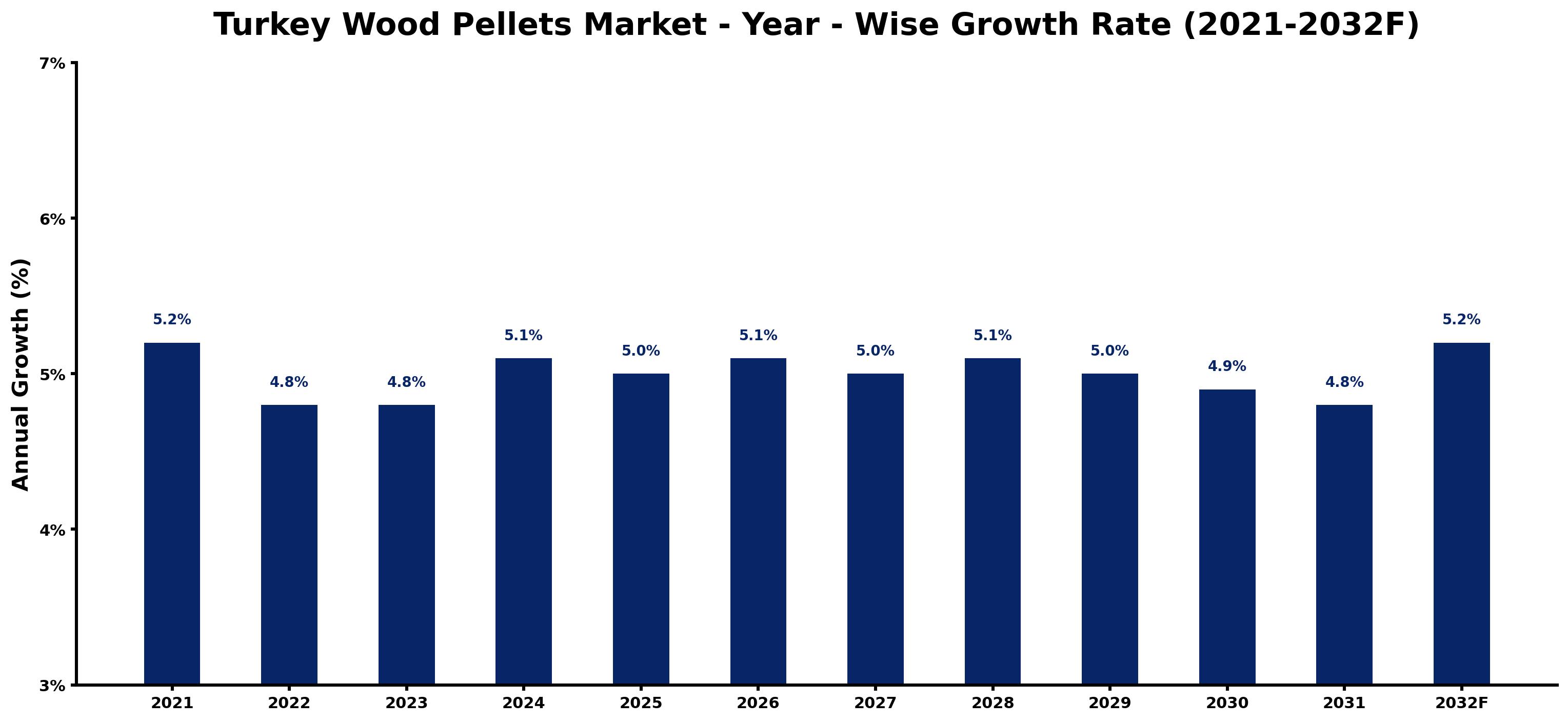
The table below presents the year wise growth rates along with the key drivers influencing the market
| Year | Growth Rate | Major Drivers |
| 2021 | 5.2% | Increasing interest in renewable energy sources has begun reshaping Turkey's energy landscape. |
| 2022 | 4.8% | Demand for sustainable heating solutions is evident in urban and rural households alike. |
| 2023 | 4.8% | Local manufacturers are enhancing production capabilities to meet domestic market needs effectively. |
| 2024 | 5.1% | Rising awareness of environmental issues encourages the switch to wood pellets for heating. |
| 2025 | 5.0% | Technological advancements in biomass combustion systems improve efficiency and reduce emissions. |
| 2026 | 5.1% | Consumer preferences are shifting towards eco-friendly products, boosting wood pellet popularity. |
| 2027 | 5.0% | International partnerships are emerging, supporting Turkey's wood pellet export opportunities. |
| 2028 | 5.1% | The hospitality industry increasingly opts for wood pellets, enhancing sustainability profiles. |
| 2029 | 5.0% | Urbanization trends drive construction projects that require efficient heating solutions like wood pellets. |
| 2030 | 4.9% | Research and development initiatives are yielding innovative applications for wood pellets in energy. |
| 2031 | 4.8% | Retail channels expand, providing consumers with easier access to wood pellet products. |
| 2032 | 5.2% | Market competition intensifies, leading to improved product quality and pricing strategies. |
Note - Market size estimations and growth projections presented in this report are based on 6Wresearch's advanced forecasting approach, validated with industry datasets as of June 2026.
Turkey Wood Pellets Market Synopsis
The Turkey Wood Pellets Market is projected to reach 5.1% and witness significant growth during the forecast period (2026-2032). The market is characterized by a steady increase in the adoption of wood pellets as a renewable energy source, propelled by the rising awareness surrounding environmental sustainability and the economic advantages associated with biomass fuel. Wood pellets emerge as an attractive alternative to conventional fossil fuels, aligning consumer interests and government policies toward greener energy solutions.
Turkey Wood Pellets Market Growth Drivers
Several factors are driving the growth of the Turkey Wood Pellets Market. Primarily, government initiatives aimed at promoting renewable energy sources foster a favorable market environment. These initiatives include financial incentives and subsidies that encourage both industrial and residential sectors to transition to wood pellets for heating and energy generation. Furthermore, the growing concern over carbon emissions and climate change makes biomass energy a compelling option, which further fuels market demand.
- The Turkish government actively promotes renewable energy initiatives, leading to an increasing adoption of wood pellets in various sectors.
- Awareness of climate change impacts contributes to the growing preference for sustainable energy solutions among consumers and industries.
- The cost-effectiveness of wood pellets compared to traditional fossil fuels enhances their appeal as an energy source.
- Advancements in pellet manufacturing technology improve production efficiency and reduce costs, boosting market competitiveness.
- Supportive policies facilitating investments in biomass energy infrastructure are enhancing the overall viability of the wood pellets market.
Turkey Wood Pellets Market Challenges and Restraints
Despite the promising prospects for the Turkey Wood Pellets Market, several challenges exist that could hinder growth. A significant concern is the variability in biomass feedstock availability, which is critical for pellet production. Fluctuations in the supply of wood waste and sawmill residues can impact production stability and costs. Additionally, regulatory changes related to renewable energy subsidies and carbon pricing mechanisms could affect market dynamics, necessitating continuous adaptability from stakeholders.
- Uncertainty regarding the availability of biomass feedstock often leads to fluctuations in production costs and supply chain disruptions.
- Regulatory changes concerning renewable energy policies can create a volatile market environment for wood pellets.
- Consumer hesitation stemming from a lack of awareness about the benefits and applications of wood pellets may slow market penetration.
- Potential competition from alternative renewable energy sources might impact the growth trajectory of wood pellets.
- Environmental regulations and sustainability criteria can impose additional operational costs, influencing overall profitability.
Turkey Wood Pellets Market Government Investment and Initiatives
The Turkish government's role in advancing the wood pellets market is significant, as numerous policies and initiatives are tailored to enhance renewable energy development. Investments focus on increasing biomass energy production and implementing energy efficiency measures. The government promotes sustainable forestry practices to ensure a stable supply of raw materials for pellet production. Initiatives include providing financial incentives for biomass energy projects, facilitating research and development in pellet manufacturing technology, and encouraging public-private partnerships to bolster infrastructure.
- Regulatory frameworks are established to encourage investments in renewable energy and improve energy efficiency across various sectors.
- Incentives for residential and industrial applications of wood pellets support Turkey's energy security and sustainability goals.
- The government is committed to enhancing the regulatory environment to attract foreign and domestic investments in biomass energy.
- Programs aimed at educating the public about the benefits of wood pellets are fundamental to increasing market penetration.
- International collaborations are encouraged to share best practices and technologies for improving biomass energy utilization.
Turkey Wood Pellets Market Latest Developments (May 2025 - June 2026)
Recent developments within the Turkey Wood Pellets Market indicate a focused effort on expanding production capabilities and enhancing distribution networks. During the specified period, various industry stakeholders have been actively engaged in initiatives to streamline the supply chain and improve logistics related to wood pellet distribution. Furthermore, government policies continue to evolve, adapting to the changing energy landscape and increasing competitiveness of biomass energy.
- There is an observable shift toward improving the quality of wood pellets through advancements in production technology and quality control measures.
- Efforts to establish regional distribution centers are gaining traction, allowing for better access to wood pellets across Turkey.
- Collaborations with research institutions are ongoing to explore innovative uses of wood pellets in electricity generation and residential heating.
- Increased focus on sustainability in forestry practices has led to improved sourcing methods for raw materials.
- Public awareness campaigns highlight the benefits of wood pellets as a viable alternative energy source, thus driving consumer interest.
Turkey Wood Pellets Market - Key Attractiveness of the Report
- 10 Years of Market Numbers
- Historical Data Starting from 2022 to 2025
- Base Year: 2025
- Forecast Data until 2032
- Key Performance Indicators Impacting the Market
- Major Upcoming Developments and Projects
Key Highlights of the Report:
- Turkey Wood Pellets Market Outlook
- Market Size of Turkey Wood Pellets Market, 2025
- Forecast of Turkey Wood Pellets Market, 2032
- Historical Data and Forecast of Turkey Wood Pellets Revenues & Volume for the Period 2022-2032F
- Turkey Wood Pellets Market Trend Evolution
- Turkey Wood Pellets Market Drivers and Challenges
- Turkey Wood Pellets Price Trends
- Turkey Wood Pellets Porter's Five Forces
- Turkey Wood Pellets Industry Life Cycle
- Historical Data and Forecast of Turkey Wood Pellets Market Revenues & Volume By Types for the Period 2022-2032F
- Historical Data and Forecast of Turkey Wood Pellets Market Revenues & Volume By Hardwood for the Period 2022-2032F
- Historical Data and Forecast of Turkey Wood Pellets Market Revenues & Volume By Softwood for the Period 2022-2032F
- Historical Data and Forecast of Turkey Wood Pellets Market Revenues & Volume By Applications for the Period 2022-2032F
- Historical Data and Forecast of Turkey Wood Pellets Market Revenues & Volume By Power Plants for the Period 2022-2032F
- Historical Data and Forecast of Turkey Wood Pellets Market Revenues & Volume By Residential Heating for the Period 2022-2032F
- Historical Data and Forecast of Turkey Wood Pellets Market Revenues & Volume By Commercial Heating for the Period 2022-2032F
- Historical Data and Forecast of Turkey Wood Pellets Market Revenues & Volume By Combined Heat and Power (CHP) for the Period 2022-2032F
- Turkey Wood Pellets Import Export Trade Statistics
- Market Opportunity Assessment By Types
- Market Opportunity Assessment By Applications
- Turkey Wood Pellets Top Companies Market Share
- Turkey Wood Pellets Competitive Benchmarking By Technical and Operational Parameters
- Turkey Wood Pellets Company Profiles
- Turkey Wood Pellets Key Strategic Recommendations






































