Turkey Wooden Furniture Market Size, Share & Growth Rate
The Turkey Wooden Furniture Market was estimated at USD 160 Million in 2025 and is projected to reach USD 218 Million by 2032, growing at a CAGR of 4.5% from 2026 to 2032. This growth is largely driven by an increase in disposable incomes and a shift toward urban lifestyles, which promote the demand for both traditional and modern wooden furniture designs. Additionally, the rising consumer preference for sustainable and aesthetically appealing products continues to support this upward trajectory.
Turkey Wooden Furniture Market Growth Rate Analysis (2021-2032)
The Turkish wooden furniture market is experiencing stable growth, with yearly increases of 5.7% in 2021, gradually tapering to 5.0% by 2031. This trend reflects a robust domestic demand fueled by a burgeoning middle class and rising disposable incomes, fostering investments in home interiors. In particular, the years 2022 and 2023 saw sustained growth around 5.6% to 5.3%, driven by innovative designs and a shift toward eco-friendly materials, aligning with global sustainability trends. However, growth rates are projected to stabilize further around 5.0% from 2030 onwards, potentially influenced by shifts in consumer preferences and the impact of digitalization on retail channels. Overall, the market remains resilient, underpinned by continuous investments in technology and manufacturing infrastructure.
Turkey Wooden Furniture Market Year-wise Growth Rate and Key Drivers
This graph highlights how the Turkey Wooden Furniture Market has steadily grown over the past five years, supported by major growth factors.
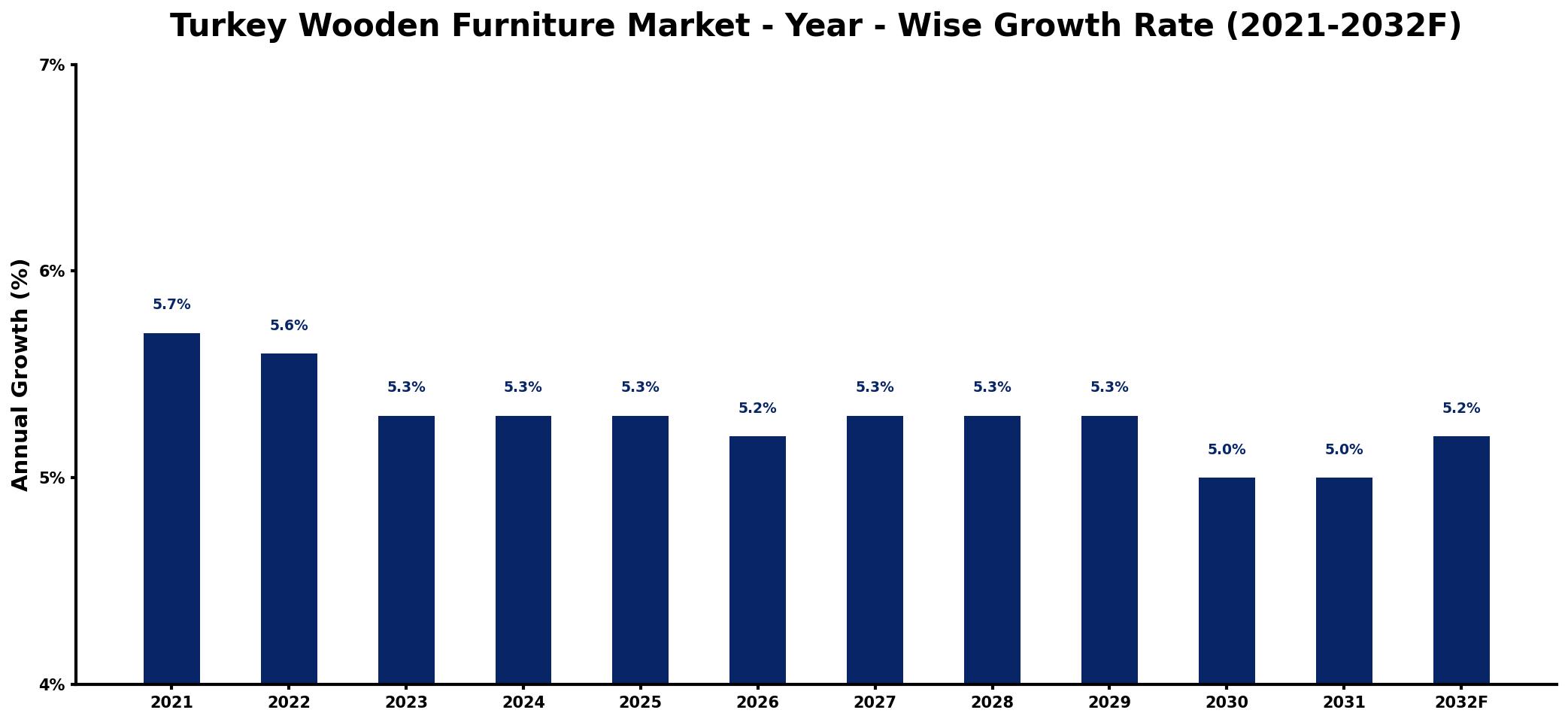
The table below presents the year‑wise growth rates along with the key drivers influencing the market
| Year | Growth Rate | Major Drivers |
| 2021 | 5.7% | Rising consumer spending on homes |
| 2022 | 5.6% | Increased urbanization and migration |
| 2023 | 5.3% | Growing demand for sustainable materials |
| 2024 | 5.3% | Expansion of online retail channels |
| 2025 | 5.3% | Investment in home renovation projects |
| 2026 | 5.2% | Surge in tourism and hospitality |
| 2027 | 5.3% | Growth in eco-friendly design trends |
| 2028 | 5.3% | Increase in disposable income levels |
| 2029 | 5.3% | Rising popularity of modular designs |
| 2030 | 5.0% | Boost in government housing initiatives |
| 2031 | 5.0% | Demand for multifunctional living spaces |
| 2032 | 5.2% | stronger distribution network expansion |
Note: Market size estimations and growth projections presented in this report are based on 6Wresearch's proprietary forecasting methodology, utilizing the latest available industry data, government publications, and primary research inputs.
Turkey Wooden Furniture Market Synopsis
The Turkish wooden furniture market is characterized by a rich blend of traditional craftsmanship and contemporary design, appealing to a diverse consumer base. The demand for customized furniture solutions is significant, allowing consumers to express their unique tastes and preferences in both residential and commercial settings.
As Turkey's urban centers expand, the hospitality sector is witnessing substantial growth, further driving the need for high-quality wooden furniture. This surge is complemented by the increasing emphasis on eco-friendly products, prompting manufacturers to innovate and integrate sustainability into their offerings.
Turkey Wooden Furniture Market Key Takeaways
- The market is set for robust growth driven by rising urbanization and disposable incomes.
- Consumer preferences are shifting towards sustainable and eco-friendly furniture options.
- Innovative designs are becoming crucial to meet diverse consumer expectations.
- Government policies are promoting quality assurance and sustainability within the industry.
- The market faces challenges related to raw material costs and the need for sustainable sourcing.
Evaluation of Restraints in Turkey Wooden Furniture Market
Despite its positive trajectory, the Turkey Wooden Furniture Market grapples with several restraints. The pressure of competitive pricing often hampers profitability, particularly for smaller manufacturers who may struggle to meet the demand for sustainable sourcing. Additionally, the volatility of raw material prices poses a significant risk to production costs, further complicating operational efficiency. Manufacturers are also challenged by the need to stay ahead of evolving regulatory standards in sustainability, which require ongoing investment in practices and certifications.
Turkey Wooden Furniture Market Trends
The market is increasingly leaning toward sustainability, with many manufacturers seeking certifications to validate their eco-friendly practices. Furthermore, technology is playing a vital role in design innovation, resulting in unique and customizable products that resonate with modern consumers. Additionally, a growing trend towards multifunctional furniture, particularly in urban dwellings, is influencing design strategies and production techniques.
Turkey Wooden Furniture Market Opportunities
Significant growth opportunities lie within the expanding hospitality sector, where the demand for bespoke wooden furniture is on the rise. Moreover, tapping into online retail channels presents an exciting avenue for manufacturers to reach a broader audience and cater to the shifting shopping habits of consumers. Innovations in material technologies also provide a chance to create more durable and sustainable products, aligning with consumer expectations.
Government Initiatives in the Turkey Wooden Furniture Market
Government policies in Turkey are increasingly aimed at enhancing the quality and sustainability of wooden furniture production. Initiatives focus on promoting craftsmanship and preserving traditional woodworking techniques, ensuring compliance with international safety and quality standards. These policies not only support local manufacturers but also encourage exports, helping to position Turkey as a competitive player in the global furniture market.
Future Insights of the Turkey Wooden Furniture Market
Looking ahead to 2026-2032, the Turkey Wooden Furniture Market is anticipated to continue its growth trajectory. The fusion of traditional craftsmanship with contemporary design will likely remain a key driver of consumer interest. Furthermore, as sustainability becomes increasingly integral to purchasing decisions, manufacturers who embrace eco-friendly practices are expected to thrive. The focus on urban living will also push for innovative, space-saving furniture solutions, positioning the market for sustained demand.
Turkey Wooden Furniture Market Latest Developments (2025 - 2026)
Recent developments indicate a growing collaboration between manufacturers and designers aimed at enhancing product offerings in the Turkish wooden furniture market. Innovations in sustainable materials are increasingly being explored, while government support for design competitions fosters creativity within the sector. Additionally, the rise of e-commerce platforms is reshaping the retail landscape, enabling consumers to access a wider variety of wooden furniture products than ever before.
Turkey Wooden Furniture Market - Key Attractiveness of the Report
- 10 Years of Market Numbers
- Historical Data Starting from 2022 to 2025
- Base Year: 2025
- Forecast Data until 2032
- Key Performance Indicators Impacting the Market
- Major Upcoming Developments and Projects
Key Highlights of the Report:
- Turkey Wooden Furniture Market Outlook
- Market Size of Turkey Wooden Furniture Market, 2025
- Forecast of Turkey Wooden Furniture Market, 2032
- Historical Data and Forecast of Turkey Wooden Furniture Revenues & Volume for the Period 2022-2032F
- Turkey Wooden Furniture Market Trend Evolution
- Turkey Wooden Furniture Market Drivers and Challenges
- Turkey Wooden Furniture Price Trends
- Turkey Wooden Furniture Porter's Five Forces
- Turkey Wooden Furniture Industry Life Cycle
- Historical Data and Forecast of Turkey Wooden Furniture Market Revenues & Volume By Type for the Period 2022-2032F
- Historical Data and Forecast of Turkey Wooden Furniture Market Revenues & Volume By Hardwood for the Period 2022-2032F
- Historical Data and Forecast of Turkey Wooden Furniture Market Revenues & Volume By Softwood for the Period 2022-2032F
- Historical Data and Forecast of Turkey Wooden Furniture Market Revenues & Volume By Material for the Period 2022-2032F
- Historical Data and Forecast of Turkey Wooden Furniture Market Revenues & Volume By Plywood for the Period 2022-2032F
- Historical Data and Forecast of Turkey Wooden Furniture Market Revenues & Volume By Laminates for the Period 2022-2032F
- Historical Data and Forecast of Turkey Wooden Furniture Market Revenues & Volume By MDF for the Period 2022-2032F
- Historical Data and Forecast of Turkey Wooden Furniture Market Revenues & Volume By Other Materials for the Period 2022-2032F
- Historical Data and Forecast of Turkey Wooden Furniture Market Revenues & Volume By Product for the Period 2022-2032F
- Historical Data and Forecast of Turkey Wooden Furniture Market Revenues & Volume By Bedroom for the Period 2022-2032F
- Historical Data and Forecast of Turkey Wooden Furniture Market Revenues & Volume By Seating for the Period 2022-2032F
- Historical Data and Forecast of Turkey Wooden Furniture Market Revenues & Volume By Kitchen for the Period 2022-2032F
- Historical Data and Forecast of Turkey Wooden Furniture Market Revenues & Volume By Other Products for the Period 2022-2032F
- Historical Data and Forecast of Turkey Wooden Furniture Market Revenues & Volume By Application for the Period 2022-2032F
- Historical Data and Forecast of Turkey Wooden Furniture Market Revenues & Volume By Residential for the Period 2022-2032F
- Historical Data and Forecast of Turkey Wooden Furniture Market Revenues & Volume By Commercial for the Period 2022-2032F
- Historical Data and Forecast of Turkey Wooden Furniture Market Revenues & Volume By Distribution Channel for the Period 2022-2032F
- Historical Data and Forecast of Turkey Wooden Furniture Market Revenues & Volume By Offline for the Period 2022-2032F
- Historical Data and Forecast of Turkey Wooden Furniture Market Revenues & Volume By Online for the Period 2022-2032F
- Turkey Wooden Furniture Import Export Trade Statistics
- Market Opportunity Assessment By Type
- Market Opportunity Assessment By Material
- Market Opportunity Assessment By Product
- Market Opportunity Assessment By Application
- Market Opportunity Assessment By Distribution Channel
- Turkey Wooden Furniture Top Companies Market Share
- Turkey Wooden Furniture Competitive Benchmarking By Technical and Operational Parameters
- Turkey Wooden Furniture Company Profiles
- Turkey Wooden Furniture Key Strategic Recommendations






































