Turkey Wooden Toys Market Size, Share & Growth Rate
The Turkey Wooden Toys Market was estimated at USD 512 Million in 2025 and is projected to reach USD 735 Million by 2032, growing at a CAGR of 5.3% from 2026 to 2032. This growth trajectory is largely driven by an increasing consumer preference for eco-friendly and non-toxic toys, as parents seek safer alternatives to plastic. Additionally, heightened awareness regarding the developmental benefits of wooden toys is fostering a market environment that favors sustainability and educational play experiences.
Turkey Wooden Toys Market Year-wise Growth Rate and Key Drivers
This graph highlights how the Turkey Wooden Toys Market has steadily grown over the years, supported by major growth factors.
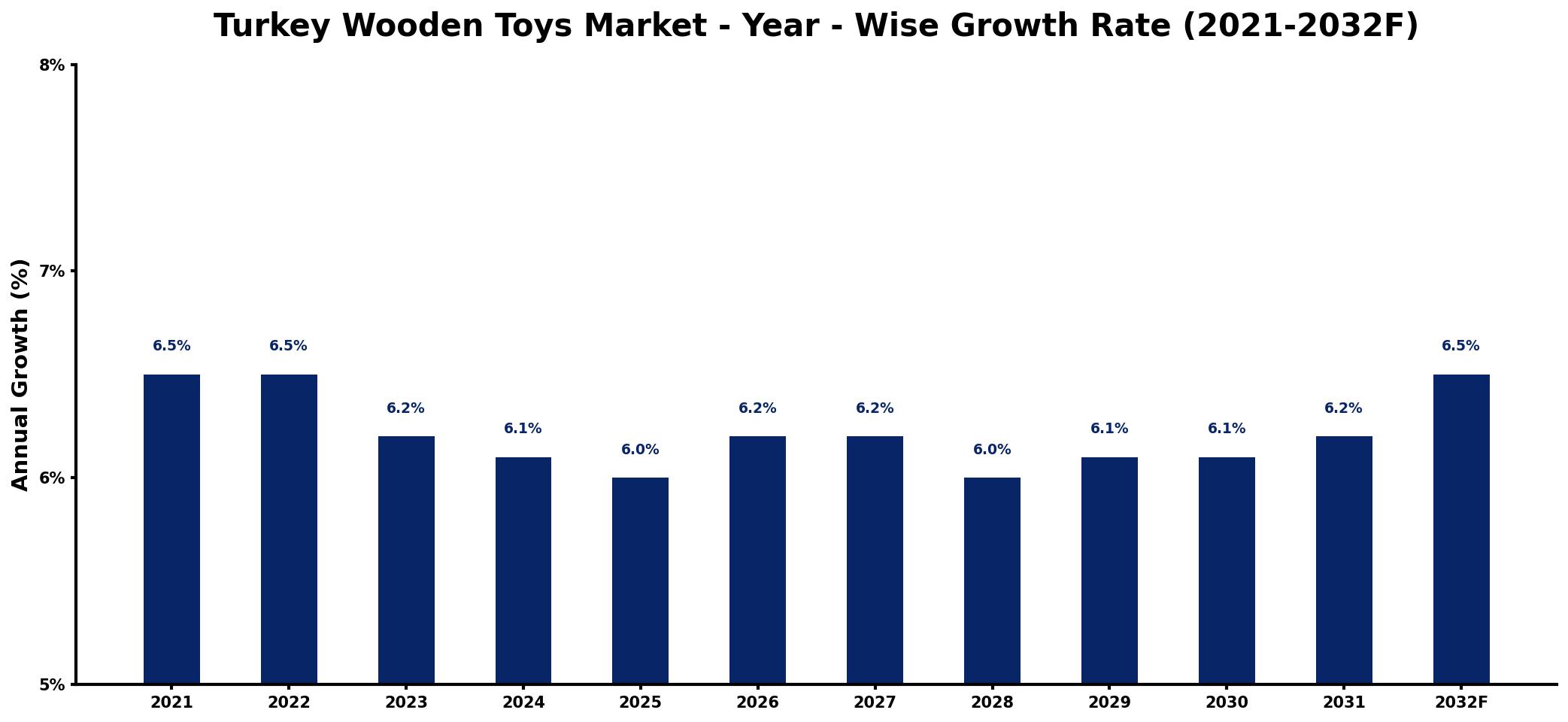
The table below presents the year‑wise growth rates along with the key drivers influencing the market
| Year | Growth Rate | Major Drivers |
| 2021 | 6.5% | Rising consumer interest in sustainability |
| 2022 | 6.5% | Increased investment in local craftsmanship |
| 2023 | 6.2% | Growing demand for eco-friendly products |
| 2024 | 6.1% | Expansion of online retail platforms |
| 2025 | 6.0% | Strengthening awareness of child safety |
| 2026 | 6.2% | Surge in educational product offerings |
| 2027 | 6.2% | Enhanced marketing strategies for families |
| 2028 | 6.0% | Collaboration with educational institutions |
| 2029 | 6.1% | Growth in international market reach |
| 2030 | 6.1% | Advancements in production technologies |
| 2031 | 6.2% | Increased participation in trade shows |
| 2032 | 6.5% | Strengthening of community support initiatives |
Note: Market size estimations and growth projections presented in this report are based on 6Wresearch's proprietary forecasting methodology, utilizing the latest available industry data, government publications, and primary research inputs.
Turkey Wooden Toys Market Synopsis
The most significant force currently shaping the Turkey Wooden Toys Market is the rising demand for safe and natural play materials among parents. This movement is not merely a trend; it reflects a deeper awareness of child development and the long-term benefits associated with traditional wooden toys.
As manufacturers increasingly emphasize quality craftsmanship and eco-friendly production practices, the market is also seeing a resurgence of interest in educational designs. This shift resonates well with contemporary consumer values, merging nostalgia with innovation in childhood play.
Turkey Wooden Toys Market Key Takeaways
- Consumer demand for sustainable and non-toxic materials is driving market growth.
- Safety regulations are becoming increasingly important, shaping product development and marketing strategies.
- Wooden toys are being recognized for their developmental advantages, including enhancing motor skills and creativity.
- Competition from plastic and electronic toys presents ongoing challenges for wooden toy manufacturers.
- Government policies support local artisans and promote the cultural heritage of traditional wooden toys.
Evaluation of Restraints in Turkey Wooden Toys Market
Despite the growth potential, the Turkey Wooden Toys Market grapples with significant challenges. Stringent safety regulations require manufacturers to meet high standards, which can increase production costs and complicate compliance processes. Additionally, the competitive landscape includes not just other wooden toys but also the allure of lower-cost plastic and electronic alternatives, which often feature enticing technology. Balancing quality, safety, and pricing remains a critical concern for manufacturers aiming to maintain consumer trust while navigating these dynamics.
Turkey Wooden Toys Market Trends
A notable trend influencing the Turkey Wooden Toys Market is the increasing preference for personalized and custom-made toys, allowing parents to select items that reflect their children's individual personalities. Additionally, there is a growing emphasis on educational toys that promote STEM learning and creativity. As consumers become more eco-conscious, manufacturers are leaning toward sustainable sourcing and production methods, further aligning with modern consumer values.
Turkey Wooden Toys Market Opportunities
The market presents lucrative opportunities for growth through the introduction of innovative, educational, and culturally significant toy designs. With rising awareness of child development, companies can invest in toys that facilitate learning while also appealing to parental nostalgia. Moreover, fostering partnerships with local artisans can enhance product authenticity, create unique offerings, and contribute to the preservation of cultural heritage.
Government Initiatives in the Turkey Wooden Toys Market
The Turkish government has implemented various initiatives aimed at ensuring consumer safety and promoting the wooden toys market. Regulations concerning manufacturing, labeling, and marketing emphasize the importance of quality and non-toxic materials. Additionally, there are programs designed to support local artisans, encouraging the production of traditional wooden toys and contributing to sustainable practices while preserving cultural identity.
Future Insights of the Turkey Wooden Toys Market
Looking ahead to the period from 2026 to 2032, the Turkey Wooden Toys Market is poised for continued growth. Factors such as increased consumer awareness and demand for safe, eco-friendly toys will likely sustain this upward trajectory. The trend toward educational play is also expected to gain momentum, as parents increasingly recognize the value of toys that promote cognitive development. Overall, a focus on quality, craftsmanship, and sustainability will define the market's future.
Turkey Wooden Toys Market Latest Developments (2025 - 2026)
Recent developments in the Turkey Wooden Toys Market highlight a shift toward enhancing safety protocols and integrating educational features into products. Manufacturers are increasingly exploring collaboration with educators to design toys that meet developmental benchmarks. Furthermore, several initiatives have been launched to increase consumer awareness about the benefits of wooden toys, particularly focusing on their safety and durability as compared to plastic alternatives.
Turkey Wooden Toys Market - Key Attractiveness of the Report
- 10 Years of Market Numbers
- Historical Data Starting from 2022 to 2025
- Base Year: 2025
- Forecast Data until 2032
- Key Performance Indicators Impacting the Market
- Major Upcoming Developments and Projects
Key Highlights of the Report:
- Turkey Wooden Toys Market Outlook
- Market Size of Turkey Wooden Toys Market, 2025
- Forecast of Turkey Wooden Toys Market, 2032
- Historical Data and Forecast of Turkey Wooden Toys Revenues & Volume for the Period 2022-2032F
- Turkey Wooden Toys Market Trend Evolution
- Turkey Wooden Toys Market Drivers and Challenges
- Turkey Wooden Toys Price Trends
- Turkey Wooden Toys Porter's Five Forces
- Turkey Wooden Toys Industry Life Cycle
- Historical Data and Forecast of Turkey Wooden Toys Market Revenues & Volume By Product Type for the Period 2022-2032F
- Historical Data and Forecast of Turkey Wooden Toys Market Revenues & Volume By Educational Toys for the Period 2022-2032F
- Historical Data and Forecast of Turkey Wooden Toys Market Revenues & Volume By Construction Toys for the Period 2022-2032F
- Historical Data and Forecast of Turkey Wooden Toys Market Revenues & Volume By Musical Toys for the Period 2022-2032F
- Historical Data and Forecast of Turkey Wooden Toys Market Revenues & Volume By Game Toys for the Period 2022-2032F
- Historical Data and Forecast of Turkey Wooden Toys Market Revenues & Volume By Dolls & Miniatures for the Period 2022-2032F
- Historical Data and Forecast of Turkey Wooden Toys Market Revenues & Volume By Automotive Toys for the Period 2022-2032F
- Historical Data and Forecast of Turkey Wooden Toys Market Revenues & Volume By Pretend Play Toys for the Period 2022-2032F
- Historical Data and Forecast of Turkey Wooden Toys Market Revenues & Volume By Wood Type for the Period 2022-2032F
- Historical Data and Forecast of Turkey Wooden Toys Market Revenues & Volume By Softwood for the Period 2022-2032F
- Historical Data and Forecast of Turkey Wooden Toys Market Revenues & Volume By Hardwood for the Period 2022-2032F
- Historical Data and Forecast of Turkey Wooden Toys Market Revenues & Volume By Age Group for the Period 2022-2032F
- Historical Data and Forecast of Turkey Wooden Toys Market Revenues & Volume By Below 1 Year for the Period 2022-2032F
- Historical Data and Forecast of Turkey Wooden Toys Market Revenues & Volume By Age 1-3 for the Period 2022-2032F
- Historical Data and Forecast of Turkey Wooden Toys Market Revenues & Volume By Age 3-5 for the Period 2022-2032F
- Historical Data and Forecast of Turkey Wooden Toys Market Revenues & Volume By Age 5-12 for the Period 2022-2032F
- Historical Data and Forecast of Turkey Wooden Toys Market Revenues & Volume By Age 12+ for the Period 2022-2032F
- Historical Data and Forecast of Turkey Wooden Toys Market Revenues & Volume By Distribution Channel for the Period 2022-2032F
- Historical Data and Forecast of Turkey Wooden Toys Market Revenues & Volume By Online for the Period 2022-2032F
- Historical Data and Forecast of Turkey Wooden Toys Market Revenues & Volume By Offline for the Period 2022-2032F
- Turkey Wooden Toys Import Export Trade Statistics
- Market Opportunity Assessment By Product Type
- Market Opportunity Assessment By Wood Type
- Market Opportunity Assessment By Age Group
- Market Opportunity Assessment By Distribution Channel
- Turkey Wooden Toys Top Companies Market Share
- Turkey Wooden Toys Competitive Benchmarking By Technical and Operational Parameters
- Turkey Wooden Toys Company Profiles
- Turkey Wooden Toys Key Strategic Recommendations






































