Ukraine 5G Core Market Size, Share & Growth Rate
The Ukraine 5G Core Market was estimated at USD 1172 Million in 2025 and is projected to reach USD 1679 Million by 2032, growing at a CAGR of 5.3% from 2026 to 2032. This growth trajectory is being fueled by the escalating demand for high-speed connectivity, particularly in urban areas, alongside the rise of data-driven applications. As telecom operators ramp up their investments in 5G core network infrastructure, enhanced connectivity solutions are set to proliferate across various sectors in Ukraine.
Ukraine 5G Core Market Year-wise Growth Rate and Key Drivers
This graph highlights how the Ukraine 5G Core Market has steadily grown over the years, supported by major growth factors.
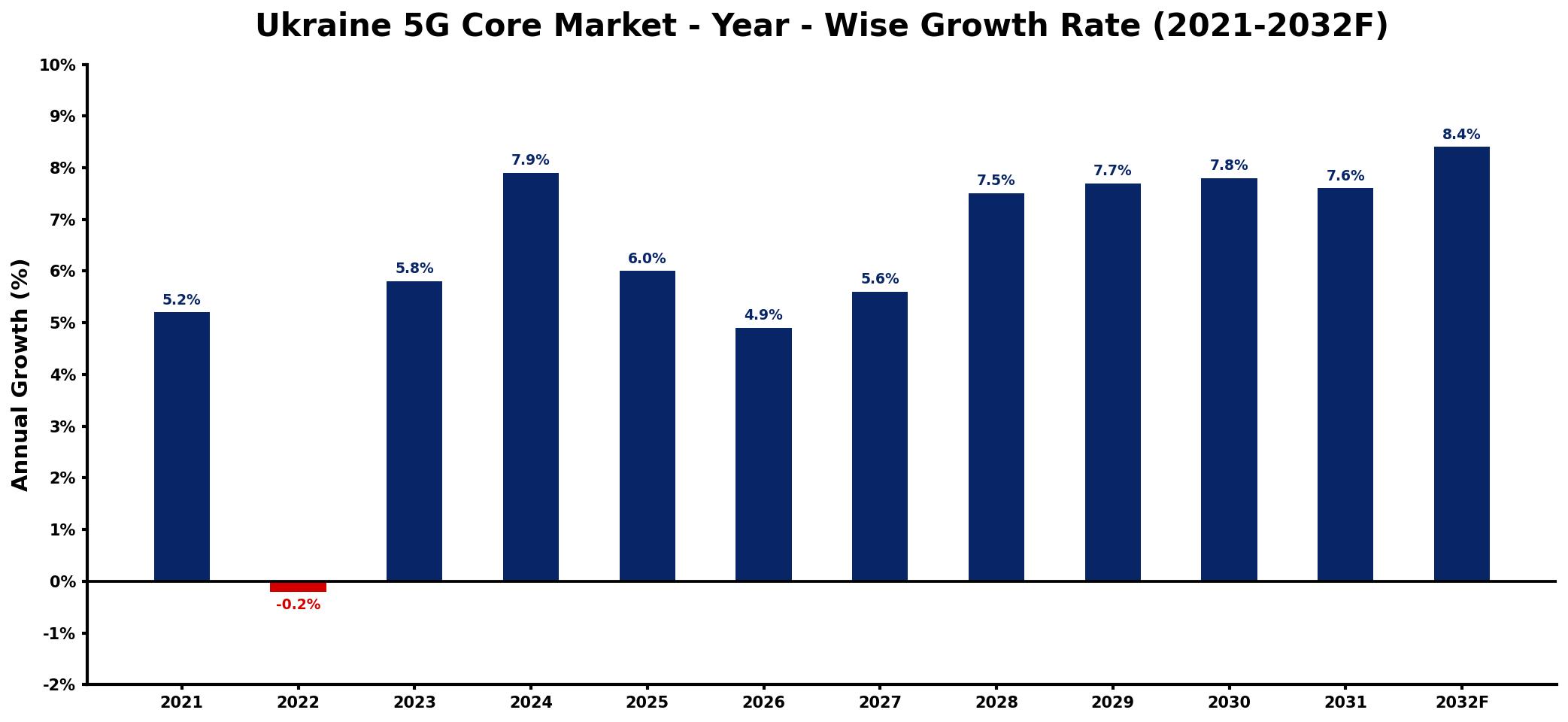
The table below presents the year‑wise growth rates along with the key drivers influencing the market
| Year | Growth Rate | Major Drivers |
| 2021 | 5.2% | Increased investment in infrastructure projects |
| 2022 | -0.2% | Reduced consumer spending on technology |
| 2023 | 5.8% | Growing demand for faster connectivity |
| 2024 | 7.9% | Expansion of mobile network providers |
| 2025 | 6.0% | Rising adoption of smart devices |
| 2026 | 4.9% | Strengthened government support initiatives |
| 2027 | 5.6% | Emergence of new technology partnerships |
| 2028 | 7.5% | Increased focus on digital transformation |
| 2029 | 7.7% | Heightened competition among service providers |
| 2030 | 7.8% | Growing interest in IoT applications |
| 2031 | 7.6% | Boosted funding for telecom innovations |
| 2032 | 8.4% | Widespread implementation of 5G solutions |
Note: Market size estimations and growth projections presented in this report are based on 6Wresearch's proprietary forecasting methodology, utilizing the latest available industry data, government publications, and primary research inputs.
Ukraine 5G Core Market Synopsis
The Ukraine 5G Core Market is currently witnessing robust momentum, propelled by strategic investments and technological advancements. With a significant shift towards cloud-native core networks, stakeholders are laying a solid foundation to meet future demands for digital transformation and connectivity.
Looking ahead, the market is projected to evolve rapidly as more sectors begin to harness the capabilities of 5G technology. The emphasis on network slicing, edge computing, and low-latency services underlines the commitment of operators to not only expand their reach but also enhance service delivery across diverse use cases.
Ukraine 5G Core Market Key Takeaways
- Significant growth forecasted due to increasing consumer and business demand for high-speed connectivity.
- Investment trends are leaning towards advanced technologies like network slicing and edge computing.
- Government initiatives are facilitating faster deployments and reducing bureaucratic barriers for telecom operators.
- Challenges remain in infrastructure costs and regulatory compliance, impacting rollout timelines.
- The market is aligning with global standards in telecommunications, enhancing its competitive edge.
Evaluation of Restraints in Ukraine 5G Core Market
Despite the positive outlook, the Ukraine 5G Core Market faces certain restraints that could impede growth. High initial capital investments necessary for infrastructure upgrades create a financial barrier for many stakeholders. Moreover, regulatory complexities surrounding spectrum allocation can delay the timely rollout of 5G services. A shortage of skilled professionals in the field poses further challenges, as does the necessity of addressing security concerns surrounding data privacy and potential cyber threats. These factors must be navigated effectively to ensure the market's sustainable advancement.
Ukraine 5G Core Market Trends
Current trends in the Ukraine 5G Core Market include a marked shift towards cloud-native architectures, allowing for greater flexibility and scalability. The deployment of network slicing technology has garnered attention, enabling telecom operators to tailor services for specific applications and user needs. Additionally, edge computing is gaining traction as it reduces latency, a critical factor in enhancing user experience and supporting IoT applications. Partnerships between telecom providers and technology vendors are further propelling innovation in the space.
Ukraine 5G Core Market Opportunities
Investment opportunities in the Ukraine 5G Core Market are promising, driven by the growing need for enhanced telecommunications infrastructure. Collaborations with local operators to supply advanced 5G core network solutions, including virtualized network functions and edge computing capabilities, present lucrative prospects. Moreover, research and development aimed at strengthening network security and optimizing performance can yield substantial returns as the market continues to evolve and mature.
Government Initiatives in the Ukraine 5G Core Market
The Ukrainian government is playing a crucial role in the promotion and facilitation of 5G technology deployment. By enacting regulations designed to stimulate competition, they are minimizing bureaucratic red tape while also incentivizing telecom companies to enhance their infrastructure. At the same time, rigorous guidelines are established to ensure national security, especially regarding data protection and privacy. Ongoing monitoring of foreign participation in the market underscores the government's commitment to securing a robust telecommunications landscape.
Future Insights of the Ukraine 5G Core Market
Looking forward to the period from 2026 to 2032, the Ukraine 5G Core Market is set to undergo transformative growth. The ongoing digital transformation efforts will likely accelerate the deployment of 5G networks, driven by demands from various industries, including automotive, healthcare, and smart city initiatives. As operators increase their investments in infrastructure and advanced technologies, the market will become increasingly interconnected, paving the way for new applications and services that leverage 5G capabilities.
Ukraine 5G Core Market Latest Developments (2025 - 2026)
Recent developments in the Ukraine 5G Core Market indicate a shift towards more collaborative approaches among telecom operators and technology firms. Initiatives aimed at enhancing network security are gaining traction, particularly as concerns over cyber threats continue to grow. Regulatory updates are being introduced to streamline spectrum allocation processes, further accelerating the deployment of 5G services. There is also a notable push for public-private partnerships to foster innovation and development within the telecommunications sector.
Ukraine 5G Core Market - Key Attractiveness of the Report
- 10 Years of Market Numbers
- Historical Data Starting from 2022 to 2025
- Base Year: 2025
- Forecast Data until 2032
- Key Performance Indicators Impacting the Market
- Major Upcoming Developments and Projects
Key Highlights of the Report:
- Ukraine 5G Core Market Outlook
- Market Size of Ukraine 5G Core Market, 2025
- Forecast of Ukraine 5G Core Market, 2032
- Historical Data and Forecast of Ukraine 5G Core Revenues & Volume for the Period 2022-2032F
- Ukraine 5G Core Market Trend Evolution
- Ukraine 5G Core Market Drivers and Challenges
- Ukraine 5G Core Price Trends
- Ukraine 5G Core Porter's Five Forces
- Ukraine 5G Core Industry Life Cycle
- Historical Data and Forecast of Ukraine 5G Core Market Revenues & Volume By Component for the Period 2022-2032F
- Historical Data and Forecast of Ukraine 5G Core Market Revenues & Volume By Solutions for the Period 2022-2032F
- Historical Data and Forecast of Ukraine 5G Core Market Revenues & Volume By Services for the Period 2022-2032F
- Historical Data and Forecast of Ukraine 5G Core Market Revenues & Volume By Network Function for the Period 2022-2032F
- Historical Data and Forecast of Ukraine 5G Core Market Revenues & Volume By Access for the Period 2022-2032F
- Historical Data and Forecast of Ukraine 5G Core Market Revenues & Volume By Mobility Management Function for the Period 2022-2032F
- Historical Data and Forecast of Ukraine 5G Core Market Revenues & Volume By Policy Control Function for the Period 2022-2032F
- Historical Data and Forecast of Ukraine 5G Core Market Revenues & Volume By Unified Data Management for the Period 2022-2032F
- Historical Data and Forecast of Ukraine 5G Core Market Revenues & Volume By Deployment Model for the Period 2022-2032F
- Historical Data and Forecast of Ukraine 5G Core Market Revenues & Volume By Cloud for the Period 2022-2032F
- Historical Data and Forecast of Ukraine 5G Core Market Revenues & Volume By On-premises for the Period 2022-2032F
- Historical Data and Forecast of Ukraine 5G Core Market Revenues & Volume By End User for the Period 2022-2032F
- Historical Data and Forecast of Ukraine 5G Core Market Revenues & Volume By Telecom Operators for the Period 2022-2032F
- Historical Data and Forecast of Ukraine 5G Core Market Revenues & Volume By Enterprises for the Period 2022-2032F
- Ukraine 5G Core Import Export Trade Statistics
- Market Opportunity Assessment By Component
- Market Opportunity Assessment By Network Function
- Market Opportunity Assessment By Deployment Model
- Market Opportunity Assessment By End User
- Ukraine 5G Core Top Companies Market Share
- Ukraine 5G Core Competitive Benchmarking By Technical and Operational Parameters
- Ukraine 5G Core Company Profiles
- Ukraine 5G Core Key Strategic Recommendations






































