Acrylic acid Market: Ukraine vs Top 5 Major Economies in 2027 (Asia)
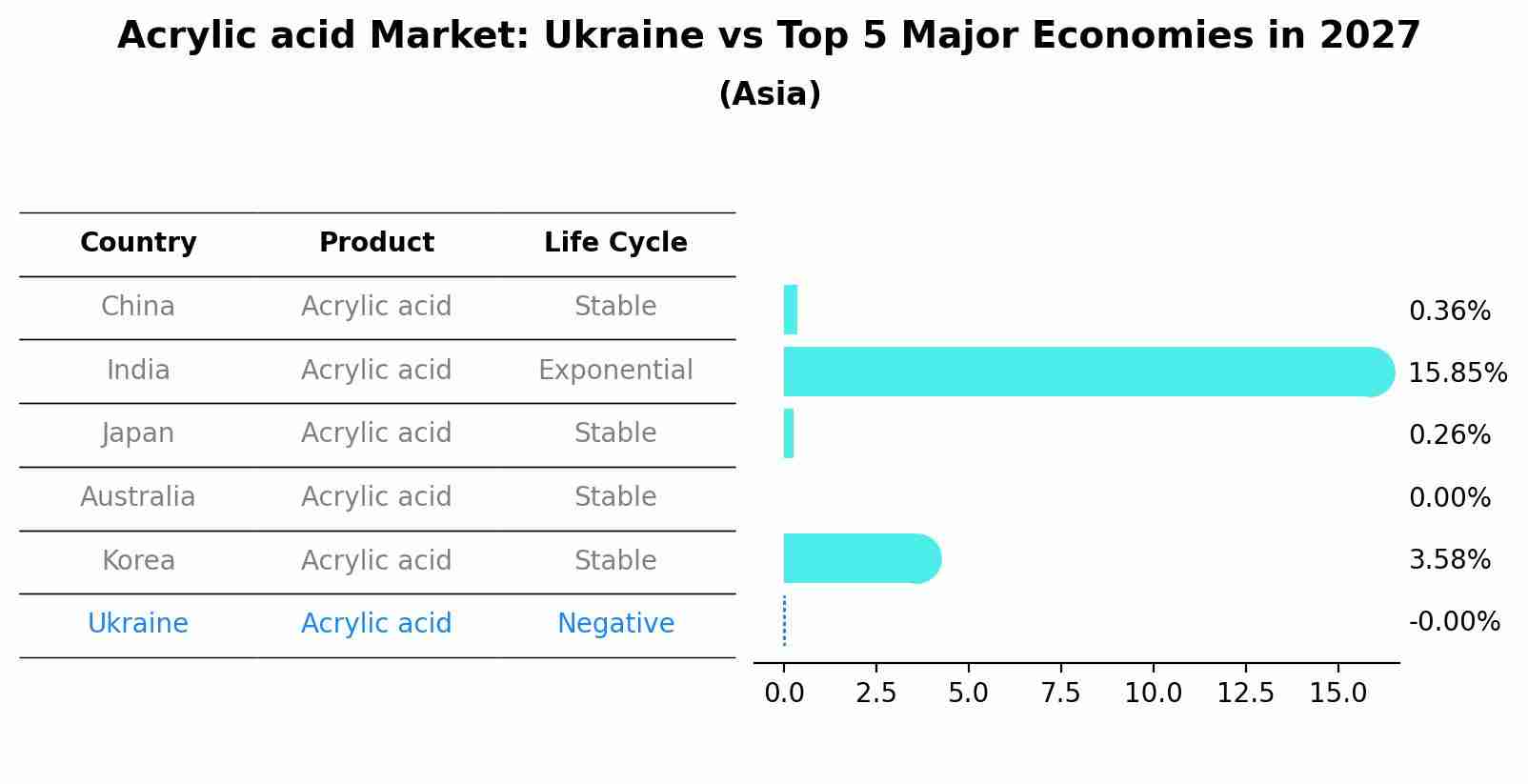
In the Asia region, the Acrylic acid market in Ukraine is projected to expand at a negative growth rate of -0.00% by 2027. The largest economy is China, followed by India, Japan, Australia and South Korea.
Ukraine Acrylic acid Market Overview
The Ukraine Acrylic Acid Market is experiencing steady growth driven by the increasing demand from various end-use industries such as adhesives, sealants, paints, and coatings. The market is witnessing a rise in production capacity with key players expanding their facilities to meet the growing demand. The market is also influenced by factors such as technological advancements in production processes, shifting consumer preferences towards eco-friendly products, and government initiatives promoting the use of acrylic acid in various applications. However, challenges such as volatile raw material prices and stringent environmental regulations may hinder market growth. Overall, the Ukraine Acrylic Acid Market is poised for continued expansion, fueled by the increasing adoption of acrylic acid-based products across different sectors.
Ukraine Acrylic acid Market Trends
The Ukraine Acrylic Acid Market is currently experiencing steady growth driven by increasing demand from industries such as coatings, adhesives, sealants, and textiles. The market is seeing a shift towards environmentally friendly products, leading to a rising preference for bio-based acrylic acid derivatives. Additionally, technological advancements in acrylic acid production processes are enhancing efficiency and reducing production costs, contributing to market expansion. The construction sector is a key driver of demand for acrylic acid in Ukraine, as it is widely used in the production of paints, coatings, and adhesives for construction applications. Overall, the Ukraine Acrylic Acid Market is poised for continued growth, supported by evolving consumer preferences and industrial developments.
Ukraine Acrylic acid Market Challenges
The Ukraine Acrylic acid market faces several challenges, including fluctuations in raw material prices, volatility in global demand, and increasing competition from other regions. The geopolitical tensions in the region also pose a risk to supply chains and trade relationships, impacting the overall market stability. Additionally, regulatory changes and environmental concerns regarding the production and use of acrylic acid can impact market growth and profitability. To remain competitive, companies in the Ukraine Acrylic acid market need to focus on innovation, cost-efficiency, and sustainable practices while closely monitoring market trends and adapting their strategies accordingly.
Ukraine Acrylic acid Market Investment Opportunities
Investment opportunities in the Ukraine acrylic acid market are promising due to the growing demand for the product across various industries such as adhesives, coatings, textiles, and personal care products. With the increasing focus on eco-friendly and sustainable products, there is a shift towards bio-based acrylic acid production, presenting a lucrative investment avenue. Additionally, the Ukrainian government`s initiatives to attract foreign investments and promote industrial growth further enhance the market`s attractiveness for investors. Collaborating with local manufacturers or establishing production facilities in the region can provide strategic advantages and access to a growing market. However, potential investors should carefully assess market trends, regulatory environment, and competition to make informed investment decisions in the Ukraine acrylic acid market.
Ukraine Acrylic acid Market Government Policy
Government policies related to the Ukraine Acrylic Acid Market primarily focus on enhancing domestic production, promoting sustainable practices, and ensuring compliance with environmental regulations. The government has implemented measures to support local manufacturers, such as providing subsidies and incentives to attract investments in the acrylic acid industry. Additionally, there are regulations in place to monitor and control the environmental impact of acrylic acid production, including waste management and emissions standards. The government also aims to promote research and development activities to improve product quality and technological advancements in the acrylic acid market. Overall, the government policies in Ukraine aim to foster a competitive and sustainable acrylic acid market while ensuring compliance with environmental standards.
Ukraine Acrylic acid Market Future Outlook
The future outlook for the Ukraine Acrylic Acid Market appears promising, with steady growth expected in the coming years. Factors such as increasing demand from end-use industries like textiles, adhesives, and coatings, along with investments in infrastructure development projects, are likely to drive market expansion. Additionally, the shift towards environmentally friendly products and the rising popularity of superabsorbent polymers in the healthcare sector are anticipated to further boost market growth. Despite challenges such as raw material price fluctuations and volatile economic conditions, the market is projected to witness a positive trajectory due to ongoing technological advancements and innovation in acrylic acid production processes. Overall, the Ukraine Acrylic Acid Market is poised for sustained growth and opportunities for market players in the foreseeable future.
Key Highlights of the Report:
- Ukraine Acrylic acid Market Outlook
- Market Size of Ukraine Acrylic acid Market, 2021
- Forecast of Ukraine Acrylic acid Market, 2027
- Historical Data and Forecast of Ukraine Acrylic acid Revenues & Volume for the Period 2018 - 2027
- Ukraine Acrylic acid Market Trend Evolution
- Ukraine Acrylic acid Market Drivers and Challenges
- Ukraine Acrylic acid Price Trends
- Ukraine Acrylic acid Porter's Five Forces
- Ukraine Acrylic acid Industry Life Cycle
- Historical Data and Forecast of Ukraine Acrylic acid Market Revenues & Volume By Product for the Period 2018 - 2027
- Historical Data and Forecast of Ukraine Acrylic acid Market Revenues & Volume By Acrylate Esters for the Period 2018 - 2027
- Historical Data and Forecast of Ukraine Acrylic acid Market Revenues & Volume By Glacial Acrylic Acid for the Period 2018 - 2027
- Historical Data and Forecast of Ukraine Acrylic acid Market Revenues & Volume By Others for the Period 2018 - 2027
- Historical Data and Forecast of Ukraine Acrylic acid Market Revenues & Volume By End-users for the Period 2018 - 2027
- Historical Data and Forecast of Ukraine Acrylic acid Market Revenues & Volume By Surfactants and Surface Coatings for the Period 2018 - 2027
- Historical Data and Forecast of Ukraine Acrylic acid Market Revenues & Volume By Organic Chemicals for the Period 2018 - 2027
- Historical Data and Forecast of Ukraine Acrylic acid Market Revenues & Volume By Water Filtration for the Period 2018 - 2027
- Historical Data and Forecast of Ukraine Acrylic acid Market Revenues & Volume By Adhesives and Sealants for the Period 2018 - 2027
- Historical Data and Forecast of Ukraine Acrylic acid Market Revenues & Volume By Textiles for the Period 2018 - 2027
- Historical Data and Forecast of Ukraine Acrylic acid Market Revenues & Volume By Water Treatment for the Period 2018 - 2027
- Historical Data and Forecast of Ukraine Acrylic acid Market Revenues & Volume By Personal Care Products for the Period 2018 - 2027
- Historical Data and Forecast of Ukraine Acrylic acid Market Revenues & Volume By Others for the Period 2018 - 2027
- Ukraine Acrylic acid Import Export Trade Statistics
- Market Opportunity Assessment By Product
- Market Opportunity Assessment By End-users
- Ukraine Acrylic acid Top Companies Market Share
- Ukraine Acrylic acid Competitive Benchmarking By Technical and Operational Parameters
- Ukraine Acrylic acid Company Profiles
- Ukraine Acrylic acid Key Strategic Recommendations






































