Ukraine AI in IoT Market Size & Growth Rate (2026-2032)
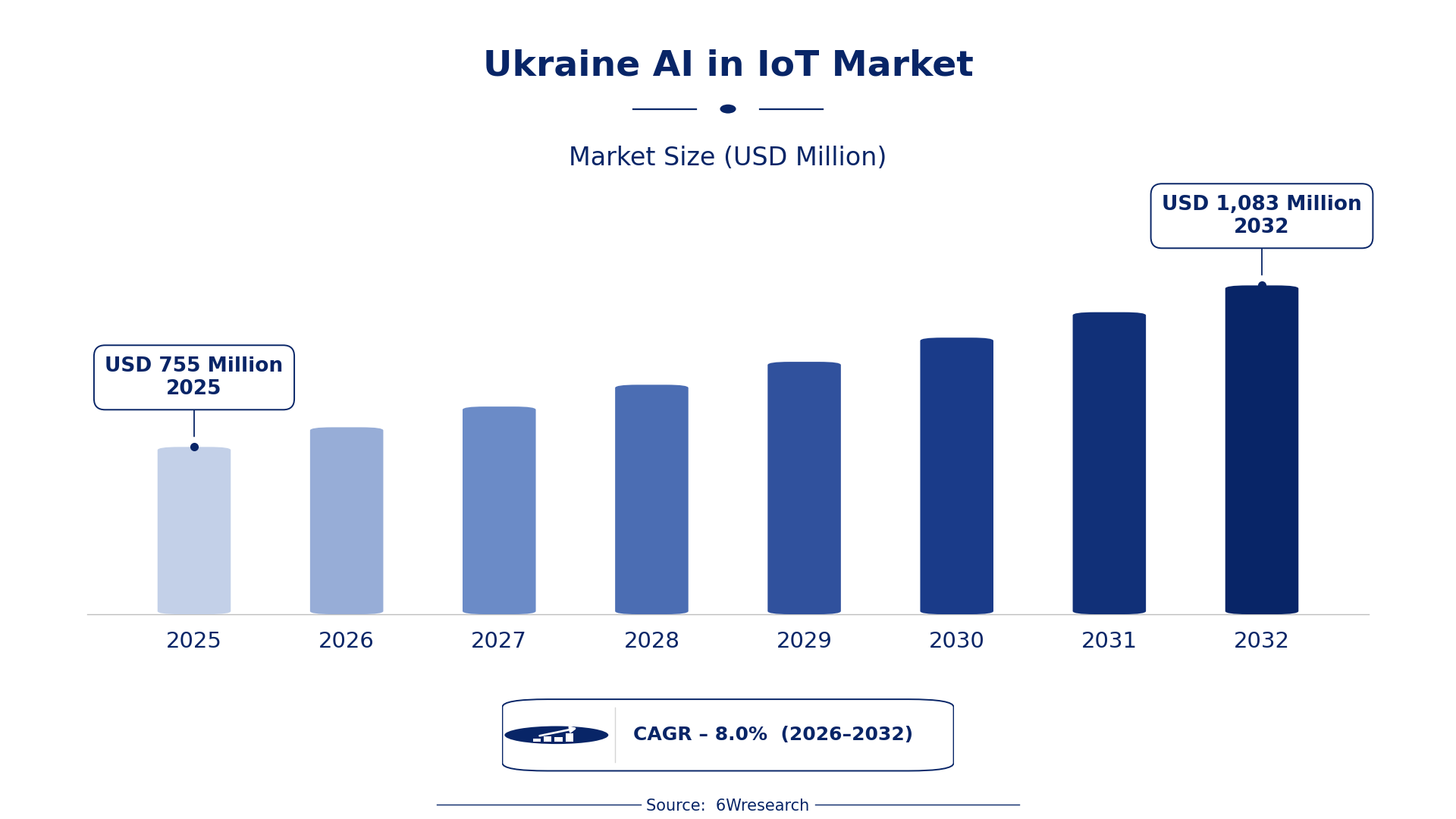
The Ukraine AI in IoT Market was estimated at USD 755 Million in 2025 and is projected to reach USD 1083 Million by 2032, growing at a CAGR of 8.0% from 2026 to 2032.
Ukraine AI in IoT Market Synopsis
The Ukraine AI in IoT market is on an upward trajectory, catalyzed by the convergence of artificial intelligence with IoT technologies. Recent momentum is notable, yet the potential for further growth remains substantial as industries increasingly realize the transformative capabilities of AI-enhanced IoT solutions.
As businesses in sectors like manufacturing, healthcare, and agriculture embrace these innovations, the demand for sophisticated AI algorithms and IoT devices is set to rise. The evolving regulatory framework and supportive government initiatives further underscore the market's potential to emerge as a regional powerhouse in technology.
Ukraine AI in IoT Market Year-wise Growth Rate and Key Drivers
This graph illustrates the annual growth rates of the Ukraine AI in IoT Market from 2021 to 2032, highlighting a steady upward trajectory and projected expansion over the forecast period.
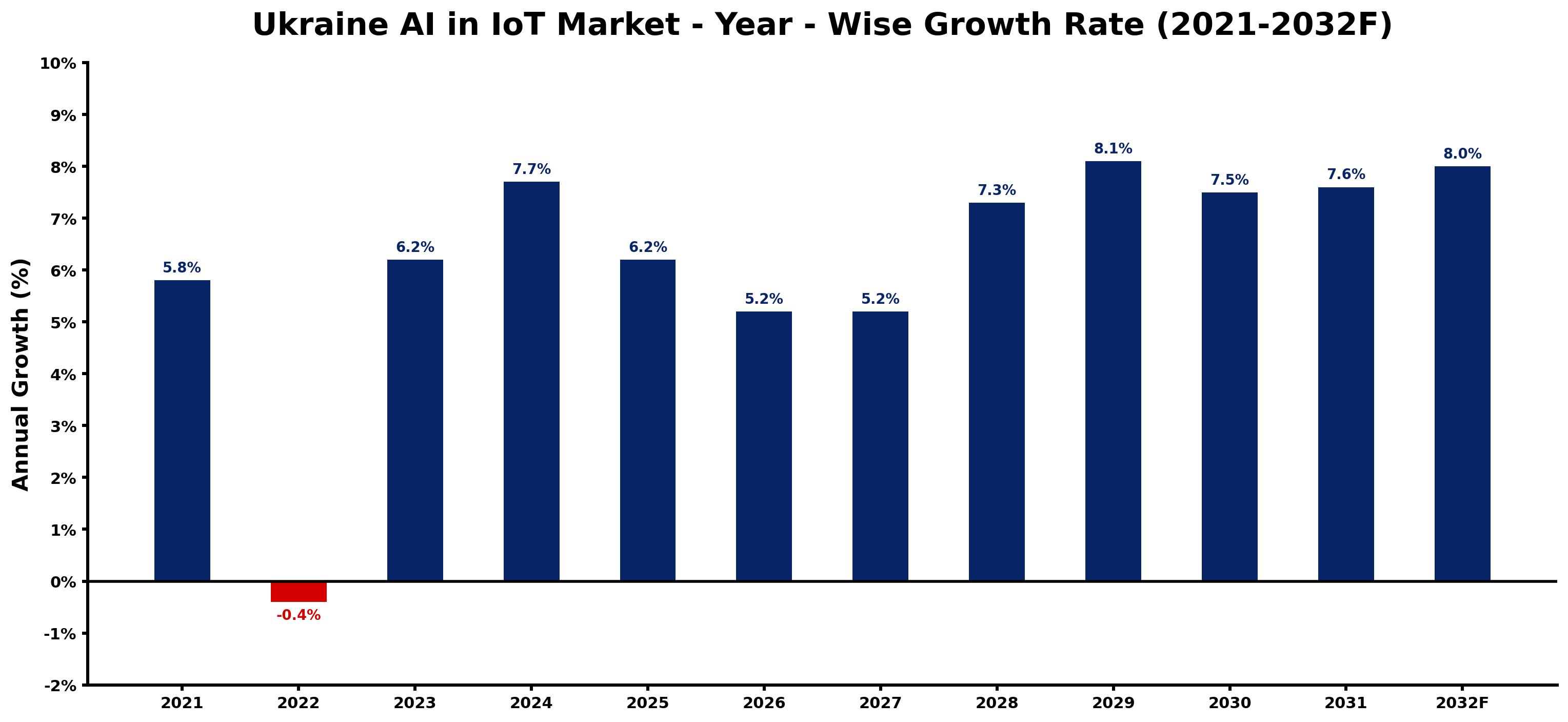
The table below presents the year‑wise growth rates along with the key drivers influencing the market
| Year | Growth Rate | Major Drivers |
| 2021 | 5.8% | Government push for smart agricultural solutions adoption. |
| 2022 | -0.4% | Disruption from ongoing conflict and infrastructure damage. |
| 2023 | 6.2% | Increased investment in cybersecurity for smart device protection. |
| 2024 | 7.7% | Emerging startups developing AI-driven smart home technologies. |
| 2025 | 6.2% | Ukrainian legislation promoting IoT innovation and integration. |
| 2026 | 5.2% | Local universities enhancing AI IoT curriculum and research. |
| 2027 | 5.2% | Rise in demand for automated supply chain solutions. |
| 2028 | 7.3% | Growing public-private partnerships for smart city initiatives. |
| 2029 | 8.1% | Increased consumer awareness of connected device benefits. |
| 2030 | 7.5% | Ukraine's tech exports driven by IoT advancements. |
| 2031 | 7.6% | Incentives for renewable energy IoT applications by government. |
| 2032 | 8.0% | E-commerce growth fueling demand for smart logistics solutions. |
Note: Market size estimations and growth projections presented in this report are based on 6Wresearch's proprietary forecasting methodology, utilizing the latest available industry data, government publications, and primary research inputs.
Ukraine AI in IoT Market Key Takeaways
Below are some of the specific key takeaways from the market, including:
- The market's projected growth reflects increasing investment in AI and IoT technologies.
- Integration of AI algorithms into IoT devices is reshaping data analytics and operational efficiency.
- Government policies are fostering a conducive environment for innovation and collaboration.
- The demand for smart home devices and connected vehicles is driving market expansion.
- Challenges related to skilled workforce and data privacy need addressing for sustained growth.
Evaluation of Restraints in Ukraine AI in IoT Market
The Ukraine AI in IoT market faces notable challenges that could hinder its full potential. A shortage of professionals skilled in both AI and IoT is a critical concern; without the right expertise, companies struggle to implement advanced solutions effectively. on top of that, data privacy and security remain significant issues. The sensitive nature of IoT data requires stringent cybersecurity measures, yet the current landscape presents vulnerabilities that could deter investment. Lastly, a fragmented regulatory environment complicates compliance, adding another layer of difficulty for businesses seeking to innovate within this space.
Ukraine AI in IoT Market Trends
Several trends are shaping the Ukraine AI in IoT market. The integration of AI into IoT devices is enhancing capabilities such as predictive maintenance and real-time data analytics. Companies are also increasingly focusing on developing smart home technologies and industrial automation solutions, which are gaining traction in both urban and rural settings. The emphasis on sustainability is driving innovations in smart agriculture, making it possible to optimize resource use and improve crop yields. This holistic approach to technology adoption is on track to elevate Ukraine’s standing in the global tech arena.
Ukraine AI in IoT Market Opportunities
The Ukraine AI in IoT market presents various growth opportunities that stakeholders should capitalize on. The rising demand for smart home devices and connected vehicles creates avenues for innovative product development. Investment in research and development is crucial, particularly for companies focusing on AI-driven solutions that enhance operational efficiencies. Additionally, partnerships between tech firms and academic institutions can foster knowledge sharing and accelerate innovation. As the government continues to support digital transformation initiatives, new projects are likely to emerge, further opening doors for investment and collaboration.
Government Initiatives in the Ukraine AI in IoT Market
Government policy is playing a significant role in shaping the Ukraine AI in IoT market. By fostering innovation and providing support for research and development, the government aims to position Ukraine as a leader in technological advancements. The establishment of regulatory frameworks focused on data privacy and security is critical for gaining public trust and encouraging wider adoption of IoT solutions. As these initiatives unfold, they will create a more favorable environment for businesses looking to invest in AI and IoT technologies.
- A national digital infrastructure upgrade programme launched in 2023 to enhance connectivity across urban and rural areas.
- Current initiatives include funding opportunities for startups focused on AI and IoT technologies, aimed at boosting local innovation.
- Ongoing collaborations between government and educational institutions to develop specialized training programmes for AI and IoT professionals.
- Planned regulations to enhance data security measures are set to be introduced in 2025, addressing privacy concerns in IoT deployments.
Future Insights of the Ukraine AI in IoT Market
Looking ahead to 2026-2032, the Ukraine AI in IoT market is expected to continue its upward trajectory. As industries further integrate AI with IoT technologies, operational efficiencies will improve, and decision-making processes will become more data-driven. The government's ongoing support for digital transformation will likely create a fertile ground for innovation, attracting both local and international investments. This could position Ukraine as a competitive player on the global stage, particularly in sectors like smart agriculture and automated manufacturing.
Ukraine AI in IoT Market Latest Developments
Recent industry activity in the Ukraine AI in IoT market has been dynamic, reflecting the growing interest and investment in this sector. Companies are increasingly focused on enhancing their technology offerings to meet the evolving demands of consumers and businesses alike. This shift is indicative of a broader trend toward digitalization and automation across multiple industries.
- A leading regional operator launched a new AI-driven IoT platform in Q2 2023, enhancing data analytics capabilities for industrial clients.
- A major technology vendor initiated an ongoing partnership with local universities in early 2023 to develop AI talent and research projects.
- By mid-2023, several agricultural tech startups unveiled innovative IoT solutions aimed at optimizing farming operations.
- Plans for a comprehensive smart city project are set to commence in late 2023, focusing on integrating IoT technologies for urban management.
Ukraine AI in IoT Market - Key Attractiveness of the Report
- 10 Years of Market Numbers
- Historical Data Starting from 2022 to 2025
- Base Year: 2025
- Forecast Data until 2032
- Key Performance Indicators Impacting the Market
- Major Upcoming Developments and Projects
Key Highlights of the Report:
- Ukraine AI in IoT Market Outlook
- Market Size of Ukraine AI in IoT Market, 2025
- Forecast of Ukraine AI in IoT Market, 2032
- Historical Data and Forecast of Ukraine AI in IoT Revenues & Volume for the Period 2022-2032F
- Ukraine AI in IoT Market Trend Evolution
- Ukraine AI in IoT Market Drivers and Challenges
- Ukraine AI in IoT Price Trends
- Ukraine AI in IoT Porter's Five Forces
- Ukraine AI in IoT Industry Life Cycle
- Historical Data and Forecast of Ukraine AI in IoT Market Revenues & Volume By Component for the Period 2022-2032F
- Historical Data and Forecast of Ukraine AI in IoT Market Revenues & Volume By Platforms for the Period 2022-2032F
- Historical Data and Forecast of Ukraine AI in IoT Market Revenues & Volume By Software Solutions for the Period 2022-2032F
- Historical Data and Forecast of Ukraine AI in IoT Market Revenues & Volume By Services for the Period 2022-2032F
- Historical Data and Forecast of Ukraine AI in IoT Market Revenues & Volume By Vertical for the Period 2022-2032F
- Historical Data and Forecast of Ukraine AI in IoT Market Revenues & Volume By Manufacturing for the Period 2022-2032F
- Historical Data and Forecast of Ukraine AI in IoT Market Revenues & Volume By Energy and Utilities for the Period 2022-2032F
- Historical Data and Forecast of Ukraine AI in IoT Market Revenues & Volume By Transportation and Mobility for the Period 2022-2032F
- Historical Data and Forecast of Ukraine AI in IoT Market Revenues & Volume By BFSI for the Period 2022-2032F
- Historical Data and Forecast of Ukraine AI in IoT Market Revenues & Volume By Government and Defense for the Period 2022-2032F
- Historical Data and Forecast of Ukraine AI in IoT Market Revenues & Volume By Retail for the Period 2022-2032F
- Historical Data and Forecast of Ukraine AI in IoT Market Revenues & Volume By Healthcare and Life Sciences for the Period 2022-2032F
- Historical Data and Forecast of Ukraine AI in IoT Market Revenues & Volume By Telecom for the Period 2022-2032F
- Historical Data and Forecast of Ukraine AI in IoT Market Revenues & Volume By Technology for the Period 2022-2032F
- Historical Data and Forecast of Ukraine AI in IoT Market Revenues & Volume By ML and Deep Learning for the Period 2022-2032F
- Historical Data and Forecast of Ukraine AI in IoT Market Revenues & Volume By NLP for the Period 2022-2032F
- Ukraine AI in IoT Import Export Trade Statistics
- Market Opportunity Assessment By Component
- Market Opportunity Assessment By Vertical
- Market Opportunity Assessment By Technology
- Ukraine AI in IoT Top Companies Market Share
- Ukraine AI in IoT Competitive Benchmarking By Technical and Operational Parameters
- Ukraine AI in IoT Company Profiles
- Ukraine AI in IoT Key Strategic Recommendations






































