Ukraine Critical Infrastructure Protection Market Size & Growth Rate (2026-2032)
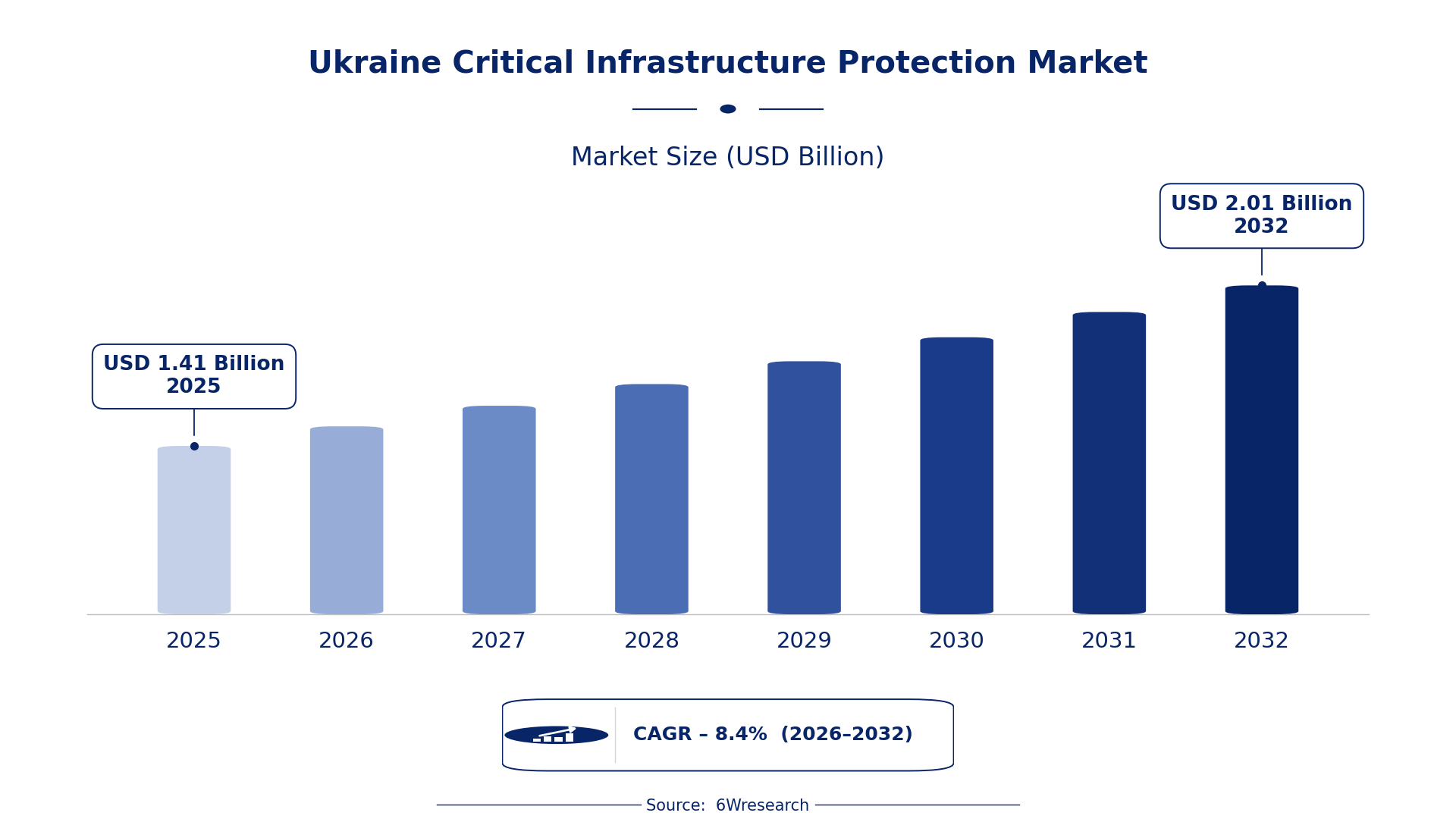
The Ukraine Critical Infrastructure Protection Market was estimated at USD 1405 Million in 2025 and is projected to reach USD 2008 Million by 2032, growing at a CAGR of 8.4% from 2026 to 2032.
Ukraine Critical Infrastructure Protection Market Synopsis
In recent years, Ukraine has prioritized the security of its critical infrastructure, a move driven by the ever-increasing threats in sectors such as energy, transportation, and communication. With geopolitical tensions and the rise in cyber threats, organizations are under pressure to enhance their security frameworks and resilience.
This market is on an upward trajectory, fueled by government initiatives focused on cybersecurity enhancements and collaboration with private sector experts. As awareness grows, so does the demand for sophisticated solutions that integrate physical and cybersecurity to ensure the operational continuity of essential services.
Ukraine Critical Infrastructure Protection Market Year-wise Growth Rate and Key Drivers
This graph illustrates the annual growth rates of the Ukraine Critical Infrastructure Protection Market from 2021 to 2032, highlighting a steady upward trajectory and projected expansion over the forecast period.
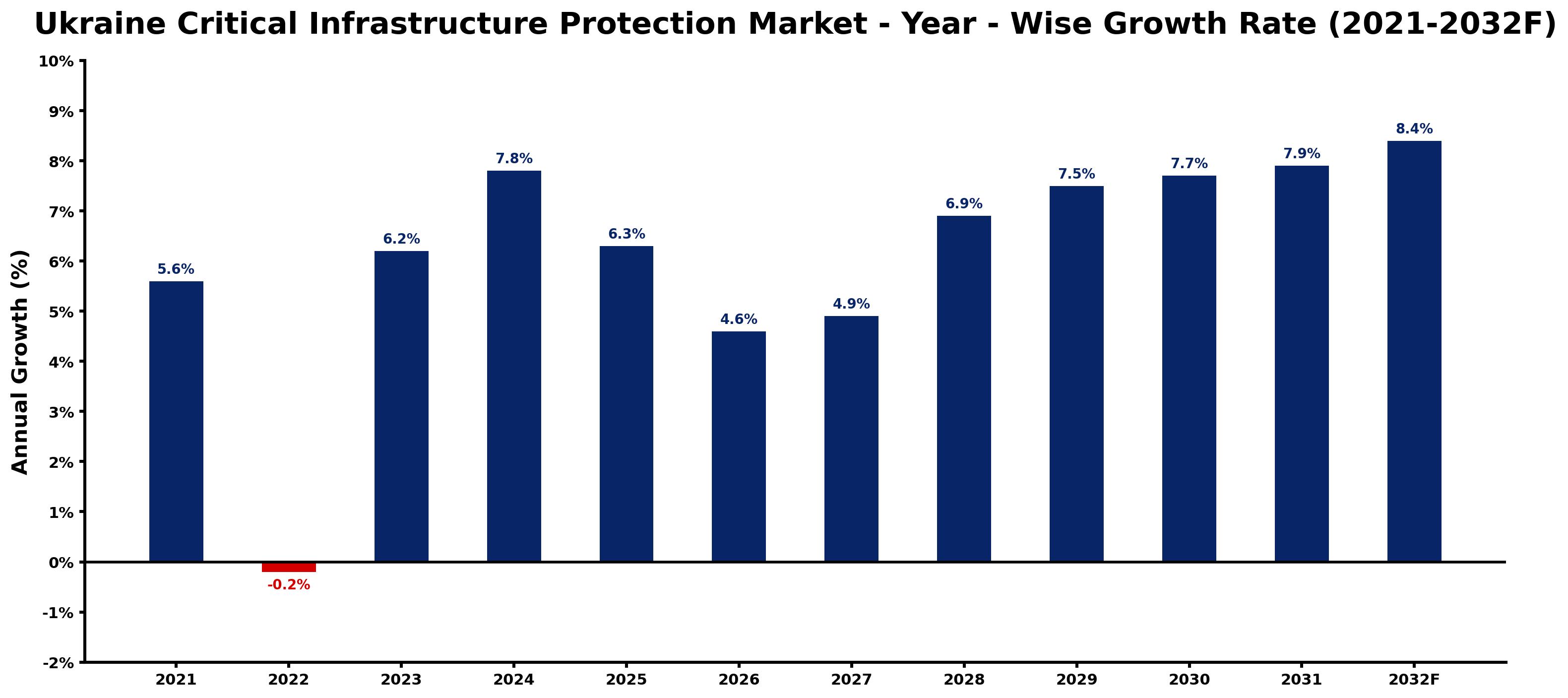
The table below presents the year‑wise growth rates along with the key drivers influencing the market
| Year | Growth Rate | Major Drivers |
| 2021 | 5.6% | Increase in government funding for cyber defense measures |
| 2022 | -0.2% | Invasion disruptions by Russian military affecting infrastructure projects. |
| 2023 | 6.2% | Implementation of new data protection regulations by lawmakers |
| 2024 | 7.8% | Rising threats from geopolitical tensions necessitating enhanced security |
| 2025 | 6.3% | Growth in local cybersecurity workforce training programs |
| 2026 | 4.6% | Launch of national critical infrastructure resilience initiatives |
| 2027 | 4.9% | Strategic alliances with international cybersecurity organizations formed |
| 2028 | 6.9% | Adoption of advanced surveillance technology for urban areas |
| 2029 | 7.5% | Government mandates for secure infrastructure modernization projects |
| 2030 | 7.7% | Investment surge in critical infrastructure cybersecurity frameworks |
| 2031 | 7.9% | Increased insurance requirements for infrastructure security compliance |
| 2032 | 8.4% | Deployment of AI technologies in threat detection systems |
Note: Market size estimations and growth projections presented in this report are based on 6Wresearch's proprietary forecasting methodology, utilizing the latest available industry data, government publications, and primary research inputs.
Ukraine Critical Infrastructure Protection Market Key Takeaways
Below are some of the specific key takeaways from the market, including:
- The government’s commitment to strengthening cybersecurity frameworks is influencing market growth.
- Technological advancements are being rapidly adopted to counter threats across critical infrastructure sectors.
- Investment opportunities are emerging in both cybersecurity solutions and physical security systems.
- Collaborations among governmental agencies and private firms are increasing to bolster overall resilience.
- Challenges such as funding constraints and political instability need addressing for sustained growth.
Evaluation of Restraints in Ukraine Critical Infrastructure Protection Market
While the market shows promise, several restraints hinder its growth. Limited funding for security enhancements often results in outdated systems that cannot effectively combat modern threats. Coordination among agencies is another issue, with various stakeholders sometimes operating in silos rather than collaboratively. The unpredictable political landscape adds another layer of complexity, making it challenging to implement comprehensive security strategies consistently. These factors highlight the urgent need for a consolidated approach to bolster Ukraine's critical infrastructure security.
Ukraine Critical Infrastructure Protection Market Trends
A noticeable trend is the increasing integration of advanced technologies like artificial intelligence and the Internet of Things into security protocols. The demand for real-time monitoring and threat detection systems is growing, reflecting a proactive stance on security. Additionally, companies are focusing on combining physical security measures with cybersecurity efforts to create comprehensive defense strategies. Partnerships between public and private sectors are also becoming more prevalent, fostering a collaborative environment to enhance security practices.
Ukraine Critical Infrastructure Protection Market Opportunities
Numerous investment opportunities are emerging in the Ukraine Critical Infrastructure Protection Market, particularly in cybersecurity software and consulting services. As organizations recognize the necessity of protecting critical assets, the demand for physical security systems like surveillance and access control technologies is on the rise. Disaster recovery solutions are becoming increasingly vital as well, enabling organizations to maintain operational continuity during unforeseen disruptions, whether from cyber incidents or natural disasters.
Government Initiatives in the Ukraine Critical Infrastructure Protection Market
The Ukrainian government has recognized the crucial need for robust critical infrastructure protection policies, establishing frameworks that not only address current threats but also anticipate future challenges. Recent regulations mandate that infrastructure operators enhance security measures and conduct thorough risk assessments. The focus is on fostering a collaborative environment where public and private sectors can share best practices and strengthen resilience against various forms of attack.
- A national strategy to bolster cybersecurity in critical sectors, launched in early 2025, aims to enhance overall security measures.
- Currently ongoing collaborations between government bodies and cybersecurity firms are focused on developing real-time threat detection systems.
- A new regulatory framework mandating regular security audits for infrastructure operators is set to be implemented by mid-2026.
- Planned investment initiatives seek to modernize physical security systems in transportation networks by 2027.
Future Insights of the Ukraine Critical Infrastructure Protection Market
Looking ahead to 2026-2032, the Ukraine Critical Infrastructure Protection Market is set to expand significantly. The ongoing modernization of critical infrastructure will necessitate advanced security solutions. Government support and a growing acknowledgment of security imperatives will drive investments in cutting-edge technologies. As cyber threats continue to evolve, the market will likely see increased demand for innovative solutions that can adapt and respond swiftly to emerging challenges.
Ukraine Critical Infrastructure Protection Market Latest Developments
In the past year, the Ukraine Critical Infrastructure Protection Market has witnessed notable developments, reflecting a proactive approach to emerging security challenges. Companies and government entities are increasingly collaborating to upgrade systems and share knowledge on best practices. This trend underscores a collective commitment to fortifying the nation's critical infrastructure against a backdrop of heightened threats.
- A significant technology upgrade for surveillance systems across major urban centers began in Q1 2025 and is expected to enhance monitoring capabilities.
- Partnership agreements between governmental agencies and private cybersecurity firms were formalized in late 2025 to improve threat intelligence sharing.
- Ongoing pilot programs are testing new AI-driven threat detection software across energy facilities, set to conclude by late 2025.
- A regulatory review of existing infrastructure protection policies is scheduled for Q3 2026, aiming to streamline compliance procedures.
Ukraine Critical Infrastructure Protection Market - Key Attractiveness of the Report
- 10 Years of Market Numbers
- Historical Data Starting from 2022 to 2025
- Base Year: 2025
- Forecast Data until 2032
- Key Performance Indicators Impacting the Market
- Major Upcoming Developments and Projects
Key Highlights of the Report:
- Ukraine Critical Infrastructure Protection Market Outlook
- Market Size of Ukraine Critical Infrastructure Protection Market, 2025
- Forecast of Ukraine Critical Infrastructure Protection Market, 2032
- Historical Data and Forecast of Ukraine Critical Infrastructure Protection Revenues & Volume for the Period 2022-2032F
- Ukraine Critical Infrastructure Protection Market Trend Evolution
- Ukraine Critical Infrastructure Protection Market Drivers and Challenges
- Ukraine Critical Infrastructure Protection Price Trends
- Ukraine Critical Infrastructure Protection Porter's Five Forces
- Ukraine Critical Infrastructure Protection Industry Life Cycle
- Historical Data and Forecast of Ukraine Critical Infrastructure Protection Market Revenues & Volume By Solution for the Period 2022-2032F
- Historical Data and Forecast of Ukraine Critical Infrastructure Protection Market Revenues & Volume By Physical Safety for the Period 2022-2032F
- Historical Data and Forecast of Ukraine Critical Infrastructure Protection Market Revenues & Volume By Security Video Surveillance Systems for the Period 2022-2032F
- Historical Data and Forecast of Ukraine Critical Infrastructure Protection Market Revenues & Volume By Screening for the Period 2022-2032F
- Historical Data and Forecast of Ukraine Critical Infrastructure Protection Market Revenues & Volume By Scanning for the Period 2022-2032F
- Historical Data and Forecast of Ukraine Critical Infrastructure Protection Market Revenues & Volume By Cybersecurity for the Period 2022-2032F
- Historical Data and Forecast of Ukraine Critical Infrastructure Protection Market Revenues & Volume By Encryption for the Period 2022-2032F
- Historical Data and Forecast of Ukraine Critical Infrastructure Protection Market Revenues & Volume By Threat Intelligence for the Period 2022-2032F
- Historical Data and Forecast of Ukraine Critical Infrastructure Protection Market Revenues & Volume By Component for the Period 2022-2032F
- Historical Data and Forecast of Ukraine Critical Infrastructure Protection Market Revenues & Volume By Solution for the Period 2022-2032F
- Historical Data and Forecast of Ukraine Critical Infrastructure Protection Market Revenues & Volume By Services for the Period 2022-2032F
- Historical Data and Forecast of Ukraine Critical Infrastructure Protection Market Revenues & Volume By Vertical for the Period 2022-2032F
- Historical Data and Forecast of Ukraine Critical Infrastructure Protection Market Revenues & Volume By Financial Institutions for the Period 2022-2032F
- Historical Data and Forecast of Ukraine Critical Infrastructure Protection Market Revenues & Volume By Government for the Period 2022-2032F
- Historical Data and Forecast of Ukraine Critical Infrastructure Protection Market Revenues & Volume By Defense for the Period 2022-2032F
- Historical Data and Forecast of Ukraine Critical Infrastructure Protection Market Revenues & Volume By Transport and Logistics for the Period 2022-2032F
- Historical Data and Forecast of Ukraine Critical Infrastructure Protection Market Revenues & Volume By Energy and Power for the Period 2022-2032F
- Historical Data and Forecast of Ukraine Critical Infrastructure Protection Market Revenues & Volume By Commercial Sector for the Period 2022-2032F
- Historical Data and Forecast of Ukraine Critical Infrastructure Protection Market Revenues & Volume By Telecom for the Period 2022-2032F
- Historical Data and Forecast of Ukraine Critical Infrastructure Protection Market Revenues & Volume By Chemicals and Manufacturing for the Period 2022-2032F
- Ukraine Critical Infrastructure Protection Import Export Trade Statistics
- Market Opportunity Assessment By Solution
- Market Opportunity Assessment By Cybersecurity
- Market Opportunity Assessment By Component
- Market Opportunity Assessment By Vertical
- Ukraine Critical Infrastructure Protection Top Companies Market Share
- Ukraine Critical Infrastructure Protection Competitive Benchmarking By Technical and Operational Parameters
- Ukraine Critical Infrastructure Protection Company Profiles
- Ukraine Critical Infrastructure Protection Key Strategic Recommendations






































