Ukraine Data Center Market Size & Growth Rate (2026-2032)
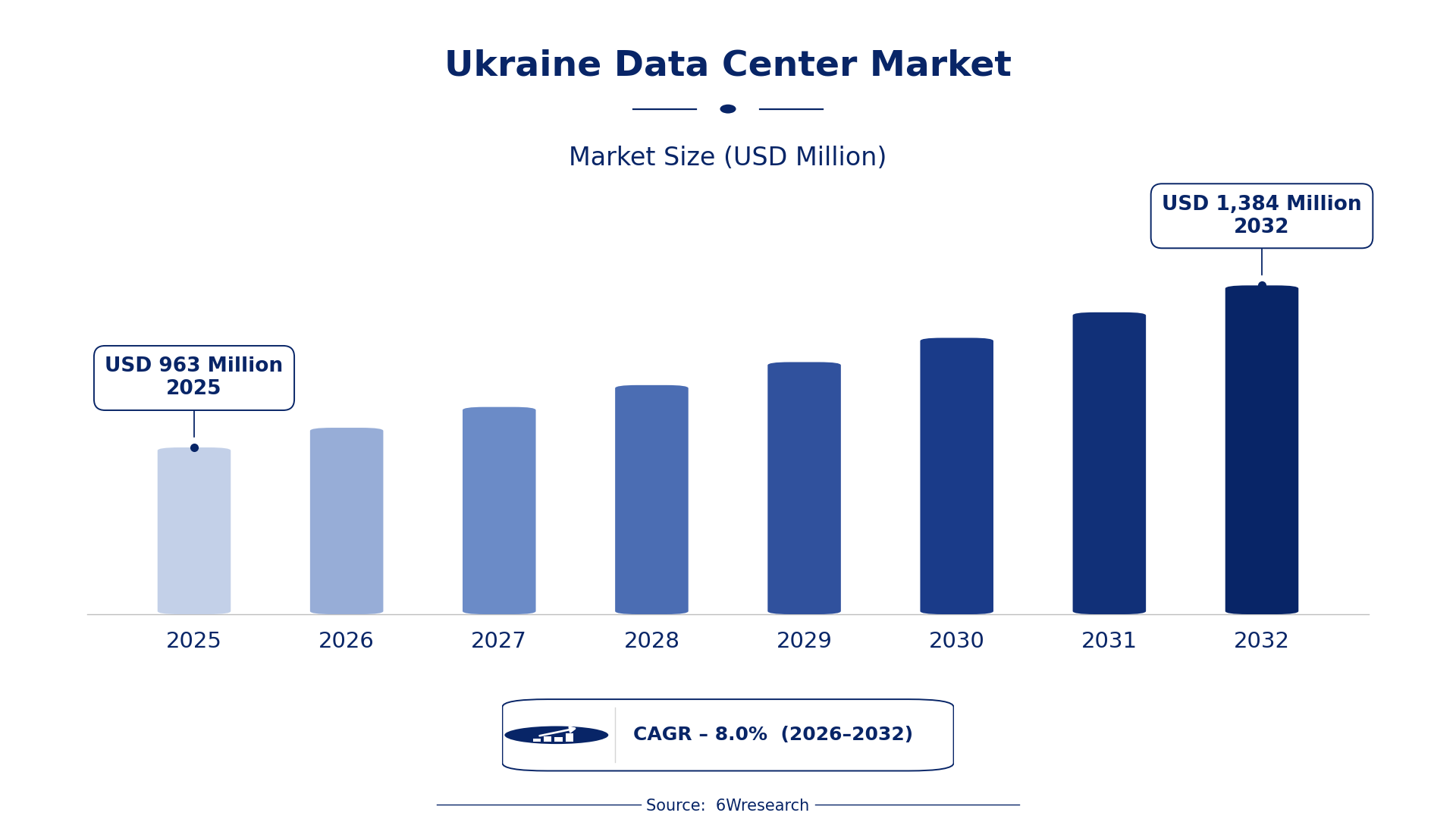
The Ukraine Data Center Market was estimated at USD 963 Million in 2025 and is projected to reach USD 1384 Million by 2032, growing at a CAGR of 8.0% from 2026 to 2032.
Ukraine Data Center Market Synopsis
The Ukraine Data Center Market is currently witnessing an accelerated pace of growth, fueled by the increasing reliance on digital solutions across various sectors. With a burgeoning demand for data storage and processing capabilities, businesses are keen to upgrade their IT infrastructure to remain competitive in the current digital-first environment.
Key drivers behind this expansion include government support for IT initiatives and the entry of international data center operators looking to tap into Ukraine's potential. As local firms embrace cloud services and edge computing, the market is set for transformative changes that promise to reshape the future of data management in the region.
Ukraine Data Center Market Year-wise Growth Rate and Key Drivers
This graph illustrates the annual growth rates of the Ukraine Data Center Market from 2021 to 2032, highlighting a steady upward trajectory and projected expansion over the forecast period.
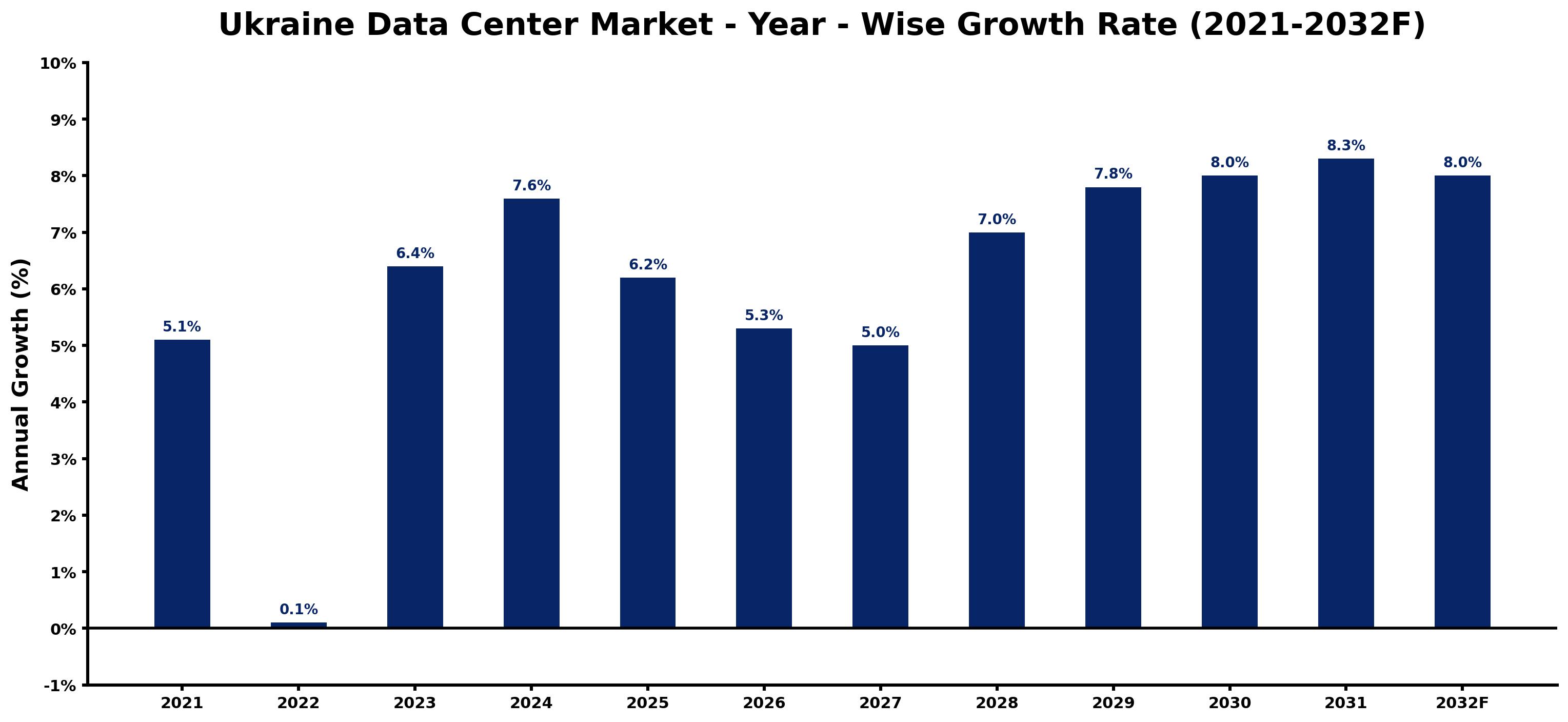
The table below presents the year‑wise growth rates along with the key drivers influencing the market
| Year | Growth Rate | Major Drivers |
| 2021 | 5.1% | Increased foreign investments in Ukrainian tech sector. |
| 2022 | 0.1% | Telecom sector growth requiring more data storage facilities. |
| 2023 | 6.4% | Growing remote work trends driving data accessibility demands. |
| 2024 | 7.6% | Ukrainian cybersecurity regulations boosting data center compliance needs. |
| 2025 | 6.2% | Emergence of AI startups needing advanced data processing. |
| 2026 | 5.3% | Local government support for tech infrastructure development. |
| 2027 | 5.0% | Rise in cloud computing adoption by Ukrainian businesses. |
| 2028 | 7.0% | Increased regional demand for colocation services in Kyiv. |
| 2029 | 7.8% | Digital currency market growth driving data center operations. |
| 2030 | 8.0% | Government-backed projects enhancing digital service capabilities. |
| 2031 | 8.3% | Surge in IoT applications necessitating robust data infrastructure. |
| 2032 | 8.0% | Focus on renewable energy sources in data center operations. |
Note: Market size estimations and growth projections presented in this report are based on 6Wresearch's proprietary forecasting methodology, utilizing the latest available industry data, government publications, and primary research inputs.
Ukraine Data Center Market Key Takeaways
Below are some of the specific key takeaways from the market, including:
- The Ukraine Data Center Market is expected to grow steadily, driven by robust demand for data solutions.
- Government policies are playing a crucial role in facilitating market growth through supportive regulations.
- Cloud services and edge computing are increasingly adopted by businesses, enhancing operational efficiency.
- International players are entering the market, creating more competition and innovation.
- Investment in infrastructure development is essential to overcome existing challenges and meet future demands.
Evaluation of Restraints in Ukraine Data Center Market
Despite the optimistic outlook, the Ukraine Data Center Market grapples with significant hurdles. A primary concern is the shortage of skilled IT professionals, which hampers the effective management of data facilities. Additionally, the existing infrastructure struggles to support the rapidly growing demand for data services, often resulting in power outages and network instability.
Energy costs in Ukraine are relatively high, posing another challenge for data center operators looking to maintain competitive pricing. on top of that, security threats, both physical and cyber, remain persistent risks that must be addressed through stringent measures to ensure data integrity and business continuity.
Ukraine Data Center Market Trends
The Ukraine Data Center Market is currently marked by several key trends shaping its evolution. A notable shift towards cloud-based solutions is gaining traction, with businesses increasingly prioritizing flexibility and scalability. The rise of edge computing is also noteworthy, as organizations look to process data closer to the source for improved performance and reduced latency.
Additionally, colocation services are becoming increasingly popular, allowing companies to outsource their data storage needs while focusing on core business operations. These trends reflect a broader movement towards digital transformation, where businesses are actively seeking innovative solutions to improve data management and analytics capabilities.
Ukraine Data Center Market Opportunities
The Ukraine Data Center Market is ripe with opportunities for growth and investment. As businesses expand their digital footprints, the demand for advanced data storage solutions will continue to rise. Operators have the chance to diversify their offerings to cater to various sectors, including finance, e-commerce, and healthcare, all of which require secure and reliable data infrastructure.
Partnerships with global players can also enhance technological capabilities, enabling local operators to offer cutting-edge services. By focusing on innovative technologies and customer-centric solutions, companies can position themselves as leaders in this emerging market.
Government Initiatives in the Ukraine Data Center Market
The Ukrainian government is actively working to foster a supportive environment for the data center market, recognizing its importance for economic growth and digital transformation. Policies designed to enhance infrastructure and attract foreign investment are critical in shaping the market's future. The regulatory framework is evolving, emphasizing data security and compliance while promoting investment in IT infrastructure.
- A tax incentive program launched in early 2023 aims to reduce corporate income tax rates for data center operators.
- Current efforts are underway to streamline the permitting process for new data center projects, facilitating quicker setups.
- A national digital infrastructure upgrade program is in the rollout phase, focusing on enhancing power supply reliability and internet connectivity.
- Plans for a public-private initiative expected to expand access to telecom infrastructure are being discussed for implementation by 2026.
- Data protection laws introduced in 2024 aim to safeguard sensitive information stored in data centers.
Future Insights of the Ukraine Data Center Market
Looking ahead to 2026-2032, the Ukraine Data Center Market is set for substantial growth. The increasing adoption of digital technologies across industries will fuel the demand for data storage and processing capabilities. As more businesses undergo digital transformation, the need for secure and efficient data solutions will become paramount.
With government support continuing to bolster the market and international operators enhancing competition, Ukraine stands to emerge as a significant player in the regional data center sector. The future appears bright, with opportunities for innovation and investment on track to drive the market forward.
Ukraine Data Center Market Latest Developments
In the past year, the Ukraine Data Center Market has seen notable activity, reflecting a strong commitment to expanding data infrastructure and services. Operators are increasingly focused on enhancing their offerings to meet the evolving needs of businesses across various sectors.
- A major technology vendor completed a significant upgrade of data center facilities in Q2 2025, enhancing energy efficiency and service capabilities.
- An ongoing initiative aims to establish a network of edge data centers, with the first site expected to launch by mid-2026.
- Recent partnerships between local and international data center operators have led to the development of advanced cloud solutions that are currently being rolled out.
- A planned expansion of existing data center capacity is set to begin in Q3 2025, targeting increased demand from the e-commerce sector.
- New cybersecurity measures were implemented in early 2025 to bolster data protection and compliance across data centers.
Ukraine Data Center Market - Key Attractiveness of the Report
- 10 Years of Market Numbers
- Historical Data Starting from 2022 to 2025
- Base Year: 2025
- Forecast Data until 2032
- Key Performance Indicators Impacting the Market
- Major Upcoming Developments and Projects
Key Highlights of the Report:
- Ukraine Data Center Market Outlook
- Market Size of Ukraine Data Center Market, 2025
- Forecast of Ukraine Data Center Market, 2032
- Historical Data and Forecast of Ukraine Data Center Revenues & Volume for the Period 2022-2032F
- Ukraine Data Center Market Trend Evolution
- Ukraine Data Center Market Drivers and Challenges
- Ukraine Data Center Price Trends
- Ukraine Data Center Porter's Five Forces
- Ukraine Data Center Industry Life Cycle
- Historical Data and Forecast of Ukraine Data Center Market Revenues & Volume By Component for the Period 2022-2032F
- Historical Data and Forecast of Ukraine Data Center Market Revenues & Volume By Electrical for the Period 2022-2032F
- Historical Data and Forecast of Ukraine Data Center Market Revenues & Volume By Mechanical for the Period 2022-2032F
- Historical Data and Forecast of Ukraine Data Center Market Revenues & Volume By Networking for the Period 2022-2032F
- Historical Data and Forecast of Ukraine Data Center Market Revenues & Volume By Racks for the Period 2022-2032F
- Historical Data and Forecast of Ukraine Data Center Market Revenues & Volume By Security Systems for the Period 2022-2032F
- Historical Data and Forecast of Ukraine Data Center Market Revenues & Volume By Fire Systems for the Period 2022-2032F
- Historical Data and Forecast of Ukraine Data Center Market Revenues & Volume By Vertical for the Period 2022-2032F
- Historical Data and Forecast of Ukraine Data Center Market Revenues & Volume By Banking Financial Services & Insurance (BFSI) for the Period 2022-2032F
- Historical Data and Forecast of Ukraine Data Center Market Revenues & Volume By Government for the Period 2022-2032F
- Historical Data and Forecast of Ukraine Data Center Market Revenues & Volume By IT & Telecom for the Period 2022-2032F
- Historical Data and Forecast of Ukraine Data Center Market Revenues & Volume By Media for the Period 2022-2032F
- Historical Data and Forecast of Ukraine Data Center Market Revenues & Volume By Retail for the Period 2022-2032F
- Historical Data and Forecast of Ukraine Data Center Market Revenues & Volume By Manufacturing for the Period 2022-2032F
- Historical Data and Forecast of Ukraine Data Center Market Revenues & Volume By Others for the Period 2022-2032F
- Ukraine Data Center Import Export Trade Statistics
- Market Opportunity Assessment By Component
- Market Opportunity Assessment By Vertical
- Ukraine Data Center Top Companies Market Share
- Ukraine Data Center Competitive Benchmarking By Technical and Operational Parameters
- Ukraine Data Center Company Profiles
- Ukraine Data Center Key Strategic Recommendations






































