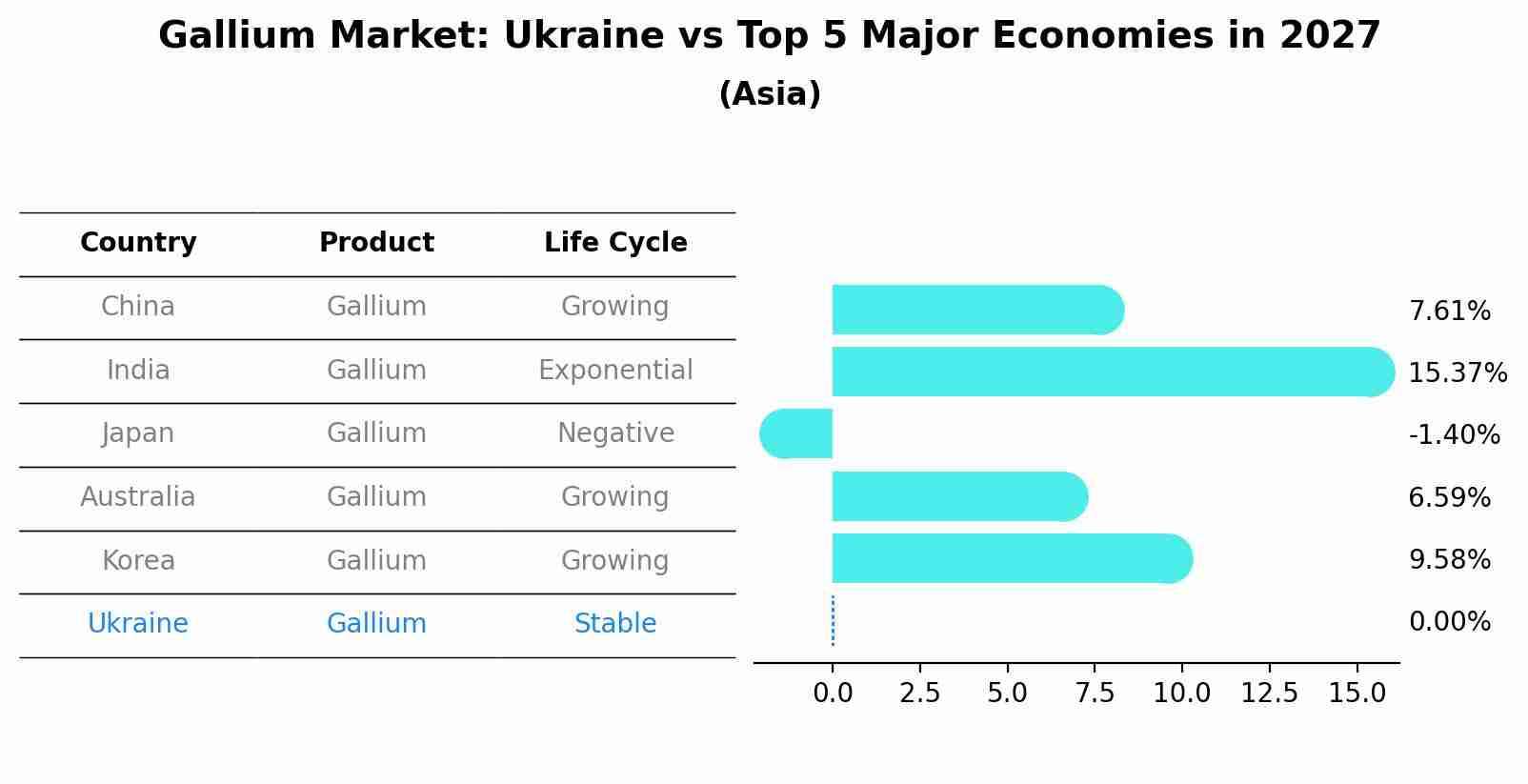
Gallium Market: Ukraine vs Top 5 Major Economies in 2027 (Asia)
The Gallium market in Ukraine is projected to grow at a stable growth rate of 0.00% by 2027, within the Asia region led by China, along with other countries like India, Japan, Australia and South Korea, collectively shaping a dynamic and evolving market environment driven by innovation and increasing adoption of emerging technologies.
Ukraine Gallium Market Overview
The Ukraine Gallium market is characterized by steady growth driven by increasing demand from industries such as electronics, semiconductors, and solar panels. Gallium is a key component in the production of LEDs and photovoltaic cells, which are witnessing growing adoption globally. The market is also benefiting from the country`s abundant reserves of gallium and the presence of key market players investing in research and development activities. However, challenges such as fluctuating prices due to global supply chain disruptions and competition from other gallium-producing countries exist. Overall, the Ukraine Gallium market is poised for further expansion as industries continue to innovate and incorporate gallium into their products for enhanced performance and sustainability.
Ukraine Gallium Market Trends
The Ukraine Gallium Market is experiencing growth due to increasing demand from the electronics industry, particularly for the production of semiconductors and LEDs. The market is also being driven by the rise in research and development activities in the country, leading to a higher demand for gallium in various applications. Additionally, the focus on renewable energy sources like solar power is boosting the demand for gallium-based thin-film photovoltaic cells. However, challenges such as fluctuating prices of raw materials and geopolitical tensions in the region could impact the market dynamics. Overall, the Ukraine Gallium Market is expected to show steady growth in the coming years, with opportunities for manufacturers and suppliers to capitalize on the increasing demand for gallium in various industries.
Ukraine Gallium Market Challenges
In the Ukraine Gallium Market, key challenges include limited domestic production capacity, reliance on imports for raw materials, fluctuating global prices impacting profitability, and competition from established international suppliers. Additionally, geopolitical tensions and regulatory uncertainties can create a volatile business environment for market players. The lack of a well-developed supply chain and infrastructure further hinders the growth of the market. These challenges make it difficult for local gallium producers to compete effectively on a global scale and capitalize on the increasing demand for gallium in various industries such as electronics and renewable energy. Overcoming these obstacles will require strategic investments in technology, infrastructure, and partnerships to enhance domestic production capabilities and ensure a more stable and sustainable market presence.
Ukraine Gallium Market Investment Opportunities
The Ukraine Gallium market presents promising investment opportunities due to the increasing demand for gallium in various high-tech industries such as electronics, semiconductors, and photovoltaics. The country`s strategic location and growing focus on developing its technology sector further enhance the market`s potential. Investing in Ukraine`s Gallium market could yield significant returns as the global demand for gallium continues to rise, driven by advancements in 5G technology, electric vehicles, and renewable energy applications. Additionally, Ukraine`s relatively untapped gallium reserves offer an attractive opportunity for investors looking to capitalize on the country`s potential as a key player in the global gallium market.
Ukraine Gallium Market Government Policy
The Ukrainian government has implemented various policies related to the Gallium Market to support domestic production and ensure national security. These policies include investment incentives for local Gallium producers, import restrictions on foreign Gallium products to promote domestic sales, and regulations to monitor and control Gallium exports to prevent unauthorized shipments. Additionally, the government has allocated funds for research and development in the Gallium sector to enhance technological capabilities and competitiveness in the global market. Overall, the government`s policies aim to strengthen the Ukrainian Gallium industry, reduce dependency on imports, and stimulate economic growth through the promotion of local production and innovation in the Gallium Market.
Ukraine Gallium Market Future Outlook
The Ukraine gallium market is expected to witness steady growth in the coming years, driven by increasing demand from the electronics and semiconductor industries. Gallium`s unique properties, such as its ability to improve the performance of semiconductors and LEDs, make it a valuable material in various high-tech applications. With the growing emphasis on technological advancements and innovation, the demand for gallium in Ukraine is projected to rise. Additionally, the country`s strategic location and established manufacturing capabilities could further bolster its position in the global gallium market. However, factors such as fluctuating raw material prices and geopolitical tensions may pose challenges to the market`s growth trajectory, requiring market players to stay agile and adaptable to navigate potential uncertainties.
Key Highlights of the Report:
- Ukraine Gallium Market Outlook
- Market Size of Ukraine Gallium Market, 2021
- Forecast of Ukraine Gallium Market, 2031
- Historical Data and Forecast of Ukraine Gallium Revenues & Volume for the Period 2018 - 2031
- Ukraine Gallium Market Trend Evolution
- Ukraine Gallium Market Drivers and Challenges
- Ukraine Gallium Price Trends
- Ukraine Gallium Porter's Five Forces
- Ukraine Gallium Industry Life Cycle
- Historical Data and Forecast of Ukraine Gallium Market Revenues & Volume By Applications for the Period 2018 - 2031
- Historical Data and Forecast of Ukraine Gallium Market Revenues & Volume By LED for the Period 2018 - 2031
- Historical Data and Forecast of Ukraine Gallium Market Revenues & Volume By Laser Diodes for the Period 2018 - 2031
- Historical Data and Forecast of Ukraine Gallium Market Revenues & Volume By Integrated Circuits for the Period 2018 - 2031
- Historical Data and Forecast of Ukraine Gallium Market Revenues & Volume By Solar Cells for the Period 2018 - 2031
- Ukraine Gallium Import Export Trade Statistics
- Market Opportunity Assessment By Applications
- Ukraine Gallium Top Companies Market Share
- Ukraine Gallium Competitive Benchmarking By Technical and Operational Parameters
- Ukraine Gallium Company Profiles
- Ukraine Gallium Key Strategic Recommendations






































