Ukraine Gamification in Education Market Size & Growth Rate (2026-2032)
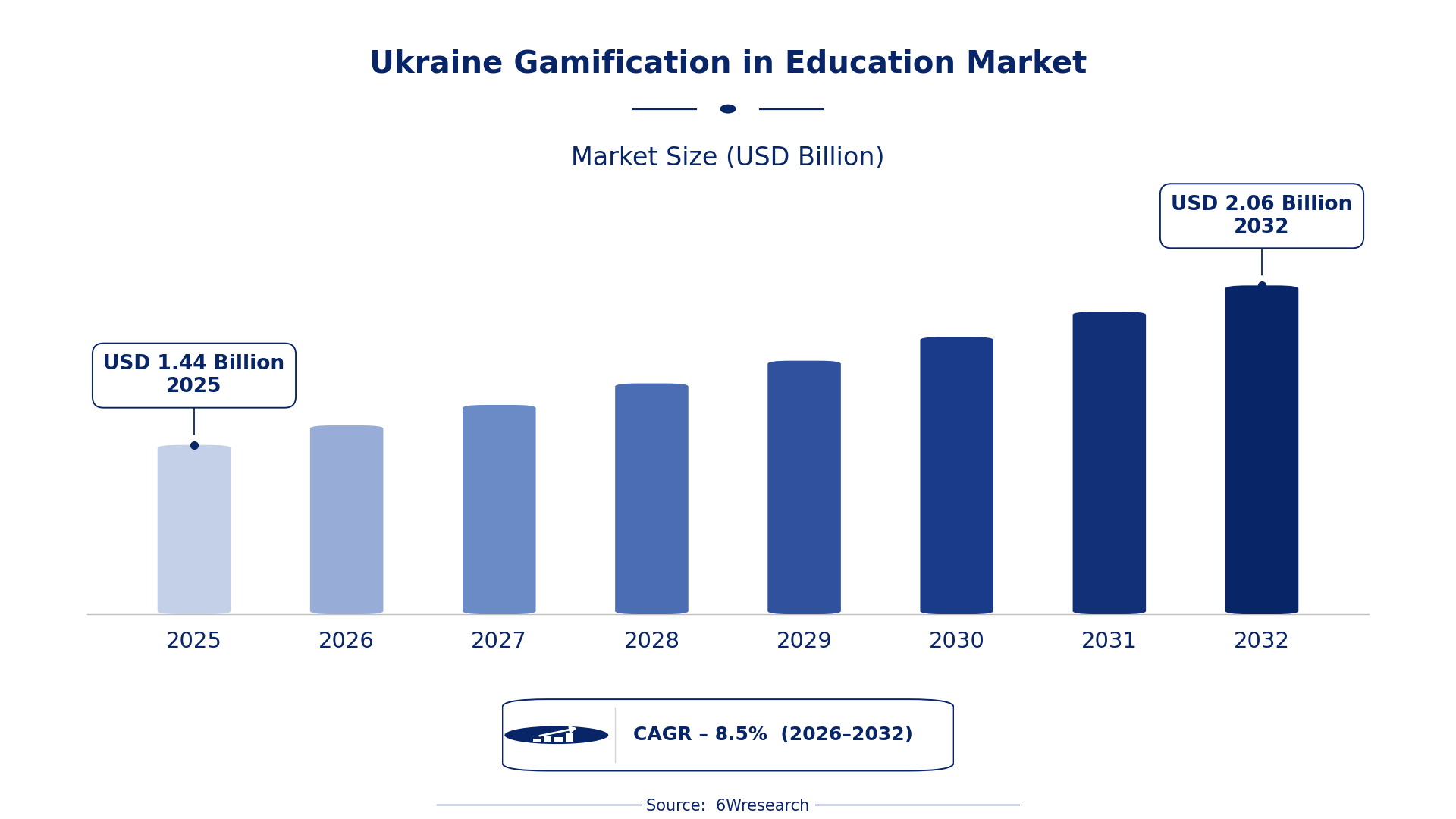
The Ukraine Gamification in Education Market was estimated at USD 1443 Million in 2025 and is projected to reach USD 2055 Million by 2032, growing at a CAGR of 8.5% from 2026 to 2032.
Ukraine Gamification in Education Market Synopsis
The most compelling force currently shaping the Ukraine Gamification in Education Market is the surge in technology adoption within the educational framework. This shift is driven by a necessity for more engaging and effective learning methods that resonate with today’s digitally-savvy students.
As educational institutions increasingly seek to enhance student engagement, gamification stands out as a transformative approach. By incorporating game elements into learning, schools aim to foster motivation and improve educational outcomes, creating a fertile ground for market growth.
Ukraine Gamification in Education Market Year-wise Growth Rate and Key Drivers
This graph illustrates the annual growth rates of the Ukraine Gamification in Education Market from 2021 to 2032, highlighting a steady upward trajectory and projected expansion over the forecast period.
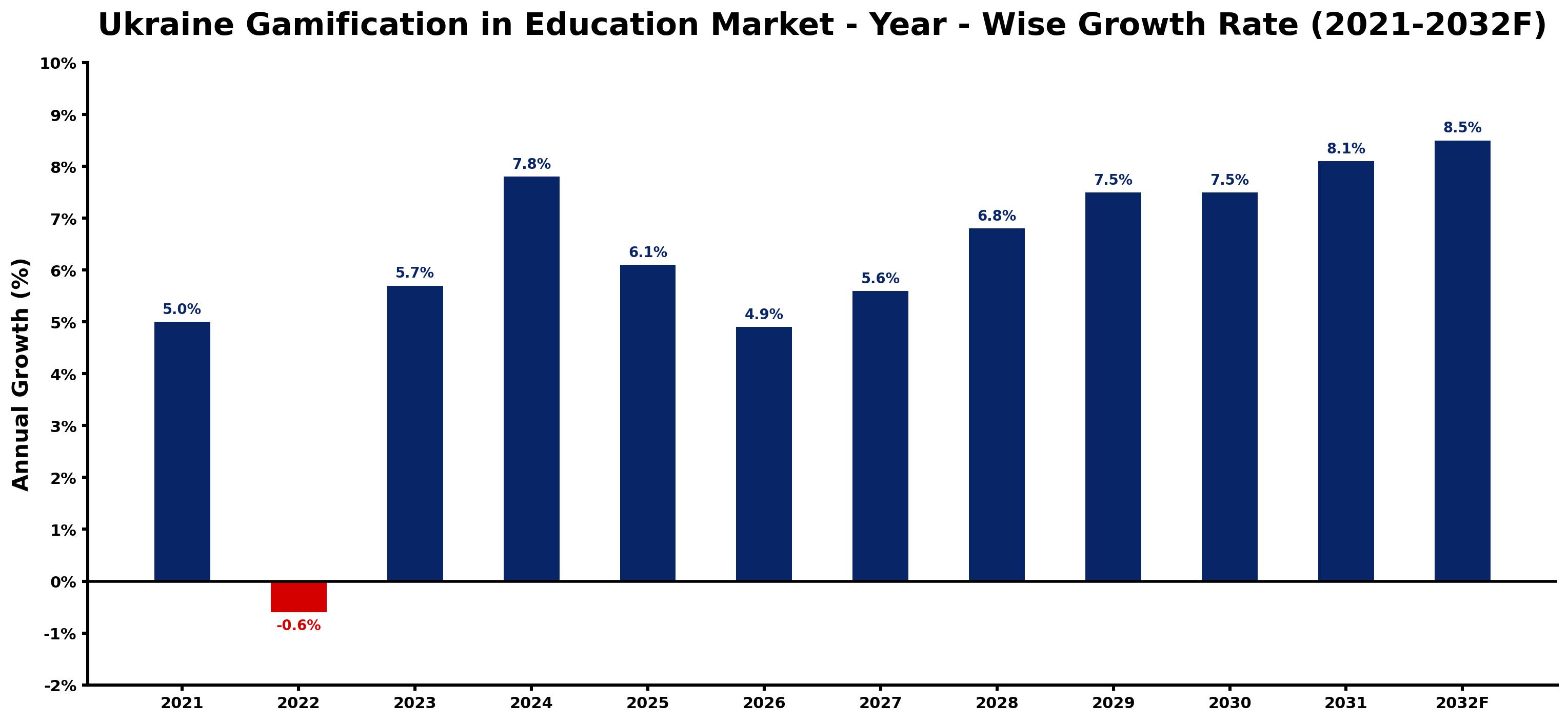
The table below presents the year‑wise growth rates along with the key drivers influencing the market
| Year | Growth Rate | Major Drivers |
| 2021 | 5.0% | Ministry of Education's gamified curriculum initiative launched |
| 2022 | -0.6% | War impact on digital infrastructure and funding challenges |
| 2023 | 5.7% | Increased smartphone penetration among students for learning |
| 2024 | 7.8% | Growing investment in digital education platforms by startups |
| 2025 | 6.1% | Government grants encouraging educational technology integration |
| 2026 | 4.9% | Increased focus on digital skills in national curriculum |
| 2027 | 5.6% | Youth engagement programs promoting gamified learning experiences |
| 2028 | 6.8% | Rising parental demand for engaging online educational resources |
| 2029 | 7.5% | Corporate sponsorships supporting gamified educational competitions |
| 2030 | 7.5% | Partnerships between schools and game developers expanding offerings |
| 2031 | 8.1% | Increased research funding for innovative teaching methodologies |
| 2032 | 8.5% | National initiatives to enhance STEM education with gamification |
Note: Market size estimations and growth projections presented in this report are based on 6Wresearch's proprietary forecasting methodology, utilizing the latest available industry data, government publications, and primary research inputs.
Ukraine Gamification in Education Market Key Takeaways
Below are some of the specific key takeaways from the market, including:
- The market is experiencing a notable increase in demand for interactive and personalized learning solutions.
- Government initiatives are actively promoting the integration of gamification into the national education curriculum.
- Innovative gamified platforms and applications are emerging to cater to diverse educational needs.
- Awareness of gamification's benefits in enhancing engagement is growing among educators and institutions.
- Collaboration between edtech companies and educational institutions is essential for developing tailored gamification solutions.
Evaluation of Restraints in Ukraine Gamification in Education Market
Despite the promising growth trajectory, the Ukraine Gamification in Education Market faces genuine limitations. A significant hurdle is the lack of understanding and awareness of gamification techniques among many educators and administrators. Traditional institutions often resist adopting new methodologies, resulting in slow integration of gamified elements into curricula. on top of that, there is a shortage of resources and training for teachers to effectively implement these innovative learning experiences. This resistance, combined with a need for more localized research on the efficacy of gamification, poses challenges that must be addressed for the market to reach its full potential.
Ukraine Gamification in Education Market Trends
Recent trends indicate a growing preference for interactive learning solutions that leverage gamification techniques. Increasingly, educational institutions are adopting mobile apps and immersive platforms designed to cater to various learning styles. Virtual and augmented reality integrations into gamified educational content are on the rise, creating richer learning environments. This trend reflects a broader shift towards personalized education, where the focus is on tailoring experiences to meet individual student needs.
Ukraine Gamification in Education Market Opportunities
The Ukraine Gamification in Education Market holds immense potential for growth, particularly for companies willing to innovate. There are substantial opportunities for edtech firms to collaborate with educators in creating customized gamification strategies that align with specific curriculum objectives. The demand for immersive and engaging learning experiences is set to rise, suggesting a fertile ground for investment in educational technology solutions that harness the power of gamification.
Government Initiatives in the Ukraine Gamification in Education Market
The Ukrainian government is actively shaping the Gamification in Education Market through various initiatives aimed at modernizing the education sector. By integrating gamified learning approaches into the national curriculum, the government emphasizes the importance of interactive education. These policies are designed to enhance student engagement and align teaching methods with technological advancements.
- A national initiative launched in early 2025 focused on integrating gamification elements into the core curriculum, encouraging schools to adopt new teaching methods.
- Current efforts include funding programs aimed at supporting educational technology startups that specialize in gamification.
- A planned public-private partnership is expected to enhance digital education infrastructure by 2027, facilitating wider access to gamified learning resources.
- Ongoing workshops and training sessions for educators are being implemented to improve awareness and understanding of gamification techniques.
- Future initiatives are expected to focus on expanding the digital skill set among educators to better integrate gamification into the classroom experience.
Future Insights of the Ukraine Gamification in Education Market
Looking ahead to 2026-2032, the Ukraine Gamification in Education Market is set for dynamic growth as technology adoption continues to rise. The increasing emphasis on personalized and engaging learning experiences will drive further integration of gamification in educational institutions. The influx of innovative educational platforms, combined with advancements in virtual and augmented reality technologies, will enhance the overall learning experience. Collaborative efforts between edtech firms and educational stakeholders are expected to yield tailored solutions, making this market one to watch in the coming years.
Ukraine Gamification in Education Market Latest Developments
In the past year, the Ukraine Gamification in Education Market has seen a flurry of activity that highlights its potential and the growing interest in this innovative approach. Many educational institutions are increasingly adopting gamified solutions, while edtech companies are investing in the development of new platforms and tools. This momentum indicates a robust future for gamification in education.
- A major educational conference held in Q2 2025 featured discussions on the benefits of gamification, attracting significant attention from educators and policymakers.
- An ongoing project initiated in early 2025 is focused on developing immersive learning experiences using augmented reality for various subjects.
- Currently, several partnerships are being formed between technology providers and universities to create gamified learning resources tailored to higher education.
- A rollout of a new educational app incorporating gamification elements is planned for mid-2026, targeting primary and secondary education sectors.
- Research initiatives aimed at assessing the effectiveness of gamification in improving learning outcomes are underway, with results expected by late 2026.
Ukraine Gamification in Education Market - Key Attractiveness of the Report
- 10 Years of Market Numbers
- Historical Data Starting from 2022 to 2025
- Base Year: 2025
- Forecast Data until 2032
- Key Performance Indicators Impacting the Market
- Major Upcoming Developments and Projects
Key Highlights of the Report:
- Ukraine Gamification in Education Market Outlook
- Market Size of Ukraine Gamification in Education Market, 2025
- Forecast of Ukraine Gamification in Education Market, 2032
- Historical Data and Forecast of Ukraine Gamification in Education Revenues & Volume for the Period 2022-2032F
- Ukraine Gamification in Education Market Trend Evolution
- Ukraine Gamification in Education Market Drivers and Challenges
- Ukraine Gamification in Education Price Trends
- Ukraine Gamification in Education Porter's Five Forces
- Ukraine Gamification in Education Industry Life Cycle
- Historical Data and Forecast of Ukraine Gamification in Education Market Revenues & Volume By Offering for the Period 2022-2032F
- Historical Data and Forecast of Ukraine Gamification in Education Market Revenues & Volume By Software for the Period 2022-2032F
- Historical Data and Forecast of Ukraine Gamification in Education Market Revenues & Volume By Services for the Period 2022-2032F
- Historical Data and Forecast of Ukraine Gamification in Education Market Revenues & Volume By End User for the Period 2022-2032F
- Historical Data and Forecast of Ukraine Gamification in Education Market Revenues & Volume By Academic for the Period 2022-2032F
- Historical Data and Forecast of Ukraine Gamification in Education Market Revenues & Volume By Corporate Training for the Period 2022-2032F
- Historical Data and Forecast of Ukraine Gamification in Education Market Revenues & Volume By Deployment Mode for the Period 2022-2032F
- Historical Data and Forecast of Ukraine Gamification in Education Market Revenues & Volume By Cloud for the Period 2022-2032F
- Historical Data and Forecast of Ukraine Gamification in Education Market Revenues & Volume By On-Premises for the Period 2022-2032F
- Ukraine Gamification in Education Import Export Trade Statistics
- Market Opportunity Assessment By Offering
- Market Opportunity Assessment By End User
- Market Opportunity Assessment By Deployment Mode
- Ukraine Gamification in Education Top Companies Market Share
- Ukraine Gamification in Education Competitive Benchmarking By Technical and Operational Parameters
- Ukraine Gamification in Education Company Profiles
- Ukraine Gamification in Education Key Strategic Recommendations






































