Ukraine Ice cream Market Size, Share & Growth Rate
The Ukraine Ice cream Market was estimated at USD 814 Million in 2025 and is projected to reach USD 1171 Million by 2032, growing at a CAGR of 5.3% from 2026 to 2032. This growth trajectory is largely fueled by rising disposable incomes among consumers and a marked shift towards premium and artisanal offerings. Additionally, the increasing popularity of healthier options like low-sugar and dairy-free products is shaping consumer preferences, creating a dynamic landscape in the Ukrainian ice cream sector.
Ukraine Ice cream Market Year-wise Growth Rate and Key Drivers
This graph highlights how the Ukraine Ice cream Market has steadily grown over the years, supported by major growth factors.
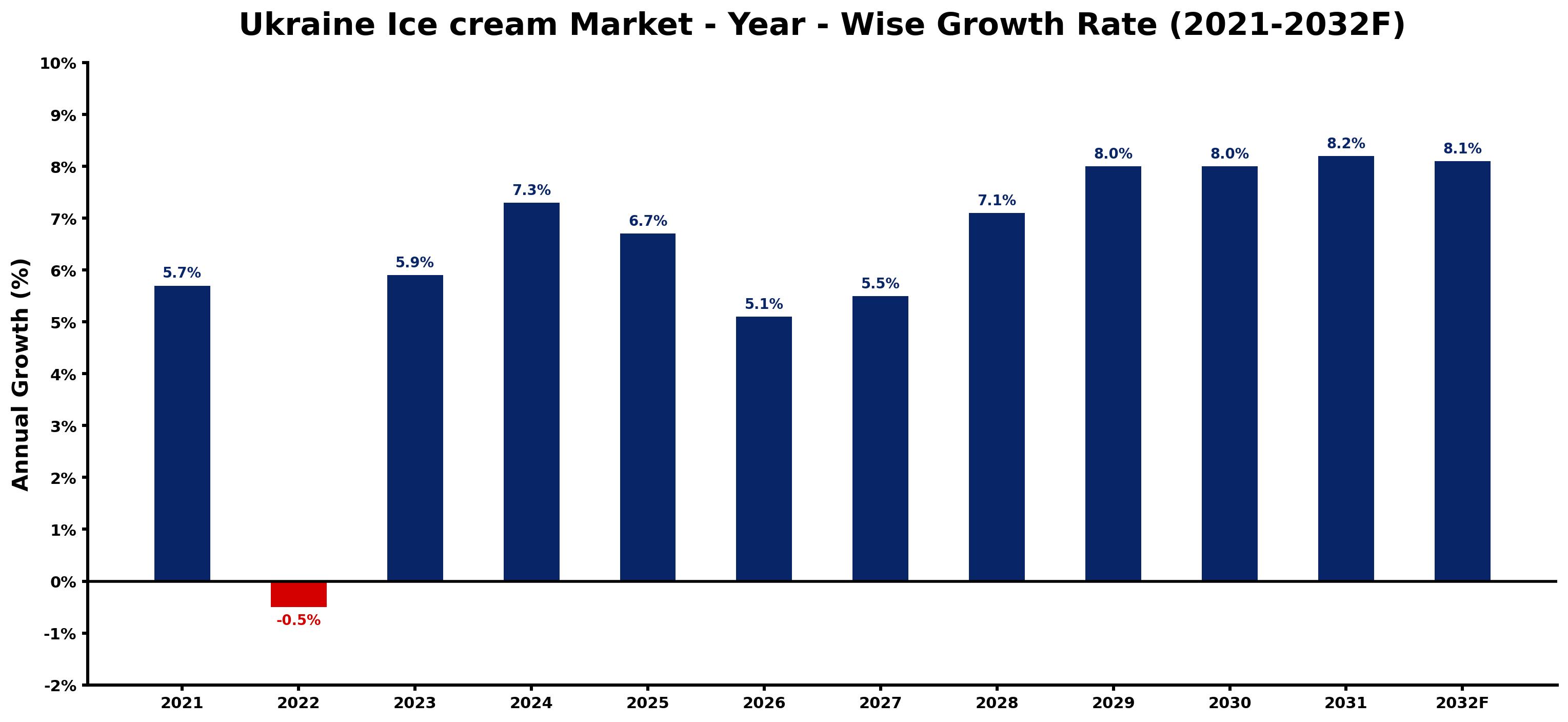
The table below presents the year‑wise growth rates along with the key drivers influencing the market
| Year | Growth Rate | Major Drivers |
| 2021 | 5.7% | Increasing industrial infrastructure investments |
| 2022 | -0.5% | Growing urbanization and commercial development |
| 2023 | 5.9% | Expansion of commercial construction activities |
| 2024 | 7.3% | Increasing smart city development projects |
| 2025 | 6.7% | Expansion of transportation and logistics networks |
| 2026 | 5.1% | Increasing industrial automation investments |
| 2027 | 5.5% | Rising electricity demand across industries |
| 2028 | 7.1% | Expansion of commercial construction activities |
| 2029 | 8.0% | Increasing smart city development projects |
| 2030 | 8.0% | Growing urbanization and commercial development |
| 2031 | 8.2% | Growing urbanization and commercial development |
| 2032 | 8.1% | Increasing industrial infrastructure investments |
Note - Market size estimations and growth projections presented in this report are based on 6Wresearch’s advanced forecasting approach, validated with industry datasets as of June 2026.
Ukraine Ice cream Market Synopsis
In Ukraine, there is a notable demand for innovative and diverse ice cream flavors, leading to a surge in artisanal brands that focus on high-quality ingredients. This trend is further enhanced by consumers' willingness to pay a premium for unique and indulgent experiences, reflecting broader lifestyle changes.
On the supply side, the landscape is characterized by a mix of local manufacturers and international brands, competing fiercely for market share. Distribution channels have expanded significantly, with supermarkets, convenience stores, and online platforms facilitating wider consumer reach and accessibility.
Ukraine Ice cream Market Key Takeaways
- The market is witnessing strong demand for premium, artisanal ice cream brands.
- Health-conscious consumers are driving the growth of low-sugar and dairy-free options.
- Distribution channels are evolving, emphasizing online sales and home delivery services.
- Seasonality remains a key factor affecting sales patterns throughout the year.
- Investment in local flavors and sustainable practices is becoming increasingly important.
Evaluation of Restraints in Ukraine Ice cream Market
Despite the positive growth prospects, the Ukraine ice cream market is faced with several restraints. Intense competition, particularly between domestic and international brands, results in price wars that can erode profit margins. Furthermore, the seasonality of ice cream consumption complicates inventory management, necessitating adaptive marketing strategies to maintain sales throughout the year. Fluctuations in the prices of raw materials, such as milk and sugar, also pose challenges for manufacturers in terms of cost control and pricing strategies. Lastly, compliance with stringent food safety regulations adds another layer of complexity for companies operating within this space.
Ukraine Ice cream Market Trends
Several key trends are emerging in the Ukraine ice cream market. One prominent trend is the increasing consumer preference for unique, high-quality flavors, which has led to a boom in artisanal brands offering small-batch ice cream. Moreover, the health trend is prompting manufacturers to innovate with low-sugar and dairy-free formulations, appealing to a more health-conscious demographic. Sustainability is also gaining traction, with consumers seeking out eco-friendly packaging solutions, further influencing product development within the industry.
Ukraine Ice cream Market Opportunities
The growing interest in premium and artisanal ice cream presents significant investment opportunities. Investors can capitalize on this trend by introducing innovative flavors and leveraging local ingredients to attract consumers. Additionally, the rise of online shopping and home delivery opens new avenues for distribution, making it easier for brands to reach customers directly. There is also potential for growth in partnerships with cafes and restaurants, which can help expand brand visibility and drive sales.
Government Initiatives in the Ukraine Ice cream Market
The Ukrainian government has implemented various policies to enhance the food production landscape, including the ice cream sector. Regulations ensure food safety and standardize labeling, while initiatives are in place to support domestic production. Additionally, tax incentives are offered to small and medium-sized enterprises, encouraging innovation and investment in the industry. These governmental efforts aim to create a competitive market environment that prioritizes quality and sustainability.
Future Insights of the Ukraine Ice cream Market
Looking ahead to 2026-2032, the Ukraine ice cream market is poised for continued growth. This is driven by a projected rise in disposable income and an ongoing shift towards indulgent yet healthier options. Manufacturers are likely to focus on product differentiation, utilizing innovative flavors and premium ingredients to attract discerning consumers. Furthermore, the expansion of distribution channels, particularly through digital platforms, will significantly influence market dynamics, fostering greater accessibility and convenience.
Ukraine Ice cream Market Latest Developments (May 2025 - June 2026)
In recent months, the Ukrainian ice cream market has seen notable developments, particularly in the area of flavor innovation. Brands are increasingly experimenting with local ingredients to create unique offerings that resonate with consumers. Additionally, there has been a rise in marketing initiatives targeting health-conscious demographics, promoting low-sugar and dairy-free products. Companies are also investing in environmentally-friendly packaging solutions to align with consumer preferences for sustainability.
Ukraine Ice cream Market - Key Attractiveness of the Report
- 10 Years of Market Numbers
- Historical Data Starting from 2022 to 2025
- Base Year: 2025
- Forecast Data until 2032
- Key Performance Indicators Impacting the Market
- Major Upcoming Developments and Projects
Key Highlights of the Report:
- Ukraine Ice cream Market Outlook
- Market Size of Ukraine Ice cream Market, 2025
- Forecast of Ukraine Ice cream Market, 2032
- Historical Data and Forecast of Ukraine Ice cream Revenues & Volume for the Period 2022-2032F
- Ukraine Ice cream Market Trend Evolution
- Ukraine Ice cream Market Drivers and Challenges
- Ukraine Ice cream Price Trends
- Ukraine Ice cream Porter's Five Forces
- Ukraine Ice cream Industry Life Cycle
- Historical Data and Forecast of Ukraine Ice cream Market Revenues & Volume By Sales?Types for the Period 2022-2032F
- Historical Data and Forecast of Ukraine Ice cream Market Revenues & Volume By Impulse ice cream for the Period 2022-2032F
- Historical Data and Forecast of Ukraine Ice cream Market Revenues & Volume By Take-home ice cream for the Period 2022-2032F
- Historical Data and Forecast of Ukraine Ice cream Market Revenues & Volume By Artisanal ice cream for the Period 2022-2032F
- Historical Data and Forecast of Ukraine Ice cream Market Revenues & Volume By Distribution Channel Type for the Period 2022-2032F
- Historical Data and Forecast of Ukraine Ice cream Market Revenues & Volume By Supermarket/Hypermarket for the Period 2022-2032F
- Historical Data and Forecast of Ukraine Ice cream Market Revenues & Volume By Convenience stores for the Period 2022-2032F
- Historical Data and Forecast of Ukraine Ice cream Market Revenues & Volume By Ice cream Parlour for the Period 2022-2032F
- Historical Data and Forecast of Ukraine Ice cream Market Revenues & Volume By Online for the Period 2022-2032F
- Historical Data and Forecast of Ukraine Ice cream Market Revenues & Volume By Others for the Period 2022-2032F
- Ukraine Ice cream Import Export Trade Statistics
- Market Opportunity Assessment By Sales?Types
- Market Opportunity Assessment By Distribution Channel Type
- Ukraine Ice cream Top Companies Market Share
- Ukraine Ice cream Competitive Benchmarking By Technical and Operational Parameters
- Ukraine Ice cream Company Profiles
- Ukraine Ice cream Key Strategic Recommendations






































