Ukraine Life Science Reagents Market Size, Share & Growth Rate
The Ukraine Life Science Reagents Market was estimated at USD 892 Million in 2025 and is projected to reach USD 1286 Million by 2032, growing at a CAGR of 5.4% from 2026 to 2032. This growth trajectory is underpinned by escalating investments in R&D, particularly in the pharmaceutical and biotechnology sectors. The urgent need for high-quality reagents, fueled by the increasing prevalence of chronic diseases and an expanding focus on personalized medicine, is central to the market's upward momentum.
Ukraine Life Science Reagents Market Year-wise Growth Rate and Key Drivers
This graph highlights how the Ukraine Life Science Reagents Market has steadily grown over the years, supported by major growth factors.
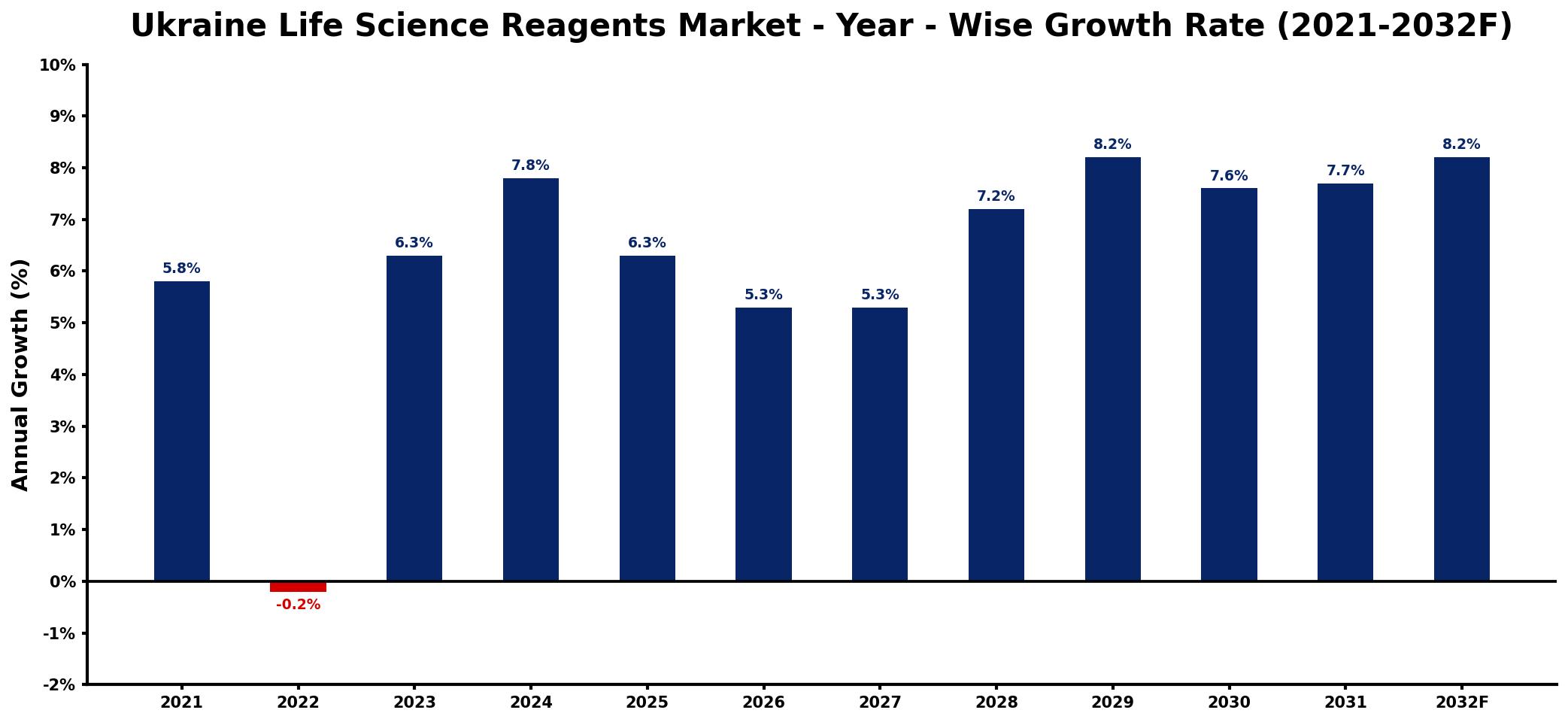
The table below presents the year‑wise growth rates along with the key drivers influencing the market
| Year | Growth Rate | Major Drivers |
| 2021 | 5.8% | Increased research funding allocations |
| 2022 | -0.2% | Decreased laboratory project investments |
| 2023 | 6.3% | Rising biotechnology sector initiatives |
| 2024 | 7.8% | Expansion of pharmaceutical manufacturing |
| 2025 | 6.3% | Growing academic research collaborations |
| 2026 | 5.3% | Strengthened healthcare infrastructure development |
| 2027 | 5.3% | Surge in diagnostic testing demand |
| 2028 | 7.2% | Emergence of innovative startups |
| 2029 | 8.2% | Heightened governmental health initiatives |
| 2030 | 7.6% | Increased global market partnerships |
| 2031 | 7.7% | Advancements in technology adoption |
| 2032 | 8.2% | rising infrastructure development spending |
Note: Market size estimations and growth projections presented in this report are based on 6Wresearch's proprietary forecasting methodology, utilizing the latest available industry data, government publications, and primary research inputs.
Ukraine Life Science Reagents Market Synopsis
The Ukraine Life Science Reagents Market is witnessing a notable surge as the country positions itself to enhance its scientific research capabilities. A strong influx of investment is evident, particularly aimed at developing innovative reagents that cater to diverse applications within genomics, proteomics, and cell biology.
Collaborations between academic institutions and industry stakeholders are becoming increasingly common, paving the way for innovation and expansion. The growing emphasis on research quality and compliance, coupled with rising public health concerns, further underscores the market's robust growth potential.
Ukraine Life Science Reagents Market Key Takeaways
- Steady growth driven by significant investments in biotechnology and pharmaceutical R&D.
- Heightened demand for specialized reagents due to rising research activities in genomics and proteomics.
- Emergence of eco-friendly reagent alternatives reflecting sustainability trends in life sciences.
- Growing partnerships between academia and industry are fostering innovation in reagent applications.
- Government support through funding and incentives is creating a favorable environment for market expansion.
Evaluation of Restraints in Ukraine Life Science Reagents Market
Despite the promising growth outlook, the Ukraine Life Science Reagents Market faces significant constraints. Import restrictions and regulatory challenges often limit access to high-quality reagents, thereby impeding research and development initiatives. Additionally, the prevalence of counterfeit products contributes to inconsistencies in product quality, creating barriers for reliable research. Furthermore, political instability and economic fluctuations can disrupt supply chains and deter investment, presenting ongoing challenges for both domestic and international stakeholders.
Ukraine Life Science Reagents Market Trends
A notable trend in the Ukraine Life Science Reagents Market is the rising emphasis on sustainability and environmentally responsible practices. Researchers are increasingly seeking reagents that not only deliver high performance but also minimize environmental impact. Additionally, technological advancements are driving the demand for innovative reagents tailored for precise diagnostic testing and therapeutic applications. The focus on personalized medicine continues to gain traction, influencing reagent development and usage in clinical research.
Ukraine Life Science Reagents Market Opportunities
Investment opportunities abound in the Ukraine Life Science Reagents Market, particularly in sectors demanding high-quality reagents for drug development and diagnostic testing. The ongoing collaboration between research institutions and biotechnology firms opens avenues for innovative solutions. Local manufacturers of specialized reagents stand to benefit from government initiatives aimed at bolstering the life sciences industry, presenting strategic opportunities for growth and market penetration.
Government Initiatives in the Ukraine Life Science Reagents Market
The Ukrainian government is actively promoting research and development in the life sciences through various initiatives. Policies aimed at encouraging local manufacturing and providing funding for innovative projects are pivotal in fostering a conducive environment for growth. Additionally, the government has established regulations to ensure the quality and safety of imported reagents, further strengthening the market's reliability. Incentives such as tax breaks and grants are available for companies investing in the sector, demonstrating a commitment to advancing Ukraine's position in the global life sciences landscape.
Future Insights of the Ukraine Life Science Reagents Market
Looking forward to 2026-2032, the Ukraine Life Science Reagents Market is set for continuous expansion, propelled by increasing research activities and technological advancements. The integration of precision medicine and genomic research will create new demand dynamics, reinforcing the need for advanced reagents. Although regulatory challenges persist, a focus on local manufacturing and strategic partnerships is anticipated to foster resilience and drive the market towards a more competitive edge.
Ukraine Life Science Reagents Market Latest Developments (2025 - 2026)
Recent trends indicate a shift towards increased collaboration between research institutions and biotech companies, leading to innovative reagent solutions. Additionally, government initiatives focusing on enhancing R&D funding have been more pronounced, positioning the market for substantial growth. The ongoing emphasis on eco-friendly reagents and sustainable practices is also shaping product development and consumer preferences, marking a transformative phase for the Ukraine Life Science Reagents Market.
Ukraine Life Science Reagents Market - Key Attractiveness of the Report
- 10 Years of Market Numbers
- Historical Data Starting from 2022 to 2025
- Base Year: 2025
- Forecast Data until 2032
- Key Performance Indicators Impacting the Market
- Major Upcoming Developments and Projects
Key Highlights of the Report:
- Ukraine Life Science Reagents Market Outlook
- Market Size of Ukraine Life Science Reagents Market, 2025
- Forecast of Ukraine Life Science Reagents Market, 2032
- Historical Data and Forecast of Ukraine Life Science Reagents Revenues & Volume for the Period 2022-2032F
- Ukraine Life Science Reagents Market Trend Evolution
- Ukraine Life Science Reagents Market Drivers and Challenges
- Ukraine Life Science Reagents Price Trends
- Ukraine Life Science Reagents Porter's Five Forces
- Ukraine Life Science Reagents Industry Life Cycle
- Historical Data and Forecast of Ukraine Life Science Reagents Market Revenues & Volume By Product for the Period 2022-2032F
- Historical Data and Forecast of Ukraine Life Science Reagents Market Revenues & Volume By Chromatography Reagents for the Period 2022-2032F
- Historical Data and Forecast of Ukraine Life Science Reagents Market Revenues & Volume By Molecular Diagnostics Reagents for the Period 2022-2032F
- Historical Data and Forecast of Ukraine Life Science Reagents Market Revenues & Volume By Immunoassay Reagents for the Period 2022-2032F
- Historical Data and Forecast of Ukraine Life Science Reagents Market Revenues & Volume By Clinical Chemistry Reagents for the Period 2022-2032F
- Historical Data and Forecast of Ukraine Life Science Reagents Market Revenues & Volume By Flow Cytometry Reagents for the Period 2022-2032F
- Historical Data and Forecast of Ukraine Life Science Reagents Market Revenues & Volume By Cell & Tissue Culture Reagents for the Period 2022-2032F
- Historical Data and Forecast of Ukraine Life Science Reagents Market Revenues & Volume By Hematology & Hemostasis Reagents for the Period 2022-2032F
- Historical Data and Forecast of Ukraine Chromatography Reagents Life Science Reagents Market Revenues & Volume By Microbiology Reagents for the Period 2022-2032F
- Historical Data and Forecast of Ukraine Life Science Reagents Market Revenues & Volume By End-user for the Period 2022-2032F
- Historical Data and Forecast of Ukraine Life Science Reagents Market Revenues & Volume By Hospitals & Diagnostics Laboratories for the Period 2022-2032F
- Historical Data and Forecast of Ukraine Life Science Reagents Market Revenues & Volume By Commercial & Contract Research Manufacturers for the Period 2022-2032F
- Historical Data and Forecast of Ukraine Life Science Reagents Market Revenues & Volume By Academic & Research Institutes for the Period 2022-2032F
- Historical Data and Forecast of Ukraine Life Science Reagents Market Revenues & Volume By Others for the Period 2022-2032F
- Ukraine Life Science Reagents Import Export Trade Statistics
- Market Opportunity Assessment By Product
- Market Opportunity Assessment By End-user
- Ukraine Life Science Reagents Top Companies Market Share
- Ukraine Life Science Reagents Competitive Benchmarking By Technical and Operational Parameters
- Ukraine Life Science Reagents Company Profiles
- Ukraine Life Science Reagents Key Strategic Recommendations






































